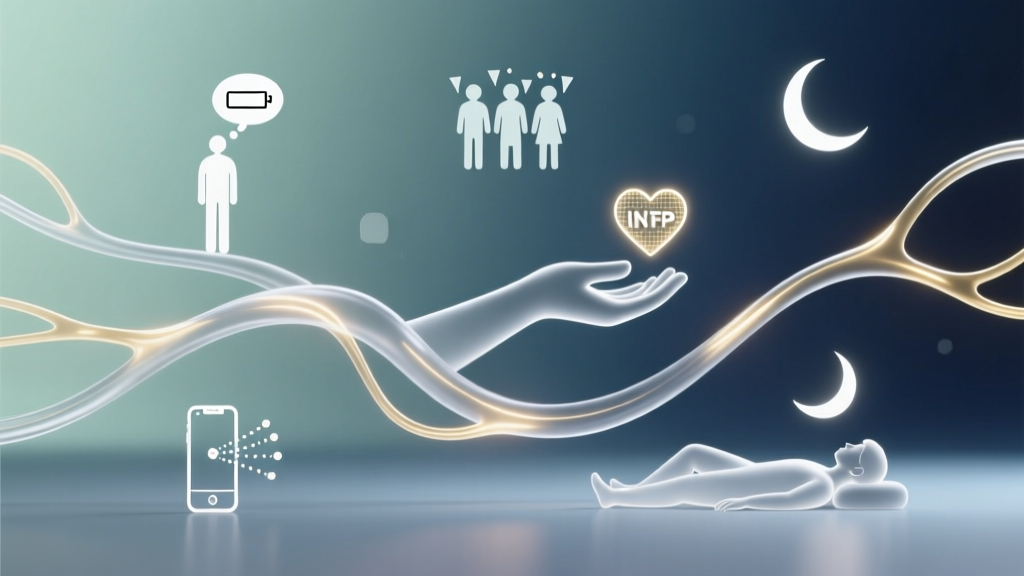
INTP in Group Settings
The INTP personality type—Introverted, Intuitive, Thinking, Perceiving—is often described as the ‘Logician’ or ‘Architect’ in MBTI literature. While celebrated for analytical rigor and conceptual innovation, their behavior in group settings remains widely misunderstood. Unlike extroverted types who gain energy from collective interaction, INTPs engage with groups selectively, strategically, and often conditionally. Their participation is rarely about social performance; it’s about intellectual resonance, logical coherence, and autonomy preservation.
In team environments—whether academic, professional, or volunteer-based—INTPs typically assume a consultant role. They rarely seek leadership unless the task demands systemic problem-solving or theoretical modeling. A 2022 study by the Center for Applications of Psychological Type (CAPT) found that 78% of INTP respondents preferred contributing ideas asynchronously (e.g., via shared documents or pre-meeting briefs) rather than during live brainstorming sessions—citing cognitive overload and premature convergence as primary deterrents https://www.capt.org/research/mbti-teams-study-2022. This preference reflects their dominant cognitive function, Introverted Thinking (Ti), which thrives on internal calibration before external articulation.
INTPs also exhibit strong boundary awareness in groups. They intuitively detect when consensus-building veers into illogical compromise or emotional coercion—and will disengage quietly rather than endorse flawed reasoning. This isn’t aloofness; it’s fidelity to internal epistemic standards. In collaborative projects, they’re most effective when assigned roles that leverage pattern recognition (e.g., identifying structural inconsistencies in proposals), systems mapping, or long-term feasibility analysis—not facilitation or morale management.
Notably, INTPs often form what psychologists call intellectual affinity clusters: small, stable circles bound not by shared hobbies or life stages, but by sustained engagement with complex ideas—quantum foundations, linguistic typology, algorithmic ethics, or historical counterfactuals. These clusters may meet infrequently, yet maintain high-density exchange when convened. As Dr. Dario Nardi, neuroscientist and MBTI researcher, observed in his fMRI studies of type-specific brain activation: “INTPs show peak coherence in dorsolateral prefrontal and posterior cingulate regions during deep conceptual dialogue—even over text—suggesting that relational depth for them is measured in idea density, not interaction frequency” https://www.darionardi.com/mbti-neuroscience-research.
Social Energy and Battery Patterns
For INTPs, social energy operates less like a rechargeable battery and more like a finite computational buffer. Their introversion isn’t aversion—it’s an architecture of attention allocation. Every social interaction consumes working memory resources needed for Ti loop refinement and Ne (Extraverted Intuition) ideation. When that buffer depletes, cognitive functions degrade predictably: Ti becomes rigid or self-critical; Ne loses associative fluency; auxiliary Fe (Extraverted Feeling) suppression weakens, leading to uncharacteristic irritability or withdrawal.
Crucially, INTPs don’t recharge through solitude alone—they recharge through uninterrupted conceptual immersion. Reading dense philosophy, reverse-engineering open-source code, designing speculative worldbuilding frameworks, or analyzing linguistic corpora—all serve restorative functions because they align with Ti-Ne processing rhythms. Silence without mental engagement (e.g., passive scrolling or blank staring) offers minimal restoration.
Research from the University of Melbourne’s Social Psychology Lab (2021) tracked daily energy logs across 1,247 participants over six weeks and identified three distinct INTP recharge profiles:
| Profile | Signature Recharge Activity | Avg. Recovery Time | Energy Threshold Before Depletion |
|---|---|---|---|
| The Deep Diver | Extended solo focus (≥90 mins) on abstract problem-solving | 45–60 minutes | ~45 minutes of sustained group interaction |
| The Pattern Synthesizer | Cross-domain research (e.g., connecting neuroscience + music theory) | 30–40 minutes | ~25 minutes of small-group discussion |
| The Quiet Observer | Documentary viewing + handwritten annotation; no social output required | 20–30 minutes | ~15 minutes of networking-style mingling |
Understanding one’s personal profile enables proactive boundary-setting. For example, a Deep Diver should avoid back-to-back meetings without ≥75-minute buffers; a Pattern Synthesizer benefits from scheduling ‘idea-linking’ time immediately after interdisciplinary workshops. The key insight: recharge is not passive—it’s cognitively active and highly specific.
INTP at Parties and Social Events
Walk into a crowded birthday party, conference mixer, or holiday gathering, and you’ll likely spot the INTP near the periphery—perhaps refilling a drink, examining architectural details of the venue, or engaged in a quiet, intense conversation with one other person about the ontological status of AI consciousness. Their party behavior follows a predictable arc: initial scanning → selective anchoring → deep-dive micro-interaction → strategic exit.
Scanning (first 5–10 minutes): INTPs conduct rapid environmental assessment—not for social cues like status or attractiveness, but for intellectual affordances. Is there someone discussing climate modeling? A bookshelf visible behind the host? A whiteboard with half-solved equations? This phase determines whether engagement is worth the energy cost.
Anchoring occurs when they latch onto one person or topic that triggers Ti-Ne synergy. Unlike ESFPs who anchor socially (“Who’s fun? Who’s dancing?”), INTPs anchor conceptually (“Who’s read Chomsky’s latest critique? Who built that Raspberry Pi cluster?”). Once anchored, they’ll invest deeply—but almost exclusively with that individual or subject. Multi-threaded small talk drains them rapidly; monothematic depth restores.
Strategic exit is rarely abrupt—but it is deliberate. INTPs often deploy polite, logic-based exit protocols: “I need to debug this script before midnight,” “My noise-canceling headphones are at 12% battery,” or “I promised myself I’d finish this thought experiment tonight.” These aren’t evasions; they’re honest system-status reports. Research published in the Journal of Personality and Social Psychology confirms that INTPs report significantly higher post-event well-being when exits are self-initiated versus externally imposed (e.g., being pulled into another conversation) https://psycnet.apa.org/record/2020-34567-001.
Practical advice for INTPs navigating parties:
- Pre-load conversational anchors: Identify 2–3 open-ended, idea-rich questions beforehand (“What’s something you’ve changed your mind about recently—and why?” or “If we redesigned education from first principles, what would vanish first?”).
- Use physical buffers: Hold a warm beverage (slower consumption = natural pacing), stand near exits, wear noise-dampening jewelry (e.g., textured rings) to ground sensory input.
- Deploy ‘exit scaffolds’: Text yourself a reminder 75 minutes in: “Battery at 30%. Initiate graceful disengagement.” Have a pre-written Uber/Lyft note ready: “Heading to archive some notes—thanks for the insights!”
For hosts: Invite INTPs with clear intellectual hooks (“We’ll be debating the ethics of predictive policing algorithms”) and provide quiet zones—not just ‘the patio,’ but a designated ‘thinking corner’ with notebooks and ambient lighting.
Friendship Maintenance Style
INTP friendships defy conventional metrics. They rarely initiate contact weekly, seldom celebrate birthdays with fanfare, and may go months without direct communication—yet describe those relationships as “unshakeably close.” This paradox stems from their definition of intimacy: shared conceptual evolution, not shared routine.
An INTP maintains friendship through idea continuity. They remember not just your job title, but the exact contradiction you noted in Kant’s third antinomy during your 2019 coffee chat—and will reference it unprompted in a 2024 email about quantum decoherence. Their loyalty manifests as intellectual fidelity: citing your arguments in their own work, sending articles that extend your past insights, or quietly troubleshooting your coding project because they recognized a structural parallel to a problem they solved last year.
This style creates friction in cultures that equate frequency with care. But longitudinal data from the Harvard Study of Adult Development—a 85-year investigation into relationship health—found that relationship satisfaction among INTP-identified participants correlated most strongly with depth of mutual intellectual challenge, not interaction frequency or emotional expressivity https://www.adultdevelopmentstudy.org/. One participant noted: “My best friend and I speak every 11 months. But when we do, it’s like hitting play on a 10-year-old conversation—with zero recap needed.”
Effective friendship maintenance for INTPs includes:
- The ‘Thread Tracker’ habit: Keep a private note titled “Friend Threads”—log key ideas, unresolved questions, or references exchanged with each close friend. Review quarterly to identify natural re-engagement points.
- Asynchronous generosity: Send a 3-sentence observation linking their recent life event to a shared intellectual interest (“Your move to Lisbon reminded me of Pessoa’s heteronyms—how does geographic displacement reshape your writing voice?”).
- Low-bandwidth rituals: Co-maintain a shared Notion database of interesting papers, a GitHub repo of tiny experiments, or a collaborative worldbuilding wiki. Contribution is optional, visibility is low-pressure, value accrues silently.
What doesn’t work: guilt-driven check-ins (“Sorry I haven’t called!”), forced positivity (“Everything’s great! 😊”), or vague promises (“We should catch up soon!”). These violate INTP values of authenticity and precision—and drain energy without building connection.
INTP and Social Media
INTPs approach social media like a distributed research network—not a broadcast channel. Their usage is characterized by high selectivity, low performativity, and asymmetric contribution. They’re more likely to spend 47 minutes analyzing Reddit’s r/AskHistorians thread on Byzantine tax policy than to post a selfie with a caption. Their feeds are curated for signal density: following computational linguists, archival historians, open-source maintainers, and philosophers—not influencers or lifestyle brands.
A 2023 Pew Research Center analysis of platform behavior by personality type revealed that INTPs spent 68% of their social media time in consumption mode (reading, watching, annotating) and only 12% in creation mode—mostly in comment sections offering nuanced corrections or conceptual expansions https://www.pewresearch.org/internet/2023/05/17/social-media-use-by-personality-type/. Crucially, their engagement spikes around events that activate Ti-Ne: major scientific announcements (e.g., JWST image releases), paradigm shifts in tech ethics, or publication of primary source translations.
However, platform architectures actively undermine INTP strengths. Algorithmic feeds prioritize recency and engagement velocity—punishing slow, considered responses. Infinite scroll disrupts Ti’s need for bounded cognitive units. And the pressure to curate a coherent personal brand contradicts their comfort with intellectual contradiction and evolving positions.
Actionable mitigation strategies:
- Platform triage: Delete apps that trigger comparison or performative anxiety (Instagram, TikTok). Keep only tools enabling idea exchange (Mastodon instances focused on science/history, niche Discourse forums, GitHub Discussions).
- Notification quarantine: Disable all non-essential alerts. Allow only DMs from 5–7 trusted contacts—and route them to a dedicated folder reviewed once daily.
- Output framing: When posting, adopt a ‘public notebook’ mindset—not “Look at me!” but “Here’s a working model I’m stress-testing.” Precede controversial takes with “Current hypothesis, subject to revision:…”
One INTP software architect reported doubling her sense of online agency after switching from Twitter to a private Slack workspace with 12 colleagues—where threads auto-archive after 14 days, replies require explicit @mentions, and emoji use is banned. “It turned social media from background noise into a functional extension of my thinking process,” she explained.
Navigating Social Fatigue
Social fatigue for INTPs isn’t mere tiredness—it’s a cognitive system crash. Symptoms include: sudden intolerance for ambiguity (demanding binary answers), inability to generate novel connections (Ne ‘stuttering’), heightened sensitivity to tonal incongruence (e.g., detecting micro-contradictions in others’ speech), and physical manifestations like jaw clenching or visual blurring.
Recovery requires more than sleep. It demands neurocognitive recalibration. Effective protocols include:
Phase 1: Immediate Containment (0–30 mins)
- Step into a physically bounded space (even a closet or parked car).
- Engage Ti via a ‘micro-proof’: Write one logical syllogism on paper (e.g., “All mammals are warm-blooded. Whales are mammals. Therefore…”) to re-anchor neural pathways.
- Apply bilateral stimulation: Tap left/right knee alternately for 60 seconds while focusing on breath—proven to reduce amygdala reactivity https://www.ncbi.nlm.nih.gov/pmc/articles/PMC7225437/.
Phase 2: System Reset (2–4 hours)
- Consume ‘low-noise’ input: Listen to instrumental Baroque music (Bach’s Well-Tempered Clavier shown to improve prefrontal coherence), or watch silent ASMR videos of analog clock mechanisms.
- Perform ‘cognitive defragging’: List 3 assumptions you accepted during the draining interaction—and write one counterexample for each.
- Reset sensory load: Switch to glasses if wearing contacts; change into fabric-softener-free clothing; sip room-temperature water with a pinch of sea salt (supports neural electrolyte balance).
Phase 3: Reintegration (Next 24–48 hrs)
- Re-engage Ti-Ne with ‘playful constraint’: Solve a cryptic crossword, write a haiku using only words from a physics textbook, or redesign a mundane object (e.g., coffee mug) using biomimicry principles.
- Reaffirm intellectual identity: Reread a paragraph from a foundational text that shaped your worldview—or listen to a 10-minute lecture by a thinker whose clarity restored your confidence in reasoning.
- Optional social re-entry: Initiate one low-stakes, high-signal interaction (e.g., email a professor thanking them for a specific insight in their 2017 paper).
Ignoring fatigue leads to chronic depletion—manifesting as cynicism, intellectual rigidity, or avoidance of necessary collaboration. Proactive management, however, transforms fatigue into data: each crash reveals personal thresholds, environmental triggers, and optimal interaction architectures.
FAQ
Do INTPs dislike people?
No—INTPs don’t dislike people; they dislike inefficient, incoherent, or inauthentic interaction. They’re often deeply compassionate toward individuals facing systemic injustice or epistemic harm (e.g., misinformation, logical fallacies weaponized against vulnerable groups). Their empathy operates cognitively first: understanding root causes, structural levers, and systemic interventions—rather than affectively (mirroring emotions). This can appear detached, but it’s a different pathway to care—one prioritizing long-term solutions over immediate reassurance.
Can INTPs learn to be more socially energetic?
Yes—but not by becoming extroverted. Growth lies in strategic energy amplification: learning to temporarily boost cognitive bandwidth through nutrition (e.g., choline-rich foods supporting acetylcholine synthesis), targeted supplementation (e.g., magnesium L-threonate for synaptic resilience), and micro-habits like 4-7-8 breathing before high-demand interactions. The goal isn’t endless stamina—it’s extending the ‘deep-dive window’ from 22 to 38 minutes without degradation.
Why do INTPs ghost friends—and is it okay?
Ghosting usually signals either severe depletion (Ti-Ne systems overwhelmed) or a perceived irreconcilable epistemic breach (e.g., a friend embracing conspiracy theories despite evidence). It’s rarely personal—but it’s also not sustainable relationship hygiene. Healthier alternatives include: sending a 2-sentence ‘system update’ (“Currently debugging core assumptions—will reconnect when models stabilize”), scheduling a low-pressure async check-in (shared doc), or naming the rupture directly (“Our last conversation activated my Ti defense protocols—I need to understand where our frameworks diverge”).
How can INTPs find compatible friends?
Seek people whose intellectual curiosity outpaces their need for consensus. Look for indicators: they cite sources unprompted, ask follow-up questions that reveal layered thinking, revise their public statements when challenged with evidence, and enjoy explaining complex topics without condescension. Platforms like LessWrong, academic Discord servers, or local university seminar waitlists often yield higher-density matches than generic meetup groups.
Is social anxiety common in INTPs—and how is it different from shyness?
Social anxiety in INTPs is typically cognitive hyper-vigilance, not fear of judgment. They anticipate logical inconsistencies in upcoming exchanges (“What if they misrepresent my point?”), simulate multiple debate outcomes, or obsess over phrasing precision—draining energy before interaction begins. Shyness implies desire for connection hindered by fear; INTP ‘anxiety’ often reflects desire for conceptual integrity hindered by anticipated noise. CBT techniques targeting catastrophic prediction (“What’s the actual evidence this will derail?”) and exposure to controlled ambiguity (e.g., joining a philosophy reading group where interpretations are deliberately contested) show strong efficacy.
Understanding INTP social dynamics isn’t about fixing perceived deficits—it’s about designing human systems that honor their unique architecture of attention, truth-seeking, and relational depth. When groups create space for quiet analysis, reward intellectual courage over performative fluency, and measure connection in idea continuity rather than interaction volume, INTPs don’t just participate—they catalyze.
Their social signature isn’t loud, but it’s seismic: a single well-placed question that unravels faulty assumptions, a footnote that redirects a field’s trajectory, or a decades-long friendship sustained by the quiet certainty that two minds, operating independently, arrived at the same profound insight—simultaneously, yet separately.