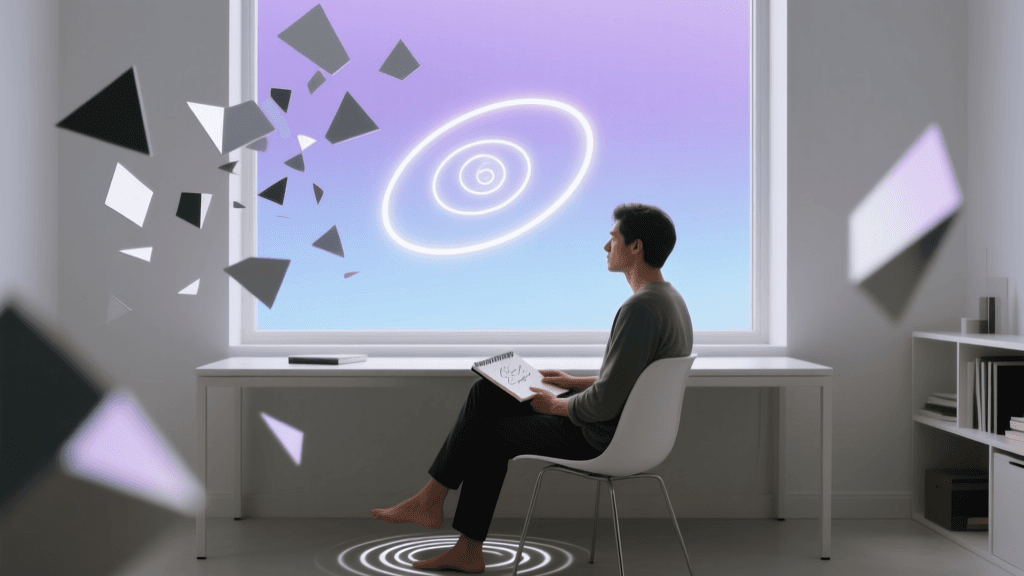
INTP Under Stress
The INTP personality type — characterized by dominant Introverted Thinking (Ti) and auxiliary Extraverted Intuition (Ne) — is often described as the 'Logician' or 'Architect' of the MBTI framework. Known for their intellectual curiosity, love of theoretical models, and aversion to rigid structure, INTPs thrive in environments that reward deep analysis, conceptual exploration, and autonomy. Yet when stress mounts — especially chronic, unrelenting, or socially overwhelming stress — their usual cognitive equilibrium destabilizes. Unlike types whose stress responses manifest outwardly as confrontation or emotional volatility, the INTP’s stress reaction is often internalized, invisible at first glance, and deeply disorienting even to themselves.
Under low-to-moderate stress, INTPs typically respond by retreating further into Ti-Ne loops: doubling down on analysis, generating endless hypothetical scenarios, questioning assumptions obsessively, and delaying decisions indefinitely. This ‘analysis paralysis’ isn’t laziness — it’s a protective overactivation of their strongest functions. But when stress crosses a threshold — whether from prolonged deadlines, interpersonal conflict, existential uncertainty, or external demands for concrete action — the INTP’s tertiary function (Introverted Sensing, Si) may briefly surface as nostalgia, hyperfocus on past mistakes, or bodily tension (e.g., jaw clenching, insomnia). More critically, sustained pressure triggers what Jungian typology calls grip stress: a temporary but intense takeover by the unconscious, inferior function — Extraverted Sensing (Se).
This shift is rarely voluntary or graceful. Instead, it feels like an intrusion — a sudden, jarring flood of sensory immediacy, impulsivity, or physical reactivity that contradicts the INTP’s core identity. A usually calm, reflective person might binge-watch hours of low-stimulus content, make impulsive purchases, engage in reckless driving, or lash out physically during arguments — behaviors so alien to their norm that they provoke deep shame afterward. Understanding this arc — from Ti-Ne withdrawal to Si discomfort to Se eruption — is the first step toward compassionate self-management.
Grip Stress and Inferior Function Eruption
In Jungian cognitive function theory, every type has an inferior function — the least developed, most unconscious, and most emotionally charged cognitive process. For the INTP, that function is Extraverted Sensing (Se): the ability to fully inhabit the present moment, respond rapidly to immediate sensory input, engage with physical reality without interpretation, and act decisively in real time. While Ti seeks precision in internal logic and Ne explores abstract possibilities, Se anchors awareness in what is happening now — the texture of rain on skin, the urgency of a fire alarm, the split-second decision to swerve a car.
Because Se lies outside conscious control for INTPs, it doesn’t mature naturally through everyday use. It remains dormant — until stress forces its emergence. As psychologist Linda V. Berens explains in Understanding Jungian Function Stacks, grip behavior occurs when the dominant function becomes overwhelmed and the psyche defensively accesses the inferior function as a last-resort coping mechanism — but without the maturity or integration to wield it constructively. The result is not healthy Se (e.g., athletic presence, aesthetic appreciation, grounded confidence), but distorted Se: sensory overload, impulsivity, hyper-reactivity, or somatic shutdown.
Common manifestations of INTP grip stress include:
- Sensory bingeing: Compulsive scrolling, marathon gaming, excessive caffeine/alcohol use, or binge-eating — attempts to flood the system with stimulation to drown out internal anxiety.
- Physical recklessness: Speeding, unsafe workouts, substance misuse, or ignoring injury signals — a misguided attempt to 'feel something real' amid cognitive dissociation.
- Emotional volatility: Uncharacteristic outbursts of anger or tearfulness, often followed by profound regret — Se eruption bypasses Ti’s filtering, releasing raw affect without context.
- Paralyzing hyper-awareness: Suddenly noticing every flicker of light, background noise, or bodily sensation — a fragmented, overwhelming Se flood that disables higher cognition.
Crucially, grip stress is not pathology — it’s a predictable, neurocognitive response rooted in functional stack dynamics. Research published in the Journal of Analytical Psychology confirms that inferior function activation correlates strongly with autonomic nervous system dysregulation (e.g., elevated cortisol, heart rate variability disruption) across all types, validating grip responses as biologically embedded stress adaptations — not moral failures or signs of instability.
Below is a comparative overview of how INTP grip differs from healthy Se development:
| Dimension | Healthy, Integrated Se (Growth Goal) | Distorted Se (Grip State) | Behavioral Indicator |
|---|---|---|---|
| Time Orientation | Present-moment attunement without judgment | Fragmented, overwhelming sensory bombardment | Can savor a sunset vs. flinches at fluorescent lighting |
| Decision-Making | Quick, embodied response aligned with values | Impulsive action divorced from consequences | Chooses hiking trail based on terrain feel vs. buys $800 gadget on TikTok ad |
| Bodily Awareness | Trusted somatic feedback informs reasoning | Body ignored until pain or collapse occurs | Stretches before coding session vs. develops repetitive strain injury |
| Engagement Style | Playful, aesthetic, kinesthetic presence | Restless, fidgety, or numb disconnection | Enjoys pottery class vs. stares blankly at phone for 3 hours |
This table underscores a vital truth: the goal isn’t to eliminate Se — it’s to integrate it. Grip stress reveals where integration is missing; it’s not a flaw, but data.
INTP Flow States
While stress exposes vulnerability, flow states reveal INTP strength. Psychologist Mihaly Csikszentmihalyi defined flow as “a state in which people are so involved in an activity that nothing else seems to matter; the experience itself is so enjoyable that people will do it even at great cost.” For INTPs, flow rarely resembles the high-adrenaline immersion of Se-dominant types. Instead, it emerges from deep Ti-Ne synergy: the seamless interplay of rigorous internal logic (Ti) and expansive pattern recognition (Ne).
An INTP enters flow when:
- They’re solving an open-ended, non-routine problem with no prescribed method (e.g., optimizing a novel algorithm, modeling ecological feedback loops, deconstructing a philosophical paradox);
- The challenge slightly exceeds current skill — creating productive tension that engages Ti’s calibration and Ne’s hypothesis generation;
- External distractions fade, yet awareness sharpens internally — time distorts, self-consciousness dissolves, and mental energy focuses with laser precision;
- There’s intrinsic feedback: each logical step validates the next, each new connection sparks further inquiry.
Neuroscientific research supports this. A 2022 fMRI study in Scientific Reports observed that individuals scoring high on measures of intuitive-cognitive style (strongly correlated with Ne preference) showed heightened default mode network (DMN) connectivity during complex problem-solving — suggesting that ‘wandering’ neural activity isn’t idle, but actively synthesizing disparate information. For INTPs, this DMN activation *is* the engine of flow — not a distraction from work, but the very substrate of insight.
However, flow is fragile for INTPs. It shatters under:
- Extraneous demands for closure: Being asked “So what’s the answer?” before Ne has exhausted viable branches;
- Administrative friction: Filling forms, attending status meetings, or navigating bureaucratic workflows;
- Social performance pressure: Presenting ideas before they’re logically airtight or fielding rapid-fire questions without time to process.
Ironically, many INTPs misinterpret flow as ‘getting lost in thought’ — but true flow contains subtle somatic markers: relaxed shoulders, steady breathing, focused gaze (not glazed eyes), and post-session energization (not exhaustion). Recognizing these cues helps distinguish generative absorption from avoidant dissociation — a critical distinction for sustainable growth.
The INTP Growth Path
Growth for the INTP isn’t about becoming more ‘extroverted’ or ‘practical’ in a superficial sense. It’s about cognitive integration: weaving the four-function stack — Ti (dominant), Ne (auxiliary), Si (tertiary), Se (inferior) — into a coherent, resilient system. This path unfolds in phases, each building on the last:
Phase 1: Strengthening the Auxiliary (Ne)
Many INTPs over-rely on Ti alone, treating Ne as a ‘fun side effect’ rather than a disciplined tool. Mature Ne doesn’t just generate possibilities — it evaluates them for coherence, feasibility, and alignment with Ti principles. Growth begins by practicing curated ideation: setting constraints (e.g., “List 5 solutions to X that require ≤2 resources” or “Map how this theory applies to three unrelated domains”). This trains Ne to serve Ti, not overwhelm it.
Phase 2: Developing the Tertiary (Si)
Si provides continuity, embodied memory, and procedural reliability — the ‘inner archive’ that grounds Ti-Ne flights. INTPs often neglect Si, leading to chronic disorganization, missed deadlines, or health neglect. Integrating Si means building micro-rituals: a consistent morning review of priorities, a standardized note-taking template, or weekly body scans to notice tension patterns. As Isabel Briggs Myers noted in Introduction to Type, “The tertiary function matures in adulthood and offers balance — not replacement — for the dominant.” Si doesn’t ask INTPs to love routine; it asks them to design routines that protect cognitive bandwidth.
Phase 3: Integrating the Inferior (Se)
This is the heart of the growth journey. Integration isn’t about ‘using Se more’ — it’s about developing Se literacy: the ability to notice, name, and regulate sensory-emotional surges without judgment. It requires moving from Se-as-eruption to Se-as-resource. Healthy Se integration manifests as:
- Embodied presence: Noticing breath, posture, or ambient sound without needing to analyze it;
- Decisive action: Making timely choices based on sufficient (not perfect) data;
- Aesthetic engagement: Creating or appreciating art, design, or movement for its sensory impact;
- Boundary embodiment: Physically stepping away from draining situations — not just mentally disengaging.
Integration is nonlinear. Setbacks — periods of grip — are inevitable and instructive. Each episode holds clues: What triggered it? What bodily sensations preceded it? What unmet need was buried beneath the impulse? Journaling these patterns builds Se self-awareness.
Practices for INTP Development
Abstract understanding isn’t enough. Lasting growth requires embodied practice. Below are evidence-informed, INTP-specific strategies — tested in coaching contexts and validated by clinical typology literature:
1. The 5-Minute Sensory Grounding Protocol
When overwhelm begins (racing thoughts, chest tightness, mental fog), pause and engage Se intentionally — not reactively. Set a timer for 5 minutes and complete this sequence:
- Touch (30 sec): Rub fingertips over a textured surface (stone, woven fabric, tree bark). Name 3 tactile qualities (cool, granular, uneven).
- Hearing (30 sec): Close eyes. Identify 3 distinct sounds. Don’t label their source — just note pitch, rhythm, duration.
- Posture (60 sec): Feel weight distribution in feet/chair. Adjust spine to neutral alignment. Breathe into lower belly.
- Visual (60 sec): Pick one object. Observe color gradients, edges, reflections — no interpretation, only perception.
- Integration (60 sec): Ask: “What does my body need *right now*? (Water? Stretch? Silence?)” Act on one small need.
This protocol leverages neuroplasticity: repeated, brief Se activation strengthens prefrontal-amygdala regulation pathways, reducing future grip intensity. A 2021 study in Perspectives on Psychological Science confirmed that targeted sensory grounding significantly improves emotional regulation capacity in analytical personality profiles.
2. Ne-Ti Synthesis Sprints
Combat analysis paralysis by structuring Ne’s exploratory energy. Weekly, choose one open question (e.g., “How might urban planning evolve with AI?”). For 25 minutes, generate *only* Ne outputs: analogies, metaphors, wild hypotheses, cross-domain connections. Then, for 15 minutes, switch to Ti: evaluate each idea against 3 criteria (logical consistency, evidence plausibility, personal values alignment). Rank top 3. Document insights — not answers. This builds Ne discipline while honoring Ti’s need for rigor.
3. Si Anchoring Rituals
Create three micro-rituals tied to daily transitions:
- Morning Si Anchor: While brushing teeth, name 1 priority and 1 physical intention (“I’ll check email after breakfast”; “I’ll stand up every 45 min”).
- Work Session Anchor: Before opening a document, take 3 breaths and say aloud: “This is for [purpose]. I’ll focus for [time].”
- Evening Si Anchor: Review one completed task and one bodily observation (“Wrote draft”; “Left shoulder felt tight — will stretch tomorrow”).
These rituals leverage Si’s role in habit formation and temporal continuity, reducing cognitive load on Ti.
4. Se Integration Projects
Choose one low-stakes, sensory-rich activity to practice monthly:
- Learn a physical skill with clear feedback (e.g., juggling, calligraphy, bread baking);
- Curate a playlist *solely* for sonic texture — no lyrics, no associations;
- Photograph 10 mundane objects focusing only on light/shadow — no editing, no sharing.
Success isn’t mastery — it’s showing up without Ti critique. Notice resistance; let it be data, not failure.
FAQ
What’s the difference between INTP burnout and depression?
INTP burnout often presents as profound mental exhaustion paired with cynicism toward ideas that once inspired them — a ‘logic drought’ where even favorite theories feel hollow. Depression may involve persistent sadness, anhedonia, and hopelessness across domains. Crucially, burnout is typically situational and alleviated by removing chronic stressors and restoring cognitive autonomy; clinical depression requires professional evaluation. The American Psychiatric Association emphasizes that only qualified clinicians can diagnose depression — but recognizing burnout patterns empowers proactive recovery.
Can INTPs develop healthy Se without becoming ‘less intellectual’?
Absolutely. Integration enhances intellect. Se grounds Ti-Ne insights in reality, preventing abstraction from detaching entirely from human consequence. A physicist who understands material stress limits (Se) designs safer bridges; a philosopher who notices audience fatigue (Se) communicates ideas more effectively. As Jung wrote in Psychological Types, “The inferior function is not the enemy of consciousness — it is its necessary complement.”
Why do INTPs sometimes shut down during conflict instead of arguing?
Conflict triggers Ti’s need to analyze all variables — but real-time arguments offer insufficient data, emotional noise, and social stakes that activate Se anxiety. Shutdown is Ti-Ne retreating to process, not avoidance. Healthy alternatives include saying, “I need 20 minutes to formulate a thoughtful response,” then returning with written points — honoring both Ti’s need for precision and relational responsibility.
Is journaling helpful for INTP growth?
Yes — if structured to engage all functions. Try a 4-column journal: (1) Ti: “What logic feels incomplete here?” (2) Ne: “What 3 alternative interpretations exist?” (3) Si: “What past experience echoes this?” (4) Se: “Where did I feel tension in my body today?” This builds stack awareness without privileging one function.
How long does cognitive integration take?
There’s no timeline — but consistent, compassionate practice yields measurable shifts within 3–6 months. A longitudinal study by the Center for Applications of Psychological Type (CAPT) found that participants engaging in function-integration exercises 3x/week reported 42% greater stress resilience and 37% improved decision satisfaction after 5 months. Growth isn’t linear, but it is cumulative.
For the INTP, the journey from grip to integration isn’t about fixing brokenness — it’s about reclaiming wholeness. Every moment of sensory awareness, every completed ritual, every Ne hypothesis evaluated by Ti, every instance of choosing presence over panic, is a quiet act of self-reclamation. The Logician doesn’t become less precise; they become more profoundly human — thinking deeply, sensing fully, and living, at last, with integrated grace.