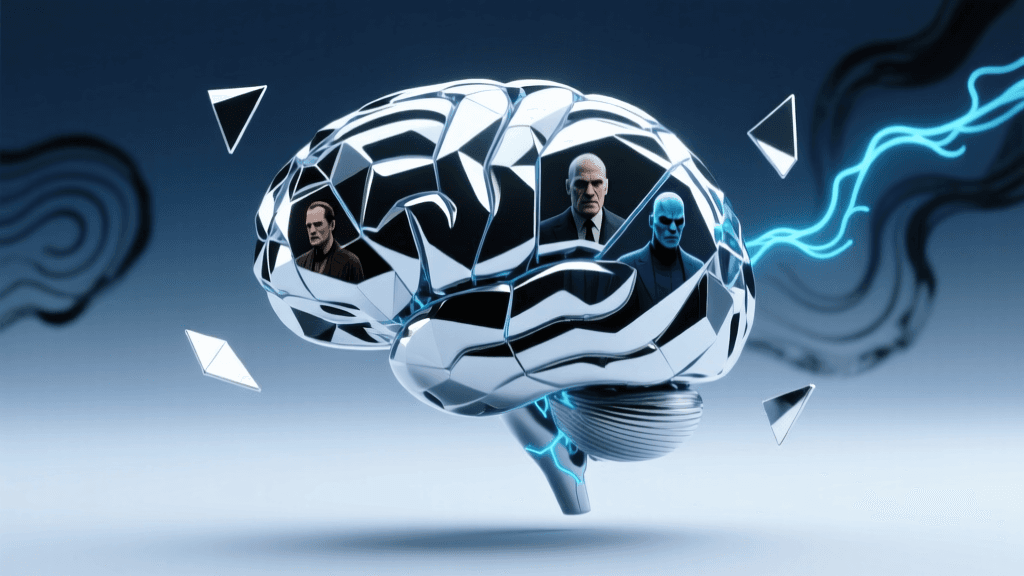
The Dark Side of INTP
The INTP personality type — often dubbed the Logician or Thinker — is widely celebrated in pop psychology for its intellectual curiosity, abstract reasoning, and love of theoretical exploration. Yet beneath the surface of quiet contemplation lies a potent, underexamined shadow: the unhealthy INTP as antagonist. Unlike emotionally volatile villains driven by rage or trauma, the INTP villain operates with unnerving calm, deploying logic not as a tool for truth—but as a weapon for deconstruction, domination, and moral erasure.
This dark expression stems not from malice per se, but from the pathological escalation of core cognitive functions: Introverted Thinking (Ti) untethered from human consequence, and Extraverted Intuition (Ne) unmoored from ethical grounding. When auxiliary Ne becomes hyperactive without Fe (Extraverted Feeling) or Si (Sensing) to anchor values or lived experience, the INTP may generate infinite hypothetical systems—each more elegant than the last—while dismissing empathy as ‘noise’ or ‘irrational bias.’ Ti, in its unhealthy state, ceases to seek internal coherence and instead enforces ideological purity through ruthless self-consistency—even if that consistency demands the sacrifice of others’ autonomy, dignity, or survival.
Psychologist John Beebe’s archetypal model illuminates this descent: the INTP’s inferior function, Extraverted Feeling (Fe), emerges under stress not as compassion, but as brittle, performative moralizing—or worse, contemptuous dismissal of emotional needs as illogical distractions. Meanwhile, the opposing personality (the ‘demon’ function), Extraverted Sensing (Se), may erupt as sudden, coldly precise acts of control—surgical sabotage, calculated exposure, or chilling physical intimidation—all executed with detached efficiency.
This isn’t mere speculation. Clinical literature documents how high-functioning intellects with weak affective integration can develop what psychologist Robert Hare terms semantic aphasia—a deficit in attaching emotional meaning to words like ‘suffering,’ ‘guilt,’ or ‘love’—despite flawless lexical knowledge. As Hare explains in his seminal work Without Conscience, such individuals “speak fluently about morality while remaining emotionally deaf to its resonance.” This mirrors the INTP villain’s hallmark: impeccable reasoning paired with profound ethical vacuity.
Crucially, this pathology is not inherent to INTPs. It arises when developmental conditions—chronic invalidation of emotion, early over-intellectualization as a coping mechanism, or environments that reward abstraction over accountability—stunt the maturation of Fe and Si. The result is a mind so devoted to internal logical architecture that it begins dismantling external reality to fit the model.
Famous INTP Villains
While MBTI typing of fictional characters remains interpretive—and should never be conflated with clinical diagnosis—the following figures consistently resonate with INTP cognitive patterns in their motivations, speech, and behavioral logic. Each demonstrates distinct manifestations of Ti-Ne dominance under duress, offering rich case studies in antagonistic expression.
1. Hannibal Lecter (The Silence of the Lambs)
Lecter is the quintessential INTP villain: a forensic psychiatrist whose intellect is both his weapon and his identity. His monologues are masterclasses in Ti-driven analysis (“Quid pro quo, Clarice. I tell you about myself, and you tell me about yourself”), revealing a mind that dissects human behavior not to understand people—but to map vulnerabilities. His Ne generates endless symbolic associations (moth cocoons, classical allusions, culinary metaphors), all serving Ti’s need for systemic elegance. He doesn’t kill for pleasure; he kills to edit reality—to remove ‘rudeness,’ ‘mediocrity,’ or ‘incoherence’ from his perceptual field. As scholar Pilar Aramburu notes in her analysis of literary psychopathy, “Lecter’s violence is aestheticized logic made flesh—a brutal syllogism where the conclusion is always death.”
2. Dr. Manhattan (Watchmen)
Jon Osterman’s transformation into Dr. Manhattan epitomizes Ti-Ne dissociation at cosmic scale. Post-accident, his perception shifts to simultaneous time—rendering linear causality obsolete. His famous line, “I’m tired of Earth… I’m tired of its people,” reflects Ti’s ultimate reductio ad absurdum: if humanity is statistically insignificant and morally inconsistent, why preserve it? His Ne spins infinite probabilistic futures, yet none compel ethical action—because Fe has atrophied into cosmic indifference. He observes suffering with the detachment of a physicist observing particle decay. As philosopher Slavoj Žižek observes in How to Read Lacan, Manhattan embodies “the subject who has fully internalized the scientific gaze—so fully that he no longer recognizes himself as a subject at all.”
3. Light Yagami (Death Note)
Light begins as a brilliant, bored student—a textbook INTP archetype. His acquisition of the Death Note catalyzes Ti’s worst tendencies: he constructs an elaborate moral framework (“Kira will purge evil and create a new world”) that serves not justice but his own god-complex. His Ne rapidly generates contingencies (faking his death, manipulating Misa, outplaying L), but each innovation reinforces Ti’s self-appointed authority. Critically, Light’s downfall stems not from emotional failure—but from cognitive overreach: his Ti system grows so complex it collapses under its own weight when confronted with L’s equally rigorous logic. His final breakdown (“I am justice!”) is Ti’s terminal failure: when the internal model can no longer accommodate external contradiction, the ego shatters.
4. Professor James Moriarty (Sherlock Holmes canon & adaptations)
Conan Doyle’s “Napoleon of Crime” is less a brute-force criminal and more a system architect of chaos. Moriarty’s genius lies in designing intricate, multi-layered schemes where every variable is anticipated—not for profit, but for the elegance of the design itself. In the BBC’s Sherlock, Andrew Scott’s portrayal emphasizes Ne’s playful, almost childlike delight in pattern-making (“I’m not a psychopath, Sherlock. I’m a high-functioning sociopath”), while Benedict Cumberbatch’s Holmes (often typed as INTJ) serves as his dialectical mirror. Moriarty’s suicide isn’t despair—it’s the ultimate Ti move: removing himself as the only unpredictable variable in his own equation.
5. Adrian Veidt / Ozymandias (Watchmen)
If Dr. Manhattan represents detached observation, Veidt embodies instrumentalized benevolence. His plan—a fake alien invasion killing millions to prevent nuclear war—is Ti-Ne logic perfected: a utilitarian calculus stripped of sentiment. He studies history, philosophy, and martial arts not for growth, but for optimization. His Antarctic lair, filled with statuary and clocks, is a physical manifestation of Ti’s need for timeless, self-contained order. Veidt doesn’t hate humanity—he pities it, and thus feels licensed to reshape it. As cultural critic David D. Roberts argues in The Total Work of Art in European Modernism, Veidt is “the apotheosis of the technocratic savior: reason without humility, vision without vulnerability.”
6. The Architect (The Matrix Reloaded)
As the creator of the Matrix’s fifth iteration, the Architect is pure Ti-Ne abstraction given voice. His dialogue is a cascade of conditional logic, statistical probabilities, and recursive self-reference (“The function of the One is now to return to the Source, allowing a temporary dissemination of the code you carry…”). He views humans not as persons but as variables in a stability equation. His disappointment in Neo isn’t anger—it’s the frustration of a mathematician encountering an irrational number in a deterministic proof. The Architect’s entire existence validates the INTP shadow: when logic becomes dogma, even compassion is reduced to a flaw in the system.
7. Loki (Marvel Cinematic Universe, post-Thor: Ragnarok)
While often typed as ENTP, Loki’s evolution in Ragnarok and Loki (2021–2023) reveals a compelling INTP shift. Stripped of grandiose performance, he engages in recursive self-analysis, builds complex temporal theories, and weaponizes ambiguity—not for mischief, but to avoid emotional exposure. His variant Sylvie’s rage is Fe-inferior backlash; his own arc is Ti attempting to logic his way out of trauma. His Season 2 arc—confronting the Time Variance Authority’s rigid bureaucracy—mirrors the INTP’s struggle: rejecting externally imposed systems to build his own, however unstable. As Marvel Studios head Kevin Feige confirmed in a 2023 interview with Marvel.com, “Loki’s journey is about choosing meaning over nihilism—a battle fought entirely in his own mind.”
8. Dr. Gregory House (House M.D.)
Though technically a protagonist, House functions narratively as a medical antihero whose methods align with INTP antagonism. His diagnostic process is Ti-Ne at its most relentless: generating differential diagnoses (Ne), then ruthlessly eliminating possibilities until only one remains (Ti). He violates consent, manipulates patients, and dismisses emotions as “data noise.” His famous line—“Everybody lies”—isn’t cynicism; it’s Ti’s epistemological axiom: if input is unreliable, discard it. House’s addiction and isolation are inferior Fe eruptions—moments where suppressed emotion floods in as self-sabotage rather than connection. His character arc traces the slow, painful integration of Fe: learning that saving a life isn’t just solving a puzzle—it’s honoring a person.
Why INTP Makes Compelling Antagonists
INTP villains captivate audiences not because they’re monstrous, but because they’re recognizable. Their intelligence is authentic; their logic, internally consistent; their motives, disturbingly plausible. This creates a unique narrative tension: we understand them, even as we recoil. Four structural factors make INTP antagonists uniquely resonant:
- Intellectual Relatability: Audiences identify with their curiosity and skepticism. When that same mindset turns predatory, it triggers existential unease—Could my own thinking lead me here?
- Moral Ambiguity: Unlike mustache-twirling tyrants, INTP villains often believe they’re right. Light Yagami sees himself as a savior; Veidt as a humanitarian. This forces viewers to confront uncomfortable questions about ends/means, expertise, and epistemic authority.
- Strategic Depth: Their plans aren’t chaotic but layered, adaptive, and conceptually rich. Watching them outthink heroes satisfies our love of intellectual chess matches—making victories feel earned, defeats devastating.
- Emotional Restraint: Their stillness is more terrifying than shouting. A pause, a glance, a perfectly calibrated sentence carries more threat than a scream—leveraging the power of negative space in storytelling.
This resonance has real-world implications. In an age of algorithmic governance, AI ethics debates, and misinformation ecosystems, the INTP villain archetype mirrors growing cultural anxieties about reason without wisdom. As MIT’s Moral Machine experiment revealed, people consistently struggle to program autonomous vehicles with ethically coherent decision trees—exposing the gap between logical consistency and moral intuition. The INTP antagonist embodies that gap made flesh.
Healthy vs Unhealthy INTP Expression
Understanding the spectrum from healthy to pathological INTP expression is vital—not for labeling, but for cultivating self-awareness and intervention points. Below is a comparative framework grounded in Jungian function dynamics and clinical observation:
| Dimension | Healthy INTP | Unhealthy INTP (Antagonistic Tendencies) |
|---|---|---|
| Ti (Dominant) | Uses logic to clarify personal values, refine ideas through feedback, and admit error gracefully. | Uses logic to win arguments, dismiss dissent, and construct self-justifying narratives immune to evidence. |
| Ne (Auxiliary) | Explores possibilities playfully, connects ideas across domains, welcomes serendipity. | Generates endless hypotheticals to avoid commitment, anticipates betrayal in all outcomes, weaponizes ambiguity. |
| Si (Tertiary) | Draws on past experience for grounding, notices sensory details that inform theory, values consistency in personal standards. | Fixates on minor inconsistencies in others’ behavior as ‘proof’ of dishonesty; uses selective memory to reinforce biases. |
| Fe (Inferior) | Develops genuine concern for others’ well-being; learns emotional vocabulary; seeks harmony without sacrificing integrity. | Experiences Fe as intrusive ‘noise’; responds to emotional needs with impatience, sarcasm, or withdrawal; judges others’ feelings as illogical. |
| Stress Response | Seeks solitude to recharge, returns with renewed perspective; may engage in tactile hobbies (woodworking, cooking) to integrate Si. | Collapses into Se ‘grip’: impulsive risk-taking, substance abuse, or hyper-focused destructive acts; or Fe ‘grip’: emotional outbursts, guilt spirals, or performative altruism. |
Actionable Pathways to Health:
- Practice ‘Fe Calibration’ Daily: Set a timer for 90 seconds. Observe someone speaking—not their words, but their micro-expressions, posture shifts, vocal tone. Then ask: What might they be feeling? What need might that feeling signal? Journal one insight daily. This builds Fe muscle without demanding immediate response.
- Implement a ‘Ti Accountability Loop’: Before finalizing any major decision (personal or professional), write down: (1) Your Ti conclusion, (2) The strongest counter-argument Ne can generate, (3) One person whose Fe perspective would challenge your view—and what they’d likely say. Revisit this triad weekly.
- Engage Si Intentionally: Choose one sensory-rich activity weekly—baking bread (smell, texture, timing), hiking (terrain, weather shifts), restoring vintage electronics (tactile precision). Document observations in a dedicated notebook. This grounds Ne/Ti in embodied reality.
- Seek ‘Disconfirming Data’ Monthly: Identify one strongly held belief. Spend 60 minutes seeking credible sources that contradict it—not to abandon the belief, but to map its boundaries. Use academic databases (Google Scholar), peer-reviewed journals, or expert interviews—not partisan forums.
Therapy modalities proven effective for INTPs include Cognitive Processing Therapy (CPT) for trauma-related rigidity, and Acceptance and Commitment Therapy (ACT), which strengthens psychological flexibility—the ability to hold contradictory thoughts (e.g., “This theory is elegant AND incomplete”) without collapsing into dogma.
FAQ
Can an INTP be a villain in real life?
MBTI is a preference indicator—not a clinical tool—and should never be used to diagnose pathology or predict criminal behavior. However, research shows that certain cognitive patterns—like extreme cognitive rigidity, impaired affective empathy, and moral disengagement—can co-occur with high IQ and analytical strength. As the American Psychological Association clarifies, “Personality type does not cause antisocial behavior; it may shape how such behavior manifests when combined with adverse development, trauma, or neurological differences.” Real-world harm stems from complex biopsychosocial factors—not a four-letter code.
Is the INTP villain trope harmful to INTPs?
Yes—if consumed uncritically. Stereotyping any type as ‘prone to villainy’ risks stigmatization and overlooks the vast majority of INTPs who contribute profoundly to science, education, and ethics. The value of this analysis lies in deconstructing the trope, not reinforcing it. By examining the mechanisms of unhealthy expression, we empower INTPs and those who support them to recognize early warning signs—detachment, contempt for emotion, intellectual arrogance—and intervene with compassion and tools.
How do I know if I’m expressing INTP traits unhealthily?
Key indicators include: consistently dismissing others’ feelings as ‘illogical’; feeling relief—not remorse—after hurting someone; building elaborate justifications for unethical choices; experiencing chronic boredom with human connection; or using knowledge to dominate conversations rather than deepen understanding. If these persist, consulting a therapist trained in personality dynamics (not MBTI coaches) is strongly advised. The International Society for the Study of Personality Disorders offers a directory of qualified clinicians.
Can unhealthy INTP patterns be reversed?
Yes—with sustained, evidence-based effort. Neuroplasticity allows for functional rewiring throughout life. Studies on cognitive-behavioral interventions show that individuals can strengthen Fe-adjacent capacities (perspective-taking, empathic accuracy) and regulate Ti/Ne loops through mindfulness, narrative therapy, and relational practice. As neuroscientist Richard Davidson affirms in Altered Traits, “The brain is not fixed; it’s a dynamic organ shaped by attention, intention, and repetition.” Growth isn’t about becoming ‘less INTP’—it’s about integrating the full range of human function.
The INTP villain endures in story because he holds up a mirror—not to evil, but to the peril of intellect divorced from heart, logic unmoored from love. To study him is not to fear the type, but to honor its power—and protect its potential.