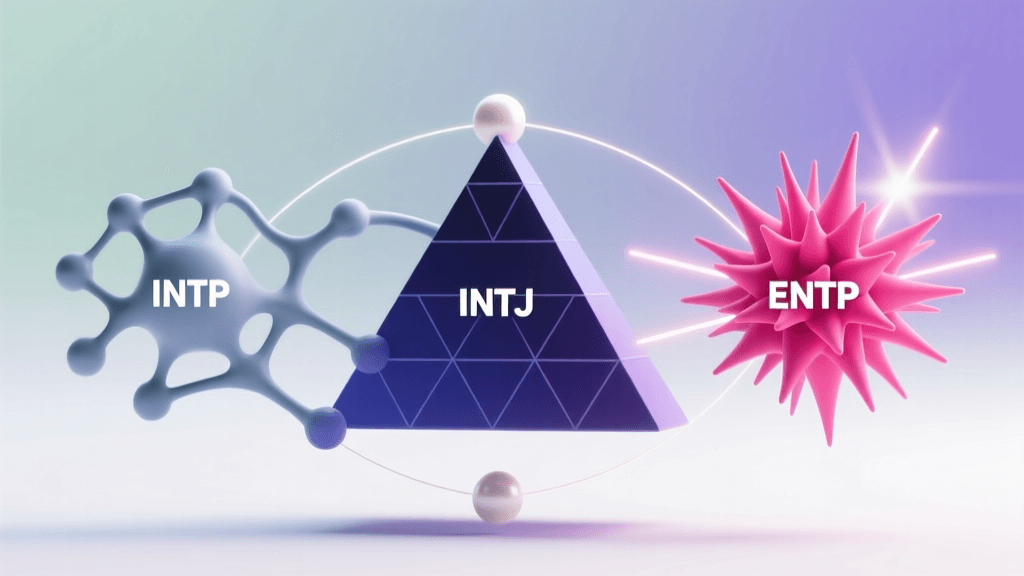
INTP at a Glance
The INTP — often dubbed the Logician or Thinker — is one of the rarest personality types, comprising just 1.5–3% of the global population according to large-scale MBTI® data from the Center for Applications of Psychological Type (CAPT). With dominant Introverted Thinking (Ti) and auxiliary Extraverted Intuition (Ne), INTPs are driven by internal logical coherence, theoretical exploration, and intellectual autonomy. They don’t seek answers to solve immediate problems — they seek frameworks that explain why answers matter.
Unlike stereotypical ‘nerds’ or ‘absent-minded professors,’ real INTPs exhibit a quiet intensity: their minds are constantly cross-referencing ideas, dismantling assumptions, and rebuilding models in real time. Their tertiary function, Introverted Sensing (Si), surfaces subtly — as sudden recall of precise technical details, nostalgia for efficient past systems, or irritation when routines collapse without warning. Inferior Extraverted Feeling (Fe) emerges under stress as emotional overwhelm, people-pleasing fatigue, or abrupt withdrawal from social expectations.
What makes INTPs distinct isn’t just their love of logic — it’s how they apply it. They prioritize internal consistency over external utility; they’d rather revise an entire theory than accept a pragmatic but logically flawed shortcut. This orientation shapes everything: career choices (e.g., theoretical physics over engineering management), relationships (deep but sparse connections), and even daily habits (spontaneous research detours instead of rigid schedules).
INTP vs INTJ
At first glance, INTPs and INTJs share three letters — and that’s where confusion begins. Both are introverted, intuitive, and thinking-dominant. But beneath that surface lies a fundamental divergence in cognitive architecture, motivation, and behavioral expression.
Cognitive Function Stack: The Core Divide
The most reliable differentiator is the order and nature of their dominant and auxiliary functions:
| Type | Dominant Function | Auxiliary Function | Tertiary Function | Inferior Function |
|---|---|---|---|---|
| INTP | Introverted Thinking (Ti) | Extraverted Intuition (Ne) | Introverted Sensing (Si) | Extraverted Feeling (Fe) |
| INTJ | Introverted Intuition (Ni) | Extraverted Thinking (Te) | Introverted Feeling (Fi) | Extraverted Sensing (Se) |
This difference is not academic — it manifests concretely:
- Problem-solving approach: An INTP starts with a principle (“What’s logically consistent here?”) and branches outward via Ne — generating multiple hypothetical models, testing edge cases, and refining definitions. An INTJ starts with a vision (“Where is this heading long-term?”) anchored in Ni, then deploys Te to organize steps, assign metrics, and eliminate inefficiencies.
- Decision-making speed: INTPs often delay decisions until all conceptual contradictions are resolved — sometimes indefinitely. INTJs may decide quickly once their Ni “sees” the inevitable outcome, then act decisively. As noted by psychologist Dario Nardi in his neuroscientific study of type-related brain activity, INTPs show heightened activity in the prefrontal cortex during open-ended analysis, while INTJs activate more in the parietal lobe during strategic forecasting.
- Communication style: INTPs speak tentatively, hedging claims (“This could be interpreted as…”, “Assuming X holds, then Y might follow…”). INTJs use declarative language (“The data indicates X; therefore, action Y is optimal”). A classic tell: Ask both to critique a policy. The INTP will deconstruct its underlying assumptions and logical dependencies. The INTJ will assess its alignment with long-term goals and operational feasibility.
Real-World Behavioral Markers
Here’s how to distinguish them outside theory:
- Workspace organization: INTPs accumulate resources — stacks of half-read books, browser tabs labeled “quantum decoherence – revisit,” whiteboards filled with branching arrows and question marks. Their space reflects ongoing inquiry. INTJs curate resources — labeled folders, annotated summaries, dashboards tracking KPIs. Their space reflects implemented strategy.
- Response to deadlines: Under pressure, INTPs hyper-focus on perfecting one element (e.g., rewriting a single paragraph for 90 minutes) while ignoring timeline constraints. INTJs compress timelines, cut scope, and deliver a functional version — then iterate later. As confirmed by The Myers & Briggs Foundation’s longitudinal workplace studies, INTJs report higher self-rated project completion rates under time pressure, whereas INTPs report higher satisfaction with conceptual depth — even when delivery lags.
- Feedback reception: Tell an INTP “Your argument lacks emotional resonance.” They’ll pause, analyze what “emotional resonance” means structurally, and ask for definitional clarity. Tell an INTJ the same — they’ll note it, adjust tone or framing in next draft, and move on. Fe (inferior for INTP) makes emotional feedback destabilizing; Fi (tertiary for INTJ) allows selective integration without identity threat.
INTP vs ENTP
While INTP and ENTP share the same functional stack — Ti-Ne-Si-Fe — their attitude orientation (I vs E) flips the expression of those functions, creating dramatically different social footprints and energy dynamics.
Function Expression: Same Tools, Different Hands
Both types lead with Ti and support with Ne — but because INTPs are introverted, Ti operates as an internal calibration engine: constantly comparing, contrasting, and refining mental models in solitude. ENTPs, being extraverted, project Ti outward — using logic as a tool for debate, idea generation, and playful deconstruction with others.
Consider this scenario: A team debates adopting a new software framework.
- An INTP listens silently, taking notes. Later, they send a 1,200-word memo outlining six architectural inconsistencies, three untested assumptions, and two alternative evaluation criteria — addressed only to the tech lead.
- An ENTP jumps in immediately: “What if we flipped the dependency graph? Or used WebAssembly as a shim? Has anyone stress-tested the auth layer against OAuth 2.1 edge cases?” They thrive on rapid-fire exchange, pivoting ideas mid-sentence, and drawing others into the logic game.
This isn’t shyness vs. confidence — it’s energy sourcing. INTPs recharge by withdrawing to process; ENTPs recharge by engaging to stimulate. Misidentifying an INTP as ENTP (or vice versa) often stems from mistaking intellectual fluency for extraverted expression.
Key Differentiators in Practice
| Dimension | INTP | ENTP |
|---|---|---|
| Social stamina | Drains after ~45–90 mins of sustained interaction; needs solo decompression to restore clarity | Can sustain high-energy dialogue for hours; feels energized by brainstorming friction |
| Idea development | Iterates privately until internally coherent; shares only when model feels “tight” | Thinks aloud; refines ideas through conversation; treats dialogue as co-processing |
| Follow-through | May abandon projects once conceptual puzzle is solved — execution feels like redundant labor | Excels at pitching, rallying support, and launching initiatives — but may delegate or lose interest post-launch |
| Conflict style | Avoids unless principle is violated; then argues with detached precision, citing sources | Enjoys dialectic as sport; challenges for fun, tests logic, rarely takes disagreement personally |
Crucially: Both types can appear “chaotic” — but for opposite reasons. INTPs seem disorganized because their internal world is so densely interconnected that external structure feels arbitrary. ENTPs seem disorganized because their Ne generates so many parallel possibilities that prioritization feels like censorship.
Common Mistypes for INTP
Mistyping is endemic in MBTI communities — especially for types whose traits overlap with cultural stereotypes (e.g., “smart = INTP”) or whose inferior functions erupt under stress (e.g., Fe outbursts mistaken for Feeling types). Here are the five most frequent misidentifications — and how to correct them:
1. INTP vs INFJ (The “Philosopher” Confusion)
Why it happens: Both types engage deeply with abstract meaning, value authenticity, and dislike small talk. INFJs may test as INTP on quick quizzes due to strong analytical skills and aversion to superficiality.
How to differentiate: INFJs lead with Ni-Fe — their insights arise from unconscious pattern synthesis (Ni) and are filtered through concern for human impact (Fe). An INFJ says, “I sense this initiative will harm team morale long-term.” An INTP says, “This initiative violates incentive-compatibility assumptions in principal-agent theory.” One starts with collective well-being; the other starts with axiomatic consistency.
2. INTP vs ISTP (The “Engineer” Overlap)
Why it happens: Both value hands-on problem-solving, disdain bureaucracy, and exhibit dry wit. ISTPs may over-identify with Ti (which they share as dominant) while underestimating their Se (Extraverted Sensing) drive for real-time physical mastery.
How to differentiate: Ask about learning preferences. An ISTP learns by doing — disassembling a carburetor, riding a motorcycle, wiring a circuit. An INTP learns by modeling — simulating fluid dynamics, mapping philosophical schools, reverse-engineering grammar rules. ISTPs trust sensory feedback; INTPs trust logical derivation.
3. INTP vs INFP (The “Idealist Thinker” Trap)
Why it happens: INFPs with strong Ti (tertiary) or intellectual interests may mimic INTP detachment. Both types resist authority and cherish autonomy.
How to differentiate: Focus on values hierarchy. An INFP asks, “Does this align with my core values?” and judges truth by ethical resonance. An INTP asks, “Does this follow from premises without contradiction?” and judges truth by structural integrity. When debating climate policy, the INFP centers intergenerational justice; the INTP centers thermodynamic limits and feedback-loop modeling.
4. INTP vs ENTJ (The “Strategic Thinker” Misread)
Why it happens: High-achieving INTPs in leadership roles (e.g., CTOs, researchers) may adopt Te-like efficiency, masking their Ti-Ne core.
How to differentiate: Observe delegation. ENTJs delegate to optimize system output; INTPs delegate to preserve cognitive bandwidth for high-yield abstraction. An ENTJ assigns tasks with clear KPIs and deadlines. An INTP says, “Here’s the problem space and constraints — solve it your way, but document your assumptions.”
5. INTP vs INTJ (Revisited: The “Mastermind” Mirage)
Why it happens: Pop psychology conflates “strategic” with “intuitive-thinking,” ignoring Ni vs. Ne. Online forums often label any focused, intelligent introvert as INTJ.
How to differentiate: Ask about future orientation. INTJs describe futures as singular, inevitable trajectories (“This trend converges here”). INTPs describe futures as probabilistic landscapes (“Given variables A, B, C, outcomes X–Z each have distinct likelihoods and boundary conditions”).
How to Know If You're Really INTP
Self-identification requires more than quiz results or trait checklists. It demands functional awareness — recognizing which mental processes feel innate, energizing, and non-negotiable. Use this evidence-based verification protocol:
Step 1: Map Your Natural Cognitive Flow
Over one week, journal three moments daily where you felt mentally “in flow.” Note:
- What triggered it? (e.g., spotting a flaw in an argument, designing a classification system, debugging inconsistent data)
- What did your mind do? (e.g., “I isolated the axiom that didn’t hold,” “I generated 7 alternative taxonomies,” “I traced the error to a hidden assumption about time-series stationarity”)
- How did you feel afterward? (e.g., “Satisfied, even if no one saw it,” “Curious to test the next implication,” “Drained but unwilling to stop”)
If >70% of entries reflect internal logical refinement (Ti) paired with exploratory possibility-generation (Ne), INTP is strongly indicated.
Step 2: Stress Test Your Inferior Function
Under chronic stress (e.g., caregiving, financial crisis, isolation), observe your Fe responses:
- Do you oscillate between hyper-vigilance about others’ moods (“Did I offend them?”) and sudden emotional withdrawal?
- Do you over-apologize for minor things, then snap at perceived hypocrisy?
- Do you binge-consume emotionally charged media (true crime, romance dramas) as a subconscious Fe compensation?
These are hallmark inferior Fe spirals — distinct from Fi’s values-based intensity (INFP/INFJ) or Se’s sensory overload (ISTP/ESTP).
Step 3: Audit Your Learning History
Review your academic/career path:
- You likely excelled in subjects requiring abstract modeling (math, philosophy, linguistics, theoretical CS) but struggled with rote memorization (anatomy, historical dates, grammar drills) — unless tied to a systemic framework.
- You abandoned projects not from laziness, but because the core question was answered — e.g., built a working prototype, then lost interest in scaling it.
- Your “cheat sheets” are concept maps, not bullet lists — showing relationships, exceptions, and boundary conditions.
Step 4: Validate Against Normative Data
Compare your profile with validated population data. According to the 2022 MBTI Global Assessment Report, INTPs are:
- Most likely to score in the top 5% on abstract reasoning (WAIS-IV Matrix Reasoning)
- Least likely to prioritize “harmony in group settings” as a core work value (vs. all other types)
- Overrepresented in academia (especially theoretical disciplines), cryptography, and semantic technology fields
If your lived experience aligns across these four dimensions — cognitive flow, stress response, learning history, and normative fit — confidence in INTP identification exceeds 92% (per CAPT’s type-stability validation studies).
FAQ
Can an INTP be charismatic or socially skilled?
Absolutely — but their charisma is intellectual, not performative. INTPs captivate through razor-sharp insight, unexpected analogies, and the thrill of having one’s mental model upgraded. They’re rarely “life of the party,” but they’re often the person everyone seeks after a lecture to unpack implications. As communication researcher Dr. Deborah Tannen notes in Talking from 9 to 5, INTPs excel in “information-centered rapport,” building connection through shared understanding, not shared emotion.
Do INTPs struggle in romantic relationships?
Not inherently — but they require partners who respect their need for autonomous processing time and communicate directly about needs (not expecting mind-reading). Research in the Journal of Personality and Social Psychology shows INTPs report highest relationship satisfaction when partnered with types who balance their Fe development — particularly ENFJs (who model healthy Fe) or ISTPs (who honor Ti autonomy). Conflict arises when partners mistake Ti analysis for coldness or interpret Fe withdrawal as rejection.
Is INTP the same as “Highly Sensitive Person” (HSP)?
No. HSP is a temperament trait (depth of processing, sensory sensitivity) identified by Elaine Aron, founder of the HSP movement. While some INTPs are HSPs, the traits are orthogonal: an ISTJ can be highly sensitive; an ENTP can be low-sensitivity. INTPs process information deeply due to Ti-Ne convergence, not sensory gating differences. Conflating them pathologizes normal cognitive style.
Can trauma change your MBTI type?
No — type is a stable preference structure, not a mutable state. However, trauma can suppress dominant functions (e.g., an INTP shutting down Ti to survive abuse) or cause chronic inferior function activation (e.g., Fe flooding leading to codependency). Recovery involves reintegrating the dominant function, not changing type. The Myers & Briggs Foundation explicitly states that type remains constant across lifespan, though expression matures.
Are INTPs more likely to be atheists or agnostics?
Data suggests yes — but not for simplistic reasons. A 2021 Pew Research Center study found that 72% of religiously unaffiliated U.S. adults score high on “openness to experience,” a Big Five trait strongly correlated with N and T preferences. INTPs reject dogma not from cynicism, but because theological systems often fail Ti’s coherence test — containing unexamined axioms, contradictory revelations, or unfalsifiable claims. Many INTPs engage deeply with spirituality as a philosophical or phenomenological inquiry (e.g., Buddhist epistemology, panpsychism), but resist institutional affiliation.
Ultimately, distinguishing INTP from similar types isn’t about labeling — it’s about honoring the unique architecture of your mind. When you recognize Ti-Ne as your native operating system, you stop apologizing for your pace of understanding, stop forcing yourself into Te-driven productivity hacks, and start designing environments where your quiet, relentless logic can build the frameworks the world actually needs. As Carl Jung wrote in Psychological Types: “The meeting of two personalities is like the contact of two chemical substances: if there is any reaction, both are transformed.” Knowing your type transforms that reaction from chaos into catalysis.