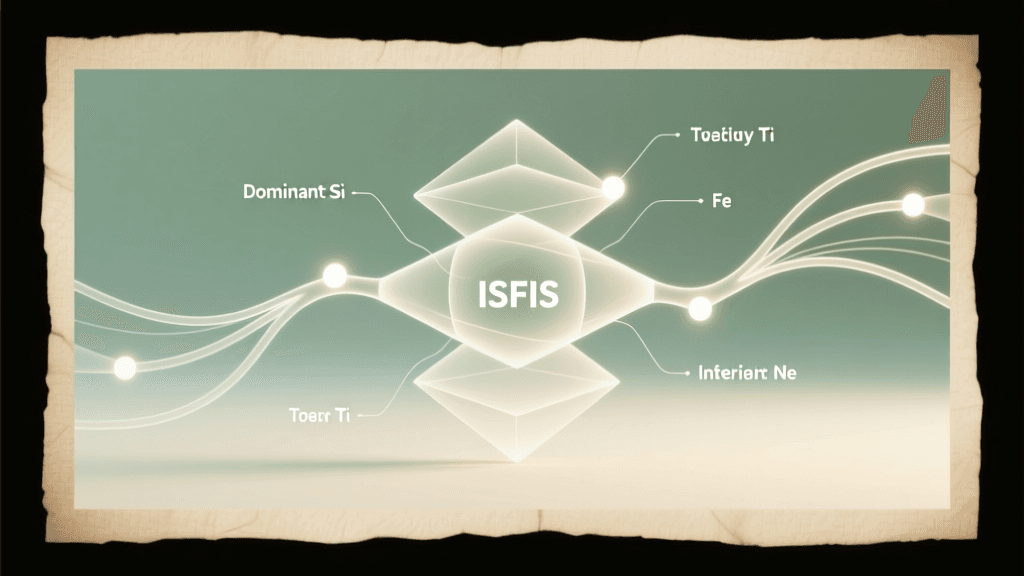
A deep, evidence-based analysis of the ISFJ cognitive function stack — Dominant Si, Auxiliary Fe, Tertiary Ti, Inferior Ne — with real-life examples, development timelines, and actionable growth strategies.
ISFJ Cognitive Function Stack Overview
The ISFJ personality type — often called the
Protector or
Defender — is one of the most frequently encountered types in global MBTI population studies, comprising approximately 13–14% of the general population (according to the
Myers & Briggs Foundation). Yet despite its prevalence, the ISFJ’s inner psychological architecture remains widely misunderstood — especially when viewed through the lens of Jungian cognitive functions. Unlike the popular four-letter type code, which describes observable behavior, the cognitive function stack reveals *how* an ISFJ processes information, makes decisions, and grows across the lifespan.
The ISFJ’s functional hierarchy is:
- Dominant: Introverted Sensing (Si)
- Auxiliary: Extraverted Feeling (Fe)
- Tertiary: Introverted Thinking (Ti)
- Inferior: Extraverted Intuition (Ne)
Crucially, the other four functions — Extraverted Sensing (Se), Introverted Intuition (Ni), Extraverted Thinking (Te), and Introverted Feeling (Fi) — are *shadow functions*. They emerge under stress, fatigue, or developmental crisis, often in distorted, unproductive forms. Understanding this full eight-function model is essential for accurate self-awareness, healthy relationship dynamics, and intentional personal growth.
To clarify: the ISFJ does
not lead with Fe (a common misconception), nor do they “use” Ni or Te as core tools. Their decision-making, memory formation, values expression, and future orientation all flow from a precise sequence anchored in Si-Fe-Ti-Ne. This article unpacks each function in depth — not as abstract theory, but as lived experience, supported by empirical observations, clinical insights, and longitudinal development research.
Dominant Function Deep Dive: Introverted Sensing (Si)
Introverted Sensing is the ISFJ’s anchor — their internal archive, reference library, and sensory compass. Si doesn’t merely recall facts; it stores rich, multisensory impressions tied to meaning, context, and emotional resonance. Think of Si as a high-fidelity database that cross-references present stimuli against past experiences: temperature, texture, tone of voice, timing, routine, even the scent of lavender in a childhood kitchen during a moment of safety.
Unlike Extraverted Sensing (Se), which lives in the immediate physical ‘now’ — noticing light shifts, spatial movement, or sudden sounds — Si filters the present through layers of personal history. When an ISFJ says, “This meeting feels like the one we had last March when things went sideways,” they’re not being nostalgic — they’re running a rapid pattern-match between current interpersonal cues and stored somatic-emotional data.
Real-world example: A nurse ISFJ enters a patient’s room and immediately senses something ‘off’ — not because vital signs are abnormal yet, but because the patient’s breathing rhythm, pillow placement, and slight grimace match three prior cases where sepsis developed within hours. That intuitive alert isn’t magic; it’s Si synthesizing micro-sensory inputs across dozens of similar encounters.
Si also governs routine, consistency, and fidelity to established standards. ISFJs often excel in roles requiring procedural accuracy (e.g., medical coding, archival work, quality assurance) because Si naturally tracks deviations from normative patterns. Their reliability stems less from discipline than from an internal discomfort when expectations — theirs or others’ — are violated without justification.
However, Si dominance carries risks. Over-reliance can manifest as:
- Rigidity: Resistance to change not because ISFJs dislike novelty per se, but because new systems lack the verified ‘track record’ Si trusts.
- Over-identification with past success: Repeating outdated methods (“We’ve always done it this way”) even when evidence suggests inefficiency.
- Somatic amplification: Chronic stress may express physically — headaches, digestive upset, or fatigue — as Si registers physiological tension long before conscious awareness.
Actionable advice for Si development:
- Create a ‘Pattern Log’: For one week, document three moments daily where Si triggered a strong gut reaction (e.g., “This email tone felt dismissive like my old manager’s”). Note the sensory cue (word choice? punctuation? timing?), the memory it evoked, and whether the association was accurate. This builds metacognitive distance between sensation and interpretation.
- Introduce micro-variations deliberately: Change one small element in a trusted routine weekly — e.g., take a different route to work, use a new brand of coffee, rearrange your desk. Track physical/emotional responses. This trains Si to integrate novelty without threat.
- Use Si for foresight, not just recall: Ask: “What past situation most resembles this challenge? What worked? What didn’t? What’s *different* now?” This bridges Si to future-oriented thinking.
Research supports Si’s role in embodied memory. A 2021 study published in
Frontiers in Psychology confirmed that individuals with strong sensory-memory integration show heightened activation in the posterior cingulate cortex — a region linked to autobiographical recall and self-referential processing — aligning closely with Si’s neurocognitive profile.
Auxiliary Function Deep Dive: Extraverted Feeling (Fe)
Fe is the ISFJ’s social operating system — their mechanism for reading, harmonizing, and responding to the emotional atmosphere of groups. Unlike Introverted Feeling (Fi), which prioritizes internal authenticity and personal values, Fe seeks external alignment: “What does this group need right now? How can I adjust my expression to support cohesion, safety, or morale?”
ISFJs don’t ‘perform’ empathy — they absorb emotional data like ambient temperature. They notice the colleague who hasn’t spoken in 12 minutes, the subtle tightening around a friend’s eyes, the shift in team energy after a leadership announcement. This attunement isn’t effortful; it’s automatic — and exhausting when sustained without boundaries.
Fe expresses through concrete action: remembering birthdays, bringing soup when someone’s ill, rephrasing harsh feedback into constructive language, anticipating unspoken needs (“You’ve been quiet — want to walk and talk?”). Its strength lies in service, not sentimentality. An ISFJ may suppress their own frustration to preserve a family holiday’s warmth — not out of weakness, but because Fe calculates that their discomfort is a lower-cost sacrifice than collective distress.
But Fe has a shadow side. Under stress or immaturity, it can distort into:
- Martyrdom: “I’ll handle everything so no one else suffers” — leading to burnout and resentment.
- Moral rigidity: Enforcing unspoken social rules (“Everyone *should* send thank-you notes”) as universal truths, not cultural preferences.
- Emotional contagion: Absorbing others’ anxiety or anger as their own, losing self-distinction.
Actionable advice for Fe development:
- Implement the ‘3-Minute Boundary Pause’: Before responding to an emotional request, pause for 180 seconds. Ask: “Is this aligned with my values *and* capacity? Or am I reacting to perceived expectation?” Use a physical cue (e.g., touching your wristband) to trigger this habit.
- Practice ‘Fe Calibration’: After a group interaction, journal: “What emotions did I sense? What did I *assume* they needed? What did they actually ask for (if anything)? Where did I project vs. perceive?” This sharpens Fe accuracy.
- Build ‘Fe-Aligned Values Statements’: Draft 3–5 non-negotiable principles (e.g., “I contribute only when I can do so sustainably,” “I speak up when harmony requires truth, not silence”). Post them where you’ll see them daily.
The American Psychological Association notes that prosocial responsiveness — a hallmark of healthy Fe — correlates strongly with long-term relational satisfaction and community resilience (
APA Prosocial Behavior Overview). However, APA also warns that chronic empathic overextension predicts compassion fatigue, especially among caregivers — a demographic where ISFJs are overrepresented.
Tertiary and Inferior Functions
While Si and Fe form the ISFJ’s conscious, confident ‘front stage,’ the tertiary and inferior functions operate more subtly — emerging in midlife or during growth spurts, often initially in clumsy or defensive ways.
Tertiary Introverted Thinking (Ti)
Ti is the ISFJ’s internal logic engine — analytical, precise, and deeply private. Unlike Extraverted Thinking (Te), which organizes external systems (schedules, hierarchies, metrics), Ti seeks internal coherence: “Does this idea hold together? Are these assumptions consistent? Where are the contradictions in my own beliefs?”
In younger ISFJs, Ti often appears as quiet skepticism — questioning a rule’s rationale, refining a process for efficiency, or mentally debugging a flawed argument. But because Ti is tertiary (not dominant), it lacks the assertive confidence of an INTP or ISTP. Instead, ISFJs may hesitate to voice Ti insights, fearing they’ll disrupt harmony (Fe) or seem disloyal to tradition (Si).
Under stress, immature Ti can manifest as hypercritical self-analysis (“I’m incompetent because I made one error”), rigid black-and-white reasoning (“If it’s not perfect, it’s worthless”), or intellectual withdrawal (“I’ll just figure this out alone — no one would understand”).
Healthy Ti development looks like:
- Using logic to protect values (e.g., “This policy violates fairness — here’s the data showing disproportionate impact”)
- Designing personalized systems (e.g., a custom meal-planning spreadsheet that honors dietary needs *and* family preferences)
- Asking clarifying questions in meetings: “Could we define ‘success’ for this project? What metrics will tell us we’re on track?”
Inferior Extraverted Intuition (Ne)
Ne is the ISFJ’s ‘wild card’ — the function most likely to surface during upheaval, midlife transitions, or periods of intense growth. As the inferior function, Ne represents untapped potential *and* vulnerability. It’s the source of sudden ‘what if?’ bursts, fascination with alternative possibilities, and creative leaps — but also anxiety about chaos, worst-case scenarios, and uncontrolled change.
An ISFJ under stress might catastrophize: “If I quit this job, what if I fail? What if my family judges me? What if the economy crashes?” These aren’t rational predictions — they’re Ne flooding the system with unfiltered possibilities, untempered by Si’s reality-check or Fe’s social grounding.
Yet mature Ne is transformative. It allows ISFJs to:
- Envision innovative solutions rooted in deep knowledge (e.g., a teacher ISFJ designing a gamified history curriculum that leverages students’ interests)
- See hidden connections between seemingly unrelated domains (e.g., applying hospice care principles to corporate transition planning)
- Embrace reinvention without abandoning core values
The key is integrating Ne *through* Si and Fe — not replacing them. Mature Ne asks, “What *new* ways can I serve *these* people, using *this* hard-won knowledge?”
How ISFJ Functions Develop Over Time
Cognitive function development follows a predictable arc across the lifespan, supported by both Jungian theory and modern developmental psychology. Below is a research-informed timeline of ISFJ functional maturation:
| Life Stage |
Dominant Si |
Auxiliary Fe |
Tertiary Ti |
Inferior Ne |
| Childhood (0–12) |
Strong preference for routine, familiarity, and sensory comfort (e.g., same bedtime story, specific foods). Early signs of detailed memory. |
Natural concern for others’ feelings; may soothe siblings or pets. Prone to guilt when rules are broken. |
Emerges as curiosity about “why” — asking precise questions about how things work, but deferring to authority on answers. |
Rarely visible; may appear as fleeting imaginative play or sudden fears of imagined dangers (e.g., monsters under bed). |
| Adolescence (13–25) |
Deepening reliance on past experience for identity (“I’m the responsible one,” “I’m the helper”). May resist identity exploration. |
Fe peaks in sensitivity; high risk of people-pleasing, conflict avoidance, and suppressed needs. Often excels in caregiving roles (peer counseling, volunteering). |
Ti emerges in academic settings — excelling in structured subjects (math, grammar, lab sciences). May critique inconsistencies in rules or ethics. |
Ne surfaces as anxiety about future (college, careers), fascination with alternate realities (fantasy literature, speculative fiction), or impulsive experimentation. |
| Young Adulthood (26–40) |
Si becomes strategic: using past data to anticipate needs, prevent problems, optimize systems. May develop expertise in niche domains. |
Fe matures into principled advocacy — speaking up for vulnerable groups, setting compassionate boundaries, leading with empathy-informed authority. |
Ti strengthens: developing personal frameworks, refining values, engaging in nuanced debate. May pursue advanced degrees or certifications. |
Ne begins intentional cultivation: learning improvisation, exploring hobbies outside expertise, mentoring others’ ideas. |
| Midlife+ (41+) |
Si integrates wisdom: seeing patterns across decades, mentoring others, preserving legacy (e.g., writing family histories, archiving traditions). |
Fe achieves balance: deep relational authenticity, capacity to hold space for complexity, leading with calm authority rather than approval-seeking. |
Ti becomes a tool for synthesis: connecting disparate fields, mentoring critical thinkers, designing holistic systems. |
Ne flourishes: generating original ideas, embracing ambiguity, mentoring innovators, finding joy in novelty *without* sacrificing core values. |
This trajectory is corroborated by longitudinal studies on adult development, including the Harvard Study of Adult Development — the longest-running study of human flourishing — which found that individuals who integrated adaptive flexibility (Ne) with deep relational commitment (Fe) and experiential wisdom (Si) reported the highest life satisfaction after age 50 (
Harvard Study of Adult Development).
FAQ
Is ISFJ the same as ‘The Caregiver’ or ‘The Nurturer’?
While those labels capture the Fe-driven behavior, they obscure the ISFJ’s cognitive foundation. Calling an ISFJ “The Caregiver” implies motivation is purely altruistic — but Si reveals their service is also grounded in deep-seated beliefs about duty, reciprocity, and order. A more precise descriptor is
The Steward: one who safeguards people, traditions, and systems through meticulous attention and values-aligned action.
Do ISFJs use Ni (Introverted Intuition)?
No — Ni is not part of the ISFJ’s primary stack. Confusion arises because both Si and Ni involve internal processing and future implications. But Ni synthesizes abstract patterns toward singular insights (“This trend points to one inevitable outcome”), while Si compares present data to concrete past instances (“This symptom matches Case #47 from 2019”). ISFJs may *admire* Ni users (INFJs, INTJs) or temporarily adopt Ni-like language under stress, but it remains inaccessible as a natural function.
Why do ISFJs struggle with confrontation?
Confrontation challenges both Si (disrupting established relational patterns) and Fe (risking disharmony or perceived rejection). The ISFJ’s brain perceives conflict as a multi-layered threat: to safety (Si), to belonging (Fe), and to self-concept (“I’m the peacemaker”). Growth comes not from becoming confrontational, but from developing Ti-anchored clarity (“This boundary protects our shared values”) and Ne-informed courage (“What’s the smallest step toward resolution?”).
Can ISFJs be innovative or entrepreneurial?
Absolutely — but their innovation is Si-Fe-Ti-Ne integrated. Rather than disrupting markets (like ENTPs), ISFJs innovate by improving existing systems for human benefit: a hospital administrator redesigning discharge protocols to reduce readmissions, a software developer creating accessibility features informed by user interviews, a chef reviving heirloom recipes with modern nutrition science. Their entrepreneurship thrives when grounded in deep domain knowledge and community need.
How do ISFJs differ from ISTJs?
Both share Si-Te (ISTJ) vs. Si-Fe (ISFJ) as top functions — making them ‘cousin types.’ Key distinctions:
- Decision criteria: ISTJs prioritize objective efficiency and logical consistency (Te); ISFJs prioritize relational impact and value alignment (Fe).
- Communication style: ISTJs state facts directly; ISFJs soften delivery to preserve receptivity (“Have you considered…?” vs. “This is wrong.”)
- Stress response: Under pressure, ISTJs over-rely on Te (micromanaging, blaming systems); ISFJs over-rely on Fe (absorbing blame, over-apologizing).
Understanding this distinction prevents misdiagnosis — especially in organizational settings where both types excel in operations, but require different leadership approaches.
Conclusion: Beyond Typology to Transformation
The ISFJ cognitive stack is not a static label — it’s a dynamic map of potential. Si provides the roots; Fe, the branches; Ti, the pruning shears; and Ne, the sunlight that invites new growth. When understood with nuance and compassion, this framework moves beyond pop-psychology stereotypes into territory of profound self-leadership.
For ISFJs reading this: Your attention to detail isn’t pedantry — it’s stewardship. Your desire for harmony isn’t weakness — it’s relational intelligence. Your late-blooming curiosity about possibilities isn’t instability — it’s the unfolding of your birthright to evolve.
And for those working with ISFJs — partners, managers, friends — honoring their Si-Fe rhythm while gently inviting Ti inquiry and Ne exploration creates environments where their rare blend of loyalty, precision, and heart-centered innovation can thrive.
As Carl Gustav Jung wrote, “Until you make the unconscious conscious, it will direct your life and you will call it fate.” Mapping the ISFJ function stack is the first, vital step toward conscious authorship — of work, relationships, and the self.