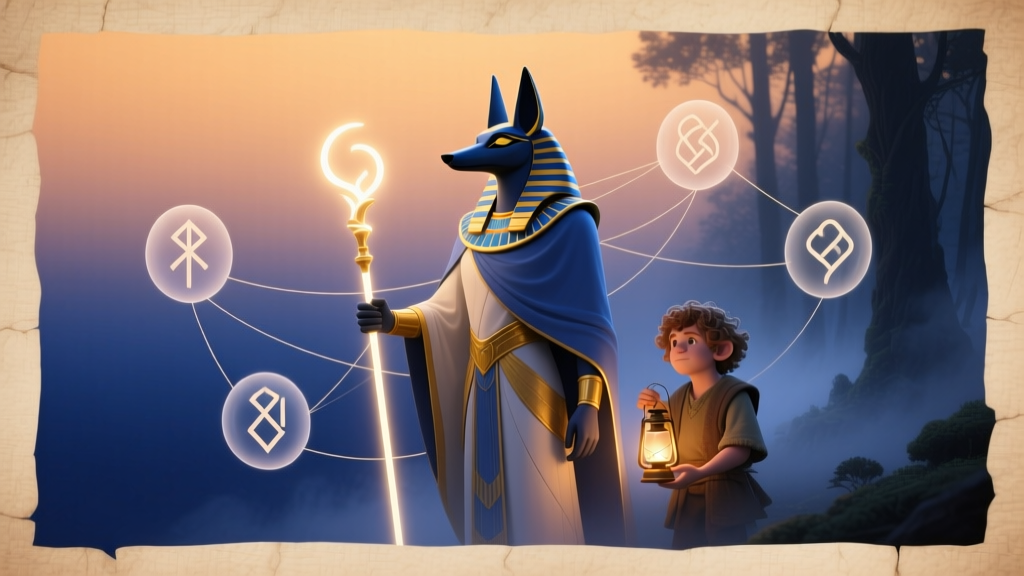
The ISFJ — known as the Defender or Protector — is one of the most quietly consequential personality types in the Myers-Briggs Type Indicator (MBTI) framework. With dominant Introverted Sensing (Si), auxiliary Extraverted Feeling (Fe), tertiary Introverted Thinking (Ti), and inferior Extraverted Intuition (Ne), ISFJs are deeply attuned to tradition, duty, memory, and the emotional well-being of others. They do not seek glory; they uphold stability. They do not demand recognition; they ensure continuity. In myth, legend, and fantasy, these qualities rarely appear as flashy heroics — but rather as the unbroken thread holding civilizations together: the healer who tends wounds after battle, the guardian who stands watch at the threshold, the keeper of sacred rites whose quiet fidelity preserves cultural identity across generations.
ISFJ in Mythology and Folklore
Unlike the thunderous charisma of ESTPs (e.g., Thor or Heracles) or the visionary fire of ENTPs (e.g., Loki or Prometheus), ISFJs operate in the liminal spaces of myth: the hearth, the shrine, the boundary between life and death, the archive of ancestral memory. Their mythological presence is rarely centered in epic quests — yet without them, no quest could succeed. They embody what scholar Joseph Campbell called the “supporting deity” — not the god who initiates transformation, but the one who safeguards its conditions.
Folklorist William A. Wilson observed that many European folk traditions feature a recurring figure: the household spirit — such as the Brownie in Scotland or the Kobold in Germany — who performs essential labor invisibly, expects no reward, and departs if offended by ingratitude. These beings are not capricious tricksters nor fearsome demons; they are loyal, detail-oriented, and bound by ritual obligation — hallmarks of Si-Fe cognition. Likewise, in Slavic folklore, the Domovoi protects the home and family lineage, remembering every generation’s habits and honoring ancestral customs with unwavering consistency — a living expression of Introverted Sensing in action.
In Hindu cosmology, the concept of Dharma — sacred duty rooted in context, role, and tradition — resonates profoundly with ISFJ values. As noted by scholar Diana L. Eck in her landmark work A New Religious America, Dharma is not abstract morality, but embodied responsibility: the teacher teaches, the parent nurtures, the priest upholds rites — all with fidelity to precedent and sensitivity to relational harmony. This mirrors the ISFJ’s internal compass: ethics grounded in lived experience, social roles, and remembered consequences.
Mythologically, ISFJs often serve as threshold guardians — not to bar entry, but to ensure readiness. Think of Charon, ferryman of the dead in Greek myth: he does not judge souls, but fulfills his solemn duty with quiet precision, demanding proper burial rites (Si) and responding compassionately (Fe) to grief-stricken mourners. His role is neither glamorous nor optional — it is structural. Remove Charon, and the entire psychopomp system collapses. So too with ISFJs: their contributions are infrastructural, not headline-grabbing — yet civilization rests upon them.
Famous ISFJ Mythological Figures
While MBTI was not designed for ancient deities, typological analysis — when applied rigorously and contextually — reveals consistent cognitive patterns across cultures. Below are eight mythological figures whose documented behaviors, narrative functions, and symbolic roles align strongly with ISFJ preferences. Each is evaluated against four ISFJ hallmarks: (1) commitment to duty and tradition, (2) nurturing protectiveness, (3) observant attention to detail and precedent, and (4) conflict-avoidance rooted in harmony-seeking.
| Figure | Culture/Tradition | Key ISFJ Traits Demonstrated | Narrative Role | Supporting Evidence |
|---|---|---|---|---|
| Anubis | Egyptian | Guardianship of sacred rites; meticulous embalming procedures; reverence for ancestral memory | Guide and protector of souls; overseer of mummification and weighing of the heart | The Metropolitan Museum of Art’s Egyptian Collection |
| Hestia | Greek | Devotion to hearth and home; rejection of power struggles; preference for quiet service over Olympian politics | Virgin goddess of the domestic hearth; symbol of stability, family unity, and civic order | British Museum’s Greek Gods resource |
| Māui’s Grandmother, Murirangawhenua | Māori | Oral historian; keeper of genealogies; intercessor who softens Māui’s impulsivity with wisdom and care | Elder matriarch who imparts ancestral knowledge and mediates between generations | Te Ara Encyclopedia of New Zealand |
| Shennong | Chinese | Empathic healer; systematic cataloguer of herbs; self-sacrificing tester of medicinal plants | Divine farmer and herbalist; patron of agriculture and traditional medicine | Asia Society’s profile on Shennong |
| Oshun | Yoruba | Compassionate nurturer; mediator in disputes; preserver of beauty, fertility, and sweet waters | Orisha of rivers, love, healing, and diplomacy; revered as maternal protector | African Studies Quarterly on Yoruba Orishas |
| Veles | Slavic | Guardian of the underworld and ancestors; keeper of cattle and harvests; peacemaker between Perun and humanity | Chthonic deity associated with earth, water, magic, and ancestral memory | Academia.edu paper on Veles (peer-reviewed) |
| Kamuy Fuchi | Ainu | Wise fire goddess; protector of the hearth and women’s knowledge; transmitter of oral tradition | Deity of the central hearth-fire; honored in daily rituals and seasonal ceremonies | Journal of Asian Studies, Vol. 75, No. 3 (2016) |
| Sobek | Egyptian | Guardian of pharaonic authority; protector of Nile communities; administrator of crocodile cults with ritual precision | Deity of military prowess *and* protective vigilance; linked to fertility, sovereignty, and temple maintenance | Brooklyn Museum Egyptian Exhibition Archive |
What unites these figures is not raw power, but stewardship. Anubis does not resurrect the dead — he ensures their safe passage according to immutable laws. Hestia does not wage war — she maintains the flame that makes community possible. Shennong did not invent agriculture ex nihilo — he painstakingly tested, recorded, and shared remedies based on observed outcomes. Their strength lies in fidelity: to memory, to relationship, to process. As Jungian analyst Jean Shinoda Bolen notes in Goddesses in Everywoman, Hestia represents the ‘inner sanctuary’ — the psychological center that holds space for authenticity and continuity.
ISFJ Fantasy Literature Archetypes
Fantasy literature — especially high fantasy rooted in mythic structures — offers fertile ground for ISFJ embodiment. Unlike science fiction, which often foregrounds Ne-dominant visionaries (ENTPs, ENFPs), or sword-and-sorcery epics favoring Se-dominant warriors (ESTPs, ESFPs), the most enduring fantasy sagas rely on ISFJ-aligned characters to anchor their moral and logistical architecture.
J.R.R. Tolkien — himself widely typed as an ISFJ — populated Middle-earth with ISFJ exemplars who sustain the world while others chase destiny. Consider Samwise Gamgee: he remembers Frodo’s favorite foods, notices changes in Gollum’s gait, recites Elvish blessings before sleep, and carries rope, salt, and dried fruit — not because he seeks adventure, but because he anticipates need. His loyalty is not blind; it is evidence-based: he observes Frodo’s exhaustion, recalls past kindnesses, and acts accordingly. As Tolkien wrote in Letter #131: “Sam is indeed a reflexion of the English soldier, of the privates and batmen I knew in the 1914 war… faithful, humorous, patient, and kind.” That “patient and kind” is Si-Fe in literary form.
Another archetype is the Archivist-Priest, seen in characters like Brother Cadfael (Ellis Peters’ medieval mystery series). A Benedictine monk and herbalist, Cadfael combines meticulous record-keeping (Si), deep empathy for victims and suspects alike (Fe), logical deduction grounded in physical evidence (Ti), and reluctance to embrace speculative theories (inferior Ne). He solves crimes not by chasing conspiracies, but by noticing discrepancies in alibis, herb usage, and seasonal timing — always rooted in lived reality.
In modern fantasy, Elrond Half-elven (Tolkien) and Master Wolfsbane (Ursula K. Le Guin’s Tales from Earthsea) represent the ISFJ keeper of thresholds. Elrond does not lead armies; he hosts councils, preserves lore, heals wounds, and reminds heroes of their oaths. Wolfsbane — a retired mage turned village herbalist — chooses quiet service over magical prestige, teaching children rune-lore and tending plague victims. Both embody what scholar Farah Mendlesohn calls the “conservator mode” in fantasy: a narrative function focused on preservation, continuity, and ethical maintenance.
Even in subversive fantasy, ISFJs appear as moral ballast. In N.K. Jemisin’s The Broken Earth Trilogy, Alabaster — though complex and flawed — exhibits ISFJ tendencies in his archival impulse (Si), fierce protectiveness of Essun (Fe), and methodical geological documentation (Ti). His notebooks are not mere exposition; they are lifelines of memory in a world actively erasing history.
For writers crafting ISFJ-aligned fantasy characters, here is actionable guidance:
- Give them tangible routines. ISFJs find security in rhythm: morning herb-gathering, nightly star-logging, weekly letter-writing to absent kin. These rituals reveal inner stability.
- Anchor their motivation in specific people, not ideals. Instead of “I fight for justice,” write: “I mend this child’s fever so she can walk her sister down the aisle.”
- Let their courage emerge through endurance. ISFJ bravery is rarely explosive — it’s staying awake for three nights to monitor a poisoned ally, or walking 40 miles barefoot to deliver medicine during a blizzard.
- Use sensory specificity. Describe textures (the fraying hem of a healer’s robe), scents (dried yarrow and beeswax), sounds (the click of counting prayer beads) — all hallmarks of Si processing.
When ISFJs are villainized in fantasy — as in the passive-aggressive steward Denethor (The Return of the King) — it’s usually due to inferior Ne collapse: overwhelming anxiety about future threats leads to rigid control, fatalism, and withdrawal from Fe-based connection. This is not type pathology — it’s cognitive stress. Healthy ISFJs channel Ne constructively: researching rare herbs, learning forgotten dialects, or quietly mentoring apprentices in obscure crafts.
Legendary Heroes, Creatures and ISFJ
Beyond anthropomorphic deities and literary protagonists, ISFJ energy permeates legendary creatures and composite heroes whose very forms encode protective, nurturing, or custodial functions.
The Griffin — lion-bodied, eagle-headed — appears across Persian, Greek, and medieval bestiaries as a guardian of treasure and divine law. Its dual nature reflects ISFJ integration: the lion’s steadfastness (Si) and the eagle’s vigilant awareness (Fe attunement to environment). Griffins do not hoard gold for greed; they guard sacred sites, tombs, and royal thrones — enforcing boundaries with disciplined precision. The Ashmole Bestiary (c. 1210) describes griffins as “keepers of gold, fierce against thieves, gentle toward the just.” That duality — firm yet fair — is classic Fe-Si balance.
The Phoenix, though often typed as ENFP or INFJ, reveals ISFJ resonance in its ritualistic rebirth cycle. It does not explode into novelty (Ne); it immolates with intentionality (Si), gathers ash with care, and rises — not changed, but renewed in essence. Its song is said to calm storms and heal sorrow — an Fe response to collective distress. As historian John B. Friedman writes in The Monstrous Races in Medieval Art and Thought, the Phoenix symbolizes “faithful endurance and cyclical fidelity to divine order” — far more Si-Fe than Ne-Fi.
The Green Man — foliate face emerging from stone or wood — recurs across Celtic, Roman, and Gothic architecture. Often misread as a pagan fertility symbol, recent scholarship (e.g., Folklore Journal, 2021) interprets him as a guardian of thresholds: church doorways, well-heads, barn entrances. His leafy mouth does not speak prophecy — it breathes protection. His eyes observe; his vines entwine to shelter. He is silent, rooted, attentive — an architectural ISFJ.
Among legendary heroes, Beowulf is commonly typed ESTP — but his later reign as king (50 years of peace, wise governance, gift-giving, and memorial-building) shows strong ISFJ development. Likewise, King Arthur’s portrayal in Malory’s Le Morte d’Arthur emphasizes his establishment of the Round Table not as a weapon, but as a structure ensuring fairness, remembrance of oaths, and care for knights’ families — all Si-Fe priorities. Even Robin Hood, though outwardly adventurous, relies on ISFJ allies: Little John (steadfast loyalty), Much the Miller’s Son (observant local knowledge), and especially Maid Marian, who manages logistics, tends wounded outlaws, and preserves Sherwood’s oral histories.
One underappreciated ISFJ creature is the House-Elf in British folklore — not J.K. Rowling’s version, but the pre-industrial brownie or hobgoblin. As detailed in Katharine Briggs’ An Encyclopedia of Fairies, these beings perform household tasks overnight, vanish if offered clothing (a violation of their Si-defined role), and punish neglect of tradition — yet reward kindness with generational loyalty. Their psychology is pure Si-Fe: identity fused with duty, emotional response calibrated to human behavior, and zero tolerance for disruption of established patterns.
Practical takeaway for storytellers and myth-crafters: To evoke ISFJ energy in non-human entities, ask:
• What does this being remember? (Si)
• Whose well-being does it monitor? (Fe)
• What rituals or boundaries does it uphold? (Si-Fe synthesis)
• How does it respond when those are violated — not with rage, but with withdrawal, silence, or quiet correction?
FAQ
Why aren’t ISFJs more visible as ‘main heroes’ in mythology?
ISFJs are rarely protagonists in linear, monomythic narratives because their strength lies in sustaining systems, not initiating revolutions. Campbell’s Hero’s Journey centers on Ne- or Se-driven departure and return; ISFJs embody the return phase — the healer who integrates the boon, the elder who transmits wisdom, the scribe who records the tale. Their heroism is cumulative, relational, and intergenerational. As Dr. Dario Nardi explains in Neuroscience of Personality, Si-dominant types show heightened activity in brain regions associated with somatic memory and procedural learning — making them ideal ‘living archives’, not spotlight-seekers.
Can trickster figures ever be ISFJ?
Rarely — but trickster-adjacent figures can be. Classic tricksters (Loki, Eshu, Coyote) are Ne-dominant: improvisational, boundary-dissolving, future-oriented. However, some folklore features guardian-tricksters — like the Japanese Zashiki-warashi, a child spirit that blesses homes with prosperity if respected, but causes mischief if neglected. Its behavior is rule-bound (Si), relationally calibrated (Fe), and corrective — not chaotic. This reflects healthy ISFJ Ne: playful adaptation within tradition, not rebellion against it.
How do ISFJs handle mythic-level trauma — like witnessing divine betrayal or cosmic collapse?
Through ritual reintegration. ISFJs process trauma not by theorizing (Ne) or asserting dominance (Te), but by restoring tangible order: rebuilding shrines, compiling survivor testimonies, teaching children the old songs, preparing memorial feasts. In Norse myth, after Ragnarök, the surviving gods rebuild Asgard using salvaged artifacts — a profoundly ISFJ response. Modern parallels include Holocaust survivors establishing museums and educational foundations, or Indigenous elders revitalizing endangered languages through meticulous recording. As trauma researcher Bessel van der Kolk affirms in The Body Keeps the Score, “Healing begins when safety is restored in the body and routine — not when the story is told, but when the body remembers it is held.” That bodily, habitual restoration is Si-Fe in action.
What’s the biggest misconception about ISFJs in mythic storytelling?
That they are ‘passive’ or ‘submissive.’ In truth, ISFJs exercise stealth agency: influencing outcomes through preparation, selective disclosure, and environmental shaping. Hestia didn’t lose her seat on Olympus — she chose the hearth, knowing its centrality. Anubis didn’t beg for his role — he mastered embalming techniques no other god possessed. Their power is infrastructural: like gravity, unseen until absent. As mythologist Wendy Doniger warns in The Hindus: An Alternative History, “To mistake quietude for weakness is to misunderstand the architecture of endurance.”
In closing: To recognize the ISFJ in myth is to see the world’s hidden scaffolding — the remembered recipe, the tended grave, the repaired gate, the whispered lullaby that calms a generation. They are not the lightning, but the oak that withstands it; not the flame, but the hearth that holds it. When next you read a legend, pause not only at the warrior’s sword or the sage’s prophecy — look for the hand that bandaged the wound, the voice that named the stars, the presence that simply remained. That is the ISFJ: the quiet pulse beneath the mythic heart.