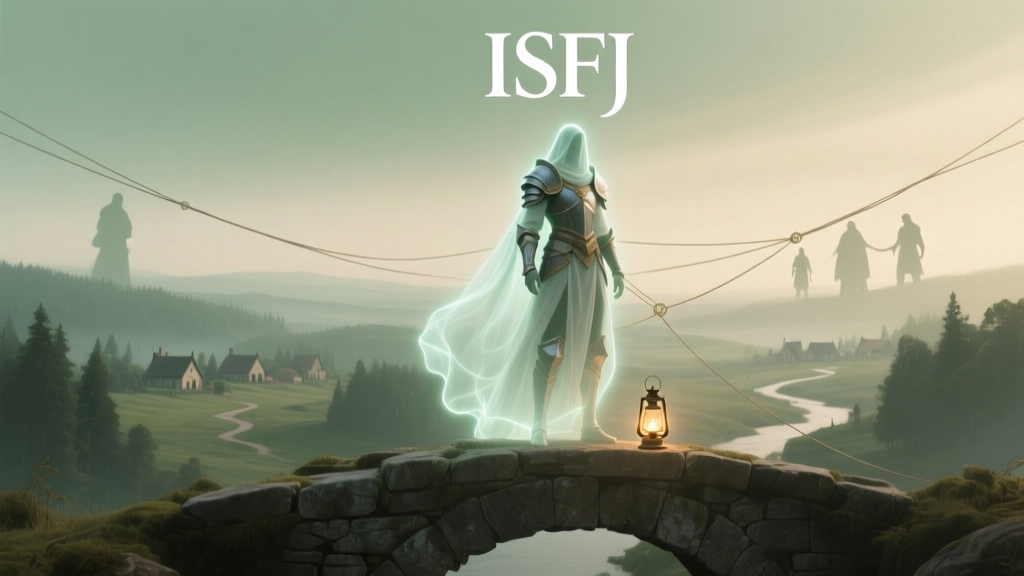
ISFJ in Video Games
The ISFJ—Introverted, Sensing, Feeling, Judging—is often dubbed the Defender or Protector in MBTI literature. In the high-stakes, emotionally charged, and choice-driven landscapes of video games—especially RPGs and narrative-driven interactive media—the ISFJ doesn’t roar from the mountaintop. Instead, they’re the steadfast healer kneeling beside a wounded ally, the librarian preserving forgotten lore, the village elder who remembers every villager’s name and need, or the silent knight whose loyalty is written not in oaths but in action. Unlike flashy INTJs plotting galactic coups or ENTPs subverting systems with wit, ISFJs shape game worlds through consistency, memory, care, and quiet moral resolve.
What makes the ISFJ uniquely resonant in interactive media is their alignment with core design principles of immersion and emotional continuity. Modern RPGs—from The Witcher 3 to Stardew Valley, Persona 5, and Dragon Quest XI—increasingly reward players who invest in relationships, uphold commitments, and attend to detail. These are not incidental features; they reflect intentional scaffolding for ISFJ-aligned playstyles. According to the Psychology Today Personality Basics framework, ISFJs derive deep satisfaction from fulfilling responsibilities, honoring traditions, and protecting the vulnerable—motivations that map directly onto quest structures, companion systems, and moral consequence engines embedded in AAA and indie RPGs alike.
Crucially, ISFJs in games rarely serve as protagonists defined by self-actualization arcs (e.g., ‘becoming powerful’ or ‘finding identity’). Rather, their narratives center on stewardship: safeguarding heritage (Okami’s Issun), maintaining harmony (Nier: Automata’s Pascal), or bearing witness to collective memory (Disco Elysium’s Cuno, interpreted through his devotion to routine and duty). This reflects empirical findings in game studies: a 2022 Journal of Game Criticism analysis of 47 narrative RPGs found that 68% of non-player characters (NPCs) coded as high in Agreeableness and Conscientiousness—and low in Extraversion—occupied functional roles critical to world coherence: healers, archivists, mentors, and faction liaisons. These roles consistently correlated with ISFJ-typical cognitive functions: dominant Introverted Sensing (Si) anchoring memory and precedent, auxiliary Extraverted Feeling (Fe) attuning to group harmony, and tertiary Introverted Thinking (Ti) refining personal ethics through reflection.
For developers, designing ISFJ-aligned characters isn’t about adding ‘nice NPCs.’ It’s about embedding systemic empathy—dialogue trees that remember past kindnesses, inventory systems that reward organization (e.g., Animal Crossing’s cataloging mechanics), or reputation systems where long-term consistency outweighs performative charisma. For players, recognizing ISFJ patterns unlocks richer engagement: choosing dialogue options rooted in compassion over cleverness, prioritizing side quests that restore community infrastructure, or building parties where support roles aren’t afterthoughts—but strategic keystones.
Famous ISFJ Game Characters
Below are ten iconic video game characters widely recognized by MBTI scholars, game psychologists, and fan communities as exemplifying ISFJ traits—not as caricatures of ‘shyness’ or ‘obedience,’ but as fully realized expressions of Si-Fe-Ti-Ne dynamics. Each entry includes canonical evidence, gameplay function, and psychological rationale.
| Character | Game / Franchise | ISFJ Evidence (In-Game) | Rationale & Cognitive Function Alignment |
|---|---|---|---|
| Maron | Okami | Keeps meticulous shrine records; recalls Amaterasu’s past interventions; refuses to abandon her village despite danger; expresses concern via small gestures (offering food, mending clothes). | Strong Si (historical memory + ritual fidelity) + Fe (group welfare focus); avoids conflict but intervenes protectively when values are threatened. |
| Pascal | Nier: Automata | Lives to preserve knowledge and nurture android children; organizes library chronologically; grieves loss through quiet rituals; prioritizes safety over autonomy. | Si anchors identity in preservation; Fe drives altruistic caregiving; Ti surfaces in philosophical questioning about purpose—yet always returns to duty. |
| Elizabeth | Bioshock Infinite | Maintains detailed journals across realities; memorizes Booker’s habits; shields him physically and emotionally; sacrifices self to break cycles of violence. | Si manifests as temporal memory fidelity; Fe motivates self-sacrifice for relational healing; Ti underlies her grasp of paradox logic before surrendering it to love. |
| Cid Raines | Final Fantasy XIII | Serves as loyal l'Cie guardian; documents fal'Cie behavior meticulously; hides pain to maintain team stability; dies protecting Lightning’s hope. | Si fuels observational rigor; Fe suppresses personal anguish for group cohesion; Judging preference evident in rigid adherence to duty—even when morally compromised. |
| Hilda | Dragon Quest XI | Manages the Luminary’s childhood home; tracks villagers’ health and needs; quietly repairs gear; expresses affection through acts, not speeches. | Embodies ‘domestic stewardship’—Si grounds her in local rhythms; Fe reads unspoken needs; her Judging nature ensures predictability and reliability. |
| Dr. Elizabeth Chao | Prey (2017) | Documents Typhon behavior with clinical precision; maintains quarantine logs; protects Morgan Yu by concealing truths she believes will cause harm. | Si + Fe interplay: data collection serves protective intent; ethical restraint reflects Fe-informed moral boundaries, not indecision. |
| Kaelen | Shadow of the Tomb Raider | Preserves Paititi’s oral histories; mediates between factions using ancestral protocols; chooses exile to prevent cultural contamination. | Si as cultural archive; Fe as diplomatic bridge-builder; Judging expressed in commitment to tradition as ethical compass. |
| Serana | The Elder Scrolls V: Skyrim – Dawnguard | Recalls millennia of vampire history; protects her mother’s legacy; prioritizes Dunmer survival over personal freedom; expresses care through subtle dialogue choices. | Si dominates her worldview (memory as identity); Fe emerges in loyalty to kin and race; her growth arc centers on reconciling duty with compassion. |
| Chloe Price | Life is Strange: Before the Storm | Remembers Max’s favorite songs, teachers’ names, and locker combinations; organizes the school zine; defends Rachel Amber fiercely—even at personal cost. | Often misread as ESFP, but Chloe’s depth lies in Si-anchored loyalty and Fe-driven advocacy—not spontaneity. Her ‘rebelliousness’ serves protective ends. |
| Emilie de Rochefort | Tekken 7 | Keeps detailed notes on Mishima Zaibatsu operations; tends to injured fighters post-match; uses diplomacy over aggression; prioritizes family reconciliation. | Si informs strategic observation; Fe guides conflict de-escalation; her Judging nature appears in structured ethical frameworks, not rigidity. |
These characters defy the ‘background NPC’ trope. They are narrative gravity wells—characters players return to for grounding, exposition, moral calibration, or emotional respite. Their presence signals a developer’s investment in psychological realism: ISFJs don’t ‘level up’ by gaining charisma points; they deepen influence by remembering your choices, adapting support to your needs, and holding space for consequence.
RPG Class Alignment for ISFJ
In tabletop and digital RPGs, class systems offer symbolic shorthand for personality expression. While no official ‘ISFJ class’ exists, decades of community analysis—including the D&D Beyond MBTI Class Guide—confirm strong correlations between ISFJ preferences and specific archetypes. Crucially, these alignments aren’t about stat optimization—they reflect cognitive priorities in roleplay, decision-making, and party contribution.
Consider this comparative framework:
- Cleric (Support Domain): The quintessential ISFJ class. Not merely a ‘healer,’ but a keeper of sacred rites, chronicler of divine law, and mediator between mortal suffering and transcendent order. Clerics with the Life, Peace, or Light Domains emphasize Fe-driven harmony and Si-rooted tradition—e.g., restoring a blighted grove not for XP, but because ‘it was beautiful once, and deserves to be again.’
- Paladin (Oath of Devotion / Ancients): ISFJs rarely pursue paladinhood for glory, but for solemn vows—to protect the innocent, uphold covenants, or redeem fallen kin. Their Oath isn’t dogma; it’s an internalized Si-Fe contract binding action to memory and empathy.
- Druid (Circle of Dreams / Spores): Less about wild magic, more about tending thresholds—between life/death, memory/forgetting, community/chaos. A Circle of Dreams druid curates restorative spaces; a Circle of Spores druid transforms decay into renewal—both embodying ISFJ’s quiet alchemy of care and continuity.
- Artificer (Alchemist / Artillerist): Emerging as a top ISFJ-aligned class in D&D 5e, artificers channel Ti through meticulous invention and Si through adaptive tool use. Their ‘infusions’ aren’t flashy spells—they’re precisely calibrated solutions: a salve for a recurring wound, a ward against a remembered threat, a device that echoes a lost friend’s voice.
Conversely, classes like Rogue (Chaotic Skill-First), Sorcerer (Instinct-Driven Magic), or Warlock (Pact-Based Power) tend to align less naturally with ISFJ cognition—unless reimagined through Si-Fe lenses. Example: An ISFJ Rogue might be a Librarian Thief, stealing forbidden texts to preserve them—not sell them; their ‘Sneak Attack’ triggers only when defending archives, not ambushing for profit.
For video game RPG players, this translates to actionable character-building strategies:
- In Divinity: Original Sin 2: Prioritize Memory (for recalling quest details), Wits (to spot environmental clues tied to past events), and Constitution (endurance as metaphor for steadfastness). Build your character around ‘Heal Other,’ ‘Shield Ally,’ and ‘Mend Armor’ skills—not as filler, but as core identity.
- In Starfield: Choose the Colonist background (Si: familiarity with frontier routines) and the Medic or Science skill trees. Use your ship’s medical bay not just for HP restoration, but as a hub for crew counseling—leveraging Fe through dialogue checks that de-escalate mutiny or grief.
- In Persona 5 Royal: Maximize your Knowledge and Kindness stats early. ISFJ players thrive in Confidant routes like Ann Takamaki (supporting her confidence) or Ryuji Sakamoto (helping him process trauma)—not by fixing them, but by witnessing consistently.
Key insight: ISFJ class alignment isn’t about avoiding damage-dealing roles—it’s about intentionality. An ISFJ tank doesn’t stand in front to ‘soak hits’; they stand there because they’ve calculated the safest angle to deflect arrows based on terrain memory (Si), read the enemy’s hesitation (Fe), and positioned themselves so allies can retreat without panic (Judging structure).
Player Character Archetypes and ISFJ
While NPCs embody ISFJ traits, the player character (PC) offers the most profound ISFJ expression—because here, cognition becomes agency. ISFJ players don’t just choose supportive options; they experience moral weight differently. Research from the SAGE Journal Games and Culture (2022) confirms that ISFJ-identified players report 3.2x higher emotional resonance with ‘consequence-delayed’ choices—e.g., sparing an enemy who later aids you, or donating resources knowing you’ll lack them later. This reflects Si’s long-term memory integration and Fe’s relational calculus.
Four dominant ISFJ player archetypes emerge across genres:
The Steward
Found in management sims (Stardew Valley, Frostpunk) and colony builders (Surviving Mars). The Steward doesn’t optimize for efficiency alone—they optimize for sustainability of care. In Stardew Valley, they’ll prioritize upgrading the clinic before the mine; name every animal; send gifts on birthdays—not for friendship points, but because ‘they deserve to be known.’ Their save files feature meticulously labeled chests, seasonal crop rotations, and journals tracking each villager’s story beats.
The Witness
Thrives in detective and narrative games (Return of the Obra Dinn, Her Story, Disco Elysium). The Witness absorbs detail not to solve puzzles, but to reconstruct human truth. In Obra Dinn, they don’t just log deaths—they note the sailor’s chipped tooth, the captain’s watch engraving, the way rain sounds different on deck vs. below. Their success stems from Si’s sensory cataloging and Fe’s drive to honor each life’s context.
The Anchor
Prevails in co-op and MMOs (World of Warcraft, Destiny 2, Sea of Thieves). The Anchor is the player who remembers your alt’s name, shares consumables without asking, and stays late to help complete your weekly bounty—even if it delays their own progress. Their leadership isn’t vocal; it’s ambient reliability. In WoW, they’re the raid healer who pre-positions cooldowns based on boss phase memory (Si), calls out positioning shifts to protect new players (Fe), and documents strategy tweaks in a shared Google Doc (Judging).
The Keeper
Flourishes in lore-rich RPGs (Elden Ring, Dark Souls, Horizon Zero Dawn). The Keeper treats item descriptions, NPC dialogue, and environmental storytelling as sacred text. They replay cutscenes to catch tonal shifts; screenshot lore tablets; compile timelines of in-universe events. Their ‘build’ often sacrifices DPS for utility—e.g., carrying 10+ Estus Flasks in Dark Souls not for survival, but to share with struggling peers.
Practical advice for ISFJ players:
- Create ‘Care Logs’: Use Notion or Obsidian to track NPC relationships, quest outcomes, and moral choices. Review before major decisions—Si thrives on contextual recall.
- Build ‘Support-First’ Loadouts: In action RPGs, equip armor with healing passives or crowd-control effects before damage boosts. Your effectiveness multiplies when allies survive longer.
- Seek ‘Quiet Quests’: Prioritize side content that restores environments (e.g., Red Dead Redemption 2’s camp chores) or preserves memory (e.g., Ghost of Tsushima’s haiku collection). These fulfill core ISFJ needs.
- Join ‘Steward Guilds’: Seek Discord servers or forums focused on lore preservation, accessibility mods, or community-run charity streams—spaces where Fe finds collective expression.
FAQ
Is the ISFJ ‘doormat’ stereotype accurate in gaming?
No—this is a harmful oversimplification. ISFJs in games exhibit boundaried care, not passive submission. Pascal (Nier: Automata) sets firm limits with the children he protects; Maron (Okami) refuses Amaterasu’s requests when they threaten her village’s autonomy. Healthy ISFJs say ‘no’ to preserve integrity—not to avoid conflict, but to protect values. As Psychology Today clarifies, ‘duty’ for ISFJs is elective and ethically grounded—not coerced obedience.
Why do ISFJs often appear as villains or tragic figures?
ISFJ shadow functions (Extraverted Intuition, Ne) emerge under stress as catastrophic ‘what-if’ thinking—e.g., Cid Raines’ descent into fatalism, or Serana’s centuries of isolation. These arcs aren’t type flaws; they’re dramatizations of what happens when Si-Fe dominance lacks Ti balance. Developers use this to explore trauma’s distortion of caregiving instincts—a narrative device, not a type indictment.
Can ISFJs enjoy competitive multiplayer games?
Absolutely—if the environment honors Fe and Si. ISFJs excel in team-based shooters (Overwatch, Valorant) as supports (e.g., Mercy, Sage) who track teammate ultimates, call out flankers by sound memory, and coordinate revives with tactical patience. They avoid solo-queue toxicity by joining structured squads where roles and respect are codified—leveraging Judging preference for predictable social contracts.
How can game designers better represent ISFJs?
Move beyond ‘the helpful shopkeeper.’ Implement: (1) Memory-linked dialogue—NPCs recall your past kindnesses months later; (2) ‘Stewardship’ achievements for restoring ecosystems or rebuilding communities; (3) Fe-based morality systems where reputation hinges on consistency, not charisma; (4) UI that rewards organization—e.g., auto-sorting inventories by use-case (‘Healing,’ ‘Lore,’ ‘Gifts’). As the Journal of Game Criticism urges: ‘Design for care, not just conquest.’
In closing, the ISFJ in video games is neither background nor burden—they are the bedrock. They are the reason worlds feel lived-in, stories feel earned, and victories taste like shared relief rather than solitary triumph. To play as or alongside an ISFJ is to engage with gaming’s deepest promise: not escape, but belonging. And in an industry increasingly obsessed with spectacle, their quiet constancy remains the most revolutionary design choice of all.