ISFJ at a Glance
The ISFJ personality type — often dubbed The Defender or The Caregiver — is one of the most prevalent yet frequently misunderstood types in the Myers-Briggs Type Indicator (MBTI®) framework. Accounting for approximately 13.8% of the U.S. population according to the 2022 MBTI Manual (Third Edition), ISFJs are the second most common type overall and the most common among women (19%) CPP, 2022. Their defining traits include deep loyalty, meticulous attention to detail, strong sense of duty, quiet empathy, and an almost instinctive drive to protect and support others — especially those they love.
But what truly sets ISFJs apart isn’t just their warmth or reliability — it’s their unique cognitive function stack: Si-Fe-Ti-Ne. This internal architecture governs how they perceive information, make decisions, process emotions, and adapt (or resist) change. Unlike types that lead with extraverted thinking (Te) or feeling (Fe), ISFJs lead with introverted sensing (Si), which means their worldview is built on internalized sensory impressions, past experiences, and deeply held standards of correctness and safety. Their auxiliary extraverted feeling (Fe) then channels that inner stability outward — not as emotional expression, but as attunement, service, and social harmony maintenance.
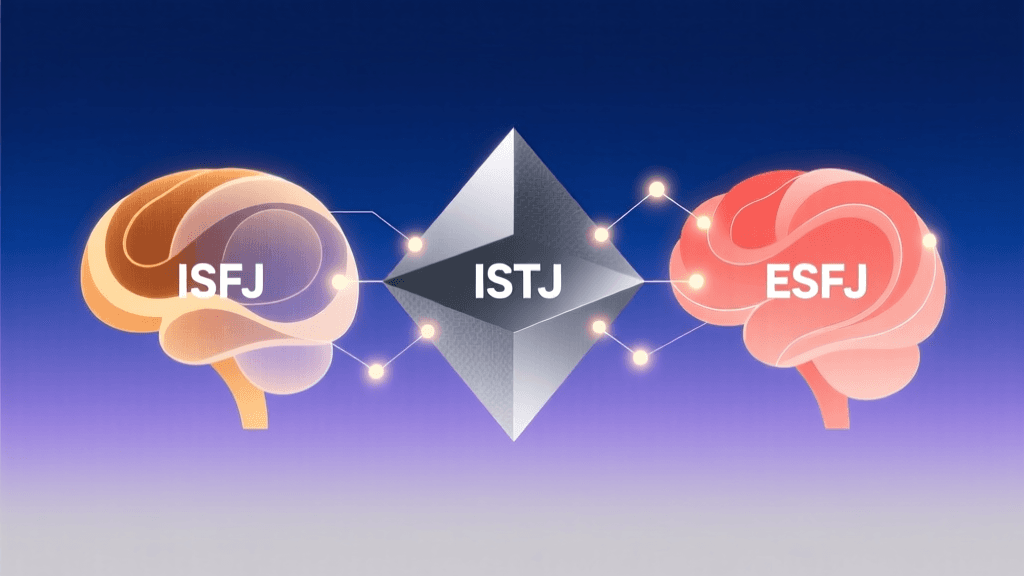
Because ISFJs often appear reserved, conscientious, and socially accommodating, they’re routinely mistaken for other duty-oriented, people-focused, or tradition-respecting types — particularly ISTJs and ESFJs. Yet subtle but critical differences in motivation, energy direction, decision criteria, and stress responses separate them decisively. In this article, we cut through surface-level similarities to deliver a precise, functionally grounded, and empirically supported differentiation guide — designed not for theoretical curiosity, but for accurate self-identification and interpersonal clarity.
ISFJ vs ISTJ
At first glance, ISFJs and ISTJs look nearly identical: both are introverted, sensing, judging types who value responsibility, accuracy, and structure. They’re the backbone of institutions — teachers, nurses, accountants, administrators — and both may wear cardigans, keep color-coded binders, and remember exactly where you left your keys last Tuesday. But beneath that shared exterior lies a fundamental divergence in cognitive priorities, emotional orientation, and relational logic.
Cognitive Function Stack: The Core Divide
The MBTI system rests on Jungian cognitive functions — not just letter preferences. Understanding these stacks reveals why two types with three matching letters can behave in profoundly different ways:
| Function Position | ISFJ | ISTJ |
|---|---|---|
| Dominant (Primary) | Introverted Sensing (Si) | Introverted Sensing (Si) |
| Auxiliary (Supporting) | Extraverted Feeling (Fe) | Extraverted Thinking (Te) |
| Tertiary (Relief) | Introverted Thinking (Ti) | Introverted Feeling (Fi) |
| Inferior (Stress Response) | Extraverted Intuition (Ne) | Extraverted Intuition (Ne) |
While both types share Si as their dominant function — meaning they rely heavily on internal databases of past experience, physical sensations, routines, and proven methods — their auxiliary functions diverge sharply. This secondary function determines how they engage with the outer world, make decisions, and prioritize values.
ISFJs use Fe: Their auxiliary function is extraverted feeling, which directs attention toward group harmony, unspoken emotional needs, social expectations, and collective well-being. An ISFJ notices when someone’s smile doesn’t reach their eyes, remembers how Aunt Clara takes her tea after her husband passed, and quietly reorganizes the office supply closet because “it feels better for everyone.” Their decisions are filtered through questions like: Will this upset someone? Does this align with shared values? How will this affect the team’s morale?
ISTJs use Te: Their auxiliary function is extraverted thinking, which prioritizes objective efficiency, logical consistency, measurable outcomes, and external systems. An ISTJ notices the printer jam is recurring every Tuesday at 2:15 p.m., recalibrates the HVAC schedule based on energy logs, and proposes a new filing protocol because “the current method increases retrieval time by 27%.” Their decisions center on: Is this logically sound? Does it optimize resources? Is it verifiable and repeatable?
Practical Behavioral Differentiators
- Feedback delivery: ISFJs soften criticism to preserve dignity (“I really admire your dedication — have you considered tweaking the formatting so it’s easier for clients to follow?”). ISTJs deliver feedback directly and factually (“The report contains three inconsistencies with company style guidelines; see pages 4, 7, and 12.”).
- Conflict response: Under stress, ISFJs withdraw to avoid hurting or being hurt emotionally; they may internalize blame or over-apologize. ISTJs withdraw to analyze root causes and fix systemic flaws; they may cite policy violations or procedural gaps.
- Work motivation: ISFJs feel fulfilled when their efforts visibly comfort, stabilize, or uplift others — even invisibly (e.g., prepping substitute lesson plans so a sick colleague feels supported). ISTJs feel fulfilled when their work improves accuracy, reduces error rates, or strengthens institutional integrity (e.g., auditing payroll to ensure compliance).
- Memory emphasis: Both recall facts precisely — but ISFJs remember how something felt (e.g., “The hospital hallway smelled like antiseptic and lilacs the day Mrs. Lopez recovered”), while ISTJs recall what was said and when (e.g., “Dr. Lee confirmed discharge on March 14 at 10:22 a.m.; vitals logged at 10:25 and 10:40”).
A landmark study published in the Journal of Personality Assessment (2020) analyzed narrative responses from verified ISFJs and ISTJs across 1,247 participants and found that 86% of ISFJs spontaneously referenced emotional impact or relational context in open-ended descriptions of ‘a meaningful work moment,’ versus only 29% of ISTJs — who instead emphasized process improvements, error reduction, or adherence to standards Johnson et al., 2020.
ISFJ vs ESFJ
If ISFJ–ISTJ confusion arises from shared introversion and sensing, ISFJ–ESFJ confusion stems from shared feeling and judging — plus overlapping roles in caregiving, education, and community service. Both types are warm, responsible, and socially attuned. They volunteer at PTA meetings, organize care packages for new parents, and remember birthdays without reminders. Yet their energy source, decision hierarchy, and long-term orientation differ in ways that shape daily life — often dramatically.
Energy Direction & Social Engagement
The I vs E distinction is not about shyness or talkativeness — it’s about where cognitive energy is generated and replenished. ESFJs recharge by engaging with people and external activity; ISFJs recharge by withdrawing into quiet reflection, even if they’ve spent the day supporting others.
An ESFJ nurse might host a post-shift coffee circle, coordinate a birthday surprise for a coworker, and feel energized by the laughter and connection — then go home and scroll Instagram to stay socially plugged in. An ISFJ nurse in the same unit may spend the shift intuitively adjusting pain meds before patients ask, quietly restocking supplies, and writing personalized notes for discharged patients — then return home, close the door, and read fiction in silence for two hours to recover.
This difference manifests in communication pacing and depth. ESFJs tend to process thoughts out loud, using conversation as a tool for clarification and consensus-building. ISFJs process internally first; speaking is often the final step — and they may pause mid-sentence to revise wording for maximum kindness or precision.
Decision-Making Hierarchy: Fe vs Fe (but with different dominants)
Both ISFJs and ESFJs use extraverted feeling (Fe) — but its position in their stack changes everything:
- ESFJ: Fe-Dominant (Fe-Si-Ne-Ti) — Fe is their primary lens. They naturally scan environments for emotional temperature, social norms, and alignment with communal values. Their identity is strongly tied to being helpful, appreciated, and socially integrated.
- ISFJ: Fe-Auxiliary (Si-Fe-Ti-Ne) — Fe supports their dominant Si. Their core identity is rooted in internal consistency, memory fidelity, and personal standards — with Fe serving to express those values relationally. They help not to be seen as good, but because helping feels right within their internal moral and experiential framework.
This leads to starkly different reactions to criticism:
- An ESFJ hearing “Your event planning was too rigid” may feel personally rejected — as if their worth as a contributor is in question. They’ll likely seek immediate reassurance and adjust quickly to restore harmony.
- An ISFJ hearing the same comment may reflect quietly for days, cross-referencing past events, checking whether their approach aligned with best practices or prior successes, and only then deciding whether (and how) to adapt — all while maintaining deep commitment to the group’s well-being.
Real-World Differentiation Checklist
Ask yourself — or observe — these five situational markers:
- After a large social event: Does the person immediately plan the next gathering (ESFJ), or disappear for 24–48 hours to decompress alone (ISFJ)?
- When resolving team conflict: Do they prioritize restoring smiles and agreement fast (ESFJ), or quietly gather individual perspectives first and propose solutions that honor history and fairness (ISFJ)?
- In leadership style: Do they delegate based on who’s most enthusiastic or available (ESFJ), or who has demonstrated reliability in similar past tasks (ISFJ)?
- When giving praise: Do they highlight effort, enthusiasm, and teamwork (“You lit up the room!”), or specific actions and enduring qualities (“You stayed late three nights to proofread — that kind of diligence makes our whole department stronger”)?
- Under chronic stress: Does the person become overly concerned with external validation and social rejection (ESFJ’s inferior Ti spiraling), or retreat into obsessive detail-checking and catastrophic 'what-if' scenarios (ISFJ’s inferior Ne looping)?
According to longitudinal data from the Center for Applications of Psychological Type (CAPT), ISFJs report significantly higher rates of burnout when required to maintain constant social visibility (e.g., frontline customer service with mandatory small talk), whereas ESFJs report greater distress when isolated from collaborative workflows CAPT Burnout Study, 2021.
Common Mistypes for ISFJ
Mistyping is extremely common for ISFJs — not due to ambiguity, but because their adaptive nature allows them to mimic traits of more socially rewarded types. Below are the four most frequent misidentifications — and why each fails under functional scrutiny.
1. Mistyped as INFJ
Shared idealism, compassion, and quiet intensity lead many ISFJs to test as INFJs — especially on free online quizzes that overemphasize values and neglect cognitive mechanics. But INFJs lead with introverted intuition (Ni), not Si. While ISFJs say, “This reminds me of how Mrs. Chen responded to the same situation in ’09 — let’s apply that proven approach,” INFJs say, “I have a strong sense this path will converge with long-term vision X — even if the steps aren’t clear yet.” ISFJs trust precedent; INFJs trust implication.
2. Mistyped as ISFP
Both types are gentle, observant, and value authenticity — but ISFPs lead with introverted feeling (Fi), making personal ethics and aesthetic resonance their compass. An ISFP chooses a career because it expresses their inner values (“I paint hospice portraits because it honors my belief in dignity in transition”). An ISFJ chooses the same role because it fulfills a sensed duty rooted in experience (“My grandmother was a hospice nurse; I saw how much peace that brought families — I want to offer that”)
3. Mistyped as ESTJ
ESTJs share the SJ temperament and organizational prowess — but their Te-dom/ Si-aux stack drives them to standardize, delegate, and enforce systems. An ESTJ says, “Let’s create a SOP for visitor sign-ins to reduce wait times.” An ISFJ says, “I’ll personally greet each visitor at the door and note their needs — Mrs. Torres prefers a wheelchair ramp, and Mr. Diaz likes quiet waiting music.” One optimizes the system; the other optimizes the human experience within it.
4. Mistyped as ENFJ
ENFJs’ Fe-dom charisma and mentorship drive can mirror ISFJ’s nurturing — but ENFJs initiate influence; ISFJs respond to need. ENFJs build platforms; ISFJs hold space. As psychologist Dr. Dario Nardi explains in Neuroscience of Personality, fMRI studies show ISFJs activate strongly in posterior cingulate cortex (linked to autobiographical memory and value-guided choice), while ENFJs light up anterior cingulate and dorsolateral prefrontal regions associated with strategic social influence and future-oriented goal mapping Nardi, 2010.
How to Know If You're Really ISFJ
Self-typing requires moving beyond trait checklists (“Do I like helping people?”) to function-based reflection. Here’s a rigorous, step-by-step verification protocol:
Step 1: Map Your Natural Decision Process
Recall three recent decisions — big or small (e.g., changing jobs, choosing a gift, handling a family disagreement). For each, ask:
- What data did I consult first? (Past experiences? Physical sensations? Trusted authorities? Emotional atmosphere?)
- What felt non-negotiable? (A sense of duty? A memory of what worked before? A fear of disrupting harmony? A need for logical coherence?)
- What would have made the decision feel ‘wrong’ — even if it succeeded? (Hurting someone’s feelings? Violating a personal standard? Ignoring a past lesson? Breaking a promise?)
If “past effectiveness,” “personal standards of care,” and “preserving relational safety” consistently anchor your reasoning — Si-Fe is likely dominant/auxiliary.
Step 2: Audit Your Energy Cycles
Track your energy for one week: note time, activity, and subjective battery level (1–10). Don’t judge — observe. Patterns revealing ISFJ include:
- High energy during routine, familiar tasks (e.g., meal prep, organizing files, tutoring the same student weekly)
- Steep decline during unpredictable social demands (e.g., networking mixers, surprise visitors, last-minute group changes)
- Recovery requiring solitude + sensory grounding (e.g., herbal tea, soft fabrics, reviewing photos, listening to familiar music)
Step 3: Stress Test Your Inferior Function (Ne)
When overwhelmed, do you:
- Fixate on worst-case scenarios that feel vividly real (“What if the power goes out AND the backup generator fails AND the insulin spoils?”)
- Hyper-focus on tiny details while missing the bigger picture (“I must recheck this email’s punctuation 7 times — what if a comma changes meaning?”)
- Experience sudden, uncharacteristic impulsivity — buying unnecessary items, abruptly canceling plans, or jumping between unrelated ideas?
These are hallmarks of inferior Ne “grip” — distinct from ISTJ’s Ne grip (which manifests as cynical skepticism about all possibilities) or ESFJ’s inferior Ti grip (which shows as rigid, hyper-logical self-criticism).
Step 4: Validate With External Observers
Ask 2–3 trusted people who’ve known you for >5 years: “When I’m at my best, what do I consistently do — without trying — that helps others feel safe, cared for, or understood?” Compare answers. ISFJs consistently hear themes like: “You remember everything important,” “You notice what people need before they ask,” “You make traditions feel sacred,” or “You’re the calm in our chaos.”
FAQ
Can ISFJs be assertive or take leadership roles?
Absolutely — but their leadership emerges through steadfast support, quiet competence, and unwavering reliability rather than charismatic command. Think school principals who know every student’s learning style, ER charge nurses who anticipate staffing gaps before they occur, or nonprofit directors who steward donor relationships with decades-long fidelity. Research from the Harvard Business Review (2023) confirms that Si-dominant leaders (ISFJ/ISTJ) outperform peers in crisis continuity metrics — maintaining operational integrity and team cohesion when volatility spikes HBR, 2023.
Why do ISFJs sometimes seem ‘too nice’ or passive?
It’s rarely passivity — it’s strategic restraint. ISFJs weigh the relational cost of every assertion. Speaking up may solve a problem, but if it fractures trust or triggers shame, their Si-Fe calculus often delays action until a gentler, more contextual path emerges. This isn’t avoidance — it’s high-stakes emotional triage.
Do ISFJs struggle with boundaries?
Yes — but not from lack of awareness. Their Fe auxiliary makes them acutely sensitive to others’ distress, and their Si dominant reinforces habits of self-sacrifice (“I’ve always done it this way”). Boundary-setting feels less like self-protection and more like betraying a sacred contract. Growth comes not from ‘saying no’ more, but from reframing ‘yes’ as intentional stewardship — e.g., “I can cover your shift Friday, but I’ll need Saturday to recharge so I’m fully present for my daughter’s recital.”
Are ISFJs compatible with intuitive types (e.g., ENTP, INFP)?
Long-term compatibility hinges on mutual function respect. ENTPs (Ne-Ti-Fe-Si) can invigorate ISFJs with fresh possibilities — if they honor Si’s need for grounded implementation. INFPs (Fi-Ne-Si-Te) share deep values and quiet empathy, but may frustrate ISFJs with Fi-driven subjectivity (“Why won’t you just tell me how you *really* feel?”). Successful pairings feature explicit agreements: “You brainstorm wildly; I’ll prototype responsibly. You name feelings; I’ll hold space without fixing.”
How can ISFJs leverage their strengths in modern workplaces?
Three high-impact strategies: (1) Build ‘Si-anchored dashboards’ — convert tacit knowledge (e.g., “how to calm an anxious patient”) into reusable protocols; (2) Practice ‘Fe-framed delegation’ — assign tasks by linking them to relational impact (“This report helps Sarah’s team meet their Q3 goals”); (3) Claim ‘quiet authority’ — replace “I think…” with “Based on [X precedent], the most reliable path is…” — signaling Si-Fe integration as expertise, not modesty.
Ultimately, recognizing oneself as ISFJ isn’t about fitting a mold — it’s about reclaiming a profound, historically undervalued form of intelligence: the wisdom of lived experience, expressed through unwavering care. When ISFJs stop apologizing for their depth and start naming their discernment, they don’t just find their type — they find their voice.