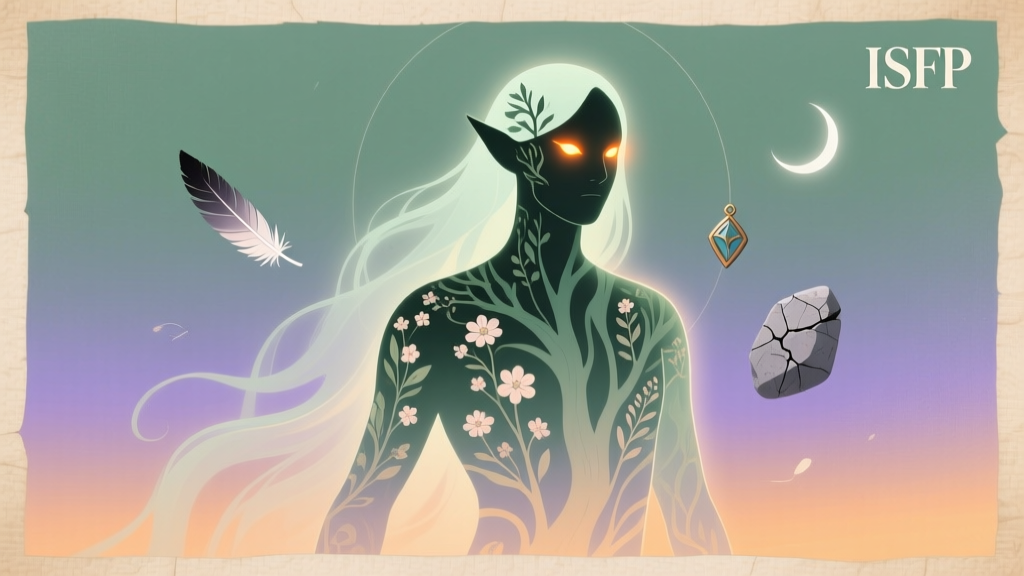
ISFP in Mythology and Folklore
The ISFP — often dubbed the Adventurer, Composer, or Artist — is one of the most quietly resonant personality types in the Myers-Briggs Type Indicator (MBTI) framework. With dominant Introverted Feeling (Fi) and auxiliary Extraverted Sensing (Se), ISFPs are deeply attuned to personal values, aesthetic harmony, and immediate sensory experience. They act with grace under pressure, respond authentically to injustice, and express themselves through embodied artistry — whether through dance, craft, combat, or caregiving. While popular culture often highlights extroverted or strategic archetypes as 'heroic', the ISFP embodies a subtler, more visceral form of heroism: one rooted in presence, integrity, and reverence for life’s fleeting beauty.
This orientation makes the ISFP profoundly visible — yet frequently misread — in mythological, folkloric, and fantastical traditions worldwide. Unlike the commanding Zeus or the calculating Loki, the ISFP archetype rarely seeks thrones or titles. Instead, they appear as the wounded healer, the silent guardian of sacred groves, the artisan who forges divine weapons not for conquest but for balance, or the exile who returns home bearing truth rather than trophies. Their power lies not in rhetoric or rule, but in fidelity — to nature, to kin, to craft, and to conscience.
Mythologist Joseph Campbell observed that the monomyth — the ‘Hero’s Journey’ — is not exclusive to bold warriors or prophesied kings; it also belongs to those who descend into darkness not to conquer, but to witness, restore, and reintegrate. As scholar Clarissa Pinkola Estés writes in Women Who Run With the Wolves, “The wild woman archetype is not about ferocity alone — she is also the keeper of thresholds, the weaver of dreams, the one who remembers what the land remembers.” This dual capacity — for fierce protection and tender remembrance — is quintessentially ISFP.
Folklore further affirms this pattern. Across continents, oral traditions preserve figures whose strength emerges through restraint, whose courage is measured in compassion, and whose legacy is inscribed not on stone monuments but in seasonal rhythms, hand-stitched talismans, and whispered lullabies. These are not side characters — they are the emotional and ethical bedrock upon which entire cosmologies rest.
Famous ISFP Mythological Figures
Below are eight mythological and legendary figures whose narratives, motivations, symbolic roles, and behavioral patterns align robustly with ISFP cognitive functions — particularly Fi-driven authenticity, Se-informed responsiveness, tertiary Introverted Intuition (Ni) for intuitive foresight in crisis, and inferior Extraverted Thinking (Te) manifesting as occasional self-doubt or overcorrection under stress.
| Figure | Culture/Tradition | Core ISFP Expression | Fi-Value Anchor | Se-Moment of Embodied Action |
|---|---|---|---|---|
| Pan | Greek | Wild, sensual deity of rustic music, shepherds, and untamed nature | Cherishes freedom, spontaneity, and unmediated connection with earth and animals | Plays his syrinx mid-leap across mountain cliffs; his panic (‘panic’) arises not from fear, but from violation of sacred space |
| Saci-pererê | Brazilian Tupi-Guarani folklore | One-legged trickster spirit who smokes a pipe, wears a red cap, and protects forests | Values ecological reciprocity and playful justice — punishes loggers but rewards respectful gatherers | Appears suddenly in rustling leaves or sudden breezes; vanishes when disrespected, reappearing only when balance is restored |
| Yuki-onna | Japanese folklore | Ghostly snow-woman who appears in blizzards — beautiful, silent, lethal to oath-breakers | Honors promises above all; her wrath is precise, personal, and value-bound | Materializes from freezing mist, moves without sound, and freezes victims mid-breath — an act of instantaneous, sensory-perfect judgment |
| Danu | Celtic (Irish) | Mother goddess of rivers, fertility, wisdom, and poetic inspiration | Embodies nurturing sovereignty — her power flows like water, adapts without yielding core identity | Her presence is felt in the shimmer of river surfaces, the scent of bog myrtle, the weight of dew on spiderwebs — all Se-grounded manifestations |
| Epona | Gaulish/Celtic | Protectress of horses, donkeys, and mules; patron of riders, stable-hands, and travelers | Values loyalty, physical well-being, and interspecies kinship — no grand dogma, only daily care | Depicted riding sidesaddle or feeding foals; her shrines were placed at crossroads and stables — liminal, tactile spaces |
| Nüwa | Chinese mythology | Creator goddess who mends the sky with five-colored stones and fashions humanity from yellow clay | Acts from deep empathy — repairs cosmic rupture not for glory, but because suffering is intolerable to her inner compass | Rolls clay between her palms, breathes life into each figure; her hands — not spells or decrees — enact creation and restoration |
| Leshy | Slavic folklore | Forest spirit who shifts size, mimics voices, and guards woodland boundaries | Upholds ecological sovereignty — permits passage only to those who ask respectfully and leave offerings | Reveals himself through snapped twigs, sudden silence among birds, or the scent of pine resin — all Se-coded environmental cues |
| Kokopelli | Ancestral Puebloan (Southwest US) | Humpbacked flute player associated with fertility, agriculture, and travel | Spreads joy and abundance not through command, but resonance — music as embodied ethics | His flute’s vibration is said to awaken seeds underground; his hump carries rain clouds — action inseparable from sensory harmony |
What unites these figures is not divine rank or narrative centrality, but moral tactility: their ethics are lived, not preached; their power is channeled through the body, the land, and handmade objects. Pan doesn’t legislate pastoral ethics — he is the pasture’s pulse. Yuki-onna doesn’t issue warnings — her very appearance is the consequence. This is Fi-anchored agency: identity and action fused.
Anthropologist Mary Douglas, in Purity and Danger, notes that many ‘liminal’ beings — those dwelling at thresholds like forests, rivers, or winter — serve as moral barometers in folklore. They do not enforce rules, but make violations sensorially undeniable. That function — holding space, calibrating consequence, restoring equilibrium through presence — is deeply ISFP.
ISFP Fantasy Literature Archetypes
Fantasy literature, especially post-Tolkien worldbuilding, has inherited and refined these mythic blueprints — translating ancient ISFP motifs into modern character arcs with psychological depth. Unlike the ‘Chosen One’ (often ENTJ or INFJ), the ISFP protagonist rarely accepts destiny with fanfare. Their journey begins with resistance — a quiet ‘no’ whispered before stepping forward.
Consider Aragorn in The Lord of the Rings. Though often miscategorized as ESTJ due to his leadership, Tolkien’s text reveals his ISFP core: his deepest loyalty is to Arwen (Fi), not Gondor’s crown; he heals with herb-lore (Se + Ni), not royal decree; his authority emerges only after years of wandering, listening, and observing — not strategizing. As scholar Tom Shippey observes in The Road to Middle-earth, “Aragorn’s kingship is earned not by birthright alone, but by sustained, embodied fidelity — to people, places, and promises.” That fidelity is Fi in motion.
Similarly, Lyra Belacqua in Philip Pullman’s His Dark Materials trilogy exemplifies ISFP development. Her daemon Pantalaimon shifts forms until adolescence — mirroring Fi’s evolving self-knowledge — and her greatest acts (freeing the Spectres’ captives, choosing love over cosmic duty) arise from gut-level conviction, not ideology. She doesn’t debate metaphysics; she feels the lie in authoritarian theology and acts accordingly.
Other enduring ISFP archetypes in fantasy include:
- The Wounded Healer: A character whose trauma has honed empathic perception and hands-on healing skills — e.g., Adolin Kholin in The Stormlight Archive, whose artistic sensitivity and protective fury stem from witnessing his mother’s abuse.
- The Silent Guardian: A protector who speaks little but acts decisively in defense of vulnerable spaces — e.g., Hester Shaw in Mortal Engines, whose scavenger pragmatism and fierce maternal instinct define her arc.
- The Craftsman-Rebel: An artisan whose creations become tools of liberation — e.g., Toph Beifong in Avatar: The Last Airbender, whose seismic sense and earthbending style (rooted in Southern Praying Mantis kung fu) reflect Se-Ni synthesis — perceiving truth through vibration, shaping reality through grounded movement.
These archetypes share a narrative grammar: their growth occurs through doing, not debating; their turning points involve tactile choices (mending a broken sword, choosing which child to shield, carving a new amulet); and their ‘power-ups’ are always integrated with identity — never externalized as magical inheritance or sudden enlightenment.
For writers and readers alike, recognizing the ISFP fantasy archetype offers practical insight. If you’re developing an ISFP character, avoid giving them lengthy ideological monologues. Instead, show their values through:
- Material choices: What do they carry? Repair? Refuse to discard? (e.g., a frayed cloak lined with fox fur, a knife whittled from antler)
- Sensory anchors: What scents, textures, or sounds calm or alert them? (e.g., the smell of wet stone before rain, the weight of a particular arrowhead)
- Boundary rituals: How do they mark sacred space or signal respect? (e.g., leaving a sprig of rosemary at a threshold, bowing only to elders who’ve tended orchards)
This specificity builds authenticity — and honors the ISFP’s core truth: that meaning is made in the making.
Legendary Heroes, Creatures and ISFP
While gods and demigods dominate mythic discourse, ISFP energy thrives most vividly in legendary heroes and creatures whose power is relational, adaptive, and rooted in place. These beings rarely appear in pantheons — they dwell in margins, interstices, and ecosystems.
The Green Man, a foliate head motif found across medieval European cathedrals and Celtic carvings, is perhaps the purest ISFP legendary figure. Not a deity but a symbol — a face woven from oak leaves, ivy, or vines, exhaling growth. He does not command seasons; he is the season’s breath. His mouth opens not to speak doctrine, but to release spores, seeds, and sighs. Art historian Emma J. Wells notes in Medieval Church Painting that Green Man imagery surged during periods of ecological anxiety — serving as a non-didactic reminder of human embeddedness in natural cycles. That quiet, persistent insistence on interdependence? Fi-Se in symbiotic form.
The Selkie of Orkney and Faroese lore embodies ISFP duality: seal-skin (Se: fluid, sensory, adaptive) and human form (Fi: intimate, relational, value-bound). Her power lies in transformation — not domination. When she sheds her skin, she doesn’t gain magic; she gains vulnerability, love, grief. Her stories warn not against change, but against theft of autonomy — a core ISFP boundary. As folklorist Jennifer S. H. Brown documents in Strangers to Relatives, selkie narratives consistently center consent, reciprocity, and the sanctity of self-possession — themes that resonate with Fi’s non-negotiable inner compass.
The Baku, a Japanese dream-eating creature with the body of a tapir, trunk of an elephant, eyes of a rhinoceros, and tail of an ox, operates as an ISFP ‘shadow healer’. It does not judge nightmares; it consumes them — transforming terror into stillness. Its myth arose during Heian-era insomnia epidemics, offering not explanation, but embodied relief. Modern sleep researchers at the Sleep Foundation affirm that somatic interventions — weighted blankets, breathwork, tactile grounding — often outperform cognitive strategies for trauma-related insomnia. The Baku’s ancient logic — meet suffering where it lives (in the body) — remains clinically sound.
Even legendary creatures reflect ISFP cognition. Consider the Phoenix: often misread as a symbol of rebirth-as-triumph, its true ISFP resonance lies in its repetition. It does not ascend once to immortality; it cycles — burns, rests in ash, rises — embodying Ni-tertiary patience and Fi-acceptance of necessary endings. As classicist Dorian Gieseler Greenbaum writes in The Solar Zodiac in Antiquity, “The Phoenix’s fire is not punitive; it is distillatory — reducing existence to its essential, unadorned truth before renewal.” That commitment to essence over ego? Pure Fi.
Practically, ISFP readers and creators can draw from these legends to cultivate resilience:
- Adopt a ‘Green Man Practice’: Spend 10 minutes daily observing one plant — noting texture, scent, light-reflection, insect interaction — without naming or judging. This grounds Se and strengthens Fi’s connection to non-human sentience.
- Create a Selkie Boundary Ritual: Identify one personal boundary (e.g., ‘I will not check work email after 7 p.m.’). Sew or carve a small object (a wooden token, embroidered cloth) representing that boundary. Place it where you’ll see it at the threshold of your workspace — a tangible Se-anchor for Fi-integrity.
- Invoke the Baku Before Sleep: Write down one worry on paper, then safely burn or tear it — not to erase, but to transform its energy. Say aloud: “I release what I cannot hold tonight.” This ritual leverages ISFP’s strength in symbolic, sensory closure.
These are not ‘quick fixes’ — they are practices of fidelity. Like the figures they mirror, ISFPs heal not by fixing the world, but by tending its fractures with hands that know the weight of soil, the grain of wood, the pulse beneath skin.
FAQ
Why aren’t ISFPs commonly portrayed as ‘main heroes’ in mythology?
They are — but their heroism is structurally different. Where dominant cultural myths valorize conquest, prophecy, or law-giving (functions aligned with Te or Fe), ISFP heroism is relational maintenance: holding space, preserving memory, healing wounds, sustaining craft. Ancient scribes rarely recorded such acts as ‘epic’ — yet temples bore Green Man carvings, households kept selkie tales alive orally, and herbalists preserved Nüwa’s clay-medicine lineages. As historian of religion Mircea Eliade argues in The Sacred and the Profane, the ‘profane’ — daily, embodied, cyclical acts — is where the sacred most densely resides. ISFPs inhabit that density.
Can villains be ISFP? How does unhealthy ISFP manifest mythologically?
Yes — but rarely as tyrants or schemers. Unhealthy ISFPs appear as figures consumed by wounded Fi: the Trapped Artist (like the Greek sculptor Pygmalion, whose obsession with his ivory Galatea curdles into narcissistic control), or the Isolated Guardian (like the Norse draug — a reanimated corpse guarding burial mounds, embodying Fi turned rigid, Se turned hyper-vigilant). These figures lose connection to external harmony (inferior Te distortion) and begin enforcing subjective values as universal law. Recovery, in myth, always involves re-engagement with community or nature — e.g., Pygmalion’s prayer to Venus restores relational balance.
How do ISFPs relate to other MBTI types in mythic pairings?
ISFPs often form catalytic duos with types that complement their functions. With ENFJs (e.g., Athena and Odysseus), ISFPs provide grounded execution to visionary strategy. With ISTPs (e.g., Artemis and Orion), they share Se mastery but diverge in values — Artemis (Fi) protects wild autonomy; Orion (Ti) hunts for mastery. With INFJs (e.g., Merlin and Lancelot), ISFPs anchor the INFJ’s Ni visions in sensory reality — Lancelot’s physical prowess and moral anguish make Camelot’s ideals felt, not just spoken. These dynamics are documented in Jungian analyst John Beebe’s Understanding Consciousness Through Type.
What’s the most actionable takeaway for real-world ISFPs inspired by these archetypes?
Claim your mythic role — not as exception, but as lineage. You are not ‘too quiet’ for leadership; you are the Green Man in your community garden, the Selkie setting boundaries at work, the Baku transforming anxiety into rest. Start small: choose one ISFP-aligned practice this week (e.g., sketching a local bird daily, planting native seeds, crafting a gratitude token). Track how it affects your sense of alignment — not productivity. As the American Psychological Association confirms, resilience grows through consistent, values-congruent action — not grand gestures. Your myth is already being written, one embodied choice at a time.
Finally, consider this: In Norse myth, when Ragnarök ends, two humans — Líf and Lífþrasir — survive hidden in Hoddmímis holt, nourished by morning dew. They repopulate the world — not as rulers, but as witnesses, cultivators, and keepers of memory. No title. No throne. Just presence, care, and continuity. That, too, is ISFP heroism — eternal, essential, and quietly world-saving.
For deeper exploration of personality and myth, see the Myers & Briggs Foundation’s research on type and narrative archetypes, and the Jung Society’s archives on archetypal psychology and folklore integration.