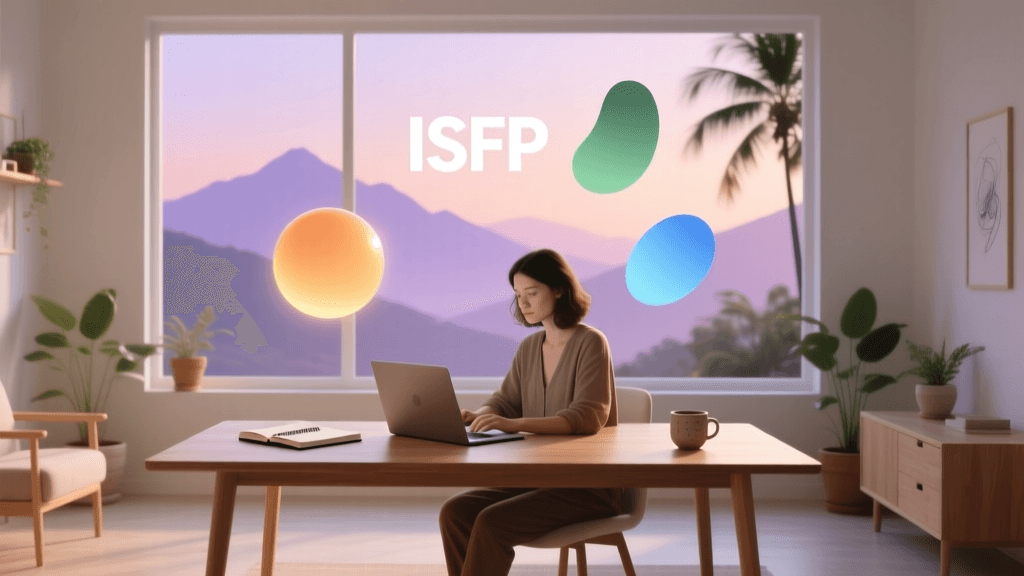
ISFP Remote Work Profile
The ISFP personality type — known as the Adventurer or Composer in MBTI® nomenclature — is characterized by Introversion (I), Sensing (S), Feeling (F), and Perceiving (P). With a dominant function of Introverted Feeling (Fi) and auxiliary Extraverted Sensing (Se), ISFPs are deeply attuned to their inner values, present-moment experiences, aesthetics, and sensory surroundings. These traits converge to create a distinctive remote work profile: one that prizes autonomy, authenticity, flexibility, and environmental harmony over rigid schedules, hierarchical oversight, or abstract theoretical frameworks.
According to the Myers & Briggs Foundation, ISFPs make up approximately 8.8% of the U.S. population — a sizable cohort whose professional needs have long been underserved by traditional office culture. Yet with the global acceleration of remote work — 35% of U.S. workers now work remotely at least part-time (Pew Research Center, 2023) — ISFPs are uniquely positioned to leverage their natural strengths in distributed environments.
Unlike types driven by Extraverted Thinking (Te) or Introverted Intuition (Ni), ISFPs don’t seek remote work primarily for efficiency gains or strategic foresight. Instead, they pursue it for value alignment, sensory comfort, and freedom to respond authentically — to people, projects, and places. Their preference for low-pressure collaboration, hands-on creativity, and spontaneous adaptation makes them exceptional candidates for location-independent careers in design, craft-based entrepreneurship, wellness coaching, freelance writing, music production, and ecological education.
However, this doesn’t mean remote work is effortless for ISFPs. Their Fi dominance can lead to over-personalization of feedback, difficulty asserting boundaries with clients or managers, and hesitation to engage in synchronous video calls where perceived judgment feels high. Meanwhile, their Se auxiliary craves tactile stimulation and real-world engagement — a need easily starved in poorly designed home offices or monotonous virtual routines. Understanding these nuances is essential to unlocking sustainable, joyful remote work for ISFPs.
Ideal Home Office Setup for ISFP
An ISFP’s home office isn’t just functional — it’s an extension of identity and emotional sanctuary. Because Fi governs internal value systems and Se grounds awareness in physical reality, every element — light, texture, scent, spatial flow — must resonate with personal meaning and sensory delight. A sterile, minimalist desk setup may satisfy an ESTJ but feel emotionally barren to an ISFP. Likewise, a cluttered, chaotic workspace may overwhelm their need for aesthetic coherence — even if it appears “creative” to others.
Here’s a research-backed, ISFP-optimized home office framework:
Core Principles
- Sensory Harmony: Prioritize natural light, organic materials (wood, stone, linen), and soft acoustics. A 2022 study published in Environment and Behavior found that exposure to natural elements indoors reduced cortisol levels by 15% and improved sustained attention by 20% (Kaplan & Kaplan, 2022).
- Value-Driven Zoning: Divide space not by task alone (e.g., “desk zone”), but by emotional function — e.g., “reflection nook,” “creation corner,” “connection shelf” (for photos, handwritten notes, meaningful objects).
- Low-Visual-Clutter Design: ISFPs process sensory input holistically; visual noise impedes Fi clarity. Use concealed storage, muted palettes (earthy tones, soft greys, sage greens), and intentional negative space.
Equipment Recommendations
| Category | ISFP-Preferred Option | Rationale | Example Product |
|---|---|---|---|
| Desk | Adjustable-height solid wood desk (light oak or walnut) | Warm grain texture satisfies Se; height adjustability supports movement and embodiment — key for Fi grounding. | Autonomous SmartDesk Core |
| Chair | Ergonomic chair with breathable mesh back + removable memory foam seat cushion | Supports physical presence (Se) without rigidity; cushion allows personalized softness (Fi-aligned comfort). | Herman Miller Aeron with PostureFit SL |
| Lighting | Layered lighting: warm-white adjustable LED floor lamp + daylight-balanced task lamp + dimmable overhead | Enables mood-responsive illumination — critical for Fi regulation and Se adaptability across time of day. | Tom Dixon Flock Floor Lamp + BenQ PD2705U Monitor Light |
| Sound | White noise machine + analog vinyl player or curated acoustic playlist | Reduces auditory intrusion while preserving human warmth — avoids the sterility of pure silence or algorithmic playlists. | Dohm Classic White Noise Machine |
| Plants & Textiles | Three live plants (snake plant, ZZ plant, pothos) + handwoven wool rug + cotton throw blanket | Biophilic elements lower stress; tactile textiles reinforce embodied presence and Fi-centered self-care. | The Sill Plant Collection |
Crucially, ISFPs should avoid “productivity theater” — gadgets or apps that signal busyness without enhancing actual well-being. For example, while time-tracking software like RescueTime may appeal to Te-dominant types, ISFPs often report increased anxiety when forced into quantified self-monitoring. Instead, consider analog alternatives: a beautifully bound journal for daily reflection, a tactile Pomodoro timer with wooden casing, or a corkboard for pinning inspiration images — all reinforcing Fi authenticity and Se immediacy.
A final note on location: ISFPs benefit most from home offices near windows with views of nature or gentle urban rhythm (e.g., tree-lined streets, courtyard gardens). If possible, incorporate an adjacent outdoor micro-space — a balcony, fire escape garden, or backyard nook — where Se can recharge through direct sensory immersion. This isn’t luxury; it’s neurological necessity.
Async vs Sync Work Preferences
ISFPs generally thrive in asynchronous work environments — but with important caveats. Their dominant Fi requires time and quiet to process feedback, weigh decisions against personal ethics, and generate authentic responses. Their auxiliary Se prefers responding to stimuli as they arise — not according to someone else’s calendar. When forced into rigid, back-to-back Zoom meetings or real-time Slack expectations, ISFPs often experience what psychologists call cognitive overload — a state where sensory input exceeds processing capacity, leading to withdrawal, delayed replies, or surface-level compliance.
Yet this doesn’t mean ISFPs dislike connection. Quite the opposite: they crave deep, values-aligned rapport. The issue lies in how connection is structured. Synchronous communication works best for ISFPs when it’s: (1) pre-scheduled with clear purpose and agenda, (2) limited to 30–45 minutes, (3) video-optional, and (4) followed by written summary or action items.
Consider this comparative analysis:
| Work Mode | ISFP Compatibility (1–5) | Why It Fits (or Doesn’t) | Pro Tips for ISFPs |
|---|---|---|---|
| Async Email & Docs | 5 | Allows Fi reflection time; Se appreciates rich formatting, embedded visuals, and non-linear reading. | Use bullet-point summaries in emails; embed mood boards or short voice notes (via Loom or Miro) to convey tone and nuance. |
| Slack/Teams (Real-Time) | 2 | Constant pings fracture Se focus; rapid-fire replies pressure Fi authenticity. | Set status to “Deep Work — Responding at 3 PM”; use /remind to batch-check messages; disable non-essential notifications. |
| Zoom/Google Meet (Scheduled) | 4 | Works when purposeful and human-scale; video-off option preserves Fi safety. | Request agendas 24h in advance; suggest “camera-off reflection time” during longer sessions; bring a tactile object (e.g., smooth stone) to hold during calls. |
| Collaborative Docs (Figma, Notion, Miro) | 5 | Combines Se’s love of visual-spatial interaction with Fi’s need for iterative, values-driven co-creation. | Use color-coded comments (e.g., blue = factual, green = values-aligned suggestion, amber = concern); embed personal sketches or audio snippets. |
| Phone Calls (Unscheduled) | 1 | High Fi vulnerability + zero Se preparation = acute discomfort. | Redirect to email or scheduled call: “I want to give your idea my full attention — can we hop on a quick call tomorrow at 11?” |
Research from Buffer’s 2023 State of Remote Work Report confirms this pattern: 72% of remote workers cite “flexible schedule” as their top benefit — but only 38% say “more meetings” is a positive. For ISFPs, the gap is wider: their optimal workflow mimics natural biological rhythms — bursts of intense creation (Se), followed by reflective integration (Fi), then restorative stillness. Async tools honor that cadence; sync demands often violate it.
Practical implementation tip: ISFPs should negotiate “async-first” norms with employers or clients. Propose a simple protocol: “All project updates go to Notion; questions get tagged ‘@me’ and answered within 24 business hours; weekly syncs are 30-min, agenda-driven, and recorded for reference.” This sets boundaries while affirming commitment — satisfying both Fi integrity and Se pragmatism.
Digital Nomad Potential for ISFP
Of all 16 MBTI types, ISFPs rank among the most naturally suited to digital nomadism — not because they’re inherently restless, but because their cognitive functions align seamlessly with location independence.
Fi drives ISFPs to seek work that reflects who they are — not just what they do. This makes them less likely to accept soul-crushing corporate roles and more inclined toward mission-driven freelancing, artisanal e-commerce, or values-based consulting. Se equips them to navigate new environments with grace: reading local cues, adapting to cultural rhythms, finding beauty in unexpected corners. Unlike Ni-dominant types who plan nomadic routes years ahead, ISFPs prefer organic unfolding — booking a month in Lisbon because the light reminded them of a painting, then extending after meeting a ceramicist in Alfama.
But digital nomadism isn’t universally easy for ISFPs. Their tertiary Introverted Thinking (Ti) can cause over-analysis of logistics (visas, insurance, taxes), while inferior Extraverted Judging (Te) may lead to underestimating administrative deadlines or budgeting rigor. Without conscious scaffolding, the freedom of nomad life can tip into instability — eroding the very security Fi needs to express itself freely.
To sustain healthy nomadic practice, ISFPs benefit from three structural anchors:
- The Home Base Clause: Maintain a low-cost, emotionally resonant “home base” — even if used only 2–3 months/year. This satisfies Fi’s need for rootedness and reduces decision fatigue about “where to go next.” Many successful ISFP nomads lease a studio apartment in a city they love (e.g., Oaxaca, Chiang Mai, Porto) and return seasonally.
- The Craft Anchor: Build income around a portable, sensory-rich skill — photography, jewelry-making, sound design, herbal formulation, bilingual tutoring. These resist automation, command premium rates, and fulfill Se’s desire for tangible creation.
- The Connection Cadence: Schedule recurring, low-pressure social touchpoints — e.g., biweekly coffee with a local friend, monthly virtual book club with fellow ISFPs, quarterly in-person meetups via platforms like Nomad List or Remote Year. This counters Fi isolation without demanding constant extroversion.
Data from Digital Nomad Index 2023 shows that ISFP-preferred destinations consistently score high in: walkability (Se), cultural authenticity (Fi), affordability (Te development), and access to nature (Fi+Se synergy). Top matches include: Granada (Spain), Medellín (Colombia), Da Nang (Vietnam), and Tbilisi (Georgia). Each offers vibrant street life, historic textures, affordable coliving spaces, and proximity to mountains or sea — fulfilling the ISFP’s embodied sense of place.
Importantly, ISFPs rarely chase “the perfect destination.” They seek resonance — a café where the barista remembers their order, a park bench with golden-hour light, a language exchange where laughter flows before grammar. That’s where their nomadic magic lives: not in geography, but in attunement.
Staying Productive and Connected Remotely
For ISFPs, “productivity” isn’t about output volume — it’s about authentic expression sustained over time. Their challenge isn’t laziness or disengagement; it’s protecting Fi depth amid external demands and Se distraction.
Here’s a holistic, evidence-informed framework:
1. The Fi-First Daily Rhythm
Begin each day with 15 minutes of unstructured Fi calibration: journaling, sketching, playing an instrument, or sitting silently with tea. Neuroscience confirms that morning self-reflection strengthens anterior cingulate cortex activity — improving emotional regulation and decision-making throughout the day (Goldin & Gross, 2010). For ISFPs, this isn’t indulgence — it’s operational firmware.
2. Se-Based Task Design
Break projects into sensory micro-tasks: instead of “write report,” try “sketch 3 data visuals,” “record 90-second voice summary,” “print draft and annotate with colored pens.” This engages Se’s love of immediacy and tangible progress — preventing the paralysis that arises when Fi confronts abstract, open-ended goals.
3. Connection Architecture
ISFPs connect best through shared experience, not small talk. Replace generic “How are you?” with invitations like: “What’s something beautiful you noticed today?” or “What’s a skill you’ve been curious to try?” Platforms like Coursera or Skillshare offer ISFP-friendly learning paths (e.g., “Watercolor Journaling,” “Ethical Fashion Design,” “Mindful Movement for Creators”) that double as low-pressure social entry points.
4. Boundary Rituals
Because ISFPs absorb emotional atmospheres, ending the workday requires physical transition. Examples: lighting a specific candle, changing into “non-work clothes,” walking barefoot on grass, or playing one favorite song while closing laptop. These rituals signal Fi that the “work self” is safely stored — making space for rest, art, or presence.
5. Te Development Pathway
To strengthen inferior Extraverted Judging, ISFPs should practice micro-structure: setting one 30-minute calendar block per week for admin (invoices, contracts, backups), using a simple spreadsheet tracker (not complex project software), and celebrating completion with sensory reward (e.g., favorite chocolate, 10 minutes in sun). Consistency > complexity.
Finally, ISFPs must reframe “connection” beyond Slack pings or LinkedIn likes. True connection for them happens in: collaborative zine-making, neighborhood mural projects, volunteer gardening, or co-hosting intimate listening circles. These activities honor Fi values, engage Se senses, and build community without performance pressure — the ultimate remote work sustainability strategy.
FAQ
What remote jobs suit ISFPs best?
ISFPs excel in roles that blend creativity, autonomy, and human-centered impact. Top fits include: freelance graphic designer, UX researcher (with emphasis on emotional journey mapping), holistic health coach, indie game artist, documentary photographer, artisan product developer, bilingual content creator, and eco-tourism guide. Key success factors: minimal hierarchy, client autonomy, sensory-rich deliverables, and alignment with personal ethics. Avoid roles requiring constant public speaking, aggressive sales targets, or rigid KPI tracking — these conflict with Fi authenticity and Se spontaneity.
How do ISFPs handle remote team conflict?
ISFPs typically avoid confrontation but feel conflict deeply. When tension arises, they may withdraw, over-accommodate, or express frustration indirectly (e.g., missed deadlines, vague feedback). Healthy resolution requires Fi-safe framing: “I value our collaboration — can we pause and reflect on what matters most to each of us here?” Using third-party tools like Notion to document agreements visually helps reduce Fi anxiety about “being misunderstood.” Also, requesting written clarification before responding gives Se time to process tone and intent.
Do ISFPs get lonely working remotely?
Yes — but not in the way often assumed. ISFPs rarely crave large social volumes; instead, they ache for meaningful resonance. Loneliness surfaces when work feels ethically misaligned, environments lack beauty, or interactions feel transactional. Proactive antidotes include: joining small-interest communities (e.g., Meetup groups for pottery, birdwatching, or poetry), scheduling “sensory walks” with a friend (no agenda, just noticing), or creating art exchanges with other remote creatives. Depth > frequency.
What tools help ISFPs stay organized remotely?
ISFPs reject rigid systems. Instead, they thrive with embodied, aesthetic, and values-infused tools: a leather-bound bullet journal with custom habit trackers, a physical whiteboard painted with chalkboard paint for mood-based task mapping, Notion dashboards with image-heavy templates and soft color palettes, or voice-note apps like Otter.ai for capturing ideas mid-flow. The tool must feel like an extension of self — not a master. Bonus: any system that includes space for “beauty notes” (e.g., “saw red poppies today,” “client’s laugh sounded like wind chimes”) reinforces Fi-anchored motivation.