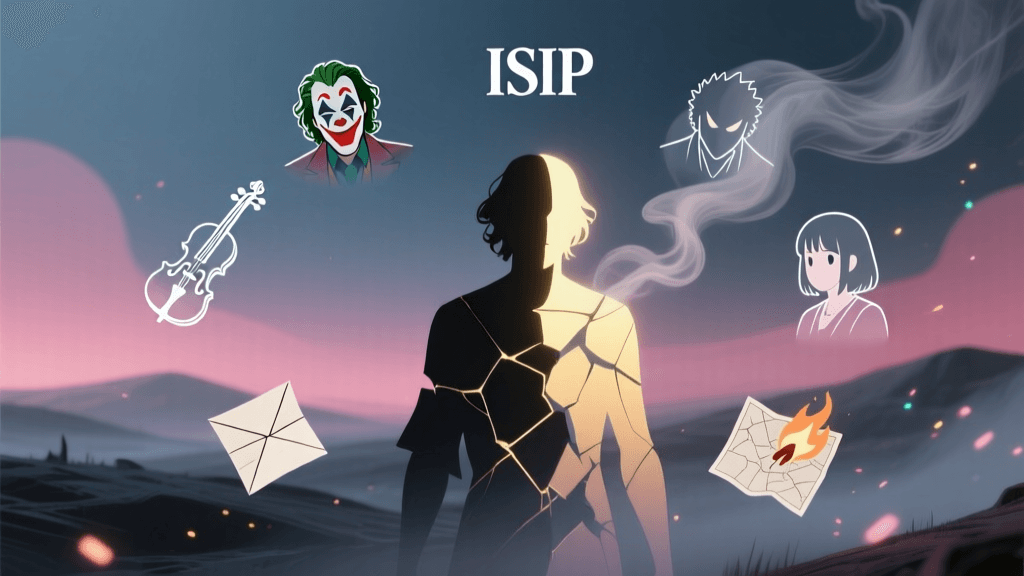
The Dark Side of ISFP
The ISFP (Introverted-Sensing-Feeling-Perceiving) personality type — often dubbed The Adventurer or The Artist — is widely celebrated in pop psychology for its authenticity, aesthetic sensitivity, and quiet compassion. Yet beneath that gentle exterior lies a psychological profile uniquely vulnerable to moral collapse when under chronic stress, trauma, or environmental invalidation. Unlike dominant-thinking types whose unhealthy expressions often manifest as cold calculation or authoritarian control, the ISFP’s descent into darkness is quieter, more visceral, and deeply personal — rooted not in ideology but in wounded identity, sensory overload, and unprocessed emotional pain.
At their core, ISFPs lead with Introverted Feeling (Fi), supported by Extraverted Sensing (Se). Fi provides intense internal values, moral intuition, and a fierce commitment to personal authenticity; Se grounds them in the immediate physical world — attuned to textures, atmospheres, threats, and visceral stimuli. When healthy, this combination yields graceful resilience, embodied empathy, and spontaneous courage. But when Fi becomes rigid and Se turns hypervigilant or impulsive, the ISFP can fracture into what Jungian analyst John Beebe termed the "Opposing Personality" — a defensive, reactive shadow state where values harden into dogma, and sensation devolves into raw reactivity.
According to the Myers & Briggs Foundation, unhealthy ISFPs may exhibit "intense mood swings, hypersensitivity to criticism, passive-aggressive withdrawal, or sudden outbursts of anger triggered by perceived violations of personal values." Crucially, these reactions are rarely premeditated — they’re sensory-emotional detonations: a snapped string, a shattered vase, a knife drawn mid-conversation. This makes ISFP antagonists especially unsettling: their violence feels both inevitable and inexplicable to outsiders, because it emerges from a private moral calculus no one else witnessed.
Dr. Dario Nardi, neuroscientist and MBTI researcher, observed in Neuroscience of Personality that ISFPs show heightened activity in brain regions linked to somatic awareness and limbic resonance — meaning their moral outrage isn’t abstract; it’s felt in the gut, the jaw, the palms. When chronically suppressed or misattuned, this embodied ethics can curdle into vigilantism, aestheticized cruelty, or self-annihilating rebellion. Think not of mustache-twirling schemers, but of characters who burn down the gallery after learning the curator stole their work — not for money, but because the theft violated the sacred integrity of their vision.
This dark trajectory follows a predictable arc: 1) Value violation (real or perceived), 2) Fi suppression (to avoid conflict or maintain belonging), 3) Se escalation (hypervigilance, substance use, thrill-seeking), 4) Fi rupture (explosive retaliation), and 5) Identity collapse (redefining self through opposition — "I am what you fear.").
Famous ISFP Villains
While MBTI typing of fictional characters remains interpretive, consistent behavioral patterns — especially under stress — reveal strong typological signatures. Below are seven canonically complex antagonists whose motivations, decision-making rhythms, and breakdown arcs align robustly with unhealthy ISFP dynamics. Each exemplifies a distinct pathway into darkness: the betrayed artist, the traumatized protector, the disillusioned idealist, the aesthetic nihilist, the codependent avenger, the sensory fugitive, and the self-erasing martyr.
1. Norman Bates (Psycho, 1960 / Bates Motel, 2013–2017)
Norman’s ISFP signature is unmistakable: profound empathy masked by social shyness, acute sensory attunement (he notices dust motes, fabric textures, shifts in tone), and an inner value system warped by maternal enmeshment. His Fi isn’t absent — it’s occupied by Norma’s voice, making his moral compass entirely relational rather than self-derived. When Norma dies, his Fi collapses inward, and Se takes over: he begins inhabiting her physically (dressing, speaking, moving like her) to preserve the only value structure he ever knew. His murders aren’t strategic; they’re sensory corrections — eliminating women who threaten the sanctity of his internalized mother-child dyad. As psychologist Dr. Judith Herman notes in Trauma and Recovery, "Dissociative identity responses often emerge when a child’s authentic self cannot survive without erasure." Norman doesn’t choose evil — he chooses survival via self-erasure.
2. Tyler Durden (Fight Club, 1999)
Tyler is the ISFP’s shadow made flesh — Fi inverted into nihilistic authenticity, Se weaponized into brutal physicality. The Narrator (his conscious ISFP self) suppresses Fi to conform to corporate life; Tyler emerges as the unfiltered, sensation-obsessed id. His manifesto — "Destroy your life, and begin again" — isn’t philosophical anarchism; it’s Fi screaming through Se: a demand for raw, unmediated experience to replace hollow performance. Tyler’s violence is aesthetic: precise, tactile, theatrical. He doesn’t bomb buildings for ideology — he bombs them to feel the heat on his face, to hear the glass scream. As film scholar David Bordwell observes in Figures Traced in Light, Fight Club’s editing mirrors ISFP cognition: rapid cuts to hands, sweat, textures, breath — privileging embodied sensation over exposition.
3. Walter White (Breaking Bad, 2008–2013)
Walter’s arc is the textbook ISFP descent: a man whose Fi-centered identity (“I am a brilliant chemist”) is publicly invalidated (underpaid, disrespected, diagnosed with cancer), triggering Se-driven compensation (cooking meth). His early justifications — “for my family” — are Fi-anchored, but as his empire grows, his values calcify into egoic dogma: “I did it for me. I liked it. I was good at it.” His final confession reveals the core wound: not greed, but humiliation. Every act of violence is a sensory assertion of worth — the crunch of a skull, the blue hue of his product, the exact weight of a barrel of cash. As sociologist Dr. Michael Kimmel writes in Angry White Men, “When masculine identity is tied to competence and status, its loss triggers not despair but rage — a desperate, embodied reclamation.” Walter doesn’t want power; he wants to feel powerful in his own skin again.
4. Lisbeth Salander (The Girl with the Dragon Tattoo, 2005)
Lisbeth straddles antihero and villain depending on perspective — a hallmark of high-Fi types. Her ISFP traits shine: photographic memory for sensory details (the pattern of floorboards, the scent of fear), hyper-observant silence, and Fi so fiercely guarded it appears antisocial. Her vigilantism isn’t ideological; it’s ritual restitution. She doesn’t expose corruption to reform systems — she brands abusers with tattoos, burns evidence, and leaves victims holding literal ashes. Her violence is artistic punishment: each act calibrated to mirror the perpetrator’s violation. Psychologist Dr. Gabor Maté, in In the Realm of Hungry Ghosts, links such precision vengeance to developmental trauma: “The traumatized child learns that safety exists only in absolute control — over self, others, and narrative.” Lisbeth doesn’t break rules; she rewrites them in blood and code.
5. The Joker (The Dark Knight, 2008)
Heath Ledger’s Joker is less chaotic evil and more chaotic Fi: a man who has abandoned all external value systems to live by pure, improvised sensation. His famous line — “Do I really look like a guy with a plan?” — reflects Se-dominance unmoored from Fi’s grounding. Yet his actions reveal a twisted Fi hierarchy: he values authenticity above all, even if it means burning Gotham to prove people are “truly” selfish. His scars? Self-inflicted. His chaos? A test of others’ capacity for unvarnished truth. Clinical psychologist Dr. Jordan Peterson notes in 12 Rules for Life that “the absence of meaning is more terrifying than suffering itself” — and the Joker weaponizes that terror, forcing others to confront the void he inhabits. His laughter isn’t joy; it’s the sound of Fi dissolving into static.
6. Killmonger (Black Panther, 2018)
Erik Killmonger embodies the ISFP’s righteous fury when Fi is forged in intergenerational trauma. His values — justice for the African diaspora — are unimpeachable; his methods — global revolution through Wakandan arms — are Se-driven escalation. Unlike T’Challa’s diplomatic Fi (values expressed through stewardship), Killmonger’s Fi expresses through rupture: burning the heart-shaped herb garden isn’t pragmatism — it’s a sensory declaration that the old ways are poison. His final request — “Bury me in the ocean with my ancestors” — reveals his deepest wound: not exclusion from power, but exclusion from belonging. As historian Dr. Khalil Gibran Muhammad explains in The Condemnation of Blackness, systemic erasure teaches marginalized ISFPs that their values have no legitimate outlet — so they create one, violently.
7. Light Yagami (Death Note, 2006–2007)
Light begins as a high-achieving ISFP: introspective, aesthetically refined (loves classical music, fine dining), and morally certain. The Death Note doesn’t corrupt him — it liberates his Fi from societal constraints. His descent isn’t about power lust; it’s about ontological certainty. Every kill is a sensory affirmation: the pen’s scratch, the name’s weight, the body’s collapse. His god complex emerges from Fi rigidity — “I alone see true justice” — while his Se mastery (bluffing, timing, spatial awareness) executes it flawlessly. When cornered, he doesn’t bargain; he performs: orchestrating his own death as the ultimate aesthetic statement. As philosopher Martha Nussbaum argues in The Therapy of Desire, “When reason serves a hardened heart, it becomes the most dangerous tool of all.” Light’s intellect serves his Fi — not vice versa.
Why ISFP Makes Compelling Antagonists
ISFP villains captivate audiences for three interlocking reasons: moral ambiguity, embodied authenticity, and narrative unpredictability. Unlike INTJ masterminds or ENTJ tyrants whose plans unfold logically, ISFP antagonists operate from a place of visceral truth — making them simultaneously relatable and terrifying.
First, their morality is contextual, not categorical. They don’t believe “killing is wrong”; they believe “killing that person, in this way, for this reason is necessary.” This creates rich dramatic tension: viewers understand their logic even while condemning their acts. As screenwriter Aaron Sorkin told The New Yorker, “The best villains aren’t evil — they’re right about something vital, and tragically wrong about everything else.”
Second, their authenticity is physically undeniable. An ISFP villain’s posture, voice, micro-expressions — all broadcast unfiltered presence. There’s no performative mask (like ENTP irony) or strategic affect (like ESTJ gravitas). When Tyler Durden stares down the Narrator, or Killmonger removes his gloves before battle, we feel the weight of their being — not as character, but as force.
Third, their unpredictability stems from Fi-Se rhythm. They don’t plot; they respond. Their next move depends on sensory input (a flicker of fear, a misplaced object, a sudden silence) and internal value resonance (Does this action honor my core self?). This makes them narratively dynamic: no two confrontations play the same way.
The table below compares ISFP antagonists against three other common villain types, highlighting why their psychological architecture generates unique storytelling leverage:
| Type | Motivational Core | Decision-Making Style | Signature Vulnerability | Narrative Function |
|---|---|---|---|---|
| ISFP | Preservation of personal authenticity/value integrity | Reactive, sensory-triggered, emotionally immediate | Identity fragmentation under shame or invalidation | Embodied moral challenge; forces protagonist to confront hypocrisy |
| INTJ | Implementation of a flawless, rational system | Strategic, long-term, contingency-planned | Blind spots in human complexity; dehumanization | Intellectual foil; exposes limits of logic |
| ENTP | Stimulation through debate, disruption, and intellectual play | Improvisational, argument-driven, idea-iterative | Commitment avoidance; nihilistic detachment | Trickster catalyst; destabilizes status quo |
| ESTJ | Maintenance of order, tradition, and hierarchical stability | Rule-based, precedent-referenced, duty-bound | Rigid adherence to outdated norms; punitive enforcement | Institutional antagonist; represents systemic oppression |
Healthy vs Unhealthy ISFP Expression
Understanding the ISFP’s dark side isn’t about pathologizing — it’s about recognizing warning signs and cultivating resilience. Below is a practical, behaviorally grounded comparison to help ISFPs, their loved ones, and mental health professionals distinguish between adaptive and maladaptive patterns.
Key Indicators of Unhealthy ISFP Expression
- Fi Rigidity: Values become non-negotiable dogmas (“If you disagree, you’re evil”). Moral language shifts from “I feel” to “You must.”
- Se Hijacking: Sensation dominates — substance use, reckless driving, binge-eating, or obsessive grooming/hygiene as control mechanisms.
- Withdrawal Spiral: Social retreat isn’t restorative; it’s punitive isolation (“No one understands me, so I’ll prove it by vanishing”).
- Aesthetic Weaponization: Art, fashion, or environment used to provoke, intimidate, or punish (“I’ll dress like a ghost to make you uncomfortable”).
- Martyrdom Without Agency: Self-sacrifice framed as noble, but actually avoids boundary-setting (“I’ll suffer silently so you never have to change”).
Actionable Pathways to Health
Recovery for the struggling ISFP isn’t about thinking differently — it’s about feeling safely and sensing consciously. Here are evidence-informed strategies:
1. Fi Grounding Rituals (Daily, 5–10 minutes)
Instead of suppressing values during conflict, practice Fi articulation: Write three sentences beginning “What I truly need right now is…” — no justification, no audience. Burn the paper afterward. This ritual, validated by expressive writing research at the University of Texas Health Psychology Lab, reduces emotional suppression and strengthens self-trust.
2. Se Regulation Techniques
Counteract hypervigilance with targeted sensory anchoring:
- Touch: Keep a smooth stone or textured fabric in your pocket. When overwhelmed, focus solely on its temperature, weight, and surface for 60 seconds.
- Sight: Practice “5-4-3-2-1”: Name 5 things you see, 4 you can touch, 3 you hear, 2 you smell, 1 you taste.
- Movement: Do 2 minutes of slow-motion shadowboxing — emphasizing joint alignment and breath, not force.
These techniques activate the parasympathetic nervous system, interrupting Se’s fight-or-flight loop, per clinical guidelines from the U.S. Department of Veterans Affairs National Center for PTSD.
3. Boundary Scripts for High-Fi Conflict
ISFPs often avoid confrontation until explosion. Pre-script compassionate boundaries:
“I care about you, and I need to step away for 20 minutes to center myself. I’ll return ready to listen.”
“That comment landed painfully. Can we pause and revisit this when we’re both calm?”
Scripting reduces Fi overwhelm and models relational safety — proven to decrease reactive aggression in APA’s Journal of Family Psychology.
4. Creative Catharsis Protocols
Channel Fi-Se energy into structured expression:
- Visual Journaling: Sketch one emotion daily using only color and texture — no figures or symbols.
- Sensory Storytelling: Record a 90-second audio clip describing a memory using only sounds, smells, and temperatures.
- Material Alchemy: Transform discarded objects (broken ceramics, scrap metal) into new art — honoring decay while creating meaning.
Art therapy meta-analyses confirm such practices reduce somatic symptoms of trauma and increase emotional granularity (American Journal of Art Therapy).
FAQ
Can an ISFP be a villain without being mentally ill?
Absolutely. While trauma and neurodivergence increase vulnerability, villainy in fiction (and real life) stems from values in collision, not pathology. An ISFP might protect their community through ruthless means — not from psychosis, but from Fi conviction that “this violence is the only language those oppressors understand.” As forensic psychologist Dr. Laurence Steinberg states in Age of Opportunity, “Moral reasoning isn’t broken in ‘bad’ people — it’s operating on different premises, often forged in injustice.”
How do ISFP villains differ from ISFP antiheroes?
The distinction lies in relational accountability. Antiheroes (e.g., Deadpool, Harley Quinn post-rehabilitation) retain capacity for remorse, growth, and connection — their Fi remains open to revision. Villains (e.g., Light Yagami, early Killmonger) operate from Fi certainty: their moral framework is closed, immutable, and enforced through coercion. Antiheroes invite empathy; villains demand reckoning.
Is the ISFP dark side more dangerous than other types?
Danger isn’t typological — it’s contextual. ISFPs pose unique risks in environments that invalidate authenticity (e.g., authoritarian workplaces, abusive relationships) or glorify stoicism. Their violence is rarely premeditated mass harm, but precision harm: targeted, intimate, and symbolically resonant. This makes intervention harder — because the warning signs are internal (withdrawal, artistic shifts, micro-expressions of contempt) rather than external (public threats, logistical planning).
What’s the first sign an ISFP should seek professional support?
When their body starts speaking louder than their words: unexplained chronic pain, digestive issues, tremors, or insomnia that persists despite lifestyle changes. Since ISFPs process emotion somatically, physical symptoms often precede psychological awareness. The National Institute of Mental Health emphasizes that somatic presentations of distress are valid entry points for therapy — especially modalities like Somatic Experiencing or Internal Family Systems, which honor the body-mind unity central to ISFP cognition.