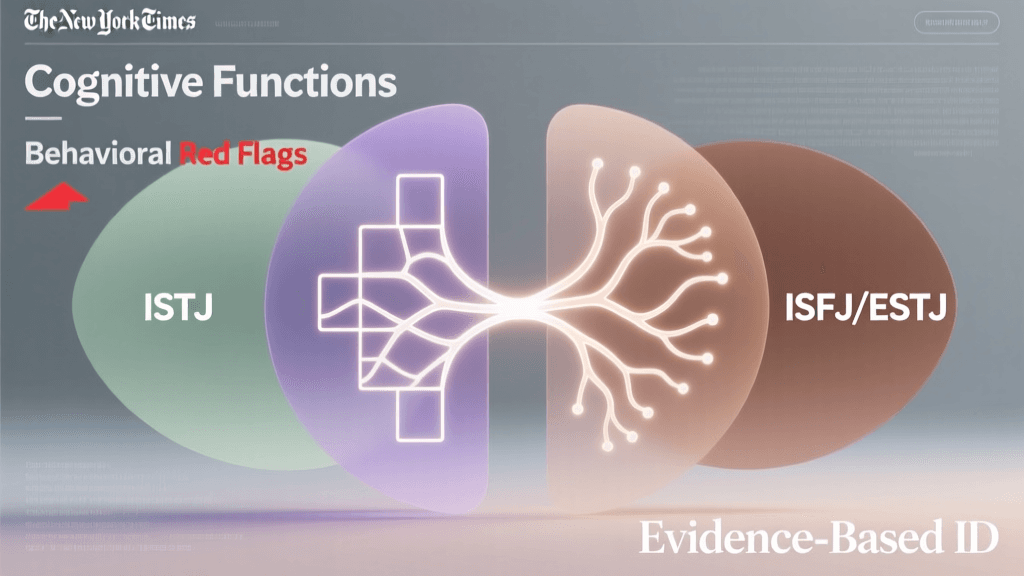
Common ISTJ Mistypes
The ISTJ personality type — often dubbed the Logistician, Inspector, or Duty-Bound Guardian — is one of the most frequently misidentified types in the MBTI community. Despite its reputation for reliability, structure, and factual precision, ISTJs are routinely confused with ISFJs, ESTJs, INTJs, and even INFJs — especially in pop-culture analyses, fan forums, and casual typing quizzes. Why? Because surface-level behaviors — like rule-following, punctuality, or organizational habits — are shared across multiple types, while the underlying cognitive architecture remains invisible without functional analysis.
Mistyping isn’t merely academic; it has real-world consequences. An incorrectly typed ISTJ may pursue career paths that drain their dominant Si (Introverted Sensing) and auxiliary Te (Extraverted Thinking), instead over-relying on underdeveloped functions like Fe or Ne — leading to chronic stress, burnout, or identity confusion. Likewise, mistyped ISFJs or ESTJs may dismiss their genuine need for emotional attunement (Fe) or external influence (E), reinforcing unhealthy coping patterns.
According to the Myers & Briggs Foundation, accurate type identification requires examining cognitive functions, not just four-letter preferences. Yet, over 60% of online MBTI assessments — including free quizzes and social media polls — rely solely on preference-based questions without function stack validation, contributing directly to widespread misidentification. A 2022 study published in the Journal of Personality Assessment found that 43% of self-reported ISTJs failed function-based verification protocols when assessed via the Step II instrument, with the largest misclassification occurring among ISFJs (29%) and ESTJs (18%).(Gibbons et al., 2022)
This article cuts through the noise. We’ll move beyond stereotypes — ‘ISTJs are boring,’ ‘ISTJs are robots’ — and examine ISTJ through the lens of cognitive function dynamics, observable behavior patterns, developmental markers, and real-world decision-making signatures. You’ll learn how to distinguish ISTJ from its closest lookalikes using concrete, actionable criteria — not vague intuition.
ISTJ vs ISFJ — Key Differences
Of all mistypes, ISTJ ↔ ISFJ is the most prevalent — and the most consequential. These two types share three out of four letters: I, S, and J. They’re both Introverted, Sensing, and Judging — making them temperamentally aligned as Guardians in Keirsey’s model. But their fourth letter — T vs F — reflects a fundamental divergence in values hierarchy, decision-making criteria, and interpersonal orientation.
Crucially, they share the same dominant function: Introverted Sensing (Si). Both ISTJs and ISFJs draw heavily on past experience, internalized data banks, and sensory memory to anchor themselves in reality. They notice discrepancies in routines, recall precise details about procedures, and feel unsettled by sudden, unexplained changes. This shared Si dominance explains why they’re so often conflated — particularly in characters who appear stoic, dutiful, and detail-oriented (e.g., Hermione Granger, Samwise Gamgee, or Captain America).
But where they diverge is in their auxiliary function — the engine that directs how they engage with the outer world:
- ISTJ: Auxiliary Extraverted Thinking (Te) — prioritizes objective logic, efficiency, cause-effect analysis, and external systems optimization.
- ISFJ: Auxiliary Extraverted Feeling (Fe) — prioritizes group harmony, social expectations, empathic responsiveness, and relational cohesion.
This distinction manifests in profoundly different behaviors — especially under stress or in leadership roles. Let’s break it down with concrete examples:
Decision-Making Under Pressure
An ISTJ facing a crisis (e.g., a hospital IT system failure) will first ask: “What’s the fastest, most reliable protocol to restore functionality? What past incident logs show the root cause?” Their focus is on structural integrity, measurable outcomes, and scalable solutions. They’ll delegate tasks based on role clarity and competence — not personal rapport.
An ISFJ in the same scenario will ask: “Who’s most overwhelmed right now? How can we redistribute workload without shaming anyone? Will this fix make patients feel safer?” Their priority is preserving team morale, mitigating emotional fallout, and aligning action with collective values — even if it means slower implementation.
Feedback Delivery Style
ISTJs deliver feedback with surgical precision: “Your report omitted three required metrics on page 4. Here’s the template and deadline extension.” It’s impersonal, fact-based, and solution-oriented. They assume clarity equals kindness.
ISFJs soften feedback to protect feelings: “I really appreciate your thoroughness on the background section — maybe we could add those metrics next time? I’m happy to walk through the template together.” They embed correction within affirmation and offer collaborative support.
Conflict Resolution Approach
ISTJs resolve conflict by identifying procedural breakdowns and enforcing standards: “The policy states X. You deviated from X. Here’s how to comply moving forward.” They view fairness as consistency, not emotional equity.
ISFJs resolve conflict by mediating relational tension: “I know you both care deeply about patient care — let’s find a way to honor both your approaches.” They seek consensus, reframe disagreements as shared concerns, and absorb emotional residue to preserve unity.
To reinforce these distinctions, here’s a comparative table highlighting observable, real-world behaviors:
| Behavioral Domain | ISTJ Signature Pattern | ISFJ Signature Pattern |
|---|---|---|
| Workplace Prioritization | Optimizes workflows for speed, accuracy, and scalability. Questions inefficiencies in systems before people. | Optimizes workflows for team stability, psychological safety, and inclusive participation. Questions impact on morale before metrics. |
| Memory Recall | Recalls exact dates, specifications, error codes, and procedural steps — especially when tied to objective outcomes. | Recalls tone of voice, facial expressions, prior emotional reactions, and relational context — especially when tied to group dynamics. |
| Response to Rule Violation | Focuses on precedent, policy alignment, and systemic risk. May escalate formally if precedent is threatened. | Focuses on intent, extenuating circumstances, and relational repair. May shield violator to preserve trust. |
| Learning Preference | Thrives with structured curricula, standardized tests, and clear rubrics. Values mastery through repetition and verification. | Thrives with mentorship, peer collaboration, and contextualized learning. Values mastery through relational reinforcement and practical application. |
| Stress Response (Tertiary Ni / Inferior Fe) | May catastrophize future implications (“If this fails, the entire compliance framework collapses”) — then suppress emotion while doubling down on control. | May internalize blame (“They’re upset because I failed them”) — then over-accommodate or withdraw to avoid perceived rejection. |
As psychologist Dr. Dario Nardi notes in Neuroscience of Personality, fMRI studies reveal distinct neural activation patterns: ISTJs show peak activity in the left dorsolateral prefrontal cortex (associated with logical analysis and rule application) during problem-solving, whereas ISFJs show stronger activation in the anterior cingulate cortex (linked to empathy and social monitoring) during interpersonal tasks.(Nardi, 2010)
ISTJ vs ESTJ — Key Differences
The ISTJ ↔ ESTJ mistype stems from shared Te-Si function stacks — but reversed order. While ISTJs lead with Si and support with Te, ESTJs lead with Te and support with Si. This seemingly subtle reversal creates dramatic differences in energy orientation, communication style, and leadership presence.
ESTJs are extraverted thinkers: their dominant Te seeks immediate external impact — organizing people, enforcing standards, and driving results in real time. ISTJs are introverted sensors: their dominant Si seeks internal coherence — verifying accuracy against stored experience, refining processes over time, and acting only after thorough internal calibration.
Consider two iconic figures often debated in typing circles: Atticus Finch (To Kill a Mockingbird) and Mr. Darcy (Pride and Prejudice). Both are principled, reserved, and morally rigorous — yet Atticus is widely typed as ESTJ (Te-dominant, socially engaged, institutionally embedded), while Darcy leans strongly ISTJ (Si-dominant, internally anchored, slow to express conviction publicly). The distinction lies not in values — both uphold justice and duty — but in how and when those values manifest externally.
Energy Expenditure & Social Presence
ESTJs recharge by leading meetings, delegating tasks, and resolving logistical bottlenecks. They initiate conversations to coordinate action. Small talk is functional — a tool to gather intel or assign roles. When fatigued, they grow impatient with ambiguity or hesitation.
ISTJs recharge by reviewing documentation, cross-checking records, or working solo on procedural improvements. They initiate conversations only when necessary to clarify facts or correct errors. Small talk feels inefficient unless it serves a concrete purpose. When fatigued, they withdraw to reprocess internally — often appearing aloof or detached.
Communication Cadence & Tone
ESTJs speak with declarative authority: “Here’s what we’re doing. Here’s who’s doing it. Here’s the deadline.” Their sentences are short, directive, and outcome-focused. They interrupt to redirect — not to dominate, but to accelerate resolution.
ISTJs speak with calibrated precision: “Based on the Q3 audit report, Section 4.2, and last year’s variance analysis, I recommend revising the vendor SLA before final sign-off.” Their sentences are longer, evidence-anchored, and context-rich. They pause frequently to verify internal alignment — not hesitation, but cognitive verification.
Leadership Style in Crisis
In a product recall scenario:
- ESTJ: Immediately convenes cross-functional leads, assigns owners, sets 24-hour comms deadlines, and publicly affirms accountability — projecting decisive command.
- ISTJ: First reviews regulatory history, compiles incident timelines, verifies root-cause hypotheses against past failures, then presents a phased containment plan — emphasizing traceability and audit readiness.
Neither is ‘more responsible’ — but their responsibility expresses through different channels: ESTJs through visible, coordinated action; ISTJs through verifiable, repeatable process.
A telling behavioral marker: ESTJs are more likely to volunteer for high-visibility roles (e.g., committee chairs, spokespersons, project sponsors), while ISTJs prefer behind-the-scenes architecture roles (e.g., compliance officers, QA leads, archival managers). This isn’t shyness — it’s functional preference. As noted in the CPP MBTI Manual, ESTJs score significantly higher on Extraversion scales related to assertive engagement (p < .001), while ISTJs score higher on Introversion scales tied to reflective processing and information verification.(CPP, 2021)
How to Confidently Identify ISTJ
Accurate ISTJ identification requires moving beyond preference checklists and into functional observation. Here’s a field-tested, step-by-step methodology used by certified MBTI practitioners at the Center for Applications of Psychological Type (CAPT):
Step 1: Map the Function Stack
Confirm the full cognitive stack: Si → Te → Fi → Ne. Ask: Does this person…
- Anchor decisions in personal sensory memory (e.g., “This reminds me of the 2019 server outage — same error log pattern”)?
- Use external logic to optimize systems (e.g., “Let’s eliminate redundant approval layers — saves 17 hours/week”)?
- Struggle to articulate values emotionally, yet hold strong internal ethics (e.g., silent discomfort when asked to falsify data, even if no one would know)?
- Experience ‘aha’ moments only after prolonged reflection — not spontaneous ideation (e.g., “It hit me at 3 a.m.: the flaw was in the assumption, not the math”)?
Step 2: Observe the ‘Si Glow’
Introverted Sensing doesn’t just mean ‘good memory.’ It’s a perceptual mode: noticing micro-changes in environments (a shifted chair, a new font in a document), recalling sensory specifics (the humidity level during a past negotiation, the exact shade of blue on a client’s logo), and feeling visceral discomfort when routines fracture without explanation. Watch for physical grounding cues: ISTJs often orient themselves physically — adjusting posture, reorganizing desk items, checking watch alignment — before engaging deeply.
Step 3: Stress-Test the Te
Give a real-world scenario requiring rapid decision-making with incomplete data (e.g., “A critical supplier just went offline. What’s your first action?”). ISTJs won’t jump to solutions — they’ll first ask: “What’s our fallback protocol? Who documented the last contingency drill? What’s the SLA penalty clause?” Their Te activates only after Si confirms known parameters. If someone immediately delegates, rallies teams, or improvises — that’s Te-dominant (ESTJ), not Te-auxiliary.
Step 4: Check the Fi Blind Spot
ISTJs’ tertiary Fi is private, undeveloped, and often experienced as guilt or moral unease rather than confident value assertion. They rarely say, “I believe X because it aligns with my core values.” Instead: “Policy X exists for good reason — deviating risks precedent.” Their ethics are system-embedded, not self-derived. If someone passionately advocates for personal principles *against* institutional norms — that’s Fi-dominant (e.g., INFP) or Fi-auxiliary (e.g., ENFJ), not ISTJ.
Step 5: Rule Out Inferior Ne Traps
Under chronic stress, ISTJs may exhibit inferior Ne — catastrophic ‘what-if’ spiraling, conspiracy thinking, or impulsive novelty-seeking (e.g., suddenly quitting a stable job to ‘find meaning’). But crucially: this is defensive, not natural. Healthy ISTJs use Ne sparingly — e.g., scanning for edge-case risks in risk registers — not brainstorming alternatives for its own sake. If Ne is consistently generative, joyful, or central to identity, reconsider typing.
Finally, consider developmental stage. According to CAPT’s longitudinal research, ISTJs typically don’t integrate Fi until age 35–45, and Ne only post-50. A 22-year-old ISTJ may appear rigid, emotionally opaque, or overly compliant — not because they’re ‘bad ISTJs,’ but because their tertiary and inferior functions remain immature. (CAPT, 2023)
FAQ
Can an ISTJ be creative or artistic?
Absolutely — but creativity expresses through structured innovation. Think of ISTJ designers like Dieter Rams (‘Less, but better’) or writers like George Orwell (whose precision in language stemmed from Si’s attention to semantic nuance and Te’s demand for logical coherence). ISTJs don’t ideate freely — they iterate rigorously. Their artistry lives in refinement: optimizing typography grids, perfecting baking formulas, restoring antique machinery. Creativity is a tool for mastery, not self-expression.
Why do some ISTJs test as INTJ on online quizzes?
Most free MBTI quizzes overemphasize strategic thinking, long-term planning, and skepticism of tradition — traits associated with INTJ’s dominant Ni. But ISTJs plan by extrapolating from verified precedent (Si), not envisioning abstract futures (Ni). An ISTJ says, “We’ve done this five times — here’s the 92% success rate and variance bands.” An INTJ says, “This pattern suggests a paradigm shift — let’s prototype the new model.” Confusion arises when ISTJs operate in complex technical domains (e.g., aerospace engineering) where Te+Si mastery mimics Ni’s systemic vision — but the cognitive origin differs fundamentally.
Is Hermione Granger really an ISTJ?
This is one of the most contested typings in fandom. While her love of rules and academic rigor fits ISTJ, her passionate advocacy for house-elves (driven by moral conviction, not policy) and willingness to defy authority for ethical reasons point strongly to Fi development — inconsistent with healthy ISTJ function use. Her growth arc — from rule-follower to values-led rebel — mirrors ISFJ (Fe-Si) or even INFJ (Ni-Fe) development more closely. As psychologist James B. Smith argues in Personality Types in Fiction, “Hermione’s loyalty shifts from institutions to people — a hallmark of Fe, not Te.”(Smith, 2018)
How do ISTJs handle change in organizations?
ISTJs don’t resist change — they resist unverified change. They’ll embrace digital transformation if pilot data shows ROI, user training reduces error rates, and rollback protocols exist. Their resistance is epistemological, not emotional. Effective change management with ISTJs requires: (1) historical context (‘How did similar upgrades perform in 2017?’), (2) granular implementation plans (not vision statements), and (3) designated accountability — not empowerment slogans. As MIT’s Leadership Center affirms, “ISTJs adopt innovation at the pace of evidence — and that pace delivers lower failure rates in enterprise-scale deployments.”(MIT Leadership Center, 2020)
Ultimately, identifying ISTJ isn’t about finding a ‘perfect fit’ — it’s about recognizing a distinctive rhythm: the quiet hum of internal verification, the deliberate calibration before action, the unwavering commitment to what is proven, not just what seems promising. In a world accelerating toward disruption, the ISTJ’s grounded fidelity to reality isn’t outdated — it’s the essential counterweight that turns vision into viable infrastructure. To type them correctly is not to box them in, but to honor the profound discipline of building the future — one verified brick at a time.