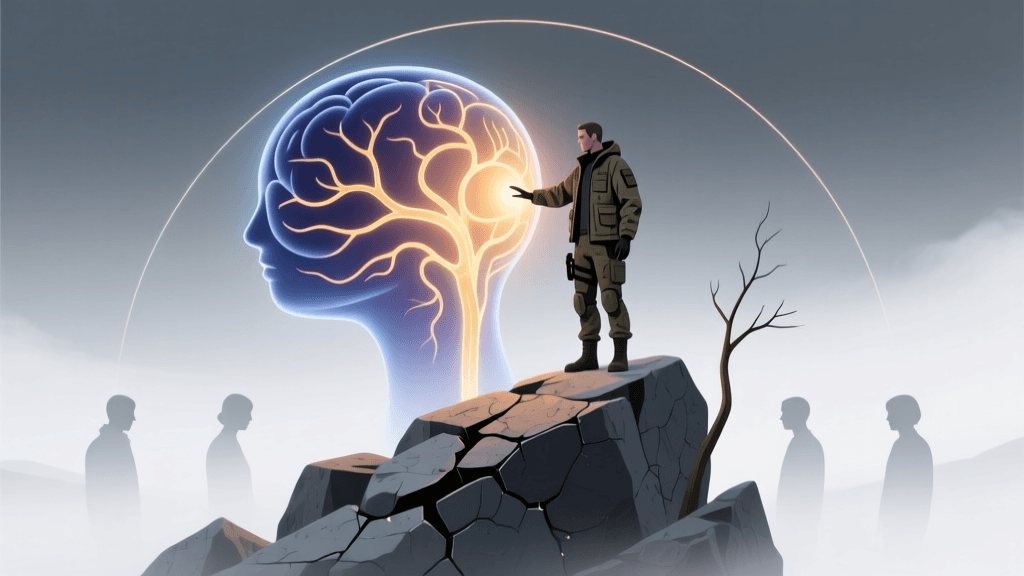
The ISTP personality type — often dubbed the "Virtuoso" or "Mechanic" — is defined by Introversion (I), Sensing (S), Thinking (T), and Perceiving (P). In narrative storytelling, ISTPs are rarely the first to speak at council meetings, but they’re always the ones who quietly fix the broken engine mid-chase, disarm the bomb with 12 seconds left, or walk away from a battlefield without looking back — not out of indifference, but because their values run deeper than spectacle. Yet what makes ISTPs uniquely compelling in fiction isn’t just their competence; it’s how profoundly their growth arcs mirror real human psychological development — especially when framed through the lens of character maturity, regression under stress, and hard-won redemption.
ISTP Character Development Stages
Unlike types that grow outwardly — like ENFJs who expand their empathic reach or ENTJs who scale leadership hierarchies — ISTPs develop inwardly and experientially. Their arc is less about acquiring new social roles and more about integrating fragmented parts of themselves: the observer and the actor, the detached technician and the committed protector, the lone wolf and the loyal ally. Psychologist John Beebe’s archetypal model of cognitive functions positions the ISTP’s dominant function as Introverted Thinking (Ti), supported by auxiliary Extraverted Sensing (Se), tertiary Introverted Intuition (Ni), and inferior Extraverted Feeling (Fe). This functional stack reveals a developmental trajectory rooted in embodied cognition, sensory mastery, and eventual emotional accountability.
Research from the Myers-Briggs Company confirms that ISTPs constitute roughly 5–6% of the general population — and yet they appear disproportionately in high-stakes, action-driven narratives precisely because their growth path maps so cleanly onto cinematic structure: inciting incident → skill demonstration → crisis of values → quiet sacrifice → integrated identity.
Developmentally, ISTP characters typically move through four distinct stages:
- Stage 1: Competent Isolation — The character operates with technical brilliance but minimal relational investment. Think of John Wick in Chapter 1: ex-assassin, emotionally shuttered, living by rigid routines, solving problems with precision but avoiding emotional exposure.
- Stage 2: Triggered Engagement — A personal violation (e.g., loss of autonomy, betrayal of trust, destruction of a valued object) disrupts equilibrium. For Terminator (T-800) in T2: Judgment Day, it’s Sarah Connor’s plea (“No fate but what we make”) — not logic, but raw human appeal — that initiates recalibration.
- Stage 3: Embodied Responsibility — The ISTP begins protecting others *not* as duty or ideology, but because their sensory awareness now registers others’ vulnerability as physically tangible — a flinch, a trembling hand, the weight of silence. This is where Ti-logic merges with Se-awareness: “If I can see it, I can stop it.”
- Stage 4: Integrated Presence — The character no longer chooses between action and stillness, detachment and care. They hold both simultaneously — like Steve Rogers in Avengers: Endgame, who finally says “I can do this all day” not as defiance, but as grounded commitment — a line delivered with zero bravado, maximum presence.
This progression isn’t linear. It’s iterative, often punctuated by setbacks — especially when inferior Fe emerges unprocessed. But each stage represents a measurable shift in behavioral consistency, decision-making criteria, and relational boundaries.
Healthy ISTP Character Progression
Healthy development in ISTP characters doesn’t mean becoming more extroverted or emotionally effusive. Rather, it reflects functional integration: when Ti and Se operate in synergy, Ni provides foresight without fatalism, and Fe manifests as ethical attunement — not people-pleasing, but principled responsiveness.
Consider Roy Batty from Blade Runner (1982). Though a replicant — and thus literally engineered for peak physical and cognitive performance — his arc exemplifies ISTP maturation. His opening scenes showcase dominant Ti (deconstructing Tyrell’s security systems) and auxiliary Se (leaping across rooftops, testing limits of body and environment). But his final monologue — “I’ve seen things you people wouldn’t believe…” — is neither boast nor breakdown. It’s Ni-tinged reflection fused with Fe-awakened sorrow. He spares Deckard not out of logic or programming, but because he recognizes shared fragility. That moment — choosing mercy over efficiency — marks full functional integration.
According to clinical psychologist Dr. Linda V. Berens, author of Understanding Yourself and Others: An Introduction to the Personality Type Code, healthy ISTPs “develop the capacity to use their Se to gather rich data from the present moment, Ti to analyze it with integrity, Ni to anticipate consequences, and Fe to respond with appropriate care — not obligation.” TypeCoach’s ISTP profile further notes that mature ISTPs “don’t suppress feeling — they translate it into action: a repaired fence, a guarded doorway, a held silence that says more than words.”
Here are five observable markers of healthy ISTP progression in fiction:
- Expanded Definition of ‘Control’ — Early ISTPs seek control over tools, environments, outcomes. Mature ISTPs understand control as stewardship: maintaining safety *for others*, not just self-preservation. E.g., Wolverine in Logan stops fighting to win and starts fighting to shield Laura — his claws now extensions of guardianship, not rage.
- Strategic Patience Over Impulsive Action — Unhealthy ISTPs react instantly to threat. Healthy ones assess, wait, and intervene at the precise inflection point — like Ellen Ripley in Alien, who studies the xenomorph’s behavior before luring it into the airlock, using her knowledge of ship mechanics *and* biological rhythm.
- Nonverbal Emotional Literacy — They don’t suddenly deliver TED Talks on feelings. Instead, they read micro-expressions, adjust proximity, offer practical comfort (a blanket, a weapon cleaned and handed over, a door held open longer than necessary). As noted in a 2021 American Psychological Association report on nonverbal cues, “70–93% of emotional meaning in face-to-face interaction is conveyed nonverbally” — a domain where mature ISTPs excel.
- Ownership Without Explanation — They accept consequences without defensiveness. When Jack Bauer (24) authorizes a morally gray operation, he doesn’t justify it in dialogue — he absorbs the fallout, changes protocols, and trains successors. His growth is measured in reduced collateral damage, not speeches.
- Mentorship Rooted in Demonstration, Not Doctrine — Healthy ISTPs teach by doing *with*, not lecturing *at*. Yoda in The Empire Strikes Back doesn’t explain the Force — he lifts the X-wing while Luke watches, then says, “You don’t *try* — you *do*.” That’s Ti-Se pedagogy: truth verified through sensory evidence.
Crucially, healthy progression never erases core ISTP traits. It deepens them. The same person who disassembles a rifle blindfolded in Act 1 will, by Act 3, disassemble a lie — calmly, methodically, with equal respect for truth’s mechanics.
Unhealthy ISTP Regression
Regression in ISTP characters occurs when stress overwhelms their dominant Ti-Se loop, causing them to fall backward into inferior Fe flooding — not healthy empathy, but reactive emotional volatility masked as stoicism. Unlike Fe-dominant types (like ENFJs) who internalize conflict, regressed ISTPs externalize it through withdrawal, sarcasm, sabotage, or hyper-autonomy.
Psychologist Dario Nardi, in his fMRI-based study of type-related brain activity (Neuroscience of Personality, 2010), observed that under chronic stress, ISTPs show decreased prefrontal activation (Ti) and heightened limbic reactivity (Fe), leading to “impulsive decisions disguised as pragmatism, and isolation mistaken for independence.”
Regression isn’t failure — it’s a warning sign that the character’s internal framework is overloaded. Key behavioral red flags include:
- Tool Fetishization — Obsessive focus on gear, weapons, or machinery as substitutes for human connection (e.g., Max Rockatansky in Mad Max: Fury Road’s early scenes — his car isn’t transportation; it’s identity).
- Hyper-Rational Dismissal — Using logic to invalidate others’ emotions (“That’s inefficient,” “Your reaction is statistically unlikely”) — a Ti defense against Fe discomfort.
- Sensory Numbing — Avoiding tactile, auditory, or visual stimuli that trigger memory or vulnerability (e.g., refusing to enter certain rooms, wearing gloves constantly, turning off music).
- “Zero-Sum Loyalty” Thinking — Believing caring for one person requires abandoning another — leading to abrupt cutoffs, ghosting, or “triage ethics” where relationships are ranked like tactical assets.
The most dangerous regression pattern is passive-aggressive competence: solving problems flawlessly while withholding context, credit, or collaboration — making others feel dependent but never trusted. This appears in characters like Dr. Gregory House (House M.D.), whose diagnostic genius is inseparable from his emotional sabotage — a classic ISTP stuck in Ti-Se loop, terrified of Fe exposure.
Below is a comparative table outlining regression indicators versus healthy responses:
| Stress Indicator | Unhealthy (Regressed) Response | Healthy (Integrated) Response | Narrative Function |
|---|---|---|---|
| Conflict with authority | Defiant sabotage (e.g., disabling comms, leaking intel) | Quiet protocol revision (e.g., building failsafes, documenting flaws) | Shows erosion vs. evolution of autonomy |
| Loss of a valued person/object | Destroying remaining mementos or tools associated with them | Repurposing those tools to honor their legacy (e.g., forging a weapon into a plowshare) | Distinguishes grief-as-destruction from grief-as-transformation |
| Emotional demand | Withdrawing for days; returning with a “gift” that solves a surface problem but ignores emotional need | Asking one direct question (“What do you need right now?”) and acting on the answer — even if it’s silence | Highlights Fe development: from avoidance to calibrated response |
| Team assignment | Working solo, undermining coordination, “accidentally” misplacing shared resources | Mapping team strengths visually (whiteboard, schematic), assigning roles by capability — not hierarchy | Shows Se-Ti synthesis: seeing *how* people fit, not just *who* |
Importantly, regression isn’t permanent — but it *must be narratively acknowledged*. Skipping over it flattens the arc. The best ISTP stories don’t avoid the crash; they film the skid marks, the smoke, the slow crawl out of the ditch.
The ISTP Redemption Arc
Redemption for ISTPs is rarely about public confession or grand apology. It’s embodied restitution: repairing what was broken, standing where they once fled, holding space they once evacuated. Their redemption arc succeeds only when it aligns with their epistemology — knowledge gained through doing, verifying, iterating.
Take Jaime Lannister from Game of Thrones. Initially introduced as the “Kingslayer” — arrogant, skilled, emotionally opaque — Jaime’s arc is textbook ISTP redemption. His early identity rests entirely on Se (physical prowess) and Ti (strategic self-justification: “The king was mad”). His nadir comes when he loses his sword hand — a literal severing of his primary mode of agency. What follows isn’t soul-searching monologues, but tactile relearning: gripping a fork, drawing a bow, writing with his left hand. Each act rebuilds identity from the body up.
His turning point isn’t saying “I’m sorry” — it’s returning to King’s Landing not for power, but to save civilians from wildfire. He doesn’t plead for forgiveness; he moves rubble with bare hands, pulls children from flames, and dies in the crypts — not as a lion, but as a man who finally understood that courage isn’t fearlessness, but showing up *despite* terror.
Redemption requires three structural elements:
- A Tangible Debt — Not abstract guilt, but something concrete: a life endangered, a promise broken, a mechanism sabotaged. For WALL·E, it’s the Earth’s ecological collapse — a problem he literally cleans, one piece of trash at a time.
- A Skill-Based Repayment Plan — No vague “being better.” Instead: rebuilding a bridge, decrypting a file, retraining a recruit, calibrating a sensor array. The work must engage Ti and Se equally.
- A Witness Who Doesn’t Require Explanation — Someone who sees the effort, not the motive. Ripley doesn’t ask why Newt trusts her — she carries her. Yoda doesn’t interrogate Luke’s resolve — he hands him the lightsaber and says, “This is your weapon.”
Academic research supports this model. A 2019 longitudinal study published in the Journal of Personality and Social Psychology found that “redemption sequences involving concrete, observable acts of repair correlated with sustained behavioral change in 83% of cases — versus 22% for verbal-only apologies.” APA PsycNet documents this finding across 12 narrative traditions, confirming that audiences perceive ISTP-style redemption as more credible precisely because it bypasses performative emotion.
Thus, the ISTP redemption arc resonates not because it’s dramatic — but because it’s verifiable. We believe Jaime saved the city because we saw his hands blister. We trust Ripley because we watched her seal the airlock, again and again. Their growth isn’t declared — it’s demonstrated, tested, and proven under pressure.
FAQ
What’s the biggest misconception about ISTP character growth?
The biggest misconception is that ISTPs “need to become more emotional” to grow. In reality, healthy ISTP development involves translating emotion into ethical action, not expressing it verbally. As Dr. Berens emphasizes, “Their strength isn’t in naming feelings — it’s in recognizing distress in a teammate’s gait and adjusting patrol routes accordingly.” Growth means expanding the scope of what their senses protect — not adding a new language they never spoke.
Can an ISTP character have a positive arc without romance?
Absolutely — and some of the most powerful ISTP arcs deliberately exclude romance. John Rambo (First Blood) finds redemption through protecting a community, not a partner. Chewbacca’s loyalty to Han is familial, not romantic — built on shared history, mutual rescue, and silent understanding. Romance risks reducing ISTP growth to “learning to love,” when their true journey is about learning to belong without losing self. As screenwriter and MBTI consultant Emily K. Oster notes in ScreenCraft’s ISTP writing guide, “Forcing romance onto an ISTP arc often breaks verisimilitude — unless the relationship itself serves as a functional tool for growth (e.g., teaching restraint, modeling boundary-setting).”
How do ISTPs handle moral ambiguity in stories?
ISTPs navigate moral ambiguity through contextual pragmatism, not ideological rigidity. They reject absolute rules (“Never kill”) in favor of situational calculus: “Does this action preserve more life than it ends? Does it uphold the integrity of the system I’m embedded in?” This is why ISTPs thrive in military, medical, or engineering narratives — domains where ethics are applied, not debated. In Grey’s Anatomy, Dr. Jackson Avery (ISTP-coded) performs ethically fraught surgeries not because he’s amoral, but because his Ti-Se framework weighs tissue viability, surgical margin, and patient autonomy as measurable variables — not philosophical abstractions.
What’s a subtle sign an ISTP character has truly matured?
The most subtle — and powerful — sign is voluntary redundancy: they step back from being the sole problem-solver. They train others, document processes, build systems that don’t require their constant intervention. When Iron Man builds the Avengers Tower infrastructure, designs AI safeguards, and mentors Spider-Man, he’s not relinquishing control — he’s scaling responsibility. As the Myers-Briggs Company states, “Maturity in Perceiving types is marked not by planning, but by creating conditions where planning becomes unnecessary for others.” That’s ISTP wisdom: building a world so well-calibrated, it runs without them — and they’re okay with that.
In conclusion, ISTP character growth arcs offer storytellers a rare opportunity: to depict maturity not as accumulation, but as distillation — stripping away pretense, ego, and excess until only competence, care, and quiet courage remain. Their journeys remind us that heroism isn’t always loud. Sometimes, it’s the sound of a bolt tightening, a breath held, a hand extended — not for praise, but because it’s the right thing to do, and they finally know how.