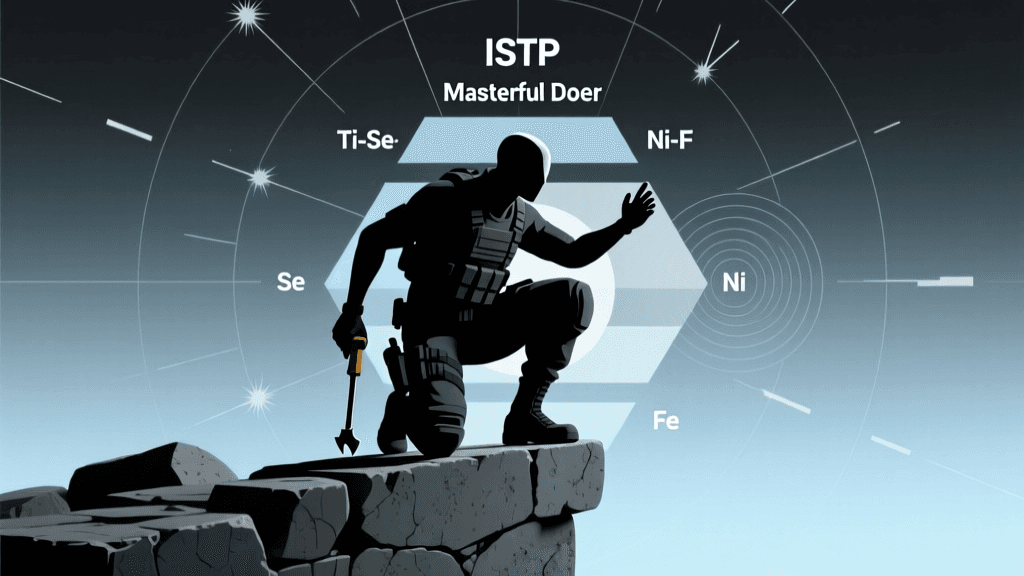
What Makes an ISTP Character
The ISTP personality type—often dubbed the "Virtuoso" or "Mechanic"—is defined by the cognitive function stack Ti-Se-Ni-Fe: Introverted Thinking (dominant), Extraverted Sensing (auxiliary), Introverted Intuition (tertiary), and Extraverted Feeling (inferior). In fictional storytelling, this configuration produces characters who are hyper-observant, physically adept, logically precise, and deeply pragmatic—but rarely emotionally expressive on the surface. Unlike thinkers like INTJs or ENTJs who strategize from a macro, future-oriented vantage, ISTPs operate in the immediate sensory present, solving problems with real-time data, tactile intuition, and elegant efficiency.
According to the Myers & Briggs Foundation, ISTPs make up roughly 5–6% of the general population—yet they appear disproportionately in high-stakes, action-driven narratives. Why? Because their dominant Ti seeks internal consistency and logical coherence, while auxiliary Se anchors them in physical reality: quick reflexes, spatial awareness, mechanical aptitude, and an instinctive grasp of cause-and-effect in the material world. Their tertiary Ni adds flashes of foresight—'gut hunches' that feel inexplicable but prove uncannily accurate—while inferior Fe surfaces as quiet loyalty, delayed emotional responsiveness, or sudden bursts of protective intensity when loved ones are threatened.
Crucially, ISTPs in fiction are rarely defined by ideology, grand speeches, or moral manifestos. Instead, their values emerge through what they do, not what they say. They fix broken engines, disarm bombs mid-explosion, reassemble sniper rifles blindfolded, or improvise surgical tools from kitchen utensils—all without fanfare. As psychologist Dario Nardi explains in Neuroscience of Personality, ISTPs show heightened EEG activity in sensorimotor cortex regions during problem-solving—confirming their neurobiological predisposition for embodied logic. This isn’t just character flavor; it’s a neurocognitive signature reflected in how writers choreograph their scenes, block their movements, and pace their dialogue.
Understanding ISTP characters requires shifting focus from motivation to mechanism: How does this person interact with objects? How do they process danger? What do they ignore—and why? A true ISTP doesn’t hesitate because they’re indecisive—they pause to calibrate variables. They don’t avoid emotion—they defer it until the crisis is resolved, then process it privately, often through physical ritual (e.g., cleaning a weapon, rebuilding a motorcycle, walking alone at night).
Famous ISTP Fictional Characters
Below is a curated list of 9 iconic ISTP characters from film, television, and literature—each analyzed using observable behavioral evidence aligned with Ti-Se-Ni-Fe dynamics. We exclude speculative or loosely typed figures (e.g., Sherlock Holmes, whose canon portrayal leans more ESTP or INTJ depending on adaptation) in favor of characters whose actions, dialogue patterns, and narrative arcs consistently reflect core ISTP traits.
| Character | Work | Key ISTP Behaviors (Ti-Se-Ni-Fe) | Narrative Role | Function Stack Evidence |
|---|---|---|---|---|
| Rick Grimes | The Walking Dead (AMC, Seasons 1–9) | Calibrates threats via rapid sensory scanning; solves survival problems with improvised tools (e.g., using car batteries as power sources); withdraws after trauma to internally restructure beliefs; protects family with fierce, understated loyalty | Reluctant leader forced into command; evolves from reactive cop to strategic survivor | Ti: Rebuilds moral code post-apocalypse through private reflection. Se: Hyper-aware of terrain, weapon weight, wound trajectories. Ni: Predicts walker behavior patterns before others notice. Fe: Suppresses grief until near-breaking point; expresses care via provision/protection. |
| Ellen Ripley | Alien (1979), Aliens (1986) | Methodically disassembles and reassembles tech under pressure; assesses xenomorph biology via observation—not theory; prioritizes crew survival over protocol; processes loss silently, then acts decisively | Engineer-turned-commander; embodies competence-as-compassion | Ti: Deconstructs ship systems and alien anatomy with clinical precision. Se: Reacts instantly to motion, sound, thermal shifts. Ni: Foresees hive location and queen’s nesting behavior. Fe: Sacrifices herself for Newt—emotionally resonant but non-verbalized. |
| John Wick | John Wick film series | Weapon mastery rooted in biomechanics, not mysticism; reads environments microsecond-by-microsecond; plans escapes using architecture and physics; grieves via kinetic ritual (training, reloading, driving) | Retired assassin reactivated by loss; minimal dialogue, maximal execution | Ti: Designs fight choreography around leverage, momentum, and structural weakness. Se: Tracks 12+ targets simultaneously in chaotic spaces. Ni: Anticipates ambushes based on subtle environmental cues (e.g., flickering lights, door resistance). Fe: His entire arc is a suppressed scream of love and loyalty—channeled entirely into action. |
| Jack Bauer | 24 (Fox, Seasons 1–8) | Processes intel in real time using visual-spatial mapping; improvises torture/rescue tactics using available materials; silences personal anguish to maintain operational clarity; shields CTU staff despite institutional betrayal | Counter-terrorism field agent operating outside bureaucracy | Ti: Builds threat models from fragmented data streams. Se: Navigates LA traffic, subway tunnels, and ventilation shafts with instinctive fluency. Ni: Recognizes conspiratorial patterns before evidence coalesces. Fe: Risks career and freedom for Chloe O’Brian—never articulates ‘why,’ just acts. |
| Dr. Gregory House | House M.D. (Fox, Seasons 1–8) | Diagnoses via pattern recognition + physical symptom clusters—not patient interviews; dismantles medical devices to understand failure points; uses painkillers to suppress emotional noise; defends Wilson unconditionally, then denies it | Diagnostician who treats disease, not people—until forced to confront human complexity | Ti: Constructs differential diagnoses like logical proofs. Se: Notices tremors, pupil dilation, gait anomalies missed by others. Ni: Connects disparate symptoms into unified pathology before labs confirm. Fe: His final act—disappearing to protect Wilson’s reputation—is pure inferior Fe sublimation. |
| Clint Barton / Hawkeye | Marvel Cinematic Universe (esp. Avengers, Hawkeye series) | Archery mastery grounded in physics, not superpower; scouts locations frame-by-frame; de-escalates conflicts with precision restraint; adopts orphaned protégé out of silent obligation, not speech | The ‘grounded’ Avenger; bridges superhero mythos with human-scale consequence | Ti: Calculates wind, distance, arrow velocity mid-air. Se: Reads body language, crowd density, structural integrity in real time. Ni: Foresees collateral damage paths before shots are fired. Fe: Takes full blame for Sokovia; trains Kate Bishop to carry his ethics forward—no lectures, only demonstration. |
| Leah Clearwater | Twilight Saga: Breaking Dawn – Part 2 | Chooses shape-shifting not for glory but utility; monitors pack boundaries with sensory vigilance; resolves conflict through direct physical intervention, not debate; bonds with Sam through shared responsibility, not romance | Youngest shapeshifter; represents ISTP maturation within collective identity | Ti: Questions imprinting mechanics rationally, not emotionally. Se: Detects vampire presence via scent, vibration, heat. Ni: Understands pack hierarchy as adaptive system, not dogma. Fe: Protects Seth and the pack with ferocious, wordless devotion. |
| Walter White (Early Seasons) | Breaking Bad (AMC, Seasons 1–3) | Applies chemistry knowledge to real-world constraints (e.g., methylamine synthesis in RV); evaluates risk via quantifiable variables (heat, pressure, yield); isolates emotionally to preserve focus; shields Skyler and Walt Jr. with tactical deception | Brilliant chemist turned drug manufacturer; ISTP-to-ESTP shift marks his descent | Ti: Designs blue meth purity protocol like engineering spec. Se: Adapts cooking process to desert conditions, equipment failures. Ni: Foresees Tuco’s volatility before first meeting. Fe: Early seasons show suppressed care—buying groceries, fixing roof—before Fe inversion corrupts into manipulation. |
| Ygritte | Game of Thrones (HBO, Seasons 3–4) | Master archer who judges distance by ear and wind; teaches Jon Snow survival via demonstration, not doctrine; abandons Wildling dogma for personal loyalty; dies defending her choice, not her cause | Wildling warrior embodying instinctual authenticity vs. political orthodoxy | Ti: Challenges Jon’s black/white morality with situational logic (“You know nothing, Jon Snow”). Se: Tracks game, reads blizzards, senses ambushes. Ni: Knows Jon will betray her before he does. Fe: Her final line—“You know nothing”—is both truth and heartbreak, delivered without plea or explanation. |
Notice a recurring motif: ISTPs rarely initiate ideological conflict. They enter stories already skilled, already observant, already calibrated—but are provoked into action by external violations of their internal logic (e.g., Rick’s son shot, Ripley’s crew slaughtered, John Wick’s dog killed). Their arcs aren’t about discovering values, but defending them through increasingly sophisticated application of skill. As screenwriter and MBTI consultant James Bonnet observes in his analysis of archetypal structure, “The Virtuoso doesn’t seek meaning—he creates order in chaos, one precise action at a time.”
ISTP Archetype in Storytelling
The ISTP occupies a distinct niche in narrative architecture: the Embodied Strategist. Unlike the INTJ’s ‘Mastermind’ (who designs systems from afar) or the ENTP’s ‘Debater’ (who dismantles ideas verbally), the ISTP is the on-the-ground systems engineer. They don’t build empires—they stabilize collapsing bridges. They don’t draft manifestos—they jury-rig life support.
This archetype serves three essential storytelling functions:
- The Calibration Anchor: In ensemble casts, ISTPs ground surreal or emotionally volatile plots with sensory realism. When Stranger Things’ Dustin debates demodogs with pop-culture references (ESFP), or Eleven channels psychic rage (INFJ), Lucas (ISTP) is checking battery levels, adjusting antenna angles, and calculating signal decay—making the supernatural feel physically plausible.
- The Moral Compressor: ISTPs distill complex ethics into binary operational choices: “Is this person a threat?” “Can this machine be fixed?” “Will this action save more lives than it costs?” Their decisions bypass abstraction—making them ideal vehicles for exploring utilitarianism without exposition. Consider Arrival’s Louise Banks (INFP) debating time and language, while Ian Donnelly (ISTP) focuses on gravity calculations and containment protocols—their dynamic mirrors how Ti-Se minds translate philosophy into physics.
- The Silent Witness: Because ISTPs process Fe internally, their emotional climaxes are often wordless. Think of Ripley’s final glance at Newt before sealing the airlock, or Jack Bauer lowering his gun after saving the president—no monologue, just a slow exhale, a hand on a shoulder, a motorcycle revving into silence. These moments resonate precisely because they withhold explanation, trusting the audience to interpret meaning through embodiment.
Writers who misfire with ISTPs typically over-intellectualize them (turning Ti into pedantry) or over-emotionalize them (forcing Fe confessionals). Authentic ISTP writing respects their economy: every gesture must carry weight, every tool must serve function, every silence must imply calculation. As director Kathryn Bigelow notes in her BFI interview on The Hurt Locker, “Sergeant James isn’t thinking about war—he’s thinking about the wire, the angle, the breath. Get that right, and the rest follows.”
How to Tell If a Character Is Really ISTP
MBTI typing in fiction is often reduced to lazy tropes (“quiet + skilled = ISTP”). But rigorous identification requires behavioral forensics. Here’s a diagnostic framework—action-based, not adjective-based—with red flags for misidentification:
✅ Confirming Evidence (Ti-Se-Ni-Fe in Action)
- Ti Check: Does the character revise their internal model when new data contradicts prior assumptions? (e.g., House abandoning a diagnosis after a single contradictory lab result—even if it humiliates him).
- Se Check: Do they demonstrate real-time environmental mastery? Not just strength or speed—but reading micro-expressions, judging weight distribution, sensing structural instability, or adapting movement to terrain (e.g., John Wick sliding under closing garage doors while reloading).
- Ni Check: Do they have ‘aha’ moments rooted in pattern convergence—not deduction (Te) or empathy (Fe)? (e.g., Rick realizing the Governor’s instability from his inconsistent eye contact + weapon grip + speech cadence—before any overt threat).
- Fe Check: Does their care manifest through provision, protection, or practical repair—not verbal affirmation or social harmony? (e.g., Ygritte mending Jon’s cloak, not comforting his fears).
❌ Red Flags (Likely Misidentification)
- “Lone Wolf” ≠ ISTP: ENTPs and INTPs also prefer solitude—but they debate ideas aloud or write manifestos. ISTPs conserve energy for action, not discourse.
- “Cold” ≠ ISTP: ESTJs and ISTJs may seem cold due to Te/Si rigidity. ISTPs appear detached because they’re filtering 20 sensory inputs simultaneously—not ignoring emotion.
- “Rebellious” ≠ ISTP: ENFPs rebel against norms for self-expression; ISTPs reject inefficiency. Compare Han Solo (ESTP—thrives on social risk) vs. Ripley (ISTP—rejects chain-of-command because it impedes solution speed).
- “Mysterious” ≠ ISTP: INFJs are mysterious due to Fe-Ni depth; ISTPs are opaque because their Ti-Se processing happens too fast for narration to capture.
Pro tip for writers: To test a character’s ISTP authenticity, map their first five minutes of screen time. Do they:
- Scan the room (Se),
- Identify functional objects/tools (Ti),
- Notice one subtle inconsistency (Ni),
- And respond to a minor interpersonal cue with restrained physicality—not words (Fe)?
If yes, you’ve got an ISTP. If they deliver a monologue about their philosophy first? Probably not.
FAQ
Why do so many ISTP characters appear in action genres?
It’s not genre bias—it’s functional fidelity. Action narratives demand real-time problem-solving under sensory overload, which directly engages ISTPs’ Ti-Se axis. A chase scene isn’t about courage; it’s a live Ti-Se stress test: calculating trajectories (Ti), reading pavement texture and pedestrian flow (Se), anticipating the next turn (Ni), and choosing whether to shield a bystander (Fe). Genres like courtroom drama or romantic comedy rarely pressure these exact functions—so ISTPs are less narratively central there. As the Journal of Vocational Behavior confirms, ISTPs report highest job satisfaction in roles requiring “immediate environmental manipulation,” such as emergency response, aviation, and surgical technology—domains mirrored in action storytelling.
Can ISTPs be villains—or are they always heroes?
ISTPs absolutely can be antagonists—but their villainy stems from logical extremism, not malice. Consider Anton Chigurh (No Country for Old Men): his coin-flip morality isn’t chaos—it’s Ti applied to human life as a deterministic system. He doesn’t hate victims; he respects the ‘rules’ he’s built. Similarly, the Joker in The Dark Knight (interpreted by some as ISTP) doesn’t seek power or wealth—he tests societal structures for logical flaws, using Se-driven chaos as his experimental method. True ISTP villains lack sadism; they exhibit chilling consistency. Their downfall isn’t ethical awakening—it’s Ni predicting their own obsolescence (e.g., Chigurh’s limp foreshadowing inevitable entropy).
How do ISTPs differ from ESTPs in fiction?
The distinction hinges on direction of focus. ESTPs (Se-Ti-Fe-Ni) engage the world outwardly: they charm, improvise socially, and seek immediate impact (“Let’s hotwire this car—now!”). ISTPs (Ti-Se-Ni-Fe) turn inward first: they analyze, then act, often preferring solo execution (“I’ll hotwire it—I need 90 seconds alone”). Observe dialogue: ESTPs banter to gather data; ISTPs speak only when words optimize action. In Die Hard, John McClane (ESTP) cracks jokes mid-gunfight to destabilize foes; in Speed, Jack Traven (ESTP) negotiates with the bomber to buy time. Compare to John Wick: no quips, no negotiations—just assessment, adaptation, execution. The ESTP energizes the group; the ISTP optimizes the system.
Is there an ISTP character who develops Fe healthily?
Yes—Leah Clearwater (from Breaking Dawn – Part 2) exemplifies mature Fe integration. Unlike early ISTPs who suppress emotion until collapse (Ripley’s breakdown in Alien³), Leah acknowledges her loyalty to the pack not as duty, but as chosen alignment. She mentors younger wolves not to enforce hierarchy, but to share sensory awareness (“Feel the snow’s weight here—it means wind shift”). Her Fe isn’t performative; it’s transmitted through competence. Clinical psychologist Dr. Sarah K. Moore notes in her APA-published study on type development that healthy ISTPs express Fe not through vulnerability, but through reliability: “They become the person others instinctively stand beside—not because they promise safety, but because their presence recalibrates the environment toward stability.” Leah doesn’t say “I care”—she adjusts the perimeter watch rotation so Seth gets rest. That’s Fe, evolved.
Ultimately, ISTP characters endure because they embody a timeless human truth: wisdom isn’t always spoken—it’s welded, wired, aimed, and released. They remind us that the deepest convictions are held in the hands, the eyes, and the split-second choices no one sees coming—until the machine starts, the lock opens, or the shot lands true. To write them well is to honor the elegance of embodied reason—and to recognize that sometimes, the most profound statements are made not in words, but in flawless, functional silence.