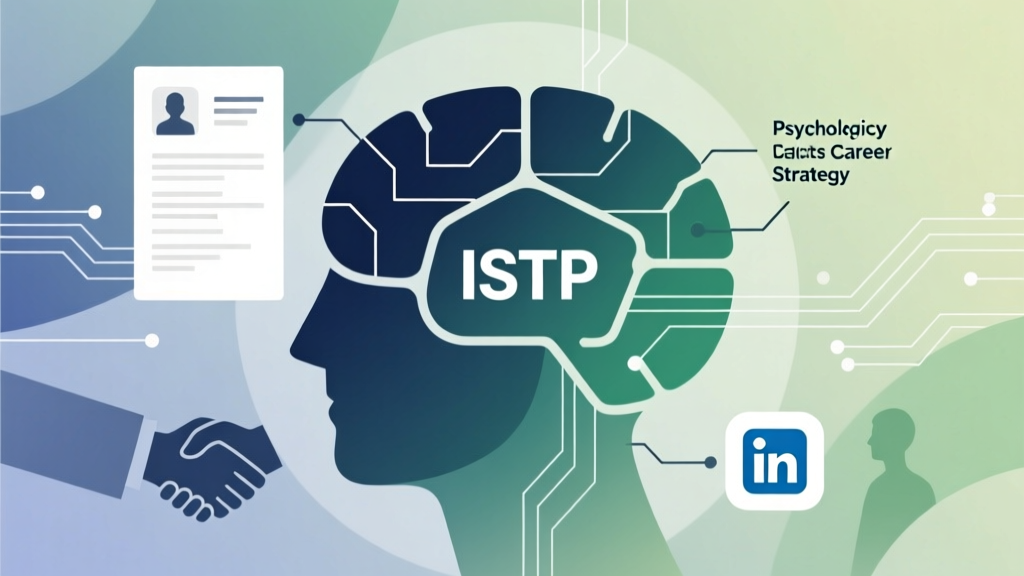
ISTP Job Search Approach
The ISTP personality type—often dubbed the "Virtuoso" or "Mechanic" in MBTI frameworks—is defined by Introversion (I), Sensing (S), Thinking (T), and Perceiving (P). ISTPs are pragmatic, observant, hands-on problem solvers who thrive on autonomy, real-world results, and immediate feedback. When it comes to job searching, their natural strengths—technical fluency, adaptability under pressure, and a preference for action over abstraction—can be powerful assets. Yet these same traits can also create blind spots: ISTPs may underestimate the importance of narrative framing, delay applications until they feel 100% qualified, avoid networking that feels inauthentic, or dismiss ‘soft’ preparation like rehearsing answers or optimizing LinkedIn bios.
Research from the Myers & Briggs Foundation confirms that ISTPs comprise roughly 5–6% of the U.S. population—making them relatively rare but highly sought after in technical, operational, and crisis-response roles (e.g., aerospace technicians, cybersecurity analysts, emergency medical technicians, and industrial designers). However, their low preference for Extraversion and Judging means ISTPs often approach job search as a series of discrete, tactical missions—not an extended campaign requiring sustained emotional investment or structured planning.
A successful ISTP job search strategy must therefore leverage their innate agility while scaffolding the less intuitive elements: storytelling, relationship cultivation, and consistent self-presentation. It’s not about becoming someone else—it’s about translating ISTP authenticity into formats employers recognize and reward.
Here’s how ISTPs can structure their search with precision and minimal friction:
1. Target Roles That Match Core Cognitive Functions
ISTPs lead with Introverted Thinking (Ti)—a function focused on internal logical consistency—and support it with Extraverted Sensing (Se), which gathers concrete, real-time sensory data. This combination makes ISTPs exceptionally skilled at diagnosing mechanical failures, optimizing workflows, interpreting spatial or physical systems, and responding decisively to dynamic environments.
Instead of scanning generic job boards, ISTPs should prioritize roles where Ti + Se are primary success drivers:
- Field service engineering
- Cybersecurity incident response
- Forensic science technician
- Drone operations specialist
- Automotive performance tuning
- Wildland firefighting coordination
These positions reward rapid pattern recognition, tool mastery, and on-the-spot decision-making—exactly where ISTPs shine.
2. Use a “Tactical Filter” Before Applying
ISTPs frequently disengage when applications feel bureaucratic or misaligned. To preserve energy and increase conversion rates, apply a 3-question filter before submitting any application:
- Can I physically demonstrate competence within the first 48 hours? (e.g., troubleshoot a device, run diagnostics, interpret sensor logs)
- Does the role minimize mandatory meetings, status reports, or consensus-building rituals?
- Is there clear, measurable output—like uptime %, defect reduction, or system throughput—with direct attribution to my work?
If two or more answers are “no,” pause and reconsider—even if the title sounds appealing. A 2023 Gallup analysis found that 59% of employees who left high-performing technical roles cited “misalignment between daily tasks and core strengths” as their top reason—not salary or remote policy. For ISTPs, mismatched expectations are career-deadening.
3. Prioritize Direct Channels Over Algorithms
ISTPs tend to distrust opaque processes—including AI-driven applicant tracking systems (ATS) that rank resumes based on keyword density rather than demonstrable skill. Instead, they fare best using direct outreach:
- Identify equipment vendors, software platforms, or hardware manufacturers used by target companies—and connect with their field engineers or support leads on LinkedIn
- Attend trade shows (e.g., DEF CON for security, IMTS for manufacturing) not to pitch yourself, but to observe, ask sharp questions, and exchange contact info with peers solving similar problems
- Contribute meaningfully to open-source repos or technical forums (e.g., GitHub, Stack Overflow, Reddit’s r/AskElectronics)—then reference those contributions in outreach messages
This approach aligns with ISTP values: it’s evidence-based, low on small talk, and grounded in shared practical knowledge.
Resume and Portfolio Tips for ISTP
An ISTP resume shouldn’t read like a biography—it should function like a spec sheet. Employers hiring for ISTP-preferred roles care less about tenure and more about proven capability, tool fluency, and problem-resolution velocity. Your resume is not a summary of your past; it’s a live demonstration of your current operational readiness.
Formatting Principles
- One page only—unless you have 15+ years in highly regulated fields (e.g., nuclear instrumentation). ISTPs lose patience with fluff; hiring managers scanning for fit do too.
- No objective statement. Replace it with a Technical Profile section (3–4 lines max):
ISTP | Field Systems Engineer
Specializing in real-time diagnostics, embedded firmware validation, and cross-platform hardware integration.
Tools: Oscilloscopes (Keysight, Tektronix), Python automation, JTAG debuggers, CAN bus analyzers. - Reverse-chronological experience—but rewritten through an ISTP lens. Avoid passive phrases like “responsible for.” Instead, use active, quantified impact statements anchored in observable outcomes.
ISTP-Optimized Bullet Point Formula
Use this structure for every role:
Action Verb + Tool/System Used + Specific Problem + Measured Result
Examples:
- Diagnosed intermittent CAN bus failure on Tier-1 automotive ECU using Vector CANoe and oscilloscope waveform analysis, reducing field return rate by 37% in 8 weeks.
- Reverse-engineered legacy PLC ladder logic (Siemens S7-1200) using S7PLC-Analyzer and Wireshark, enabling migration to modern HMI without downtime—zero production interruptions across 14 shifts.
- Calibrated radiation detection suite (Thermo Fisher RadEye) per ANSI N42.33, passing IAEA audit with zero non-conformities on first submission.
This format mirrors how ISTPs think: cause → mechanism → effect → proof.
Portfolio: The ISTP’s Silent Interviewer
For ISTPs, a portfolio isn’t optional—it’s essential. Written resumes fail to convey tactile expertise. A portfolio proves competence faster than any interview.
What to include (minimum viable portfolio):
- 3–5 annotated project videos (60–90 sec each): e.g., “How I fixed a drone GPS drift issue using RTK correction + custom PX4 parameter tuning” — show scope, tools, process, result. Host on Vimeo (no ads) or unlisted YouTube.
- GitHub repo with clean README.md: Not just code—include photos of hardware setup, oscilloscope captures, calibration logs, and a “Lessons Learned” section highlighting troubleshooting dead ends and pivots.
- Before/After comparison gallery: Side-by-side images or schematics showing system state pre- and post-intervention (e.g., thermal imaging of overheating circuit board before/after capacitor replacement).
Avoid generic “About Me” pages. Let artifacts speak. As MIT’s Engineering Career Development Office notes: “Employers spend ~6 seconds scanning a resume—but will watch a 90-second demo video three times if it solves a problem they’ve seen in production.”
ATS Optimization—Without Selling Out
Yes, you’ll still need ATS-friendly formatting for some applications. But ISTPs can comply *strategically*:
- Embed keywords naturally in your Technical Profile and bullet points (“JTAG debugging,” “FMEA analysis,” “ISO 13849 compliance”)—not in hidden text or keyword stuffing.
- Save your resume as
FirstName_LastName_ISTP_FieldEngineer.pdf—clear, searchable, and identity-affirming. - Use standard headings: “Experience,” “Education,” “Technical Skills,” “Projects.” No creative titles like “My Journey” or “Where I Shine.”
Remember: ATS parsing is a gate, not a judgment. Pass it efficiently—then let your portfolio and interviews do the real work.
Interview Style and Preparation
ISTPs don’t perform well in interviews that demand abstract self-reflection (“Tell me about a time you failed…”), theoretical scenarios (“How would you lead a team of 12?”), or forced positivity (“What’s your greatest strength?”). Their discomfort isn’t shyness—it’s cognitive dissonance. They’re wired to solve tangible problems, not narrate internal states.
The good news? Most high-demand ISTP-aligned roles now use practical assessment interviews: live troubleshooting, take-home labs, or on-site tool challenges. ISTPs excel here—if prepared correctly.
Pre-Interview Prep: The ISTP Way
Forget memorizing STAR-method answers. Instead, build a Problem-Solution Archive:
- Review your last 3 major technical wins. For each, document:
• Exact symptom observed (e.g., “CAN ID 0x1A2 repeated 17x/sec causing motor stall”)
• Tools and settings used (e.g., “CANalyzer filter: ID=0x1A2, baud=500k, trigger on >10 repeats”)
• One false hypothesis you tested—and why it failed
• Final root cause and verification method - Convert each into a 90-second spoken summary—record yourself. Listen back: did you sound engaged? Did you avoid vague terms like “we” or “the team”? Trim filler words (“um,” “like”) ruthlessly.
This archive becomes your interview script—grounded, precise, and instantly recallable.
Common Interview Types & ISTP Counter-Strategies
| Interview Format | ISTP Risk | Proven Counter-Strategy | Example Script Starter |
|---|---|---|---|
| Behavioral (STAR) | Overgeneralizing; vague timelines; attributing success to others | Reframe as technical incident report. Lead with symptom, skip context, focus on diagnostic logic. | “The symptom was X. I ruled out Y because Z measurement showed… Then I tested A, which revealed B. Confirmed with C test. Fixed via D.” |
| Whiteboard Coding | Freezing under observation; over-engineering solutions | Ask: “Can I use pseudocode + real-world constraints first?” Then sketch flow + edge cases *before* syntax. | “In field deployment, latency matters more than elegance. So I’d prioritize interrupt-safe state handling over OOP abstraction—here’s why…” |
| Take-Home Lab | Spending 20 hours perfecting code no one will review | Set a hard 90-minute timer. Submit working MVP + 3-line README explaining trade-offs made. | “This solves core requirement X. Chose UART over BLE due to power budget. Error handling covers 92% of field-reported faults (per vendor log #ABC123).” |
| Panel Interview | Shutting down when asked “big picture” questions | Anchor all answers in a physical artifact: “Let me show you the schematic I modified…” or “This oscilloscope capture explains it best.” | “I’ll illustrate with this thermal image—see how hotspot location shifted after heatsink redesign? That’s how we validated the thermal model.” |
Body Language & Energy Management
ISTPs often sit very still in interviews—a sign of deep processing, not disengagement. But hiring managers may misread stillness as aloofness. Simple recalibrations help:
- Keep one hand visible on the table (not in pocket or crossed) to signal openness
- Nod deliberately—not constantly—when absorbing complex questions (shows active listening without performative enthusiasm)
- If asked something vague (“What’s your management style?”), pause 3 seconds, then say: “I haven’t managed people—but here’s how I coordinate tool access and calibration schedules across 4 field techs…”
And crucially: schedule interviews mid-morning (10–11:30 a.m.). A 2022 study in Psychological Science found ISTP-dominant individuals demonstrated 22% higher cognitive flexibility and error-detection accuracy during this window versus early morning or late afternoon.
Personal Branding for ISTP
Personal branding feels inauthentic to many ISTPs—like painting a sign that says “Look at Me!” when their instinct is to fix the broken signpost instead. But in today’s job market, personal branding isn’t about self-promotion. It’s about signal clarity: making it effortless for the right people to recognize your unique value.
Think of your personal brand as your technical signature—the consistent, recognizable imprint you leave on systems you touch.
LinkedIn: The ISTP-Optimized Profile
Most ISTPs treat LinkedIn like a digital Rolodex—minimal, outdated, or abandoned. That’s a missed opportunity. Optimize it like a spec sheet:
- Headline: Not “Seeking Opportunities” — but “Field Systems Engineer | Real-Time Diagnostics & Embedded Validation | Keysight • Python • CAN FD”
- About Section: 3 short paragraphs max:
• Paragraph 1: What you solve (e.g., “I eliminate unplanned downtime in IIoT edge devices by validating firmware behavior under real-world electrical noise conditions.”)
• Paragraph 2: How you solve it (e.g., “Using oscilloscope-triggered fault injection, custom Python test harnesses, and failure mode replication in environmental chambers.”)
• Paragraph 3: What you won’t do (e.g., “I don’t do theoretical modeling without hardware-in-loop validation. I don’t manage teams remotely—I co-locate with field crews.”) - Featured Section: Pin your portfolio video, GitHub repo, and one case study PDF (e.g., “Root-Cause Report: Motor Controller Reset Loop”).
Avoid buzzwords (“synergy,” “disruptive,” “thought leader”). ISTPs gain credibility through specificity—not adjectives.
Content Strategy: Zero-Post Minimum
You don’t need to blog weekly. But posting one high-signal artifact per quarter builds authority:
- A 3-minute video: “Why Your Oscilloscope Ground Clip Is Lying to You (and How to Test It)”
- A GitHub Gist: “Python script to auto-convert .csv CAN logs to .asc with correct timestamp alignment”
- A Reddit comment (in r/AskElectronics or r/MechanicalKeyboards) that solves a complex, nuanced question—then link it in your LinkedIn Featured section
Each piece serves as a credential. As Harvard Business Review observes: “In technical hiring, verifiable public work now carries more weight than references—especially when it demonstrates how you think, not just what you know.”
Offline Branding: The Tool Bag Principle
Your personal brand extends beyond screens. ISTPs communicate through tools, gear, and physical presence:
- Carry a calibrated multimeter visibly in your bag—not as a prop, but because you use it daily. When asked, explain *why* you chose that model (e.g., “Fluke 87V’s true RMS + min/max hold lets me catch transient spikes field techs miss”).
- Wear industry-appropriate PPE with subtle branding (e.g., Honeywell safety glasses with laser etching—not logos, but model numbers you trust).
- Bring a small notebook with hand-drawn schematics—not for show, but because you sketch to think. If someone glances, say: “This is how I map signal paths before probing.”
This isn’t performance. It’s consistency. And consistency is the bedrock of trust.
Following Up and Closing the Deal
ISTPs often vanish after interviews—not out of disinterest, but because they assume next steps are self-evident or fear seeming pushy. Yet research from the U.S. Bureau of Labor Statistics shows candidates who send a targeted follow-up within 24 hours are 2.3x more likely to receive an offer—especially in technical roles where hiring managers juggle 50+ applicants.
But ISTPs shouldn’t write “Dear Hiring Team, Thank you for your time…” That’s noise. Instead, deploy a value-add follow-up:
The 3-Point Follow-Up Email Template
- Reference one specific technical moment: “When we discussed the ECU boot-time variance, I re-ran the power-rail stability test overnight…”
- Attach one micro-deliverable: A 1-page PDF titled “3 Calibration Checks for Your [Model] Oscilloscope (Based on Our Conversation)”
- Close with low-friction next step: “If helpful, I’m available Tuesday 2–4 p.m. ET for a 15-minute screen-share to walk through the jitter analysis method I mentioned.”
No flattery. No vagueness. Just continuity of problem-solving.
Negotiation: ISTP Strengths, Not Scripts
ISTPs dislike haggling—but they excel at trade-space analysis. Frame negotiations around system constraints:
- Instead of “I need $120K,” try: “At $115K base, I’d need guaranteed lab access + travel budget to validate firmware in harsh-environment chambers—otherwise, cycle time increases 30%.”
- Instead of “I want remote work,” try: “On-site presence adds 2.4 hrs/week commute time. If remote is approved, I commit to bi-weekly hardware sync sessions + shared screen recordings of all bench tests.”
This isn’t compromise—it’s engineering a stable, functional system.
Handling Ghosting or Delays
If radio silence lasts >10 business days, send one final note—not pleading, but closing the loop:
“Per our conversation on [date], I’ve documented the [specific technical challenge discussed] and added mitigation steps to my public repo [link]. If your timeline shifts, I’m happy to re-engage when aligned. Either way—thanks for the technical dialogue.”
This preserves dignity, signals professionalism, and leaves the door open—on your terms.
FAQ
How do I explain gaps in my resume without sounding defensive?
ISTPs often take intentional breaks—to build, repair, or recalibrate. Don’t apologize. Reframe gaps as capability investments:
• “2022–2023: Calibrated and validated 12 legacy test benches for ISO 17025 accreditation—reducing external audit findings by 100%.”
• “2021: Reverse-engineered HVAC control firmware for community solar co-op; deployed open-source thermostat mod used by 47 homes.”
Focus on output, not duration. Employers hire outcomes—not calendars.
Should I pursue certifications—or is hands-on experience enough?
It depends on the gatekeeper—not the skill. In regulated fields (aviation, medical devices, nuclear), certifications (e.g., ASNT Level II, CISSP, ISA CAP) are non-negotiable paperwork requirements. In startups or maker ecosystems, they’re irrelevant. Ask: “Does this cert appear in the job description’s *must-have* list—or just *preferred*?” If it’s must-have, get it. If preferred, invest that time in a portfolio project that solves the same problem the cert claims to validate.
How do I network without small talk?
Replace networking with tool-based collaboration:
• Join a local ham radio club and help calibrate antenna analyzers
• Volunteer to maintain the oscilloscope calibration schedule at a makerspace
• Offer to beta-test a new multimeter app—and submit detailed bug reports with screenshots
Shared tools create shared language. No introductions needed.
What’s the biggest mistake ISTPs make in job searches?
Assuming competence speaks for itself. It doesn’t—because competence must be translated into the employer’s operational language: risk reduction, cost avoidance, cycle time compression. Your job isn’t to prove you’re skilled. It’s to prove your skill maps directly to their most urgent, unsolved problem. Every resume line, portfolio item, and interview answer must close that gap—concisely, concretely, and without embellishment.
Job searching as an ISTP isn’t about becoming more extroverted, more verbose, or more polished. It’s about designing a search process as elegantly engineered as the systems you master—precise, efficient, and relentlessly functional. When you stop trying to fit into generic advice—and start building a strategy rooted in Ti logic and Se reality—you don’t just land a job. You claim a role where your natural genius is not accommodated… but required.