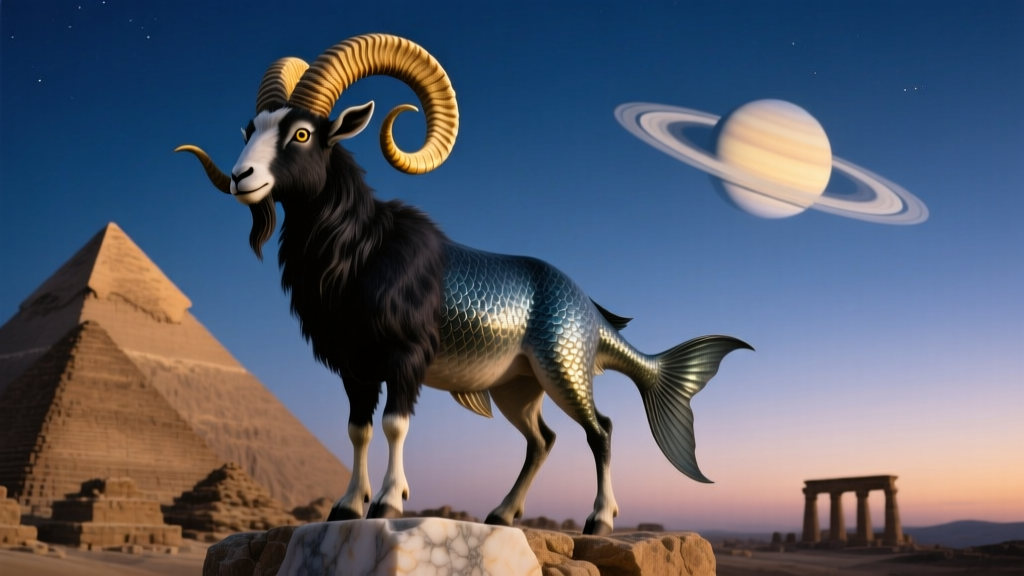
Individuals born under the january 10th horoscope sign fall into the middle of Capricorn, a zodiacal archetype steeped in ancient Mesopotamian mythology and Hellenistic astronomical observation. Unlike modern pop-astrology that reduces Capricorn to mere career ambition, the historical origin of this sign reveals a complex duality: the terrestrial goat climbing the mountain and the celestial fish navigating the deep unconscious. To understand the psychological and spiritual blueprint of a January 10th native, we must trace the lineage of the Sea-Goat back to Sumerian star catalogs, Greco-Roman mythos, and the Chaldean decan system.
The Ancient Roots of the January 10th Horoscope Sign
The conceptual foundation of Capricorn predates Western astrology by millennia. In the Babylonian star catalog known as the MUL.APIN (compiled around 1000 BCE), the constellation was designated as SUḪUR.MAŠ, translating to the 'Goat-Fish.' This hybrid creature was not a random artistic choice but a profound theological symbol representing the god Ea (also known as Enki in Sumerian). Ea was the deity of wisdom, magic, and the subterranean fresh waters known as the Abzu. According to the Metropolitan Museum of Art's archives on Mesopotamian history, Ea was often depicted with streams of water flowing from his shoulders, teeming with fish, cementing the aquatic half of the Capricorn archetype.
For a January 10th native, this Babylonian origin implies an innate connection to hidden knowledge, structural wisdom, and the ability to navigate emotional depths (the fish tail) while maintaining a pragmatic, grounded exterior (the goat). The duality of the SUḪUR.MAŠ is the earliest recorded evidence of Capricorn's capacity to bridge the material and spiritual realms.
Mythological Origins: The Sea-Goat and the Gods
As astrological knowledge migrated from Babylon to the Hellenistic world, the Goat-Fish was syncretized with Greek mythology, adopting the name Aigokeros (Goat-Horned). The mythological origin story most closely associated with this sign involves the god Pan and the monstrous Titan Typhon.
Pan and the Escape to the Nile
According to Hellenistic myth, when the hundred-headed monster Typhon attacked Mount Olympus, the gods fled to Egypt, disguising themselves as animals to hide. Pan, in a state of panic, attempted to transform into a fish to swim away in the Nile River. However, his transformation was incomplete: his upper half remained a goat, while his lower half became a fish. Zeus, amused and impressed by this bizarre hybrid form, later placed Pan's image in the heavens as the constellation Capricornus. This myth highlights the January 10th archetype's survival instinct, adaptability under extreme pressure, and the occasional awkwardness of balancing earthly responsibilities with emotional escapism.
The Egyptian Connection: Khnum and the Nile
Parallel to the Greek myth, the Egyptians associated the Goat-Fish with the flooding of the Nile and the god Khnum, the ram-headed deity who molded humanity from river clay. The heliacal rising of the constellation in ancient times coincided with critical agricultural shifts. Thus, the historical Capricorn is intrinsically linked to the management of resources, the building of civilization, and the mastery over chaotic natural forces.
Astrological Evolution: Hellenistic to Modern Capricorn
The interpretation of the sign has shifted dramatically across different astrological eras. Understanding these shifts provides a multi-layered framework for analyzing the January 10th personality profile.
| Era | Designation | Ruler / Deity | Core Historical Attribute |
|---|---|---|---|
| Babylonian (c. 1000 BCE) | SUḪUR.MAŠ (Goat-Fish) | Ea / Enki | Wisdom, Subterranean Waters, Magic |
| Hellenistic (c. 2nd C. BCE) | Aigokeros (Goat-Horned) | Cronus / Saturn | Time, Agriculture, Boundaries, Karma |
| Medieval Islamic (c. 9th C.) | Al-Jady (The Billy Goat) | Zuhal (Saturn) | Melancholy, Structural Foundation, Endurance |
| Modern Psychological (20th C.) | Capricorn | Saturn / Earth Element | Ambition, Shadow Integration, Systemic Authority |
Claudius Ptolemy, in his foundational 2nd-century text Tetrabiblos (available via the Perseus Digital Library), classified Capricorn as a cardinal, earthy, and commanding sign. Ptolemy's framework shifted the focus from the aquatic mythology of Babylon to the terrestrial, structural qualities of the Earth element, cementing the modern association with ambition and material mastery.
The Second Decan: Taurus Influence on January 10th
To achieve absolute precision in historical astrology, one must look beyond the primary sign and examine the decan system. The zodiac is divided into 36 decans, each spanning 10 degrees. January 10th typically falls between the 19th and 20th degrees of Capricorn, placing it squarely in the Second Decan of Capricorn.
In the Chaldean decan system, the second decan of Capricorn is sub-ruled by Taurus, and by extension, its planetary ruler, Venus. This introduces a fascinating historical paradox: a sign ruled by the austere, restrictive planet Saturn is internally modified by the sensual, wealth-oriented energy of Venus/Taurus.
- Material Manifestation: While first-decan Capricorns (ruled purely by Saturn) focus on abstract authority and duty, January 10th natives possess the Taurean drive to build tangible, aesthetic, and lasting material wealth.
- Sensory Grounding: The Venusian sub-rulership grants a profound appreciation for physical comforts, fine arts, and culinary excellence, serving as a necessary counterbalance to Saturn's ascetic tendencies.
- Stubborn Endurance: The combination of Cardinal Earth (Capricorn) and Fixed Earth (Taurus decan) creates an immovable force. Historically, this placement was associated with master builders and architects who refused to compromise on structural integrity.
Saturn's Historical Rulership and the Festival of Saturnalia
Capricorn's traditional ruler is Saturn (Chronos to the Greeks). In ancient Rome, the winter solstice period—when the Sun traversed the early degrees of Capricorn—was marked by the festival of Saturnalia. This was a time of role-reversal, feasting, and the temporary suspension of societal hierarchies.
The historical purpose of Saturnalia was to acknowledge the darkness of winter and the necessity of releasing control before the slow climb back toward the light. For the January 10th native, whose birthday occurs shortly after the solstice and the peak of these ancient festivities, the psychological imperative is clear: true mastery (Saturn) requires the wisdom to know when to release control, rest, and allow the natural cycles of renewal to occur. The rigid taskmaster archetype is historically incomplete without the Saturnalian understanding of rest and communal bonding.
Practical Application: Using Historical Archetypes Today
Integrating these ancient origin stories provides a highly specific, actionable framework for individuals born on January 10th. Rather than relying on generic horoscopes, leverage your historical blueprint:
- Channel the Ea/Enki Archetype for Problem Solving: When faced with a crisis, do not rely solely on brute-force logic. Engage the 'Goat-Fish' duality. Dive into the emotional and intuitive depths (the fish) to gather subconscious data, then apply rigorous, structural analysis (the goat) to build a solution.
- Utilize the Taurus Decan for Asset Building: Your Venusian sub-ruler demands that your ambitions result in tangible beauty and comfort. Direct your Saturnian discipline toward acquiring high-quality, enduring assets (real estate, fine craftsmanship, long-term dividend portfolios) rather than chasing fleeting status symbols.
- Implement Saturnalian Rest Cycles: To prevent the notorious Capricorn burnout, schedule mandatory, non-negotiable periods of 'Saturnalia'—times where you completely invert your daily routines, abandon productivity metrics, and engage in pure, unstructured communal joy.
By understanding the profound mythological and astronomical roots of the Sea-Goat, the January 10th native can transcend modern astrological stereotypes, utilizing a 3,000-year-old blueprint to navigate the complexities of modern life with historical wisdom and grounded authority.