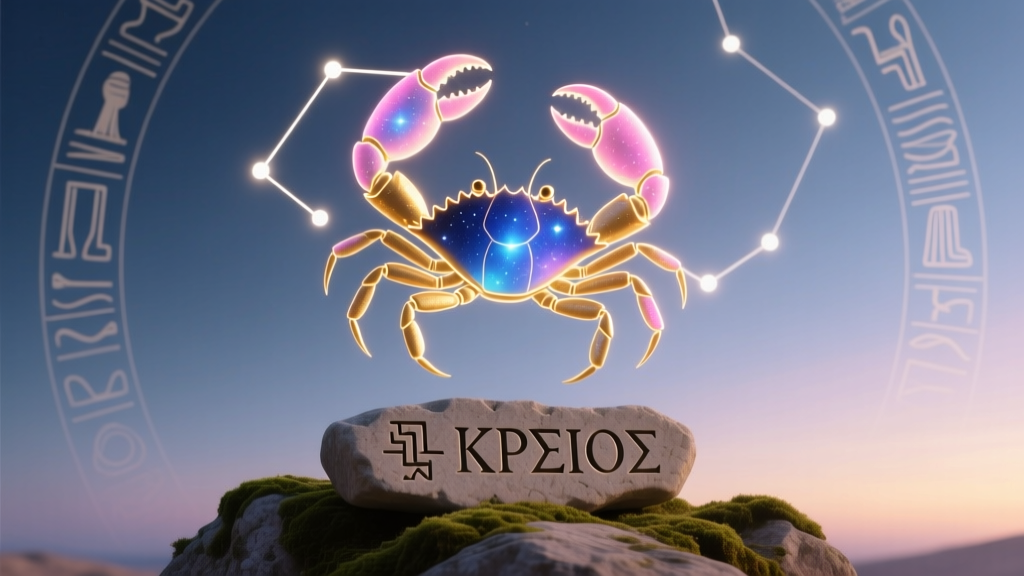
The 14th july zodiac signature places the Sun at approximately 21 to 22 degrees of Cancer, positioning it firmly within the third decan of the constellation. To understand the psychological and spiritual blueprint of individuals born on this date, we must bypass modern pop-astrology and examine the ancient Babylonian, Hellenistic, and mythological frameworks that originally defined this sector of the ecliptic. The historical origins of the mid-July Cancerian archetype reveal a complex synthesis of lunar protection, Jovian expansion, and ancient stellar omens. By tracing the etymology and mythological lineage of the Crab, we uncover the foundational mechanics of the July 14 personality.
Babylonian Origins: Al-lul and the Gate of Men
Long before Hellenistic astrologers formalized the tropical zodiac, Babylonian astronomers cataloged the stars in texts like the MUL.APIN (circa 1000 BCE). In this ancient compendium, the constellation we now call Cancer was identified as Al-lul, meaning the Crayfish or Crab. For the Babylonians, this sector of the sky held profound cosmological significance as the historical location of the summer solstice.
Because the solstice marked the turning point where the Sun's light began to wane, Al-lul was designated as the "Gate of Men." According to ancient Mesopotamian and later Neoplatonic theology, this celestial gateway was the precise portal through which souls descended from the ethereal realm into physical incarnation. Individuals born under the 14th july zodiac placement inherit this esoteric gatekeeper archetype. They possess an innate, often unconscious, sensitivity to the threshold between the material and spiritual worlds, making them highly attuned to the emotional undercurrents and unspoken needs of their communities.
The Dendera Zodiac: Egyptian Stellar Timekeeping
Before the Greeks synthesized Babylonian omens with geometric horoscopy, the Egyptians mapped the ecliptic through the Dendera Zodiac, a bas-relief ceiling in the Hathor Temple at Dendera dating to the late Ptolemaic period. In this Egyptian framework, the sector corresponding to mid-July Cancer was associated with the scarab beetle (Khepri) and the goddess Isis. The scarab represented cyclical rebirth, the rolling of the sun, and the hidden gestation of life beneath the surface.
For the July 14 native, the Egyptian scarab archetype adds a crucial layer of historical context: the necessity of subterranean emotional processing. Unlike the modern interpretation of Cancer as merely nostalgic, the Dendera framework reveals a sign deeply engaged in the alchemical process of emotional regeneration. Individuals born on this date possess a historical mandate to digest past traumas and transform them into nourishing wisdom for their community, mirroring the scarab's biological cycle of burial and rebirth.
The Karkinos Myth: Loyalty and the Hydra
The Greek mythological origin of the Cancer constellation centers on Karkinos, a giant crab summoned by the goddess Hera to aid the Lernaean Hydra during Heracles' second labor. While Heracles ultimately crushed the crab underfoot, Hera rewarded the creature's unwavering loyalty and willingness to face insurmountable odds by placing it in the heavens. You can read the primary mythological accounts of this creature on Theoi Project's Karkinos archive.
This myth is not merely a story; it is the psychological blueprint for the July 14 native. The archetype is defined by tenacious loyalty rather than guaranteed victory. Those born on this date are historically predisposed to defend their loved ones with fierce, self-sacrificing determination. The actionable takeaway for this demographic is recognizing the difference between protective loyalty and self-destructive martyrdom. Establishing firm emotional boundaries prevents the Karkinos archetype from being crushed by the very conflicts they attempt to mediate.
Hellenistic Astrology and the Third Decan of Cancer
In Hellenistic astrology, the zodiac was subdivided into 36 decans (or drekkana), each spanning 10 degrees. The 14th of July falls squarely in the third decan of Cancer (20° to 30°). While the Moon rules the overarching sign of Cancer, the Chaldean decan system assigns Jupiter as the sub-ruler of this specific 10-degree sector.
Evolution of Decan Rulerships and Egyptian Bounds
The integration of Jupiter into the lunar domain of Cancer creates a fascinating historical paradox. The Moon demands security, enclosure, and emotional preservation, while Jupiter demands expansion, philosophy, and boundary-dissolution. Furthermore, according to the Egyptian Terms (or Bounds) system utilized by Ptolemy, the 21st and 22nd degrees of Cancer fall under the specific jurisdiction of Jupiter. This creates a rare and powerful historical resonance: the Sun is simultaneously in the Chaldean Decan of Jupiter and the Egyptian Bound of Jupiter. This double-Jovian influence mitigates the traditional debilitation often associated with the Sun in Cancer, granting the July 14 native an exceptional capacity for benevolent leadership. The following table illustrates how different historical astrological systems interpreted this specific sector:
| Era / System | Decan Ruler | Associated Imagery | Core Archetypal Focus |
|---|---|---|---|
| Chaldean / Hellenistic | Jupiter | A man holding a snake; a woman weaving | Wisdom, domestic expansion, healing arts |
| Medieval / Picatrix | Jupiter | A hunter with a hound; gathering of resources | Provision for the family, strategic acquisition |
| Modern / Triplicity | Pisces (Neptune) | Oceanic depths, collective empathy | Spiritual dissolution, psychic boundaries |
According to the 2nd-century astrologer Vettius Valens, planets placed in the Jupiter-ruled decan of Cancer indicated individuals who would find success through teaching, managing communal resources, or engaging in maritime and cross-cultural trades. Detailed historical analyses of Hellenistic decan theory and planetary bounds can be found in academic overviews on Britannica's Astrology history section.
Stellar Omens: Praesepe and the Aselli
Ancient astrologers did not rely solely on the tropical ecliptic; they heavily integrated fixed stars and nebulae. The 21st and 22nd degrees of Cancer historically aligned with Praesepe (the Beehive Cluster, or M44), flanked by the stars Asellus Borealis and Asellus Australis (the Northern and Southern Asses).
Claudius Ptolemy, in his foundational text Tetrabiblos, categorized the stars in this cluster as having a nature similar to Mars and a moderately benefic Moon. Historically, this cluster was known as the "Manger." When prominent in a birth chart, it bestowed a deeply nurturing, almost aggressively protective instinct regarding sustenance and community welfare. However, ancient texts also warned that malefic afflictions to this specific degree could lead to "blindness"—a metaphor that modern psychological astrology interprets as a willful ignorance of harsh realities in favor of maintaining emotional comfort. The actionable directive here is to practice radical objectivity when assessing family or domestic crises, ensuring that the desire to nurture does not devolve into enabling destructive behaviors.
Practical Synthesis: Applying Historical Archetypes
Understanding the historical and mythological origins of your birthdate provides a distinct advantage in personal development. The 14th july zodiac profile is not merely a list of generic emotional traits; it is a highly specific intersection of Babylonian soul-descent mythology, Greek defensive loyalty, and Jovian expansion.
- Leverage the Gatekeeper Archetype: Use your innate sensitivity to transitional spaces by pursuing roles in mediation, grief counseling, or organizational change management, where guiding others through thresholds is required.
- Manage the Karkinos Reflex: Before intervening in a loved one's conflict, institute a mandatory 24-hour deliberation period to assess whether your involvement is genuinely protective or merely a reflexive martyrdom response.
- Activate the Jovian Decan: Counteract the restrictive tendencies of the Crab's shell by committing to one annual cross-cultural immersion or advanced philosophical study, satisfying the third-decan requirement for expansive meaning.
- Utilize the Praesepe Nurturing Instinct: Channel the "Manger" archetype into structured community-building, such as organizing local food security initiatives or creating mentorship networks, rather than internalizing the emotional burdens of your immediate family.
By anchoring your self-awareness in these ancient frameworks, you move beyond superficial horoscopes and begin operating within the deep, structural mechanics of your astrological lineage.