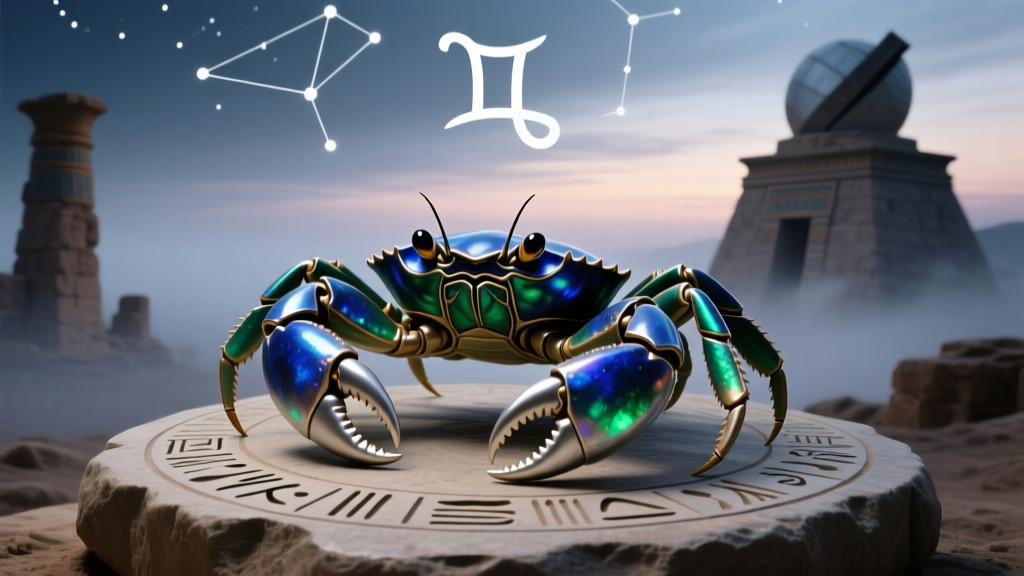
The july 6 zodiac profile occupies a highly specific and historically rich coordinate in the astrological calendar: the 14th to 15th degrees of tropical Cancer. Unlike modern sun-sign columns that homogenize the entire month, historical astrology dissects this exact placement through the lens of ancient decans, lunar mansions, and Babylonian stellar catalogs. To understand the true origin story of a July 6 birth, we must bypass contemporary psychological astrology and examine the Mesopotamian boundary stones, Hellenistic decan rulers, and the mythological texts that first codified the archetype of the celestial crab. By tracing the lineage from the MUL.APIN astronomical compendium to the Hellenistic synthesis of Vettius Valens, we uncover the precise historical mechanics that govern this mid-summer placement.
Babylonian Roots: MUL.AL.LUL and the Boundary Stones
Long before the Greeks formalized the zodiac, the Babylonians mapped the ecliptic in the MUL.APIN astronomical compendium, compiled around 1000 BCE. In this early catalog, the constellation we now recognize as Cancer was designated as MUL.AL.LUL, translating to the "turtle" or "crayfish." This amphibious archetype was intrinsically linked to the Euphrates River. The heliacal rising of this constellation coincided with the peak summer flooding of the river, a vital agricultural event that brought fertile silt to Mesopotamia.
For an individual born on July 6, the historical archetype is not merely a crab, but a boundary-dweller. The crayfish and the turtle both possess hard exterior shells and soft interiors, navigating the liminal space between water and land. According to the British Museum's Mesopotamian astronomical diaries, this specific sector of the sky was associated with the goddess Ningal, a deity of reed beds and marshlands. This origin story imbues the July 6 native with an ancestral resilience and an instinctual drive to protect their emotional core beneath a calcified exterior.
The Hellenistic Shift and the July 6 Zodiac Decan
As astrological knowledge transferred from Babylon to Alexandria, Hellenistic astrologers like Ptolemy and Vettius Valens refined the zodiac into a highly structured mathematical system. A critical component of this system was the decan division, which split each 30-degree sign into three 10-degree sectors. The July 6 placement falls squarely into the second decan of Cancer (spanning 11° to 20°).
Under the Chaldean order of planetary rulerships, the first decan of Cancer is ruled by the Moon (the sign's domicile ruler), but the second decan is sub-ruled by Mercury. This creates a fascinating historical paradox: the deeply emotional, lunar-driven waters of Cancer are filtered through the intellectual, communicative, and analytical lens of Mercury. In his foundational text, the LacusCurtius archive of Ptolemy's Tetrabiblos, the synthesis of these planetary influences suggests a personality that processes profound emotional undercurrents through a highly rational, articulate framework. This Mercurial sub-rulership explains the historical association of this specific decan with commerce, navigation, and the translation of feelings into tangible systems.
Historical Evolution of the July 6 Archetype
| Era | Designation | Ruling Planet/Deity | Core Archetypal Focus |
|---|---|---|---|
| Babylonian (c. 1000 BCE) | MUL.AL.LUL (Crayfish/Turtle) | Ningal / Ea | Agricultural cycles, river flooding, boundary protection |
| Hellenistic (c. 150 CE) | Cancer Decan II (Karkinos) | Moon (Domicile) / Mercury (Decan) | Navigation, commerce, intellectualizing emotion |
| Medieval (c. 1200 CE) | Al-Tarf (The Glance) | Moon / Mars (Mansion influence) | Strategic vision, defensive positioning, maritime trade |
Karkinos and the Heraclian Mythos
The transition from the Babylonian crayfish to the Greek crab (Karkinos) was solidified in the mythological texts of the Hellenistic and Roman eras. The most authoritative account of this origin story is found in the Catasterismi (Constellation Myths), attributed to Eratosthenes of Cyrene in the 3rd century BCE.
According to the myth, during Heracles' second labor to slay the Lernaean Hydra, the goddess Hera—seeking to ensure Heracles' failure—sent a giant crab to distract him by biting his heel. Heracles, annoyed by the minor nuisance, crushed the crab beneath his foot. Recognizing the creature's loyal sacrifice, Hera elevated Karkinos to the heavens, placing it near the Lion (Leo) and the Hydra. For the July 6 native, this mythos is not merely a story of defeat; it is a historical blueprint for strategic distraction and loyalty. The crab's hard shell and sideways movement represent an evolutionary adaptation to confronting overwhelming forces not through direct, brute-force confrontation (the domain of Aries or Leo), but through tactical flanking, environmental awareness, and impenetrable defense.
The Tropic of Cancer and Axial Precession
A crucial piece of the July 6 zodiac history involves the geographical and astronomical naming of the "Tropic of Cancer." In the Hellenistic era, when the zodiac was formalized by figures like Hipparchus of Nicaea (c. 127 BCE), the summer solstice occurred precisely when the Sun entered the constellation of Cancer. The latitude at which the Sun was directly overhead on this day was thus named the Tropic of Cancer.
However, due to the precession of the equinoxes—a 25,772-year wobble in the Earth's rotational axis discovered by Hipparchus—the summer solstice Sun now resides in the sidereal constellation of Gemini, and the tropical sign of Cancer begins slightly before the solstice. Despite this astronomical shift, the tropical zodiac used by Western astrologers remains anchored to the seasons rather than the visible constellations. Therefore, the July 6 placement retains its historical title as the "Gate of Men," the traditional Hellenistic designation for the summer solstice ingress point through which souls were believed to descend into physical incarnation.
Applying Historical Astrology to the Modern Profile
Understanding the ancient mechanics of this placement provides a concrete framework for decision-making and self-actualization, moving beyond vague horoscopes into applied historical astrology:
- Leverage the Mercurial Decan: Because the 11°–20° sector of Cancer is historically ruled by Mercury, July 6 natives should schedule critical contract negotiations, real estate closings, and intellectual property filings during the Moon's transit through this exact decan. The synthesis of lunar intuition and Mercurial precision yields optimal outcomes for binding agreements.
- Utilize the Lunar Mansion (Al-Tarf): In the Arabic lunar mansion system, the mid-degrees of Cancer correspond to Al-Tarf (The Glance or The Eye). Historically used for maritime navigation and strategic observation, this mansion favors gathering intelligence and assessing competitors. Natives should use this period for market research and competitive analysis rather than aggressive public launches.
- Embrace the Boundary-Dweller Archetype: Drawing from the Babylonian MUL.AL.LUL, individuals born on this date thrive in liminal industries. Career paths that bridge two distinct worlds—such as maritime law, environmental engineering, psychological translation, or cross-cultural diplomacy—align with the ancient archetype of the creature that navigates both land and water.
The historical record of the July 6 zodiac reveals a lineage far more complex than the standard "nurturing crab" trope. By integrating the Babylonian association with vital waterways, the Hellenistic Mercurial sub-rulership, and the strategic mythos of Karkinos, we uncover a highly specialized astrological profile designed for tactical navigation, intellectualized empathy, and resilient boundary maintenance.