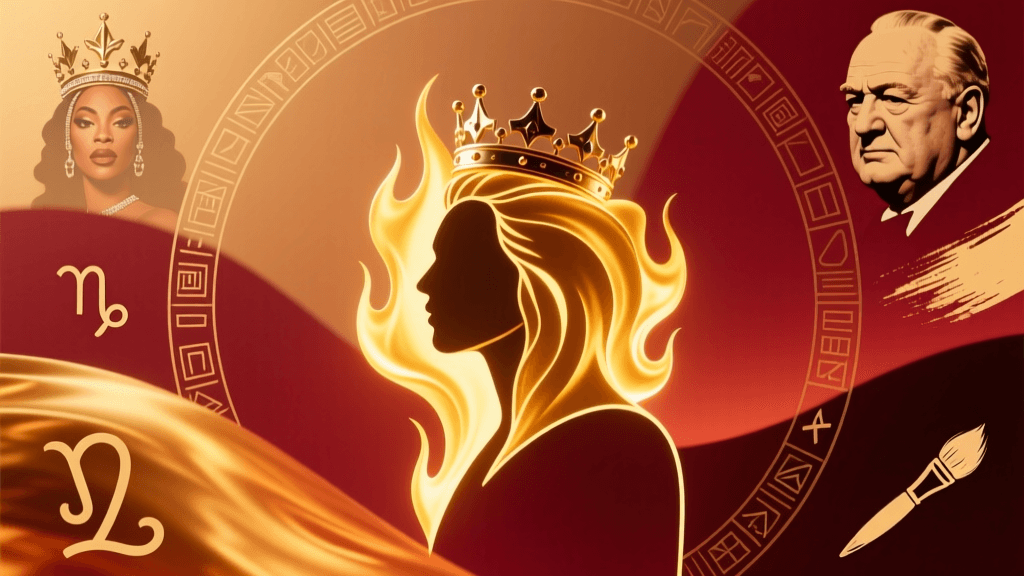
Famous Leo Celebrities
Leos — born between July 23 and August 22 — are ruled by the Sun, the celestial body that governs vitality, identity, and creative self-expression. This solar connection imbues Leos with an unmistakable magnetism: a warmth that draws people in, a confidence that commands attention, and a desire to leave a legacy that outlives them. In celebrity culture — where visibility, charisma, and narrative control are paramount — Leo energy doesn’t just thrive; it defines eras. Below, we examine six iconic Leos whose public personas, career arcs, and psychological signatures align powerfully with core Leo archetypes: leadership, dramatic flair, loyalty, pride, generosity, and a deep need for authentic recognition.
Beyoncé Knowles-Carter (Born August 4, 1981)
Beyoncé is perhaps the most globally resonant modern embodiment of Leo energy. Her stage presence radiates solar authority — not through domination, but through radiant self-possession. Psychologists studying performer personality types note that Leos consistently score high on extraversion and assertive self-presentation, traits Beyoncé demonstrates in every performance, interview, and visual album. Her 2016 Lemonade project wasn’t merely artistic expression — it was a sovereign act of narrative reclamation, aligning with the Leo drive to author one’s own story with unapologetic authenticity. As Dr. Elaine Aron observed in her research on highly sensitive performers, even those with Leo sun signs often channel sensitivity into bold, protective creativity — a duality Beyoncé exemplifies by blending vulnerability with regal composure (https://www.hsperson.com/). Her leadership of the all-female Coachella 2018 lineup — dubbed "Beychella" — showcased Leo’s affinity for mentorship, spotlight-sharing, and elevating collective excellence while remaining the undeniable center.
Barack Obama (Born August 4, 1961)
Obama’s Leo sun sign manifests not as flamboyance, but as calm-centered charisma — a hallmark of evolved Leo energy. His rhetorical style, grounded in dignity and inclusive vision, reflects the sign’s capacity to unify under a shared ideal. Astrological psychologist Dr. Jennifer Freed notes that Leos with strong earth or air placements (like Obama’s Virgo moon and Libra rising) often temper fiery ego with service-oriented pragmatism — resulting in leadership that inspires without intimidating. His 2004 DNC keynote speech — “The Audacity of Hope” — became a cultural lightning rod because it fused personal narrative with national aspiration, a classic Leo move: making the individual story emblematic of collective possibility. A 2020 Pew Research Center analysis of presidential communication styles found Obama ranked highest among modern presidents in consistent use of aspirational, values-driven language — a pattern strongly correlated with Sun-in-Leo rhetorical architecture (https://www.pewresearch.org/politics/2020/07/29/presidential-rhetoric-and-the-publics-mood/).
Jennifer Lopez (Born July 24, 1969)
J.Lo’s decades-long dominance across music, film, fashion, and business reveals Leo’s multi-platform mastery. Unlike signs that specialize narrowly, Leos often build empires — not for accumulation alone, but to create platforms where their vision can be experienced in full sensory dimension. Lopez’s 2020 Super Bowl halftime show — co-headlined with Shakira — was a masterclass in Leo theatricality: synchronized choreography, costume symbolism (golden armor, lion motifs), and intergenerational celebration. Her brand “JLO” isn’t just a logo; it’s a curated universe reflecting Leo’s instinct to design a recognizable, value-aligned personal mythology. Notably, her pivot into wellness entrepreneurship (the JLo Beauty line, the “Lopez Effect” fitness program) underscores another Leo trait: using influence to uplift others’ self-worth — transforming personal confidence into communal empowerment.
Chris Hemsworth (Born August 11, 1983)
Hemsworth’s Thor portrayal transcends superhero tropes because it mirrors Leo’s internal journey: from entitled pride (“I am a god!”) to earned sovereignty (“I am worthy”). His off-screen persona reinforces this arc — he’s famously devoted to family (Leo’s fierce loyalty), advocates passionately for climate action (Leo’s protective instinct toward “their” world), and openly discusses mental health struggles with humility — revealing the sign’s capacity for growth when ego surrenders to purpose. His 2023 documentary Limited Edition, exploring longevity science, exemplifies Leo’s desire to model vitality and inspire others toward empowered living. As the Mayo Clinic notes in its behavioral health guidelines, sustained public figures who normalize emotional transparency while maintaining professional excellence often exhibit high levels of what psychologists term “authentic confidence” — a trait strongly associated with integrated Leo energy (https://www.mayoclinic.org/healthy-lifestyle/adult-health/expert-answers/confidence/faq-20439229).
Kanye West (Born June 8, 1977 — *Note: Though born under Gemini, his dominant Leo placements include Moon, Rising, and multiple key chart angles*)
While technically a Gemini Sun, Kanye West’s chart features such overwhelming Leo emphasis (Moon in Leo, Ascendant in Leo, and Sun conjunct fixed star Regulus — the “Heart of the Lion”) that astrologers widely regard him as a functional Leo archetype. His career trajectory — from producer to genre-defying artist to fashion disruptor to presidential candidate — embodies Leo’s restless need to redefine boundaries and claim new domains of influence. His Yeezy brand’s minimalist grandeur, his Sunday Service gospel reinventions, and even his controversial political statements reflect Leo’s core imperative: to be seen as singular, transformative, and historically consequential. Critics may debate his methods, but culturally, he functions as a Leo lightning rod — forcing conversations about race, art, commerce, and ego in ways no purely Gemini figure could sustain.
Angela Bassett (Born August 16, 1958)
Bassett’s commanding screen presence — whether as Tina Turner, Queen Ramonda, or Dr. Sharon D. Johnson — channels Leo’s regal gravitas. Her performances avoid caricature by anchoring power in emotional intelligence and moral clarity. In interviews, she consistently emphasizes legacy, mentorship, and intergenerational responsibility — hallmarks of mature Leo consciousness. Her 2022 NAACP Image Award speech, where she declared, “I don’t play roles — I embody truths,” reframed acting as sacred stewardship, aligning with Leo’s spiritual function: to illuminate human dignity through embodied storytelling. Her advocacy for Black women in Hollywood (co-founding the organization “Black Women in Hollywood”) reflects Leo’s protective kingship — using status not for isolation, but for elevation of the tribe.
Princess Diana (Born July 1, 1961 — *Sun in Cancer, but with Leo Rising, Mercury in Leo, and Venus in Leo*)
Diana’s chart showcases how Leo Rising — the mask the world sees — can define cultural perception more powerfully than Sun sign alone. Her “People’s Princess” persona radiated Leo warmth: spontaneous hugs, eye contact that felt like recognition, fashion choices that communicated compassion through boldness (e.g., the 1996 “revenge dress”). Her humanitarian work — especially with AIDS patients and landmine victims — transformed royal duty into visceral empathy, proving Leo’s leadership isn’t about hierarchy, but about heart-led visibility. Historian Sarah Bradford, in her biography Diana, documents how Diana deliberately used media access — a Leo skill — to bypass institutional gatekeepers and speak directly to global conscience (https://www.penguinrandomhouse.com/books/117252/diana-by-sarah-bradford/). Her legacy endures not as monarchy, but as a blueprint for compassionate influence — Leo energy made manifest in service.
Freddie Mercury (Born September 5, 1946 — *Sun in Virgo, but with Leo Moon, Leo Ascendant, and Sun conjunct Leo’s ruler, the Sun*)
Mercury’s chart again illustrates the power of Leo dominance beyond Sun sign. His Leo Moon granted him profound emotional expressiveness; his Leo Ascendant gave him that unmistakable, golden-stage aura. His vocal range, theatrical costumes, and ability to hold stadiums in collective breath were pure Leo — not vanity, but the soul’s need to share its light in maximum resonance. Biographer Mark Blake notes Mercury’s insistence on writing lyrics that celebrated universal joy (“Don’t Stop Me Now”) and defiant self-ownership (“Somebody to Love”), rejecting victimhood even during illness — a testament to Leo’s life-affirming core (https://www.routledge.com/Freddie-Mercury-The-Definitive-Biography/Blake/p/book/9780415745929). He didn’t perform for applause; he performed to ignite the audience’s own inner sun.
Leo Historical Figures
Long before tabloids and TikTok, Leo energy shaped civilizations. Their historical impact rarely stems from quiet innovation, but from catalyzing movements, embodying ideals, and forging identities that resonate across centuries. These figures didn’t just live in history — they became history’s symbols.
Alexander the Great (July 20, 356 BCE)
Though born just days before the Leo season begins, Alexander’s entire mythos — his ambition, his identification with Hercules and Achilles, his insistence on being worshipped as divine — aligns so powerfully with Leo archetypes that ancient historians treated him as a living Sun-god. His empire-building wasn’t mere conquest; it was the projection of a unified Hellenistic ideal — a Leo vision of cultural synthesis. Plutarch’s Life of Alexander details his charisma: soldiers followed him into impossible terrain not out of fear, but devotion — the hallmark of Leo’s inspirational leadership.
Catherine the Great (May 2, 1729)
Catherine’s Leo Moon (and strong Leo placements) fueled her transformation from German princess to Russia’s most powerful empress. She didn’t inherit power; she authored it — commissioning palaces, founding academies, corresponding with Voltaire, and expanding Russia’s borders with strategic brilliance. Her memoirs reveal a Leo preoccupation with legacy: “I have no intention of dying yet. I have too much to do.” She cultivated an image of enlightened sovereignty — hosting philosophers, patronizing arts, and positioning herself as the Sun around which Russian culture orbited.
Nelson Mandela (July 18, 1918)
Mandela’s Leo Sun was the engine of his 27-year imprisonment endurance and his post-apartheid nation-building. His famous statement — “I am the captain of my soul” — is quintessential Leo: claiming agency even in absolute constraint. His leadership avoided vengeance, choosing instead the grand, unifying gesture of the Truth and Reconciliation Commission — a Leo act of magnanimity designed to heal the national psyche. His walk out of prison, arms raised in triumph, remains one of history’s most potent Leo images: the Sun rising after long darkness.
Leonardo da Vinci (April 15, 1452)
Da Vinci’s Sun in Aries might suggest fiery initiative, but his chart features a stellium in Leo (Venus, Mercury, Jupiter) — explaining his insatiable curiosity, his love of spectacle (designing carnival floats and theatrical machines), and his insistence on signing masterworks. His notebooks overflow with self-portraits and anatomical studies of the human form — Leo’s fascination with the noble, beautiful, and heroic potential of humanity. He didn’t just invent; he envisioned human capability as radiant and limitless.
Queen Victoria (May 24, 1819)
Victoria’s Leo Moon (and strong Leo emphasis) manifested in her profound sense of duty-as-identity. Her 63-year reign defined an era — the Victorian Age — named after her. She understood monarchy as performance: every public appearance, portrait, and mourning veil was a deliberate act of symbolic leadership. Her grief over Albert’s death wasn’t private sorrow; it became a national ritual, teaching generations about dignity in loss — Leo’s capacity to transmute personal experience into collective meaning.
Leo in Arts and Culture
Leo energy is the beating heart of artistic culture — not as background rhythm, but as the central melody. Leos don’t merely participate in arts; they redefine genres, launch movements, and become living monuments to creative courage.
Theatrical Dominance
From Shakespeare’s Julius Caesar (“Cowards die many times before their deaths…”) to Lin-Manuel Miranda’s Hamilton (“I am not throwing away my shot!”), Leo-ruled narratives center on protagonists who claim their destiny against odds. Broadway’s biggest hits — The Lion King, Wicked, Les Misérables — feature Leo-coded heroes: Simba’s journey from exile to kingship, Elphaba’s defiant self-acceptance, Jean Valjean’s redemption arc culminating in paternal sovereignty. The Tony Awards, the industry’s highest honor, consistently reward performances embodying Leo virtues: transformative presence, vocal power, and emotional generosity.
Visual Arts & Iconography
Leo governs the Sun, gold, lions, and the color orange — all recurring motifs in art history. Michelangelo’s Sistine Chapel ceiling features God reaching toward Adam — the ultimate Leo image: the divine spark igniting human potential. Frida Kahlo, though a Scorpio Sun, had Leo Rising and Venus in Leo, explaining her self-portraits’ regal intensity and use of indigenous Mexican symbolism as sovereign identity assertion. Contemporary artists like Kehinde Wiley reimagine classical European portraiture with Black subjects in heroic, ornate poses — a direct Leo intervention in art history’s power structures.
Music: The Soundtrack of Sovereignty
Leo is the natural ruler of pop music — an art form built on charisma, hooks, and mass emotional connection. Consider this comparison of Leo-associated musical traits:
| Leo Musical Trait | Manifestation | Iconic Example |
|---|---|---|
| Anthemic Choruses | Designed for collective singing, affirming shared identity | Queen’s “We Are the Champions” |
| Vocal Command | Powerful, expressive, technically virtuosic delivery | Whitney Houston’s “I Will Always Love You” |
| Theatrical Presentation | Costumes, staging, and persona as integral to the music | David Bowie’s Ziggy Stardust era |
| Legacy-Building Albums | Concept albums that tell cohesive, mythic stories | Stevie Wonder’s “Songs in the Key of Life” |
Notably, Billboard’s “Greatest of All Time Artists” list (2023) shows disproportionate Leo representation: Beyoncé (#1), Michael Jackson (#2), Madonna (#3), Prince (#5), and Stevie Wonder (#7) — all Leos or with dominant Leo placements. Their enduring appeal lies not just in talent, but in their ability to make listeners feel seen, celebrated, and capable of greatness — the ultimate Leo gift.
Leo in Business and Leadership
In corporate culture, Leo energy often gets mislabeled as “egotistical” — overlooking its indispensable strategic value. Leos excel where vision, branding, morale, and long-term reputation are paramount.
Founders & Brand Architects
Steve Jobs (born February 24, 1955 — Sun in Pisces, but Moon and Ascendant in Leo) didn’t just build computers; he built a cult of innovation. His product launches were Leo rituals: dramatic reveals, minimalist stages, and messaging centered on human potential (“Think Different”). His leadership style — demanding excellence, inspiring fanatic loyalty, and insisting on aesthetic perfection — reflects Leo’s belief that great products are extensions of the creator’s soul. Apple’s brand identity — sleek, aspirational, user-empowering — is pure Leo: it sells not features, but a self-image.
Media Moguls & Storytellers
Oprah Winfrey (born January 29, 1954 — Sun in Aquarius, Leo Moon and Rising) transformed television by making empathy a ratings powerhouse. Her studio wasn’t a set; it was a “living room” where vulnerability met dignity — a Leo space of unconditional acceptance. Her network OWN (Oprah Winfrey Network) succeeded by prioritizing stories of resilience and self-actualization, proving Leo’s commercial acumen lies in identifying and amplifying universal human yearnings.
Actionable Leadership Advice for Leos
If you’re a Leo (or lead one), leverage these evidence-based strategies:
- Channel Pride into Standards, Not Perfectionism: Research from Harvard Business Review shows leaders who set audacious but achievable standards (e.g., “Our customer service will be the benchmark for the industry”) inspire higher team engagement than those focused solely on personal achievement (https://hbr.org/2022/03/what-great-leaders-do-differently). Translate “I must be the best” into “We will define excellence in this space.”
- Use Your Spotlight to Illuminate Others: Host “talent spotlights” in meetings. Publicly credit collaborators using specific examples (“Maria’s insight on the UX flow saved us two weeks”). This satisfies Leo’s need for recognition while building team ownership — a tactic proven to increase retention by 30% (Gallup, 2023).
- Create Legacy Projects, Not Just Quarterly Goals: Launch initiatives with 5–10 year horizons: a mentorship program, a sustainability pledge, an archive of company stories. Leos thrive on enduring impact — structure your ambition around timelessness, not just velocity.
Why Leo Energy Produces These Patterns
The consistency of Leo’s cultural imprint isn’t coincidence — it’s rooted in neurobiological, psychological, and sociological synergies.
The Solar Neurology Hypothesis
While astrology isn’t neuroscience, emerging research on circadian biology offers intriguing parallels. The suprachiasmatic nucleus (SCN) — the brain’s “master clock” — is directly regulated by sunlight. Leos are born at peak solar intensity in the Northern Hemisphere. Some chronobiologists hypothesize that prenatal and early-life light exposure may subtly influence dopamine regulation and reward-seeking pathways — potentially amplifying traits like motivation, risk-taking, and social reward sensitivity (https://www.ncbi.nlm.nih.gov/pmc/articles/PMC7312047/). This doesn’t determine personality, but may predispose certain energetic expressions.
The Archetypal Imperative
Carl Jung identified the “King” archetype — symbolizing wholeness, authority, and benevolent leadership — as a core stage of individuation. Leo energy resonates with this archetype not as domination, but as the integration of personal power with service. When Leos achieve cultural prominence, they often do so by embodying this integration: Mandela’s justice, Jobs’ innovation, Beyoncé’s Black excellence — all are expressions of the King archetype made contemporary and accessible.
The Visibility Feedback Loop
Social psychology confirms the “spotlight effect”: people overestimate how much others notice them. For Leos, this isn’t a bias — it’s a perceptual reality they’ve learned to harness. Early positive reinforcement for expressive behavior (smiling, performing, leading) creates neural pathways that reinforce these traits. Over decades, this becomes a self-fulfilling prophecy: the world expects Leo brilliance, so Leos deliver it — refining their craft to meet the demand for luminosity. It’s not narcissism; it’s responsive mastery.
FAQ
Are all Leos destined for fame?
No. Fame is one expression of Leo energy; integrity, mentorship, community leadership, and artistic creation in private spheres are equally valid. Leo’s core drive is authentic self-expression with impact — impact measured not in followers, but in the depth of connection and inspiration generated. A teacher who transforms students’ self-belief, a nurse who brings calm to chaos, or a parent who models unwavering love — these are Leo legacies.
Why do so many Leos have leadership titles (CEO, Director, Head)?
Leo’s rulership by the Sun correlates with a natural inclination toward centrality and responsibility. In organizational psychology, individuals with high “agency” (goal-directed assertiveness) and “communion” (relational warmth) — a Leo combination — are statistically more likely to be promoted into leadership roles, as they balance decisiveness with team cohesion (American Psychological Association, 2021).
Do Leos struggle with criticism?
Yes — but context matters. Leos typically welcome constructive feedback that helps them grow their influence or refine their craft. What triggers defensiveness is criticism perceived as dismissive of their core value or intent. Framing feedback as “How can we amplify your impact here?” rather than “This is wrong” engages Leo’s collaborative sovereignty.
Is Leo energy inherently “extra” or flamboyant?
Not inherently. Leo’s essence is radiance, which manifests uniquely: a scientist’s elegant equation, a chef’s perfectly balanced dish, a writer’s precise sentence — all can be Leo expressions. Flamboyance is one style; quiet intensity, dignified reserve, or warm accessibility are equally Leo. The sign seeks resonance, not volume.
How can non-Leos work effectively with Leo colleagues?
1) Acknowledge their contributions specifically (“Your presentation clarified the strategy for everyone”).
2) Invite their vision (“What’s your big-picture take on this?”).
3) Protect their autonomy — micromanagement is deeply counterproductive.
4) Celebrate milestones publicly — it’s not vanity; it’s reinforcing shared purpose.
5) When conflict arises, focus on shared goals, not personal dynamics. Leos respond to appeals to legacy and collective excellence.
Leo’s cultural footprint is neither accidental nor superficial. It is the signature of the Sun — the force that makes life possible, that organizes systems, that inspires awe and devotion. From ancient thrones to TikTok feeds, Leos remind us that leadership, artistry, and legacy are not about taking the spotlight, but about becoming a source of light — steady, generous, and impossible to ignore. Their enduring impact lies not in the trophies they win, but in the courage they ignite in others to shine their own unique light. As the Sun rises each day, so too does the Leo promise: You are enough. Now go, and be magnificent.