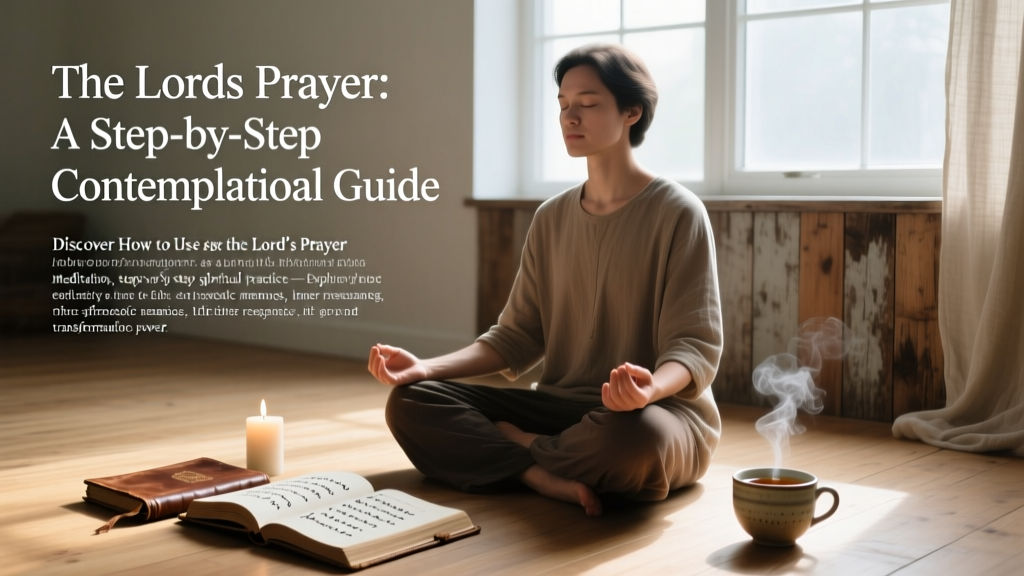
The lords prayer (Matthew 6:9-13) is frequently reduced to rote recitation in mainstream religious contexts. However, its original Greek syntax and underlying Aramaic rhythms outline a precise psychological and spiritual technology. For modern spiritual practitioners, transitioning from passive memorization to active, step-by-step contemplation transforms the text into a framework for consciousness alignment. This guide deconstructs the prayer into actionable phases, offering a practical methodology for esoteric Christian mysticism and daily meditative practice.
The Esoteric Mechanics of the Lords Prayer
Exoteric traditions often treat the prayer as a list of petitions directed at an external deity. Esoteric and contemplative traditions, drawing from early Christian mystics and modern metaphysical scholars, interpret it as an internal sequence for aligning the human will with divine consciousness. According to the Catechism's theological breakdown, the prayer is structured not merely as requests, but as a progressive movement of the soul from adoration to supplication, and finally to spiritual warfare and grounding.
By applying a step-by-step contemplative lens, each line becomes a specific cognitive and spiritual exercise. The practitioner moves from establishing a non-dual connection, through ego dissolution, to integrating shadow aspects (forgiveness), and finally sealing the energetic field.
Step-by-Step Contemplative Framework
To utilize the lords prayer as a practical spiritual tool, isolate each phrase. Pair the recitation with specific visualizations and breathwork patterns to anchor the psychological intent.
Step 1: Establishing Non-Dual Awareness
"Our Father who art in heaven"
This opening requires shifting from an isolated ego-state to a universal perspective. "Father" (Abba) denotes the source of all emanation, while "heaven" represents the unmanifested realm of pure potential. Action: Inhale deeply, visualizing your awareness expanding outward from the physical body into the surrounding space, dissolving the boundary between self and source.
Step 2: Vibrational Alignment
"Hallowed be thy name"
In esoteric traditions, a "name" is not a label but a vibrational frequency or essence. To hallow is to set apart as sacred and to tune into that specific resonance. Action: Hold your breath for four seconds, focusing on the sensation of stillness. Exhale slowly, intending to match your personal frequency to a state of reverence and neutrality.
Step 3: Ego Dissolution and Surrender
"Thy kingdom come, thy will be done, on earth as it is in heaven"
This is the core mechanism of surrender. It requires the conscious dismantling of personal attachments to specific outcomes. The "kingdom" is the realized state of divine order within the practitioner's immediate reality (earth). Action: Identify one specific anxiety or desire you are clinging to. Mentally place it in a conceptual container and release it, affirming that the macrocosmic order supersedes microcosmic preferences.
Step 4: Assimilating Supersubstantial Energy
"Give us this day our daily bread"
The Greek word used in the original text is epiousios, which translates more accurately to "supersubstantial" or "super-essential" bread, rather than mere physical food. It refers to the spiritual energy required for the current cycle of evolution. Action: Visualize drawing vital, sustaining energy from the environment into your solar plexus, grounding it for the specific challenges of the present 24-hour cycle.
Step 5: Karmic Release and Shadow Integration
"And forgive us our trespasses, as we forgive those who trespass against us"
Trespasses (or debts) represent energetic blockages caused by misaligned actions or unresolved grievances. This step is a reciprocal law: you cannot clear your own energetic debt while holding onto the debt of others. Action: Bring to mind a lingering resentment. Consciously sever the energetic cord attached to that memory, recognizing that holding the grievance restricts your own spiritual flow.
Step 6: Grounding and Energetic Protection
"And lead us not into temptation, but deliver us from evil"
Temptation here refers to being led into states of spiritual amnesia or unconscious reactivity. "Evil" (the Greek poneros) signifies the entropic forces that pull consciousness back into fragmentation. Action: Visualize a grounding cord extending from the base of your spine into the earth, sealing your energetic field against reactive, lower-frequency environmental stimuli.
Structural Breakdown: Petitions vs. Doxology
Understanding the architectural division of the text prevents practitioners from rushing through the sequence. The prayer is mathematically divided into distinct phases of psychological operation.
| Section | Phrases Included | Psychological Function | Contemplative Pacing |
|---|---|---|---|
| The Adoration | Our Father... Hallowed be thy name | Centering and frequency matching | Slow, expansive breaths |
| The Surrender | Thy kingdom come... thy will be done | Relinquishing egoic control | Extended exhalations |
| The Petition | Daily bread... forgive us... temptation | Resource acquisition and shadow work | Steady, rhythmic breathing |
| The Doxology | For thine is the kingdom, the power... | Sealing the practice and integration | Return to baseline awareness |
Integrating the Practice into Daily Ritual
To move the lords prayer from a Sunday habit to a daily spiritual technology, implement the following structural parameters:
- The 15-Minute Contemplative Block: Allocate exactly 15 minutes upon waking. Spend two minutes in silent centering, ten minutes moving through the six steps outlined above (spending roughly 90 seconds on each phrase), and three minutes in silent integration.
- Somatic Pairing: Use a physical anchor, such as a prayer rope (chotki) or mala, to track the repetitions. This engages the motor cortex, preventing the mind from wandering during the recitation.
- Circadian Rhythm Alignment: Borrowing from the Liturgy of the Hours, recite the petition phase (daily bread and forgiveness) at midday to reset your psychological state, and the protection phase (deliver us from evil) before sleep to clear the day's energetic residue.
- Micro-Dosing the Text: During high-stress moments in the day, isolate a single line. For instance, when facing interpersonal conflict, silently repeat only the forgiveness clause to trigger an immediate state-shift away from reactivity.
Common Misalignments and Corrections
Practitioners frequently encounter friction when attempting contemplative prayer. Recognizing these errors allows for immediate recalibration.
Error 1: Transactional Recitation. Treating the text as a mechanism to extract favors from the divine. Correction: Reframe the prayer as an internal tuning fork. You are not changing the divine mind; you are altering your own consciousness to perceive and accept the existing divine order.
Error 2: Semantic Glazing. The brain's tendency to auto-complete familiar phrases, resulting in zero cognitive engagement. Correction: Read the text backward, or translate key phrases into your native conceptual language (e.g., replacing "trespasses" with "karmic debts" or "psychological friction") to force the brain to process the meaning anew.
For deeper historical context on the evolution of contemplative practices, the Stanford Encyclopedia of Philosophy's entry on Mysticism provides extensive analysis on how repetitive sacred texts alter neural pathways and induce non-ordinary states of consciousness. Furthermore, analyzing the original Greek texts via resources like Bible Gateway's interlinear tools reveals the nuanced vocabulary that standard English translations often flatten.
Mastering the lords prayer as a step-by-step contemplative practice requires consistent, deliberate effort. By treating each phrase as a distinct psychological operation, practitioners transform a familiar historical text into a dynamic, living instrument for spiritual and cognitive alignment.