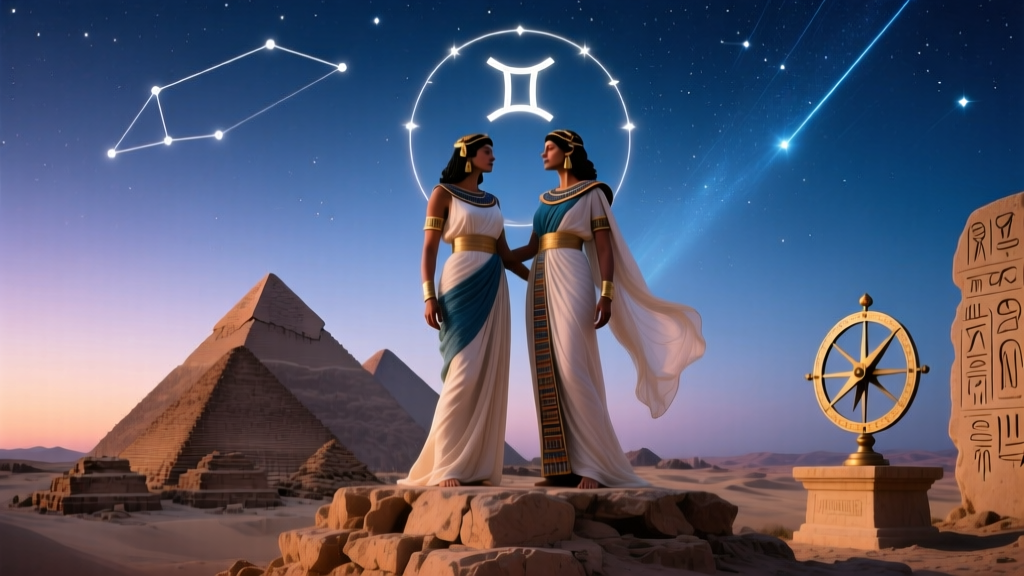
Identifying the horoscope sign for May 26 requires looking past modern pop astrology and examining the rigorous historical, astronomical, and esoteric frameworks that define Gemini. Individuals born on this date fall under the tropical sun sign of Gemini, specifically within the first decan. However, the true depth of this placement is rooted in thousands of years of celestial observation, Mesopotamian myth, and Hellenistic philosophy. To understand the psychological and spiritual architecture of the May 26 native, we must trace the origin story of the Twins from the clay tablets of ancient Babylon to the precise astronomical mappings of the modern era.
The Astronomical and Historical Roots of the Horoscope Sign for May 26
The assignment of the horoscope sign for May 26 to Gemini is a product of the tropical zodiac system, formalized by the Hellenistic astrologer Claudius Ptolemy in the 2nd century CE. Ptolemy anchored the zodiac to the vernal equinox rather than the shifting backdrop of the constellations. Therefore, while the sun transits the astronomical constellation of Taurus in late May due to the precession of the equinoxes, the astrological sign of Gemini governs the ecliptic longitude from 60° to 90°. This distinction is critical for understanding the archetypal energy of May 26: it is tied to the seasonal transition into late spring in the Northern Hemisphere, a period historically associated with rapid growth, intellectual pollination, and the Mercurial principle of connectivity.
Babylonian Origins: The MUL.APIN and the Great Twins
The earliest recorded origin story of this zodiacal sector originates in ancient Mesopotamia. According to the World History Encyclopedia's archive on ancient astrology, Babylonian astronomers compiled the MUL.APIN, an astronomical compendium dating back to roughly 1000 BCE. In this text, the stars we now associate with Gemini were designated as MUL.MASH.MASH, translating to 'The Great Twins.' Unlike the later Greek interpretation of mortal brothers, the Babylonian Twins were deeply tied to the underworld deities Nergal and Meslamtaea. They represented a liminal threshold between the world of the living and the dead, embodying the dual nature of existence, protection, and the duality of the harvest cycle. This ancient framework establishes the foundational esoteric trait of the May 26 native: an innate ability to navigate dual realities and mediate between opposing concepts.
Hellenistic Mythology vs. Astronomical Reality
As astrological knowledge migrated from Babylon to Alexandria and Athens, the archetype was Hellenized into the Dioscuri: Castor and Polydeuces (Pollux). The mythological origin story centers on their divergent parentage. Castor was the mortal son of King Tyndareus, while Pollux was the immortal son of Zeus. When Castor was killed in battle, Pollux begged Zeus to share his immortality, resulting in the Twins alternating between Mount Olympus and the Underworld. This myth of shared consciousness and sacrifice became the bedrock of Western astrological interpretation regarding duality, adaptability, and the synthesis of the mortal and divine mind.
The Stellar Duality of Castor and Pollux
The mythological duality of the Twins is mirrored with striking precision in their astronomical reality. As documented by the International Astronomical Union (IAU), the two brightest stars in this sector present a fascinating study in contrasts. Pollux (Beta Geminorum) is an orange giant star located approximately 34 light-years from Earth, burning with a steady, singular luminosity. Castor (Alpha Geminorum), however, is not a single star at all. For deeper astronomical data, Britannica's astronomical overview of Gemini notes that Castor is a complex sextuple star system comprising three binary pairs orbiting a common center of gravity. This astronomical fact provides a profound metaphor for the May 26 personality: what appears on the surface to be a singular, adaptable identity is often a complex, multi-layered network of internal thoughts, personas, and intellectual pursuits operating in tandem.
Chronological Evolution of the Gemini Archetype
To fully grasp the historical weight of this placement, it is necessary to map how the archetype evolved across major astrological epochs. The following table outlines the transformation of the Twins from agrarian omens to psychological frameworks.
| Era | Civilization | Designation | Core Symbolism & Function |
|---|---|---|---|
| c. 1000 BCE | Babylonian | MUL.MASH.MASH | Underworld guardians, agrarian duality, liminal protection. |
| c. 400 BCE | Hellenistic | Dioscuri | Immortal/mortal synthesis, horsemanship, maritime salvation. |
| 2nd Century CE | Roman/Ptolemaic | Gemini (The Twins) | Mercurial intellect, communication, the mutable air triplicity. |
| 20th Century | Modern Psychological | The Integrator | Cognitive flexibility, neural networking, dialectical thinking. |
Decan Analysis: The Mercurial Influence on May 26
The specific date of May 26 places the sun roughly between 5° and 6° of Gemini. In the Chaldean decan system, which divides each 30-degree sign into three 10-degree sub-sections, this falls squarely in the first decan of Gemini. The first decan is ruled by Mercury, the very planet that governs the sign of Gemini itself. This creates a powerful 'double Mercurial' resonance. Historically, Mercury (Hermes) was the psychopomp, the translator of divine will into human language, and the patron of boundaries, commerce, and information exchange.
Natives born under this specific decan exhibit the purest, most unadulterated expression of the Mercurial archetype. They are not concerned with the emotional depth of water signs or the material consolidation of earth signs; their primary evolutionary drive is the acquisition, synthesis, and transmission of data. The historical origin of this decan in Hellenistic astrology was associated with the concept of 'The Scribe' or 'The Messenger,' indicating a life path deeply intertwined with language, coding, teaching, or systemic analysis.
Actionable Frameworks for the May 26 Native
Understanding the historical and astronomical origins of your placement is only valuable if it can be translated into actionable, real-world strategies. The May 26 native can harness their ancient Mercurial duality using the following specific frameworks:
- Dialectical Journaling: Because the Babylonian Twins represented opposing forces, May 26 natives thrive when they externalize internal debates. Maintain a two-column journal when facing complex decisions. Write the thesis in the left column and the antithesis in the right. The Mercurial brain will naturally synthesize the third option in real-time.
- Context-Switching Sprints: The sextuple nature of the Castor star system mirrors the native's need for varied stimulation. Instead of forcing deep, single-task focus for eight hours, utilize 45-minute 'sprints' alternating between two entirely different cognitive domains (e.g., 45 minutes of data analysis followed by 45 minutes of creative writing). This mimics the alternating days the Dioscuri spent in Olympus and the Underworld.
- Information Arbitrage: Lean into the historical role of Hermes as the crosser of boundaries. Your highest professional value lies in identifying trends in one industry and translating their underlying mechanics to a completely unrelated field. Actively consume literature outside your primary expertise to build unique, cross-disciplinary mental models.
- Somatic Grounding for the Air Triplicity: As a mutable air sign, the historical weakness of the Gemini archetype is nervous system burnout from excessive mental transmission. Implement strict 'sensory deprivation' protocols—such as 15 minutes of daily silence without auditory input—to allow the nervous system to down-regulate from its natural Mercurial hyper-connectivity.
By anchoring the modern experience of the May 26 personality in the deep historical soil of Babylonian mythology and the hard astronomical data of the Castor system, the native moves beyond superficial horoscope readings. They step into a lineage of intellectual mediators, equipped with the psychological architecture required to navigate an increasingly complex and interconnected world.