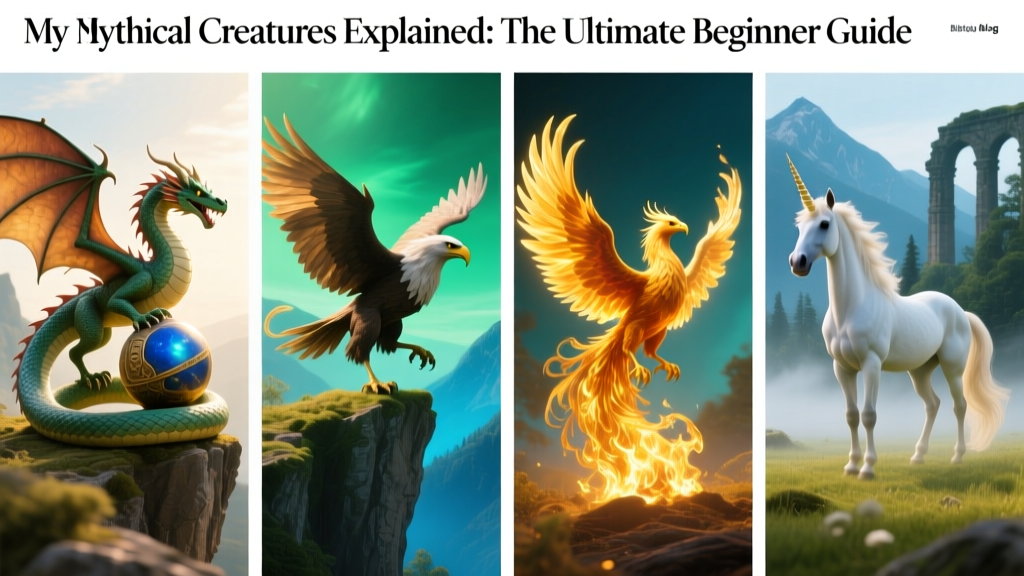
What Defines Mythical Creatures in Global Folklore?
When studying global folklore, the term mythical creatures refers to supernatural beasts originating from human myth, legend, and religious texts. Unlike cryptozoology, which investigates unproven biological entities like Bigfoot or the Loch Ness Monster, mythology uses these beings as psychological archetypes and cultural allegories. From the water-manipulating dragons of Chinese antiquity to the shape-shifting kitsune of Japanese Shinto, these entities map the ancient human understanding of nature, morality, and the cosmos. This beginner-friendly explainer breaks down the classification, symbolism, and historical origins of the most prominent beasts in world mythology, providing a framework to understand their enduring legacy.
Distinguishing Mythology from Cryptozoology
A common point of confusion for beginners is the boundary between mythological beasts and cryptozoology. Cryptozoology is the pseudoscientific search for animals whose existence is unproven, such as the Mothman or the Chupacabra. Practitioners of cryptozoology argue that these beings possess biological, flesh-and-blood reality. Mythology, conversely, does not claim biological reality. Mythical entities are symbolic constructs designed to explain natural phenomena, enforce social norms, or map the human psyche. When a medieval cartographer inscribed "Here Be Dragons" on the edges of a map, it was not a biological warning; it was a philosophical demarcation of the unknown, signaling the edge of human comprehension and the boundary of divine order.
The Elemental Classification System
Folklorists and mythologists often categorize ancient beasts by their elemental associations. This system, heavily influenced by Paracelsian alchemy and earlier Greek humoral theory, helps beginners understand the environmental and spiritual domains these entities govern. The table below outlines the four classical elemental categories and their corresponding mythological representatives.
| Element | Creature Example | Cultural Origin | Core Symbolism |
|---|---|---|---|
| Fire | Phoenix / Salamander | Greek / Persian | Rebirth, purification, solar energy |
| Water | Kelpie / Kappa | Scottish / Japanese | Unpredictability, hidden depths, danger |
| Earth | Golem / Troll | Jewish / Norse | Raw material, stubbornness, physical labor |
| Air | Sylph / Thunderbird | Alchemical / Indigenous American | Intellect, communication, divine messages |
Four Foundational Mythical Creatures Explained
To grasp the mechanics of mythological worldbuilding, we must examine the most ubiquitous archetypes. These entities appear across multiple, disconnected civilizations, suggesting a shared psychological function in the human subconscious.
The Dragon: Chaos, Weather, and Cosmic Order
The dragon is arguably the most universal of all mythical creatures, yet its interpretation splits dramatically along geographic lines. In Western traditions, rooted in Mesopotamian chaos myths like the Enuma Elish (where Marduk slays Tiamat), the dragon represents hoarding, destruction, and untamed wilderness. The Anglo-Saxon epic Beowulf codifies the Western dragon as a fire-breathing guardian of cursed gold.
Conversely, the Eastern dragon (Long) is a benevolent, water-associated deity of weather and imperial authority. Archaeological evidence from the Hongshan culture (c. 4700–2900 BCE) reveals jade "pig-dragons," demonstrating that these creatures were tied to agricultural fertility and rainfall long before written records. According to the World History Encyclopedia, the Chinese dragon is an amalgamation of various totem animals, featuring the horns of a deer, the scales of a carp, and the claws of an eagle, symbolizing the unification of disparate tribes.
The Griffin: Guardian of the Divine Threshold
Combining the eagle (king of the sky) and the lion (king of the earth), the griffin represents supreme dominion and divine protection. Originating in the ancient Near East and the Achaemenid Empire, griffins were frequently depicted in Scythian gold artifacts and Persian palace reliefs. The Metropolitan Museum of Art notes that griffins were often positioned near the Tree of Life or guarding the gold of the Hyperboreans in Greek myth. Their dual nature makes them a primary symbol of Christ's dual divine and human nature in later medieval bestiaries.
The Sphinx: The Riddle of Mortality and Intellect
The sphinx highlights how the same morphological concept can yield vastly different psychological meanings. The Egyptian sphinx (androsphinx) features a human head atop a lion's body, representing the intellect ruling over animalistic passions. The Great Sphinx of Giza (c. 2500 BCE) serves as a benign, solar guardian of the pharaoh's necropolis. Data from The British Museum confirms that Egyptian sphinxes were overwhelmingly male and protective.
The Greek sphinx, however, was imported and mutated into a female, demonic entity with the wings of a bird. In the myth of Oedipus, she acts as an agent of divine punishment, strangling those who cannot solve her riddle. Here, the creature embodies the inescapable and often cruel nature of fate, testing human hubris against divine omniscience.
The Jungian Psychology of Beast Archetypes
Carl Jung posited that these entities are manifestations of the collective unconscious. The dragon, for instance, often represents the "Shadow" or the chaotic, unintegrated aspects of the psyche. Slaying the dragon in myth is not an act of zoological extermination, but a psychological allegory for ego-development and the conquest of primal instincts. Similarly, the chimera—a hybrid of lion, goat, and serpent—represents the terror of boundary violation and the chaotic results of disrupting the cosmic order. Understanding this psychological layer transforms these beasts from mere fairy tale monsters into profound tools for self-analysis and spiritual shadow work.
A Practical Framework for Analyzing Mythological Archetypes
For writers, spiritual practitioners, and mythology students, simply memorizing beast names is insufficient. You must learn to decode their structural purpose. Use this three-step analytical framework when encountering any mythical entity in texts or media:
- Step 1: Identify the Morphological Contradiction. What natural rules does the creature break? A griffin breaks taxonomic boundaries by merging mammal and avian traits. This signals a bridging of two realms (earth and sky) and an elevation above mortal concerns.
- Step 2: Determine the Ecological Niche. Where does it live, and what does it guard? Creatures guarding thresholds (bridges, caves, temple gates) function as psychological tests for the hero. Creatures hoarding resources (gold, water, knowledge) represent societal anxieties about scarcity and the monopolization of divine power.
- Step 3: Map the Moral Alignment. Is the creature an embodiment of natural law (like the Egyptian Ma'at-aligned sphinx) or a manifestation of human transgression (like the Minotaur, born of Pasiphaë's unnatural desire)? The creature's origin story almost always dictates its moral function within the narrative.
Recommended Texts for Further Mythological Study
To move beyond beginner summaries and engage with primary sources and rigorous academic analysis, consult the following foundational texts:
- The Book of Imaginary Beings by Jorge Luis Borges: A masterful, encyclopedic compilation of obscure and famous zoological anomalies from global literature, providing deep insight into how different cultures construct the "other."
- Animal Symbolism in Celtic Mythology by Miranda Green: Essential for understanding how indigenous European cultures mapped spiritual concepts, seasonal cycles, and tribal identities onto local fauna.
- The Masks of God: Primitive Mythology by Joseph Campbell: Provides the psychological and anthropological framework necessary to understand why early humans projected animalistic traits onto the divine, and how these projections evolved into complex pantheons.
Understanding these ancient beasts requires looking past their monstrous appearances. They are, ultimately, mirrors reflecting the deepest anxieties, aspirations, and philosophical inquiries of the cultures that birthed them. By studying them, we do not merely learn about the past; we decode the symbolic language of the human mind.