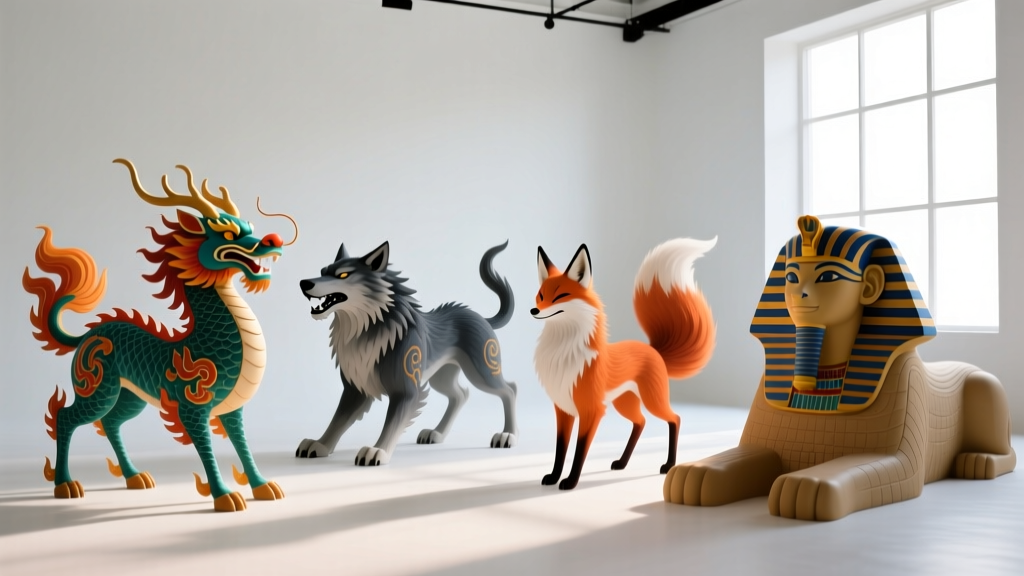
The study of ancient folklore requires a nuanced, multidisciplinary lens. When cataloging mythical creatures, mythical creatures frequently emerge not as mere fantasy or primitive misunderstandings of natural phenomena, but as complex psychological and spiritual archetypes. Across diverse pantheons, these entities map the human subconscious, representing elemental forces, shadow aspects, and transcendent ideals. For students of esoteric knowledge, mythology, and personality psychology, understanding these beasts provides a robust framework for decoding ancient mystery traditions and engaging in deep shadow work. This comprehensive guide moves beyond basic bestiaries to analyze the structural taxonomy, Jungian symbolism, and alchemical utility of these legendary entities.
The Elemental Taxonomy of Global Bestiaries
To understand the esoteric function of legendary beasts, one must first examine them through the lens of elemental taxonomy. In the 16th century, the Swiss alchemist Paracelsus formalized the classification of elementals in his treatise Liber de Nymphis, Sylphis, Pygmaeis et Salamandris. While Paracelsus focused on micro-spirits (Gnomes, Undines, Sylphs, and Salamanders), macro-mythology scales these elemental forces into massive, culture-defining beasts.
Fire and the Transmutative Serpent
Fire-aligned entities represent destruction, purification, and spiritual transmutation. The Dragon, ubiquitous in both Eastern and Western mythos, operates as a supreme fire archetype. In Western alchemy, the dragon often symbolizes the chaotic, unrefined prima materia that must be conquered. Conversely, in Eastern traditions, the dragon (such as the Chinese Long) governs water and weather, demonstrating how elemental alignments shift based on cultural psychological needs. The Phoenix represents the pinnacle of fire's regenerative capacity, embodying the cyclical nature of spiritual death and rebirth.
Water and the Subconscious Abyss
Water creatures map directly to the Jungian collective unconscious. The Leviathan, the Kraken, and the dragon-turtle of Mesoamerican lore (Cipactli) represent the terrifying, consuming depths of the unexplored psyche. Water beasts are rarely rational; they operate on instinct, emotion, and the overwhelming power of the deep subconscious. Engaging with these creatures in myth often symbolizes a descent into the unconscious mind to retrieve hidden wisdom or confront repressed trauma.
Global Bestiary: A Comparative Analysis
The following table synthesizes the elemental, psychological, and spiritual functions of five prominent entities across varying cultural paradigms. This data highlights how distinct civilizations utilize similar archetypal frameworks to explain the human condition.
| Entity | Cultural Origin | Elemental Alignment | Jungian Archetype | Esoteric / Spiritual Function |
|---|---|---|---|---|
| Ouroboros | Hellenistic / Egyptian | Aether / Fire | The Self | Represents infinite cyclicality, the unity of opposites, and the eternal return. |
| Sphinx | Egyptian / Greek | Earth / Air | Guardian of the Threshold | Tests intellectual and spiritual readiness before granting access to hidden mysteries. |
| Qilin | Chinese | Earth / Wood | The Benevolent Sovereign | Signals the arrival of a sage; represents harmony between the natural and spiritual realms. |
| Ammit | Egyptian | Fire / Earth | The Shadow / Devourer | Enforces cosmic law (Ma'at) by consuming the heavy, unrepentant ego (the heart). |
| Thunderbird | Indigenous North American | Air / Water | The Divine Messenger | Bridges the upper world and the earthly plane; catalyst for sudden spiritual awakening. |
Decoding Mythical Creatures: Mythical Creatures as Jungian Archetypes
Carl Jung posited that mythological figures are not arbitrary inventions but spontaneous manifestations of the collective unconscious. When we analyze mythological narratives, the beasts within them serve as vital markers for psychological development and individuation.
The Shadow and the Minotaur
The Minotaur, trapped within the Cretan Labyrinth, is perhaps the most potent symbol of the Jungian Shadow. The labyrinth itself represents the convoluted, confusing architecture of the human mind, while the beast at its center embodies the repressed, primal urges that society forces us to hide. In spiritual practice, "slaying" the Minotaur is a flawed objective; true individuation requires navigating the labyrinth, confronting the beast, and integrating its raw power into the conscious ego. The Shadow is not meant to be destroyed, but understood and harnessed.
The Anima/Animus and the Shapeshifter
Creatures that bridge the human and animal kingdoms—such as the Selkie, the Kitsune, or the Siren—often represent the Anima (the inner feminine in men) or the Animus (the inner masculine in women). These beings are alluring, dangerous, and deeply tied to the natural world. They challenge the rigid boundaries of the conscious ego, inviting the individual to embrace their contrasexual soul-image. Encounters with these creatures in myth invariably lead to a psychological crisis that forces the protagonist to expand their consciousness.
Alchemical Symbolism and Spiritual Transmutation
In the hermetic tradition, mythical beasts were utilized as coded allegories for the stages of the Magnum Opus (The Great Work). According to scholars of historical alchemy, the transformation of base lead into gold was a metaphor for the elevation of the human soul from a state of ignorance to divine enlightenment.
- The Nigredo (Blackening): Represented by the Raven or the decaying Dragon. This stage signifies putrefaction, the breaking down of the ego, and the confrontation with the darkest aspects of the self. It is the necessary destruction of the false personality.
- The Albedo (Whitening): Symbolized by the White Swan or the Pelican (which was believed to pierce its own breast to feed its young). This stage represents purification, the washing away of egoic attachments, and the awakening of spiritual intuition.
- The Rubedo (Reddening): Embodied by the Phoenix or the Red Lion. The final stage of integration, where the conscious and unconscious minds merge. The Phoenix rising from the ashes signifies the birth of the fully realized, indestructible Self.
Practical Application: Archetypal Shadow Work
Understanding the esoteric taxonomy of these entities is only valuable if applied to personal spiritual development. Practitioners of depth psychology and esoteric traditions can utilize the following framework for archetypal shadow work, drawing upon the Jungian concepts of active imagination.
- Identify the Triggering Beast: When you experience disproportionate emotional reactivity (fear, anger, or obsessive fascination), assign a mythological beast to that emotion. Is your anger a chaotic Fire Dragon, or a brooding, subterranean Earth Golem?
- Trace the Elemental Root: Determine the elemental alignment of your identified beast. If it is Water-based (e.g., a Siren or Kraken), the root issue likely involves emotional boundaries, grief, or subconscious fears. If Air-based (e.g., a Harpy), it may involve intellectual anxieties or communication breakdowns.
- Engage in Active Imagination: Enter a meditative state and visualize the labyrinth or environment where your beast resides. Do not bring weapons. Instead, bring an offering that corresponds to its elemental nature. Ask the entity what aspect of your psyche it is guarding, and record its response in a dedicated esoteric journal.
By treating the lore of ancient beasts not as mere fiction, but as a sophisticated, encoded map of the human psyche, we unlock profound avenues for self-mastery. The monsters of antiquity are still alive; they simply reside within the uncharted territories of our own minds.