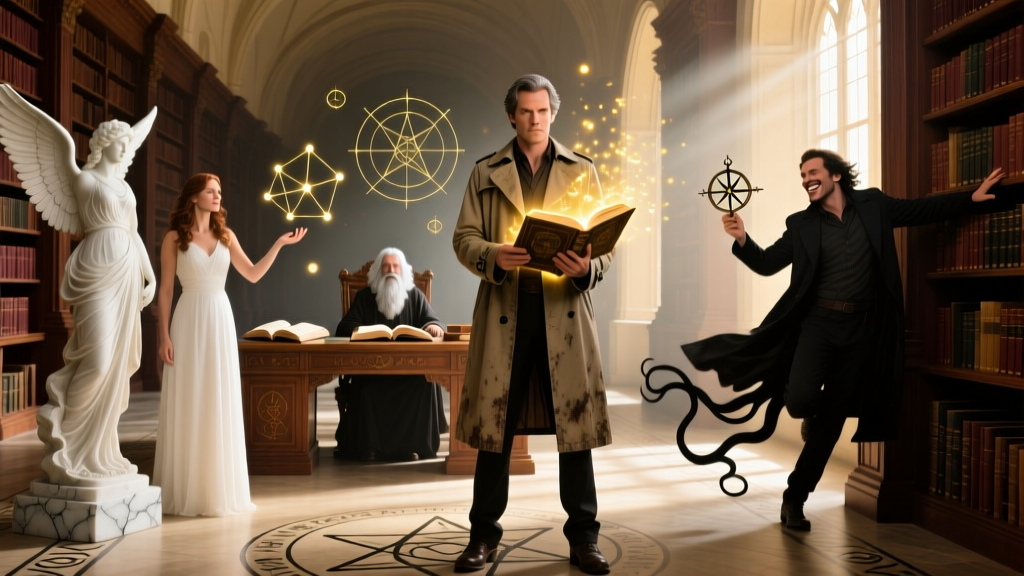
Television narratives centered around magical artifacts and ancient myths often serve as modern vehicles for esoteric traditions and psychological archetypes. The fantasy-adventure series The Librarians follows a secret organization dedicated to protecting humanity from supernatural threats. However, beyond the surface-level action, analyzing the librarians cast through the lens of esoteric traditions, Jungian psychology, and astrological alignments reveals a meticulously crafted tapestry of mythological archetypes. This case study examines how the characters function as modern vessels for ancient paradigms, bridging the gap between historical mysticism and contemporary storytelling.
The Hermetic Tradition and the Modern Wunderkammer
Before dissecting the specific character alignments, it is vital to understand the environmental archetype of the show: The Library itself. In esoteric history, the concept of a universal repository of magical and historical artifacts mirrors the Renaissance Wunderkammer (cabinet of curiosities) and the legendary Library of Alexandria. The Library in the series operates as a nexus point, a concept heavily rooted in Hermeticism, specifically the principle of correspondence ('As above, so below'). The artifacts housed within are not merely dangerous weapons; they are concentrated nodes of collective unconscious energy. The individuals chosen to guard them must therefore embody specific elemental and psychological balances to withstand the ontological weight of these objects.
Archetypal Breakdown of The Librarians Cast
According to Carl Jung's theory of archetypes, human psychology is governed by universal, archaic patterns and images that derive from the collective unconscious. The ensemble of the series maps almost perfectly onto these foundational Jungian models, paired with specific mythological deities and astrological modalities.
Flynn Carsen: Thoth and the Solitary Adept
Flynn Carsen, the original Librarian, embodies the archetype of the Magician and the Sage. In mythological terms, his closest parallel is Thoth, the Egyptian deity of wisdom, writing, and magic, who served as the scribe of the gods and the mediator of cosmic balance. Astrologically, Flynn exhibits strong Uranian and Mercurial traits: a relentless pursuit of higher knowledge, eccentricity, and a highly active, restless intellect. His early isolation mirrors the solitary adept of the Hermetic Order of the Golden Dawn, seeking enlightenment through the solitary study of the Corpus Hermeticum. Flynn's journey throughout the series is one of moving from intellectual hubris to integrated wisdom, learning that true esoteric mastery requires grounding (Earth) rather than just mental expansion (Air).
Eve Baird: Martial Astrology and the Athena Complex
Colonel Eve Baird represents the Warrior and the Caregiver archetypes. Her mythological counterparts are Athena (strategic warfare and wisdom) and Bellona (Roman goddess of war). Eve's astrological signature is heavily Martian, specifically resembling Mars in Aries or Mars in Capricorn—indicating disciplined, protective, and highly tactical martial energy. In esoteric traditions, the Guardian of the Threshold is a formidable entity that tests the initiate before they can access higher mysteries. Eve functions as this threshold guardian for the new Librarians, ensuring their psychological and physical resilience before they engage with reality-altering artifacts.
Jacob Stone and Cassandra Cillian: Earth and Ether
The dynamic between Jacob Stone and Cassandra Cillian provides a fascinating case study in the duality of matter and mind.
- Jacob Stone (Earth / Hephaestus): Jacob possesses an IQ of 190 and an encyclopedic knowledge of art and history, but his true esoteric gift is psychometry—the ability to read the history of an object through tactile contact. He aligns with the Earth element and the Greek god Hephaestus, the master craftsman. His expertise grounds the team, providing the historical and material context necessary to understand the physical anchors of magical artifacts.
- Cassandra Cillian (Air / Ether / Pythagoras): Cassandra's magical ability manifests as synesthesia and mathematical precognition, triggered by her brain lesion. She embodies the Air element and the esoteric discipline of Pythagorean numerology. Her visions often involve sacred geometry and the Tetractys, symbolizing the underlying mathematical fabric of the universe. Mythologically, she channels the Oracle of Delphi, receiving fragmented, chaotic glimpses of the cosmic tapestry that must be decoded by logic.
Ezekiel Jones: Mercurial Trickster and Shadow Integration
Ezekiel Jones, the master thief, represents the Trickster archetype. In mythology, the Trickster (Loki, Hermes, Coyote) disrupts the status quo, crosses boundaries, and ultimately forces evolution through chaos. Ezekiel's astrological alignment is highly Mercurial, with a prominent shadow aspect. In Jungian psychology, Joseph Campbell and Jung both note that the Trickster often carries the 'Shadow'—the repressed, unacknowledged parts of the psyche. Ezekiel's arc is a textbook case study in shadow integration; he must transition from using his Mercurial skills for selfish gain (the unintegrated shadow) to using them for the collective good, thereby achieving psychological wholeness.
Esoteric Alignments Data Matrix
The following table synthesizes the mythological, elemental, and psychological profiles of the primary ensemble, providing a structured framework for understanding their esoteric functions.
| Character (Actor) | Jungian Archetype | Mythological Parallel | Elemental Alignment | Esoteric Discipline |
|---|---|---|---|---|
| Flynn Carsen (Noah Wyle) | The Magician / Sage | Thoth / Hermes Trismegistus | Air / Fire | Hermeticism, Alchemy |
| Eve Baird (Rebecca Romijn) | The Warrior / Guardian | Athena / Valkyrie | Fire / Earth | Martial Mysticism, Warding |
| Jacob Stone (Christian Kane) | The Creator / Explorer | Hephaestus / Ptah | Earth | Psychometry, Antiquarianism |
| Cassandra Cillian (Lindy Booth) | The Innocent / Oracle | Pythia / The Fates | Air / Aether | Sacred Geometry, Numerology |
| Ezekiel Jones (John Harlan Kim) | The Trickster | Hermes / Loki | Air / Water | Shadow Work, Illusion |
| Jenkins (John Larroquette) | The Caretaker / Mentor | Galahad / Chiron | Earth / Spirit | Arthurian Lore, Ley Lines |
Case Studies in Mythological Artifacts
The artifacts featured in the series are not mere plot devices; they are deeply rooted in real-world occult history and mythological case studies. Analyzing how the librarians cast interacts with these items reveals the show's commitment to esoteric accuracy.
Excalibur and the Tarot Suit of Swords
In the series, Excalibur is depicted as a conduit for immense, often corrupting, power tied to the ley lines of the Earth. In real-world esoteric traditions, particularly within the Tarot, the Sword represents the intellect, the element of Air, and the power to cut through illusion. The mythological case study of Excalibur aligns with the Buddhist concept of the Khadga (the wisdom sword of Manjushri), which severs the bonds of ignorance. When characters in the show attempt to wield Excalibur without the requisite moral and psychological purity, they suffer from ego-inflation—a concept Jung identified as the dangerous identification with the archetypal Self. The sword demands a vessel that has integrated its shadow, otherwise, the martial energy consumes the host.
The Apple of Discord and Ego Dissonance
The Apple of Discord, inscribed with 'To the Fairest,' triggers the Trojan War in Greek mythology. In the show, it operates as an artifact of psychological warfare, amplifying the insecurities and competitive drives of those nearby. According to Theoi Greek Mythology, Eris (the goddess of strife) used the apple to exploit the vanity of Hera, Athena, and Aphrodite. From a psychological perspective, the Apple serves as a case study in cognitive dissonance and ego fragmentation. It forces the characters to confront their deepest insecurities regarding their worth, beauty, and intellect. Overcoming the Apple's influence requires the team to practice radical acceptance and detach their self-worth from external validation, a core tenet of Stoic philosophy and modern shadow work.
The Psychological Resonance of Mythic Storytelling
The enduring appeal of this specific ensemble lies in their embodiment of the collective unconscious. By mapping the librarians cast onto foundational mythological and astrological frameworks, the narrative transcends standard fantasy tropes. It provides viewers with a symbolic language to understand their own internal conflicts. The Magician's pursuit of truth, the Warrior's establishment of boundaries, the Trickster's disruption of stagnant paradigms, and the Oracle's connection to the unseen—these are not just character traits; they are vital psychological functions required for human individuation. When audiences engage with these archetypal vessels, they are participating in an ancient tradition of mythic resonance, utilizing modern media to navigate the timeless landscapes of the human psyche.