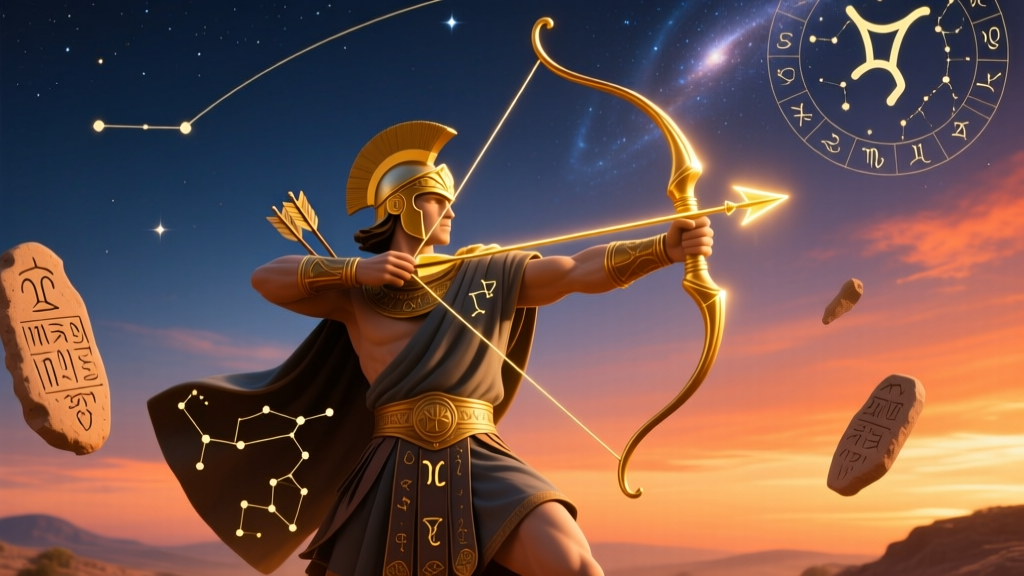
The Astronomical and Mythological Roots of the Nov 24 Zodiac Sign
Individuals researching the nov 24 zodiac sign are examining the early degrees of Sagittarius, a mutable fire sign governed by Jupiter. However, the archetype of the Archer is not merely a modern horoscope trope; it is a complex tapestry woven from ancient Mesopotamian star lore, Greek mythology, and Hellenistic astronomical mathematics. To understand the true psychological and spiritual blueprint of a November 24 birth, we must excavate the historical origins of the centaur, the evolution of the zodiacal wheel, and the specific decanic rulerships that differentiate this exact date from the rest of the Sagittarian month. This historical analysis reveals the deep esoteric roots of the Archer.
Babylonian Origins: Pabilsag and the MUL.APIN Compendium
The Western zodiac did not originate in Greece; it was inherited from the Babylonians. In the ancient Mesopotamian star catalog known as the MUL.APIN (compiled around 1000 BCE), the stars that currently form the tropical sign of Sagittarius were associated with the god Pabilsag. Pabilsag was the tutelary deity of the city of Isin and was depicted as a centaur-like figure, but with a distinct twist: he possessed a scorpion's tail and the wings of an eagle, alongside his bow and arrow.
This hybrid imagery is crucial for understanding the underlying psychological architecture of the nov 24 zodiac sign. The scorpion tail links the Archer to the preceding sign of Scorpio, representing the transformative, underworld energy that Sagittarius seeks to elevate through philosophy and higher truth. According to Encyclopedia Britannica, the Babylonians viewed this constellation as a marker of the winter solstice's approach, embedding a sense of urgency, foresight, and preparation into the astrological DNA of those born under its influence. The arrow of Pabilsag was not aimed at random prey; it was directed toward the heavens, symbolizing the soul's trajectory toward divine understanding.
The Transition to Hellenistic Astrology
When Alexander the Great conquered Babylon in the 4th century BCE, Greek scholars translated these cuneiform tablets, merging Babylonian observational astronomy with Hellenistic geometry. The scorpion tail was eventually dropped from the visual representation, standardizing the image into the half-man, half-horse centaur we recognize today. This shift marked the transition from a deity of agricultural and seasonal foresight to a symbol of human intellect striving to master animalistic instincts.
Greek Mythology: Crotus, Chiron, and the Centaur Archetype
A common misconception in modern pop astrology is that the Sagittarius constellation represents Chiron, the wise centaur who tutored heroes like Achilles and Heracles. However, historical astronomical texts tell a different story. In the Catasterismi, a 2nd-century BCE compendium of star myths attributed to Eratosthenes of Cyrene, the Archer is explicitly identified as Crotus (or Krotos), a satyr rather than a centaur.
Crotus was the son of Pan and the inventor of archery. Unlike the savage, wine-crazed centaurs of Greek myth, Crotus was a creature of rhythm, intellect, and precision. The Muses were so enamored with his invention of the bow and his ability to blend music with hunting that they requested Zeus place him in the stars. This historical distinction is vital for individuals born on November 24. The Crotus archetype emphasizes skill-stacking—the synthesis of physical coordination (archery) and artistic expression (music)—rather than the purely academic mentorship associated with Chiron.
Chiron, meanwhile, was placed in the stars as the constellation Centaurus. Chiron's mythos involves an unhealable wound inflicted by a poisoned arrow, which he eventually traded to free Prometheus. While Chiron is not the literal constellation of Sagittarius, his mythological resonance heavily influences the esoteric interpretation of the sign, particularly regarding the concept of the 'wounded healer.' For the November 24 native, this manifests as a profound ability to articulate philosophical solutions to problems they themselves struggle to solve in their personal lives.
Decan Astrology: The Specific Degrees of November 24
To achieve granular precision, Hellenistic astrologers divided each 30-degree sign into three 10-degree segments called decans. November 24 falls squarely within the first decan of Sagittarius (approximately 0° to 10°). This decan is traditionally sub-ruled by Jupiter, but in the Chaldean order, it carries the underlying vibrational frequency of Mercury.
| Decan | Degree Span | Approximate Dates | Sub-Ruler | Historical Attribute |
|---|---|---|---|---|
| First Decan | 0° - 10° | Nov 22 - Nov 26 | Jupiter / Mercury | Intellect, Philosophy, The Archer's Aim |
| Second Decan | 10° - 20° | Nov 27 - Dec 6 | Mars | Action, Conflict, The Centaur's Hooves |
| Third Decan | 20° - 30° | Dec 7 - Dec 21 | Sun | Vitality, Leadership, The Flaming Arrow |
The Jupiter-Mercury synthesis in the first decan creates a highly specific cognitive profile. Jupiter expands, while Mercury analyzes. Consequently, the nov 24 zodiac sign native possesses an innate drive to systematize belief systems. They are not merely satisfied with experiencing spiritual or philosophical epiphanies; they feel a compulsive need to codify, write, and teach these insights. This decanic placement explains the historical prevalence of November 24 births among theologians, legal scholars, and authors of foundational manifestos.
The Astronomical Shift: Constellation vs. Tropical Zodiac
It is imperative to distinguish between the astronomical constellation of Sagittarius and the tropical zodiac sign. Due to the precession of the equinoxes—a 26,000-year wobble in the Earth's rotational axis documented extensively in Britannica's guide to the precession of the equinoxes—the Sun is no longer in the physical constellation of Sagittarius on November 24. Astronomically, the Sun is transiting through the constellation of Ophiuchus or the late degrees of Scorpio during this time.
However, Western astrology utilizes the Tropical Zodiac, which was fixed to the seasons by Claudius Ptolemy in the 2nd century CE. In this system, the sign of Sagittarius begins exactly at the 240-degree mark of the ecliptic, regardless of the background stars. Therefore, the 'origin story' of the November 24 zodiac sign is inextricably linked to the seasonal transition of the Northern Hemisphere—the period where the final harvests are secured, and humanity turns its gaze toward the darkening winter sky, relying on the fire of intellect and philosophy to sustain the spirit.
Actionable Frameworks for the Modern Archer
Understanding the historical and astronomical origins of your zodiac placement provides a distinct advantage in personal development. Rather than relying on generic daily horoscopes, apply these historically grounded frameworks to leverage the specific energy of the November 24 birth chart:
- The Crotus Skill-Stacking Method: Emulate the satyr Crotus by combining two seemingly disparate skills to create a niche monopoly. If your primary skill is data analytics, integrate a secondary skill like public speaking or musical rhythm. The first decan rewards the synthesis of analytical Mercury and expansive Jupiter, allowing you to communicate complex data with theatrical precision.
- Execute Chiron Shadow Work: Identify the specific intellectual or philosophical domain where you experience imposter syndrome—the 'unhealable wound' of the centaur. Dedicate 90 days to rigorous, documented study in this exact area. The historical archetype dictates that your greatest authority will eventually stem from the exact subject that initially caused you intellectual frustration.
- Leverage the Pabilsag Foresight Protocol: The Babylonian scorpion-tailed archer was a marker of seasonal preparation. Implement a bi-annual 'wintering' audit in your business or personal life. Use the last week of November not for aggressive expansion, but for securing resources, archiving data, and aiming your strategic 'arrow' at a single, high-value target for the upcoming year.
The history of the nov 24 zodiac sign is a testament to humanity's enduring attempt to map the pursuit of truth onto the canvas of the night sky. By moving beyond superficial personality traits and engaging with the Babylonian, Greek, and Hellenistic mechanics of the Archer, individuals born on this date can align their modern ambitions with ancient, proven archetypes of intellectual mastery and strategic foresight.