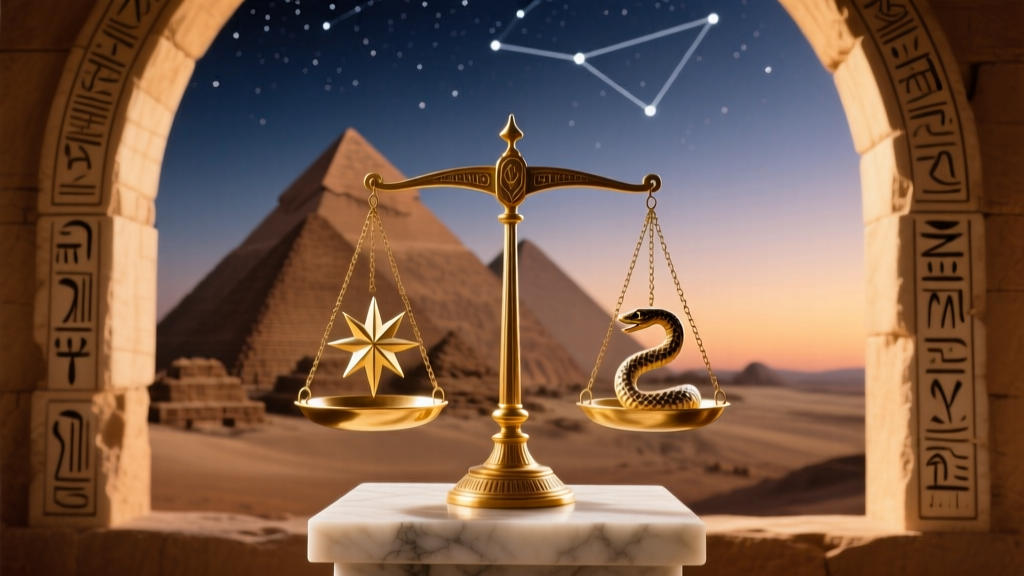
Individuals born under the oct 6 zodiac fall within the second decan of Libra, an astrological placement steeped in millennia of mythological and astronomical evolution. Unlike the fire and water signs that dominated early zodiacal catalogs, the origins of the Libra scales represent a fascinating intersection of Babylonian agriculture, Egyptian theology, and Greco-Roman jurisprudence. To understand the specific archetype of the October 6 birthdate, we must bypass modern pop astrology and examine the primary source texts of Hellenistic astrologers like Vettius Valens and Claudius Ptolemy, alongside ancient Mesopotamian star catalogs. This historical analysis reveals a complex, dual-natured profile governed by both Venusian harmony and Saturnian structure.
The Astronomical Roots of the Oct 6 Zodiac Sign
The conceptualization of the autumn sky as a celestial balance predates the Hellenistic zodiac by over a thousand years. In the Babylonian star catalog known as the MUL.APIN, compiled around 1000 BCE, the region of the sky we now call Libra was recorded as Zibanu. This Akkadian term translates directly to the scales or balance. The Babylonians recognized this asterism as the marker of the autumnal equinox, the precise moment when the hours of daylight and darkness achieved perfect equilibrium.
Babylonian Zibanu and the Scorpion's Claws
Simultaneously, early Mesopotamian astronomers also referred to this region as the Claws of the Scorpion (Zubeni). The two brightest stars in the constellation, Zubenelgenubi (the southern claw) and Zubeneschamali (the northern claw), retain these ancient Arabic-Latinized names today. The transition from a violent, predatory appendage (the scorpion's claw) to an instrument of civilized measurement (the scales) mirrors humanity's historical shift from agrarian survival to codified legal systems. For the oct 6 zodiac archetype, this dual heritage manifests as an internal tension between aggressive self-defense and the pursuit of diplomatic resolution.
Mythological Origins: Ma'at, Themis, and the Scales
The visual motif of the scales was heavily influenced by the Egyptian concept of Ma'at. In the funerary text known as the Book of the Dead, the heart of the deceased was weighed against the feather of Ma'at (truth and cosmic order) on a giant set of scales. If the heart was heavier with sin, it was devoured; if balanced, the soul achieved eternal life. This theological framework established the scales not merely as a tool of commerce, but as the ultimate arbiter of moral and spiritual weight.
When Greek culture synthesized with Egyptian and Babylonian traditions during the Ptolemaic period, the scales were personified by Themis, the Titaness of divine law, and her daughter Dike, the goddess of human justice. By the time the Romans formalized the twelve-sign tropical zodiac, the constellation was firmly detached from Scorpius and elevated as an independent symbol of imperial justice and civic order.
The Roman Shift: Libra as an Independent Constellation
According to Encyclopedia Britannica's astronomical history, the Romans were the first to widely depict the constellation as a figure holding scales, often associated with Astraea, the star-maiden who fled Earth's corruption to reside in the heavens. The October 6 placement falls during the historical Roman harvest festivals, where grain and tribute were meticulously weighed and taxed. Consequently, the archetypal energy of this birthdate is deeply tied to resource allocation, contractual fairness, and the administration of societal debts.
Hellenistic Decans: The October 6 Birthdate Profile
To pinpoint the exact historical attributes of October 6, we must apply the Chaldean decan system, which divides each 30-degree zodiacal sign into three 10-degree segments. October 6 typically corresponds to 13 degrees of Libra. This places the birthdate squarely in the Second Decan of Libra, which spans from 11 to 20 degrees.
In traditional astrology, while Venus rules the sign of Libra as its domicile, the Chaldean decan system assigns Saturn as the sub-ruler of the second decan. This creates a highly specific planetary signature: Venusian aesthetics and diplomacy filtered through Saturnian rigor, boundaries, and karmic consequence. The medieval astrological grimoire, the Picatrix, describes the talismanic image of this specific decan as a man holding a balance in one hand and a sword in the other, symbolizing that true equity requires the enforcement of boundaries.
| Decan | Degree Range | Approximate Dates | Chaldean Ruler | Historical Imagery (Picatrix) |
|---|---|---|---|---|
| First | 1 - 10 | Sept 23 - Oct 2 | Moon | A man holding a balance, seeking peace. |
| Second | 11 - 20 | Oct 3 - Oct 12 | Saturn | A man holding a balance and a sword, enforcing justice. |
| Third | 21 - 30 | Oct 13 - Oct 22 | Jupiter | A man holding a balance and a staff, guiding others. |
The transmission of these decanic images from Babylonian astral magic through Hellenistic Egypt and into medieval Islamic scholarship demonstrates the enduring power of the October 6 archetype. In the Hermetic tradition, the second decan of Libra was invoked in talismanic operations designed to secure favorable outcomes in legal disputes and to bind unjust adversaries. The sword depicted in the Picatrix imagery is not a weapon of war, but an instrument of surgical separation—the cutting away of falsehoods to reveal objective truth.
Venus and Saturn: The Dual Rulership in Classical Astrology
The friction between Venus and Saturn is the defining psychological hallmark of the October 6 native. Venus seeks connection, aesthetic pleasure, and frictionless harmony. Saturn demands structure, accountability, and the acknowledgment of limitations. Claudius Ptolemy, in his foundational text the Tetrabiblos, noted that the equinoctial signs (Aries and Libra) are characterized by their balancing of extremes. For the October 6 individual, this balancing act is not a passive state of indecision, but an active, Saturnian process of weighing evidence and executing judgment.
Furthermore, the astronomical reality of the October 6 birthdate means the Sun is navigating the exact degrees where the celestial equator intersects the ecliptic. In ancient mundane astrology, this intersection point was considered the hinge of the year, dictating the balance of power between ruling factions and the populace. Natives born on this hinge are historically predisposed to act as the fulcrum in their social or professional circles. They absorb the systemic pressures of their environment and are tasked with redistributing that energy fairly. This explains the profound psychological exhaustion often reported by October 6 individuals; they are literally functioning as human counterweights in unbalanced systems.
Practical Application of Historical Archetypes
Understanding the ancient, structural origins of your astrological placement provides a distinct advantage in personal and professional development. Rather than leaning into the modern stereotype of the indecisive Libra, the October 6 native can leverage their historical Saturnian sub-rulership for high-level mediation and systemic design.
- Contractual Architecture: Utilize the Venus-Saturn synthesis to draft agreements that are not only mutually beneficial (Venus) but structurally unbreakable and legally sound (Saturn). You excel at foreseeing loopholes that others miss.
- Systemic Mediation: In conflict resolution, avoid the trap of superficial appeasement. Channel the Picatrix imagery of the sword and scales by addressing the root structural inequities causing the dispute, rather than just soothing bruised egos.
- Aesthetic Durability: When engaging in design, architecture, or art, prioritize materials and forms that withstand the test of time. Your historical archetype favors classical permanence over fleeting trends.
- Karmic Boundary Setting: Recognize that your tolerance for injustice is historically linked to the weighing of the heart. When a relationship or professional environment becomes fundamentally unbalanced, your Saturnian sub-ruler demands immediate, decisive severance rather than prolonged negotiation.
By anchoring your identity in the ancient MUL.APIN star catalog and the rigorous decan systems of antiquity, you transcend generic horoscopes. The oct 6 zodiac profile is not merely a seeker of peace; it is the historical architect of justice, equipped with both the scales to measure equity and the sword to enforce it.