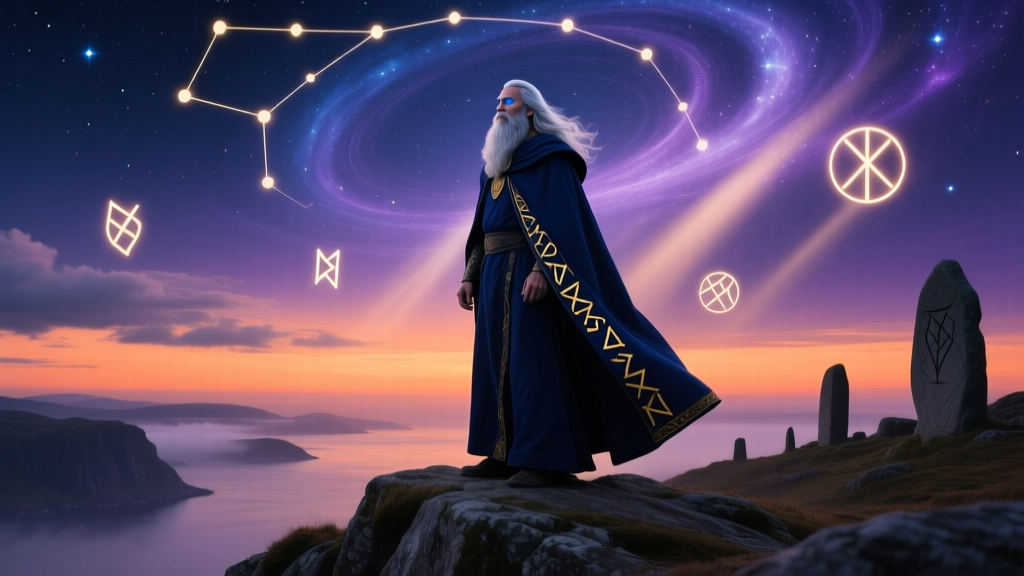
The figure of Odin stands as the most complex and heavily analyzed deity in the Norse pantheon. Far from the one-dimensional war god popularized by modern media, the historical Odin evolved over centuries, absorbing attributes of sovereignty, magic, poetry, and death. To understand the origin story of the Allfather, we must look past the 13th-century Icelandic manuscripts and examine the linguistic, archaeological, and cultural shifts that transformed the Proto-Germanic Wōdanaz into the Viking Age ruler of Asgard. This evolution reveals a deity intimately tied to the socio-political structures of early Germanic tribes, shifting from an ecstatic shamanic figure to a patron of aristocratic warbands.
The Proto-Germanic Roots: From Wōdanaz to Odin
The linguistic origin of the deity begins with the Proto-Germanic theonym Wōðanaz. Etymologists trace this to the Proto-Germanic root *wōðaz, meaning 'seer, prophet, or madman.' This root shares a common Indo-European ancestry with the Latin vates (seer/poet) and the Old Irish fáith (prophet). Consequently, the original domain of the god was not warfare, but spiritual frenzy, ecstatic inspiration, and altered states of consciousness.
When the Roman historian Tacitus wrote Germania in the 1st century CE, he employed interpretatio romana—the practice of identifying foreign gods with Roman equivalents. Tacitus identified the chief god of the Germanic tribes with Mercury, not Mars. Mercury’s domains as a psychopomp (guide of the dead), a master of wisdom, and a wanderer perfectly align with the early characteristics of Wōðanaz. It was only later, as Germanic societies became increasingly militarized, that the god absorbed the martial attributes that would define the Viking Age Odin.
Archaeological Evidence and the Shift in Sovereignty
The material record provides critical insights into how early Germanic peoples interacted with the god before the advent of written sagas. During the Migration Period (c. 400–550 CE), gold bracteates (thin, single-sided gold discs) frequently depicted a central figure on horseback, often accompanied by birds or interacting with a fallen warrior or animal. Scholars interpret these motifs as early representations of Wōðanaz. Furthermore, the Ribe skull fragment, dating to the early 8th century, bears a runic inscription invoking the high god to heal or protect, demonstrating that Odin’s association with esoteric healing and runic magic was well established before the Viking Age truly began.
The Merseburg Incantation and Material Magic
One specific bracteate motif shows the god healing a horse's foal, a scene that directly parallels the 9th-century Merseburg Incantation. In this Old High German spell, Wodan heals the sprained leg of Balder’s horse through spoken magic (galdor). This archaeological and literary overlap confirms that Odin's role as a master of spoken, reality-altering magic predates his later literary codification as a mere warrior king.
This era also marks a critical theological shift: the eclipse of Tyr (Proto-Germanic Tīwaz) by Odin. According to the comparative mythologist Georges Dumézil, early Indo-European societies divided the 'first function' of sovereignty into two halves: legal/contractual (represented by Tyr) and magical/ecstatic (represented by Odin). During the Roman Iron Age, agrarian Germanic societies relied on the Thing (the legal assembly), elevating Tyr as the chief sky father. However, as the Migration and Viking Ages ushered in an era of mobile, aristocratic warbands (comitatus), the charismatic, magical, and ruthless patron of warriors proved more politically useful. Odin’s ascension to the head of the pantheon directly mirrors the historical shift from egalitarian agrarian assemblies to stratified, martial aristocracies.
Literary Codification: Euhemerism vs. Pagan Strata
Our most detailed narratives regarding Odin’s mythology originate from 13th-century Iceland, centuries after the official conversion to Christianity. Snorri Sturluson’s Prose Edda and Heimskringla present a euhemerized version of the god. In the Ynglinga saga, Snorri frames Odin not as a divine being, but as a historical Trojan king who migrated to Scandinavia, bringing advanced magic and culture to the indigenous populations. This was a deliberate literary device designed to preserve pagan poetry without incurring the wrath of the Christian Church.
Conversely, the Poetic Edda—a compilation of older, anonymous oral traditions—preserves much older pagan strata. The poem Hávamál ('Sayings of the High One') serves as a primary source for Odin’s origin of wisdom. It details his grueling self-sacrifice, wherein he hangs himself from the world tree, Yggdrasil, for nine nights, pierced by his own spear, to perceive and grasp the runes. For a comprehensive overview of these literary transitions, the World History Encyclopedia provides excellent contextual analysis of how oral traditions were adapted by Christian scribes.
Odin’s Epithets and Their Historical Contexts
Odin possesses over 170 recorded names and epithets, the highest of any Norse deity. These names are not merely poetic flourishes; they act as historical markers, revealing which aspects of the god were emphasized during different eras and by different social classes.
| Epithet / Name | Translation | Historical & Cultural Context |
|---|---|---|
| Wōðanaz | The Inspired / Mad One | Proto-Germanic era; highlights shamanic roots, trance states, and spiritual frenzy. |
| Valföðr | Father of the Slain | Viking Age; reflects the aristocratic warband culture and the promise of Valhalla for elite warriors. |
| Baleygr | Flame-Eyed | Associated with shamanic trance, altered states of consciousness, and the piercing gaze of the seer. |
| Jafnhárr | Just as High | Emphasizes the egalitarian nature of wisdom-seeking; the god who wanders in disguise to test hospitality. |
| Hangatýr | God of the Hanged | Relates to his self-sacrifice on Yggdrasil and the historical practice of sacrificial hangings in sacred groves. |
Reconstructing Historical Practices for Modern Spirituality
For modern practitioners of Heathenry, Ásatrú, and Norse paganism, understanding the historical origin of Odin is crucial for moving beyond pop-culture caricatures. Authentic engagement with the Allfather requires adopting the practices of historical seekers rather than merely worshipping a martial archetype. Actionable spiritual frameworks include:
- Runic Carving and Galdor: Odin did not merely 'invent' the runes; he discovered them through ordeal. Modern practitioners emulate this through rigorous study, meditation, and the carving of runic staves (talismans) using traditional materials like ash or yew, accompanied by galdor (runic chanting) to awaken the spiritual resonance of the wood.
- Utiseta (Sitting Out): Historically, this involved sitting on a burial mound or in a liminal natural space at night, wrapped in a cloak, to induce a trance state and commune with spirits or the god himself. Modern spiritual seekers can adapt this by engaging in solitary, sensory-deprived meditation in wild, untamed natural environments, focusing on the breath and the intention of receiving óðr (divine inspiration).
- The Sacred Duty of Hospitality: Engaging with the concept of the Gastaboð aligns with Odin’s role as the wandering wanderer (Jafnhárr). Historical sources indicate that treating strangers with profound respect was a direct way to honor the god, who frequently tested the moral character of mortals in disguise.
As noted by Encyclopedia Britannica, Odin's dual nature as a god of both terrifying martial fury and profound, wandering wisdom demands a multifaceted spiritual approach. By grounding modern practice in the linguistic and archaeological realities of Wōðanaz, seekers can forge a deeper, more historically authentic connection with the Allfather.