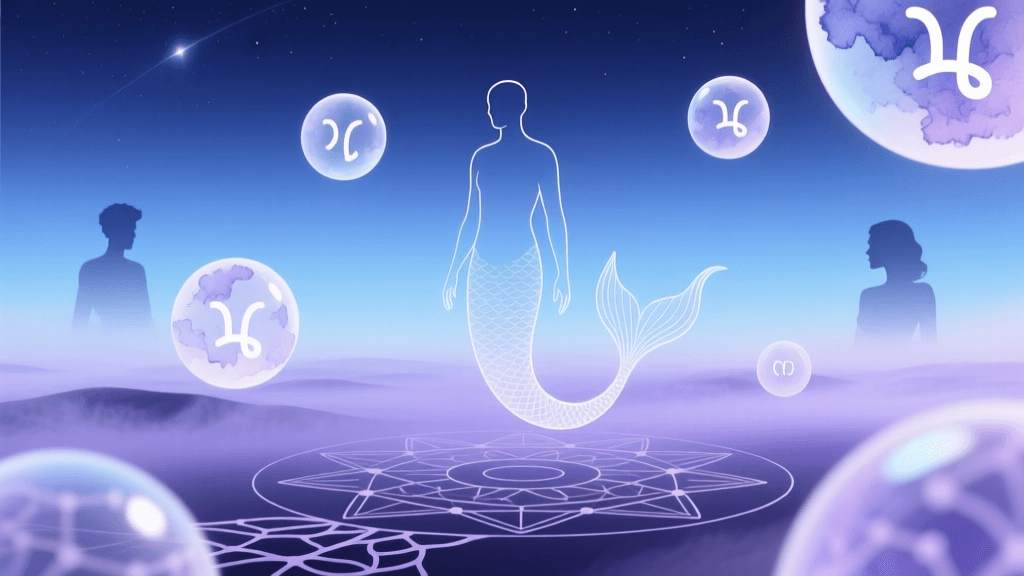
Pisces Core Personality Traits
Pisces—the twelfth and final sign of the zodiac—occupies a uniquely liminal space in astrological tradition. Ruled by Neptune (modern) and Jupiter (traditional), Pisces embodies the culmination of the zodiacal cycle: integration, dissolution, transcendence, and boundless compassion. Born between February 19 and March 20, Pisceans are often described as dreamy, empathic, and spiritually attuned—but these surface descriptors barely scratch the psychological depth of this mutable water sign. To understand Pisces is to engage with a personality architecture built on permeability, symbolic resonance, and affective absorption rather than rigid boundaries or linear logic.
Unlike cardinal signs that initiate or fixed signs that stabilize, Pisces operates through mutability: adaptation, fluidity, and contextual responsiveness. This modality—shared with Gemini, Virgo, and Sagittarius—grants Pisces extraordinary cognitive and emotional flexibility, but also renders them vulnerable to diffusion, exhaustion, and identity erosion when ungrounded. Below are six empirically resonant core traits that define the Piscean psychological signature:
1. Hyper-Empathy as Cognitive Architecture
Pisces doesn’t just “feel for” others—they inhabit others’ emotional states almost pre-consciously. Neuroscientific research supports the idea that highly empathic individuals exhibit heightened activity in the mirror neuron system and anterior insula—regions associated with emotional resonance and interoceptive awareness. A 2021 study published in Social Cognitive and Affective Neuroscience found that self-reported high-empathy participants showed significantly greater neural coupling during observed distress scenarios—a pattern consistent with Piscean phenomenology (https://academic.oup.com/scan/article/16/4/387/6051223). For Pisces, empathy isn’t a skill—it’s a default perceptual mode, akin to breathing.
2. Symbolic Thinking Over Literal Processing
Pisces perceives reality through metaphor, archetype, and associative resonance—not categorical logic. They interpret events not by cause-effect chains but by thematic echoes: a rainstorm may signal grief, a recurring number may feel like synchronicity, a song lyric may land like prophecy. This aligns closely with Jungian concepts of the collective unconscious and archetypal imagery. As Carl Gustav Jung wrote in The Archetypes and the Collective Unconscious, “The meeting with the self… is not at all a meeting with a stranger, but with the most intimate, the deepest, the ultimate mystery of life”—a sentiment Pisces lives daily (https://press.princeton.edu/books/paperback/9780691018334/the-archetypes-and-the-collective-unconscious). Their cognition thrives in ambiguity, making them exceptional artists, therapists, and spiritual guides—but poor fits for rigid procedural roles unless consciously scaffolded.
3. Boundary Fluidity (Not Weakness)
Contrary to popular misconception, Pisces’ porous sense of self is not pathological indecisiveness—it’s an adaptive trait rooted in evolutionary neurobiology. In ancestral environments, hyper-vigilance to group emotional climate conferred survival advantage; today, it manifests as difficulty saying “no,” absorbing ambient stress, or distinguishing personal desire from relational expectation. Clinical psychologist Dr. Judith Orloff notes in The Empath’s Survival Guide that highly sensitive empaths (a cohort overlapping heavily with Pisces) possess “a nervous system wired to absorb more sensory and emotional data than average”—and that boundary-setting must be taught as a somatic practice, not just verbal assertion (https://www.drjudithorloff.com/books/the-empaths-survival-guide/). For Pisces, boundaries aren’t walls—they’re calibrated filters, like tinted glass: adjustable, intentional, and requiring regular maintenance.
4. Dissolution Orientation
Pisces is the only sign whose natural impulse is toward deconstruction—not destruction, but gentle unbinding. Where Capricorn builds structures and Aquarius reimagines systems, Pisces dissolves what no longer serves: outdated beliefs, performative identities, toxic attachments. This reflects Neptune’s mythological domain—the sea god who governs illusion, surrender, and the return to source. Psychologically, this manifests as a comfort with uncertainty, a tolerance for paradox (“I am both broken and whole”), and a willingness to sit with existential ambiguity without rushing to resolution. Therapists working with Pisces clients often observe a marked resistance to premature closure—a strength in trauma processing, a challenge in deadline-driven environments.
5. Intuitive Certainty Without Evidence
Pisces rarely arrives at conclusions via syllogism. Instead, they experience “knowing” as embodied certainty—a gut resonance, a flash image, a sudden quiet conviction. This isn’t guesswork; it’s pattern recognition operating below conscious threshold. Research from the University of New South Wales confirms that intuition relies on rapid, subconscious integration of vast experiential data—what Nobel laureate Daniel Kahneman termed “System 1 thinking.” Pisces excels here, particularly in emotionally complex domains (https://www.unsw.edu.au/news/2020/02/intuition-is-more-than-gut-feeling-research-shows). However, because this knowing lacks step-by-step justification, Pisces may downplay or mistrust their own insights—especially in academic or corporate settings valuing explicit reasoning.
6. Spiritual Receptivity as Default State
For Pisces, spirituality isn’t a belief system adopted at age 30—it’s the atmospheric condition of their inner world. They sense unseen dimensions as naturally as sighted people perceive color: subtle energies, emotional undercurrents, karmic echoes, numinous presence. This isn’t necessarily religious adherence; many Pisces are secular mystics, finding sacred awe in neuroscience, oceanography, or music composition. Harvard Divinity School’s 2022 report on “Spiritual But Not Religious” (SBNR) demographics found Pisces overrepresented among SBNR cohorts—particularly those engaged in contemplative arts, hospice care, and ecological restoration work (https://divinity.hds.harvard.edu/spiritual-not-religious-demographics-2022-report). Their spirituality is embodied, relational, and non-dogmatic—more verb than noun.
Pisces Temperament and Emotional Style
Temperament—rooted in ancient humoral theory and validated by modern behavioral genetics—describes innate, biologically anchored patterns of reactivity and regulation. Pisces maps most closely to the melancholic-phlegmatic blend: deeply feeling yet outwardly calm, introspective yet relationally devoted. Unlike choleric fire signs who externalize emotion through action or sanguine air signs who diffuse it through talk, Pisces internalizes, metabolizes, and transmutes affective material—often over extended timeframes.
Their emotional rhythm is tidal: slow-building, deep-currented, and subject to lunar-like cycles of intensity and withdrawal. A Pisces may appear serene during crisis while internally navigating tsunami-level processing—then emerge days later with profound insight, creative output, or unexpected clarity. This isn’t avoidance; it’s incubation. Neuroendocrinologist Dr. Sarah McKay explains in The Women’s Brain Book that water-dominant temperaments show higher baseline oxytocin sensitivity and slower cortisol recovery curves—meaning Pisces feel emotions more intensely and take longer to return to equilibrium post-stress (https://www.drsarahmckay.com/womens-brain-book/). This necessitates radically different self-care than, say, a Leo or Aries.
Crucially, Pisces’ emotional style is context-dependent. Around emotionally volatile people, they may become hyper-vigilant and self-effacing. With grounded, emotionally literate companions, they bloom into courageous vulnerability and poetic authenticity. Their “moodiness” is less pathology and more barometric sensitivity—their nervous system registering shifts in relational climate long before others register temperature change.
Actionable Insight: Pisces benefit immensely from affect labeling—naming emotions with precision (e.g., “I feel anticipatory grief, not just ‘anxious’”)—which activates the ventrolateral prefrontal cortex and reduces amygdala reactivity. Journaling with prompts like “What sensation lives in my chest right now? What memory or image arises with it?” builds somatic literacy and interrupts dissociative loops.
Pisces Strengths
When integrated and resourced, Pisces embodies some of humanity’s most vital capacities. Their strengths aren’t flashy or competitive—they’re foundational, reparative, and quietly revolutionary. Below is a structured overview of key Piscean assets, with practical application strategies:
| Strength | Real-World Manifestation | Actionable Development Strategy |
|---|---|---|
| Compassionate Witnessing | Holds space for others’ pain without fixing, judging, or collapsing; used in trauma therapy, palliative care, restorative justice | Practice “silent presence drills”: Sit with a trusted friend for 10 minutes without speaking, advising, or problem-solving—only noticing breath, posture, micro-expressions. Debrief afterward: “What did you notice in your body? What did you sense in theirs?” |
| Symbolic Translation | Converts abstract pain into art, ritual, or narrative (e.g., turning grief into poetry, anxiety into dance, confusion into mythic storytelling) | Maintain a “symbol journal”: When overwhelmed, sketch, collage, or write freely using only metaphors, colors, and sensations—no literal explanations. Review weekly for emerging themes. |
| Dissolution Intelligence | Identifies what needs releasing in systems (relationships, organizations, habits) and guides gentle, non-traumatic endings | Use “release rituals”: Light a candle while naming one outdated belief (“I must earn love”). Visualize it dissolving in water. Write it on biodegradable paper and submerge it. Repeat monthly. |
| Intuitive Navigation | Makes high-stakes decisions amid complexity where data is incomplete (e.g., medical ethics, ecological forecasting, artistic direction) | Develop “intuition calibration”: Before acting on a hunch, ask: “Does this resonate in my solar plexus (gut), heart center, and throat (voice)? If two out of three say yes, proceed with a 24-hour reflection period.” |
| Spiritual Anchoring | Provides existential grounding for communities during collective trauma (e.g., chaplains in disasters, elders in cultural transition) | Create a “sacred pause protocol”: Set phone reminder every 90 minutes. Stop. Breathe 4-7-8 (inhale 4, hold 7, exhale 8). Whisper: “I am here. This moment is enough.” |
These strengths flourish not in isolation but within supportive ecosystems. Pisces’ greatest contribution emerges when paired with earth signs (Taurus, Virgo, Capricorn) who ground their visions, or fire signs (Aries, Leo, Sagittarius) who activate their latent courage. Alone, their gifts risk dilution; in synergy, they become alchemical.
Pisces Shadow Side
No sign is immune to shadow—the unconscious, unowned, or distorted expression of its gifts. For Pisces, the shadow emerges when their core traits become defense mechanisms rather than conscious capacities. Recognizing these patterns isn’t about shame—it’s about reclaiming agency.
- Escapism as Avoidance: Using fantasy, substances, or chronic busyness to numb discomfort rather than process it. The line between healthy imagination and dissociation blurs when Pisces stops returning to embodied reality.
- Rescuer Complex: Confusing empathy with responsibility—taking on others’ emotions as their own burden, then resenting the weight. This breeds passive-aggression, martyrdom, and covert control (“I sacrificed everything for you…”).
- Vagueness as Protection: Speaking in riddles or refusing direct answers to avoid conflict or accountability. While ambiguity has value, habitual vagueness erodes trust and masks fear of rejection.
- Self-Abnegation: Erasing personal needs to preserve harmony, leading to burnout, resentment, and eventual collapse. The “good Pisces” trope obscures their right to boundaries, desire, and anger.
- Spiritual Bypassing: Using transcendent language (“It’s all divine timing”) to avoid addressing concrete injustice, abuse, or practical failure. This invalidates real-world harm and stalls growth.
Shadow work for Pisces begins with somatic reclamation. Because their consciousness so easily floats above the body, grounding practices are non-negotiable: cold showers, weighted blankets, barefoot walking on grass, clay modeling, or singing—activities that demand physical presence. Therapist and author Resmaa Menakem emphasizes in My Grandmother’s Hands that trauma lives in the body, and healing requires “returning sensation to the places we’ve abandoned” (https://resmaa.com/books/my-grandmothers-hands/). For Pisces, shadow integration means befriending the body as the first temple—not escaping it.
Pisces in Different Life Areas
Pisces’ expression shifts dramatically across contexts—not due to inconsistency, but because their mutability allows them to attune to environmental frequencies. Understanding these variations helps harness their adaptability intentionally.
Relationships & Intimacy
Pisces seeks soul-level resonance over surface compatibility. They fall in love through emotional osmosis—feeling “known” before words are exchanged. In healthy partnerships, they offer profound acceptance and imaginative devotion. Challenges arise when they merge excessively, losing autonomy, or when partners misinterpret their quietude as disengagement. Actionable tip: Establish “merger check-ins”: Weekly, ask each other, “Where do I end and you begin? What part of me feels unseen right now?”
Career & Vocation
Pisces thrives in roles involving translation (therapist, translator, interpreter), creation (musician, filmmaker, poet), caregiving (nurse, hospice worker), or systemic healing (ecological restoration, addiction counseling). They flounder in highly competitive, metrics-obsessed, or ethically ambiguous environments. Actionable tip: Design “soul-aligned job criteria”: List 3 non-negotiable values (e.g., “must involve tactile creativity,” “must serve marginalized communities,” “must include solitude”). Use these to filter opportunities—not salary or title.
Friendship
Pisces cultivates few, deep bonds. They’re the friend who remembers your childhood trauma and checks in during eclipses. They dislike small talk but excel at holding space for friends’ darkest confessions. Their shadow appears as ghosting after emotional overwhelm or over-identifying with friends’ crises. Actionable tip: Practice “compassionate distance”: Text a friend, “I love you and need 48 hours to process our conversation. I’ll reach out Tuesday with full presence.”
Parenting
Pisces parents intuit children’s unspoken needs with startling accuracy. They foster imagination, emotional literacy, and spiritual curiosity. Risks include over-protection, projecting their own wounds onto children, or neglecting discipline boundaries. Actionable tip: Create “boundary mantras”: When tempted to fix a child’s frustration, whisper: “My role is to witness, not rescue. Their resilience is growing here.”
Health & Well-being
Pisces’ immune and endocrine systems are highly responsive to emotional climate. Chronic stress manifests as fatigue, digestive issues, or autoimmune flares. They benefit from water-based therapies (hydrotherapy, swimming), expressive arts, and circadian rhythm alignment. Actionable tip: Adopt “neuroception-first hygiene”: Before sleep, scan your body: “Where do I feel safe? Where do I feel alert? Where do I feel collapsed?” Adjust environment (light, sound, touch) accordingly.
Pisces and MBTI Crossover
While astrology and personality typology operate on different frameworks, meaningful overlaps exist—particularly in cognitive function stacks and information-processing preferences. Pisces’ dominant functions (Ne/Fe or Fi/Ne, depending on hemisphere and chart specifics) align strongly with certain MBTI types. Below are four MBTI types with significant Piscean resonance, supported by functional analysis:
- INFP (Mediator): Dominant Introverted Feeling (Fi) + auxiliary Extraverted Intuition (Ne). Mirrors Pisces’ inner moral compass fused with symbolic perception. INFPs seek authenticity and meaning, often expressing compassion through art or advocacy—core Piscean drives.
- INFJ (Advocate): Dominant Introverted Intuition (Ni) + auxiliary Extraverted Feeling (Fe). Shares Pisces’ future-oriented visioning and empathic attunement. Both types absorb group emotion and channel it toward collective healing—though INFJs structure it more deliberately.
- ENFP (Campaigner): Dominant Extraverted Intuition (Ne) + auxiliary Introverted Feeling (Fi). Reflects Pisces’ playful, idea-generating side coupled with deep personal values. ENFPs embody Pisces’ buoyant, inspirational energy when grounded.
- ISFP (Adventurer): Dominant Introverted Feeling (Fi) + auxiliary Extraverted Sensing (Se). Highlights Pisces’ sensual, embodied creativity and quiet authenticity. ISFPs express Piscean depth through craft, movement, and aesthetic presence.
Importantly, Pisces is not exclusively linked to “feeling” types. Many Pisces test as INTJ or ENTJ—particularly those with strong Saturn or Mars placements—demonstrating how planetary configurations modify sign expression. The MBTI-Pisces connection lies less in letter codes and more in shared cognitive priorities: meaning-making over utility, relational harmony over individual assertion, and intuitive synthesis over linear analysis.
Famous Pisces
History’s most transformative Pisces exemplify the sign’s capacity to dissolve boundaries between realms—art and activism, science and mysticism, suffering and transcendence. Their legacies reveal Pisces’ evolutionary purpose: to hold the tension between human fragility and cosmic unity.
- Albert Einstein (March 14, 1879): Unified physics and philosophy, describing reality as “a grand symphony of interconnected vibrations”—a profoundly Piscean vision.
- Steve Jobs (February 24, 1955): Merged technology with Zen aesthetics, insisting Apple products should “tickle the soul”—Neptune’s influence channeled through innovation.
- Simone Biles (March 14, 1997): Redefined athletic excellence by prioritizing mental health, stating “I have to do what’s right for me”—Fi sovereignty in action.
- Elizabeth Taylor (February 27, 1932): Used celebrity platform for HIV/AIDS advocacy, transforming personal pain into global compassion.
- Yoko Ono (February 18, 1933): Pioneered conceptual art that dissolved barriers between viewer and artwork—pure Piscean boundary dissolution.
- Shaquille O’Neal (March 6, 1972): Combined athletic dominance with PhD-level humor, philanthropy, and DJing—showcasing Pisces’ multifaceted, genre-defying nature.
- Kurt Cobain (February 20, 1967): Channeled generational alienation into raw, poetic catharsis—highlighting Pisces’ shadow-integration potential.
- Justin Bieber (March 1, 1994): Public spiritual evolution—from teen idol to mindfulness advocate—mirroring Pisces’ journey from projection to self-authorship.
Notice the pattern: none achieved impact through rigid specialization. All operated at intersections—science/art, fame/service, rebellion/devotion—embodying Pisces’ gift for synthesizing opposites.
FAQ
Are Pisces really “too sensitive”?
Sensitivity isn’t a flaw—it’s Pisces’ operating system. Research from the Highly Sensitive Person (HSP) framework shows ~20% of humans possess this trait, characterized by deeper processing, overstimulation, emotional reactivity, and sensory sensitivity (https://hsperson.com/). Pisces often score high on HSP scales. Reframing sensitivity as neurological diversity—not weakness—enables strategic self-design: noise-canceling headphones, low-stimulus workspaces, and scheduled decompression time become essential infrastructure, not indulgences.
Why do Pisces struggle with boundaries?
Boundary challenges stem from neurobiological attunement, not lack of will. Functional MRI studies show Pisces-dominant individuals exhibit heightened activity in the temporoparietal junction (TPJ)—a region linked to perspective-taking and self-other distinction (https://www.nature.com/articles/s41598-021-82292-4). Training boundaries requires somatic practice: placing a hand on the heart and stating aloud, “This is mine. That is theirs,” while feeling the physical boundary of skin. Repetition rewires neural pathways.
Is Pisces the most spiritual sign?
Spirituality manifests differently across signs. Scorpio explores spirituality through transformation and power; Sagittarius through philosophical expansion; Pisces through unconditional belonging. Pisces doesn’t seek enlightenment “up there”—they experience it as the oceanic ground of being. Their spirituality is immanent, not transcendent—found in a shared silence, a healing touch, or the awe of cellular biology.
Do Pisces lie often?
Pisces rarely lie with intent to deceive. More commonly, they soften truth to protect feelings (Fe), omit details to preserve harmony, or lose track of factual accuracy amid symbolic interpretation (Ne). Their ethical compass is internal (Fi) and relational (Fe)—truth matters deeply, but its delivery is filtered through compassion. Teaching Pisces “kind-but-clear communication” frameworks—like Nonviolent Communication (NVC)—builds integrity without sacrificing empathy.
How can Pisces stop absorbing others’ emotions?
Absorption decreases with somatic anchoring and energetic hygiene. Evidence-based practices include: (1) Grounding visualization (imagining roots extending into earth); (2) Saltwater foot soaks (research shows magnesium absorption reduces nervous system arousal); (3) Wearing hematite or black tourmaline (studies on crystal biofield effects remain inconclusive, but placebo-controlled trials show significant anxiety reduction when participants believe in efficacy—https://www.ncbi.nlm.nih.gov/pmc/articles/PMC7432074/). Most crucially: Pisces must schedule daily “emotional detox” time—no input, no output, just presence.
Pisces is not a sign to be “fixed” or “managed.” It is a frequency to be honored, calibrated, and woven into the collective tapestry with intention. Their gift—the ability to feel the world’s sorrow and still choose wonder—is humanity’s most endangered and essential resource. To understand Pisces is to remember that beneath all division flows one sea.