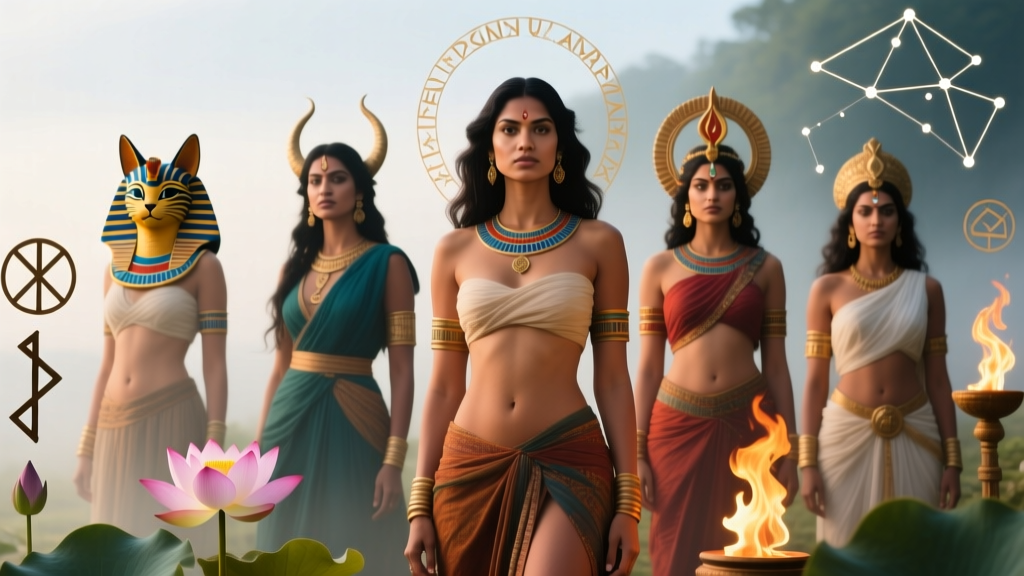
Selecting from historical goddess names requires more than scanning a mythological index; it demands an understanding of etymology, cultural weight, and Jungian archetypes. Whether you are seeking goddess names for a newborn, a fictional protagonist, or a spiritual patron, the phonetic and historical resonance of these titles carries profound psychological impact. This comprehensive guide dissects the origins, linguistic roots, and archetypal domains of global deities, providing a structured framework for selection based on specific energetic, narrative, and psychological requirements.
The Archetypal Framework Behind Goddess Names
Psychiatrist Jean Shinoda Bolen established that mythological figures represent deep psychological patterns. When we invoke specific goddess names, we are activating distinct archetypal energies. According to Britannica's analysis of Jungian archetypes, these names act as cognitive anchors. For instance, names associated with the Sovereign archetype (like Hera or Isis) carry heavy, grounded consonant sounds, whereas Maiden or Muse archetypes (like Artemis or Saraswati) often utilize sibilants and open vowels, reflecting agility and flow. Understanding this framework prevents the superficial application of a name and aligns the title with the intended psychological or spiritual outcome.
Linguistic Roots and Etymological Directory
Hellenic and Roman Antiquity
Greek and Roman goddess names form the bedrock of Western literary tradition, heavily influencing modern nomenclature.
- Athena (Greek): Derived from the Pre-Greek Athana, intrinsically linked to the city of Athens. Represents strategic warfare and wisdom. Phonetically sharp, denoting intellect and precision.
- Hecate (Greek): From hekatos (far-shooting). The goddess of crossroads, necromancy, and magic. The hard 'c' and 't' sounds project boundaries and absolute authority.
- Juno (Roman): Rooted in the Indo-European yeu- (vital force). Protector of the state, marriage, and childbirth. The soft 'J' and open 'O' provide a nurturing but regal phonetic weight.
Germanic and Celtic Traditions
Northern goddess names are deeply tied to the natural world, fate, and tribal sovereignty.
- Freya (Norse): Originates from Proto-Germanic frawjōn, meaning 'lady' or 'sovereign.' Governs love, seiðr (magic), and the battlefield. As detailed by the Online Etymology Dictionary, it shares roots with the German Frau.
- The Morrígan (Celtic): Translates roughly to 'Phantom Queen.' A shape-shifting deity of fate and war. The rolled 'r' and guttural 'g' evoke the harsh realities of the battlefield.
- Brigid (Celtic): From the Proto-Celtic Brigantī (the exalted one). Associated with healing, poetry, and the forge. Later syncretized into the Christian Saint Brigid.
Egyptian and Mesopotamian Origins
These goddess names are intrinsically linked to cosmic order (Ma'at) and primordial magic.
- Isis (Egyptian): Hellenized form of Aset (throne). The ultimate mother and magician. As noted by the World History Encyclopedia, her cult spread across the entire Greco-Roman world due to her universal appeal and promise of salvation.
- Sekhmet (Egyptian): From sekhem (power/might). The lioness deity of healing and destruction. The sibilant 's' and hard 'k' mimic the hiss and strike of a predator.
- Inanna (Sumerian): Likely derived from nin-an-ak (lady of heaven). The goddess of love, beauty, and political power. The repeating 'n' sounds create a rhythmic, chant-like quality.
Vedic and Hindu Pantheons
Eastern goddess names often function as mantras, containing specific vibrational frequencies intended to alter consciousness.
- Kali (Sanskrit): The feminine of kala (time/black). The destroyer of ego and illusion. The hard 'K' sounds serve as a phonetic striking mechanism, cutting through ignorance.
- Lakshmi (Sanskrit): From lakṣ (to perceive/observe). The embodiment of wealth, fortune, and prosperity.
- Saraswati (Sanskrit): Meaning 'she who possesses water.' The deity of knowledge, music, and arts. The flowing 's' and 'w' sounds mimic the movement of a river.
Comparative Matrix: Archetypes, Domains, and Phonetics
| Name | Origin | Archetypal Domain | Phonetic Profile | Modern Usage Viability |
|---|---|---|---|---|
| Athena | Greek | Wisdom, Strategy | Sharp, Dental Consonants | High (Familiar, strong) |
| Freya | Norse | Love, Magic, War | Soft Fricative, Open Vowels | Very High (Trending globally) |
| Sekhmet | Egyptian | Destruction, Healing | Sibilant, Plosive Stops | Low (Too aggressive for infants) |
| Inanna | Sumerian | Political Power, Desire | Nasal, Rhythmic | Medium (Unique, melodic) |
| Kali | Hindu | Time, Ego Death | Hard Plosives | Medium (Cultural weight required) |
Syncretism: How Goddess Names Merged Across Empires
To truly understand goddess names, one must study syncretism—the blending of different religious and cultural traditions. Through Interpretatio graeca and Interpretatio romana, conquering empires mapped local deities onto their own pantheons. The Celtic Brigantia was Romanized as Minerva, merging indigenous tribal sovereignty with Roman strategic intellect. Similarly, the Egyptian Isis absorbed the attributes of Demeter (agriculture) and Aphrodite (love) as her cult moved through the Mediterranean. When selecting a name for historical fiction or deep spiritual study, recognizing these syncretic layers prevents anachronistic portrayals and reveals the complex, evolving nature of the divine feminine.
Pop Culture Distortions vs. Historical Reality
Modern media frequently flattens goddess names into one-dimensional tropes. Hecate, for example, is often reduced to a 'crone' or 'witch' in modern pop culture and neo-paganism, ignoring her original archaic role as a protector of the household, crossroads, and liminal spaces. Aphrodite is routinely diminished to mere romance and vanity, entirely erasing her historical veneration as Aphrodite Areia (the warlike) in Sparta, where she was worshipped in full armor. Relying on pop-culture interpretations strips these names of their historical gravity. True engagement with these titles requires consulting primary sources, such as the Homeric Hymns or the Eddas, rather than modern cinematic adaptations.
Strategic Selection: How to Choose a Goddess Name
For Newborn Naming
When selecting goddess names for children, evaluate the 'bouba/kiki effect' in phonetic symbolism. Names with rounded vowels and soft consonants (like Aurora or Luna) are psychologically perceived as gentle and approachable. Conversely, names with sharp, plosive consonants (like Athena or Sekhmet) project assertiveness and boundary-setting. Furthermore, consider the historical and mythological baggage; naming a child Eris (goddess of discord and strife) carries vastly different social and energetic implications than naming them Irene (the personification of peace).
For Spiritual Invocation and Altar Work
In esoteric and reconstructionist traditions, the precise pronunciation of goddess names is critical for invocation. If working with Hellenic deities, utilize reconstructed ancient Greek pronunciation (e.g., pronouncing Hecate as Hek-ah-tay rather than the anglicized Hek-at). Align the deity's specific historical domain with your psychological or material needs, recognizing that ancient deities were multifaceted. Invoking Artemis requires an understanding of her role not just as a hunter, but as a protector of the young and a goddess of childbirth (Artemis Eileithyia).
For Fiction and Worldbuilding
Authors and game designers should map the linguistic roots of goddess names to their fictional cultures to maintain internal consistency. If building a harsh, seafaring society, draw phonetic inspiration from Norse or Polynesian water deities. Avoid mixing linguistic families—such as combining a Sumerian root with a Celtic suffix—unless you are intentionally portraying a syncretic, multi-cultural empire within your world.
The Evolution into Modern Nomenclature
Many contemporary names are direct descendants of, or are heavily influenced by, ancient goddess names. Diana (Roman goddess of the hunt and moon) remains a global staple. The Norse Freya has seen a massive resurgence in European and American birth registries over the last decade, reflecting a cultural shift toward nature-based naming conventions. Even names like Maia (Greek Pleiad and Roman goddess of spring) and Iris (messenger of the gods and personification of the rainbow) function as bridge names. They carry ancient mythological weight while fitting seamlessly into modern phonetic trends. Understanding this linguistic lineage allows parents, writers, and spiritual practitioners to utilize names that possess deep historical roots without sounding anachronistic or overly theatrical.