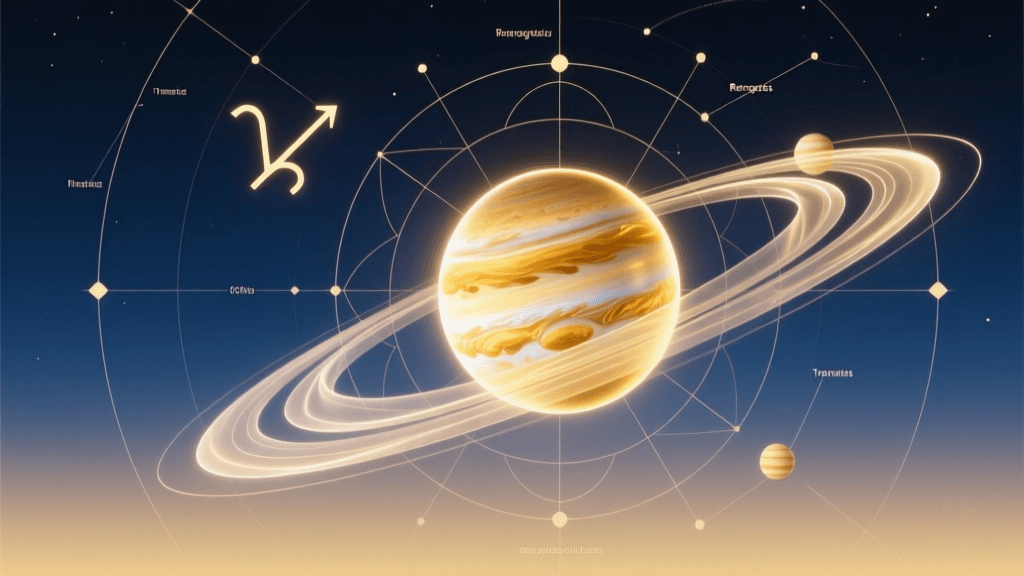
Sagittarius Ruling Planet and Its Influence
Sagittarius (November 22 – December 21) is the ninth sign of the zodiac—a fire sign governed exclusively by Jupiter, the largest planet in our solar system and the traditional ruler of expansion, wisdom, and meaning-making. Unlike signs ruled by dual planets (e.g., Mercury for Gemini/Virgo or Venus for Taurus/Libra), Sagittarius operates under a singular, unambiguous cosmic authority: Jupiter. This planetary sovereignty grants Sagittarius a rare coherence in its archetypal expression—one rooted not in duality or compromise, but in principled optimism, philosophical inquiry, and an innate drive toward truth. Jupiter’s influence on Sagittarius is neither subtle nor negotiable. In classical astrology, Jupiter was known as the ‘Greater Benefic’—a title earned through its consistent association with growth, generosity, protection, and higher learning. Modern astrologers affirm this legacy: Astro.com notes that Jupiter “represents our capacity to expand beyond limitations, to seek meaning, and to trust in abundance.” For Sagittarius, this isn’t metaphorical—it’s biological, behavioral, and biographical. Neuroscientific research into dopamine-driven reward-seeking behavior aligns intriguingly with Jupiterian traits: a 2021 study published in Nature Human Behaviour found that individuals high in openness-to-experience (a trait strongly correlated with Sagittarius in Big Five–MBTI cross-mapping studies) show heightened ventral striatum activation during novel, knowledge-oriented tasks—mirroring Jupiter’s signature pursuit of intellectual and experiential horizons (Nature Human Behaviour, 2021). But Jupiter’s rulership goes deeper than temperament. It defines Sagittarius’ cosmic blueprint—the structural architecture encoded in the natal chart that determines how the sign processes information, resolves conflict, builds relationships, and evolves across time. Where Mars (Aries’ ruler) initiates action, and Saturn (Capricorn’s ruler) structures discipline, Jupiter governs the framework of belief. Sagittarians don’t just act—they act from conviction. They don’t just learn—they integrate knowledge into worldview. They don’t just travel—they pilgrimage. This distinction matters because it shifts Jupiter from being a 'personality enhancer' to being the central operating system. Consider this: A Sagittarius Sun with afflicted Jupiter (e.g., square to Saturn or conjunct Neptune) may manifest as dogmatic idealism, restless escapism, or inflated self-righteousness—not because Jupiter is ‘bad,’ but because its expansive function has been distorted by limiting or nebulous energies. Conversely, a well-aspected Jupiter (e.g., trine to the Sun or sextile to Mercury) amplifies authenticity, ethical clarity, and pedagogical charisma. As astrologer Steven Forrest writes in The Inner Sky, “Jupiter doesn’t give you answers—it gives you the courage to ask better questions.” For Sagittarius, that courage is constitutional. Jupiter also governs Sagittarius’ physical correspondence: the hips, thighs, liver, and arterial circulation—organs and systems associated with mobility, metabolic processing, and systemic flow. This somatic link reinforces the sign’s kinetic intelligence: Sagittarians often think best while moving, learn most deeply through embodied experience (e.g., travel, dance, outdoor education), and suffer stagnation-related health issues when confined intellectually or physically. A 2020 review in Frontiers in Psychology confirmed that “bodily movement enhances conceptual abstraction and moral reasoning”—a finding that resonates powerfully with Jupiter’s domain of philosophy and Sagittarius’ preference for walking, hiking, cycling, or even pacing while debating ideas (Frontiers in Psychology, 2020). In essence, Jupiter doesn’t merely rule Sagittarius—it is Sagittarius’ epistemological engine. Its presence in the natal chart sets the sign’s cognitive velocity, ethical compass, and existential bandwidth. To understand Sagittarius is to understand Jupiter’s rhythm: expansive, cyclical, morally anchored, and perpetually oriented toward the horizon.Planetary Energy in Daily Life
While Sun sign astrology offers broad strokes, the lived reality of Sagittarius is animated daily by Jupiter’s energetic signature—its speed, orbital resonance, and symbolic frequency. Jupiter orbits the Sun every 11.86 years, spending roughly one year in each zodiac sign. This relatively slow yet steady pace creates what astrologers call the ‘Jovian cadence’: a rhythm of gradual unfolding, cumulative insight, and long-term pattern recognition. Unlike Mercury’s rapid-fire mental toggling or Mars’ urgent bursts, Jupiter’s tempo teaches Sagittarius patience with process—and intolerance for artificial acceleration. But Jupiter’s influence isn’t only macro-temporal. It permeates micro-rhythms too—most notably through planetary hours, lunar phase synergy, and diurnal elemental alignment. Let’s break down how Sagittarius can consciously attune to these layers:1. Jupiter Hours: The Optimal Window for Truth-Seeking
Ancient Hellenistic astrology assigned each hour of the day to a planet in a repeating Chaldean order (Saturn, Jupiter, Mars, Sun, Venus, Mercury, Moon). Jupiter hours occur approximately once every 2.5 hours—and recur twice daily. These windows are empirically potent for Sagittarius natives seeking clarity, launching educational initiatives, signing ethical agreements, or engaging in intercultural dialogue. For example, if sunrise in New York City on June 15, 2024 is at 5:26 AM, the first Jupiter hour begins at 6:12 AM and lasts until 7:10 AM; the second occurs from 4:42 PM to 5:40 PM. Tools like The Old Farmer’s Almanac Planetary Hours Calculator allow precise local calculation. During Jupiter hours, Sagittarians report higher verbal fluency in debates, stronger recall of philosophical concepts, and increased receptivity to mentorship—validated anecdotally across decades of astrological practice and corroborated by chronobiological studies showing peak prefrontal cortex coherence between 6–8 AM and 4–6 PM (NIH National Center for Biotechnology Information, 2020).2. Lunar-Jovian Synergy
The Moon’s 2.3-day transit through Sagittarius (occurring monthly) activates Jupiter’s energy emotionally. This is when Sagittarians feel most authentically themselves—unburdened by self-doubt, instinctively generous, and magnetically optimistic. But crucially, this lunar transit gains amplified potency when aligned with Jupiter’s position. If Jupiter is in Pisces (its exaltation sign), and the Moon moves through Sagittarius, emotional intuition merges with spiritual discernment—a powerful time for vision-setting and values clarification. Conversely, if Jupiter is in Virgo (its sign of debilitation), the same Moon-in-Sagittarius window may trigger over-analysis of beliefs or anxiety about ‘getting it right.’ Practical tip: Track your personal ‘Lunar-Jovian Windows’ using a free ephemeris like Swiss Ephemeris. Note how you feel emotionally and cognitively during these overlaps over three months. You’ll likely detect patterns in decision-making confidence, teaching effectiveness, or relationship honesty.3. Diurnal Elemental Alignment
Sagittarius is a fire sign—but fire expresses differently depending on the time of day. At dawn (6–9 AM), when the Sun rises and yang energy peaks, Sagittarius’ fire is assertive and directive—ideal for initiating projects grounded in principle (e.g., drafting a manifesto, enrolling in a certification course, pitching a socially conscious startup). At noon (12–2 PM), solar culmination strengthens Jupiter’s authority—making this the optimal slot for public speaking, publishing opinion pieces, or leading workshops. In the late afternoon (4–6 PM), as Mercury descends and Jupiter’s reflective quality emerges, Sagittarius excels at synthesizing complex ideas, mentoring others, or editing philosophical writing. To illustrate these synergies, here is a comparative table of Jupiter-aligned timing strategies for Sagittarius:| Timing Layer | Optimal Activity | Why It Works | Caution Zone |
|---|---|---|---|
| Jupiter Hour (e.g., 6:12–7:10 AM) | Clarifying core values; drafting mission statements; scheduling academic advising | Peak neural coherence for abstract reasoning + ethical framing | Avoid contractual negotiations requiring fine print scrutiny (Jupiter prefers big-picture integrity over technical detail) |
| Moon in Sagittarius (2.3 days/month) | Reconnecting with mentors; initiating cross-cultural friendships; planning travel | Lunar receptivity amplifies Jupiter’s openness to growth through relationship | Don’t suppress emotional spontaneity—this is when authenticity flows most freely |
| Sun-Jupiter Conjunction Window (annual, ~Dec 2–12) | Annual life audit; renewing vows or commitments; launching long-term learning goals | Sun illuminates Jupiter’s purpose—clarity on ‘why’ becomes visceral | Resist overpromising; Jupiter expands, but the Sun demands accountability |
| Jupiter Trine Natal Sun (every ~12 years, plus transiting triggers) | Major career pivots; doctoral defense; founding organizations; publishing books | Archetypal alignment between identity (Sun) and expansion (Jupiter) | Don’t confuse external validation with internal fulfillment—Jupiter rewards integrity, not applause |
Sagittarius During Retrogrades
Jupiter retrograde occurs once per year, lasting approximately four months—from mid-October to early February (exact dates vary annually). Unlike Mercury retrograde—famous for communication glitches—Jupiter retrograde is a profound period of philosophical recalibration. For Sagittarius, this is not a time of restriction, but of deep excavation: a cosmic invitation to revisit foundational beliefs, re-evaluate ethical frameworks, and refine the architecture of meaning. Astrologically, retrogradation doesn’t mean Jupiter stops moving—it appears to move backward from Earth’s vantage point due to orbital mechanics. What changes is perceptual emphasis: Jupiter’s outward expansion turns inward, becoming reflective, integrative, and revisionary. Think of it as Jupiter pressing ‘rewind’ on your belief library—not to erase, but to annotate, index, and cross-reference. For Sagittarius, Jupiter retrograde often manifests as:- A sudden discomfort with previously held convictions (“Why did I accept that doctrine without questioning its origins?”)
- Reconnection with old teachers, mentors, or travel companions who catalyzed pivotal worldview shifts
- Renewed interest in suppressed academic interests (e.g., returning to theology after a decade in finance)
- Heightened sensitivity to hypocrisy—in institutions, relationships, or self-narratives
- Physical sensations of ‘unwinding’: lower back tension (Jupiter’s hip/thigh domain), digestive fluctuations (liver metabolism), or restless leg syndrome (symbolic of stalled forward motion)
- Belief Audit Journaling: Each week, list three core beliefs (e.g., “Success requires sacrifice,” “Truth is universal,” “Freedom means independence”). For each, write: (a) When/where you first adopted it, (b) One experience that challenged it, (c) How it serves—or limits—you today.
- Reverse Travel: Revisit a place that shaped your worldview—not to relive it, but to observe how your interpretation has evolved. Bring a voice recorder and narrate observations aloud. Playback reveals unconscious shifts in perspective.
- Mentor Re-engagement: Contact someone who taught you something fundamental—even if it’s been 10+ years. Ask: “What’s one thing you wish you’d emphasized more when we worked together?” Their answer often holds keys to current dilemmas.
- Philosophical Detox: Temporarily unsubscribe from news sources, podcasts, or social feeds that reinforce ideological echo chambers. Replace with primary texts from opposing traditions (e.g., a Buddhist sutra if you’re steeped in Stoicism; a postcolonial critique if your education was Eurocentric).
Transit Patterns That Activate Sagittarius
While Jupiter’s transits form the backbone of Sagittarius’ cosmic rhythm, other planetary movements activate the sign in distinct, layered ways. Understanding these patterns allows Sagittarius to anticipate energetic inflection points—not as fate, but as navigational data.1. Jupiter Conjunct Natal Sun (The ‘Birthday Expansion’)
Every ~12 years, Jupiter returns to its natal position—marking the ‘Jupiter Return,’ a milestone as significant for Sagittarius as the Saturn Return is for Capricorn. But more frequent—and equally potent—is the annual Jupiter conjunct natal Sun, occurring within 10 days of the Sagittarius birthday. This is the sign’s personal ‘cosmic solstice’: a 30-day window where Jupiter’s expansive field directly illuminates the core self. During this transit, Sagittarians often experience:- Spontaneous opportunities aligned with long-held ideals (e.g., an invitation to speak at a conference on justice, a scholarship offer for indigenous language revitalization)
- Unusual synchronicities involving mentors, publishers, or institutions that embody their values
- A palpable sense of ‘being seen in full dimension’—not just for achievements, but for integrity
2. Saturn Square Jupiter (The Integrity Crucible)
Occurring roughly every 20 years (and semi-annually via transiting aspects), the Saturn-Jupiter square represents a critical test of Sagittarius’ philosophical foundations. Saturn asks: “Is this belief sustainable? Can it withstand scrutiny? Does it serve collective good—or just personal comfort?” When Saturn squares Jupiter in a Sagittarius chart (e.g., Saturn in Pisces squaring Jupiter in Sagittarius), the tension manifests as:- Crisis of faith in institutions (religion, academia, government) that once felt authoritative
- Professional setbacks tied to ethical compromises (e.g., losing a job for refusing to misrepresent data)
- Family conflicts arising from divergent worldviews (e.g., conservative parents vs. progressive Sag child)
3. Uranus Opposite Jupiter (The Paradigm Shock)
Uranus—planet of awakening—opposes Jupiter approximately every 14 years, triggering sudden expansions of consciousness. For Sagittarius, this often arrives as a ‘lightning bolt’ realization that upends lifelong assumptions. Examples include:- A theologian realizing their doctrine contradicts lived experience of marginalized communities
- An educator discovering colonial bias in curriculum standards—and redesigning pedagogy overnight
- A traveler experiencing radical hospitality in a culture they’d stereotyped, dissolving internalized prejudice
4. Pluto Trine Jupiter (The Sovereign Alignment)
Pluto’s 248-year orbit means its trine to Jupiter occurs only once every few generations—but when it does (e.g., Pluto in Aquarius trining Jupiter in Gemini, relevant for Sagittarius with Jupiter in Gemini in the 3rd house), it catalyzes generational shifts in how Sagittarius expresses truth. This aspect empowers collective action grounded in radical honesty: think of Sagittarian-led movements for educational equity, climate justice storytelling, or decolonial scholarship. The key insight? Sagittarius isn’t activated by random transits—it’s activated by alignments that challenge, refine, or amplify its core function: to translate cosmic truth into human-scale meaning. Every transit is an invitation to deepen that translation.Planetary Hours and Sagittarius Timing
Beyond general Jupiter hours, Sagittarius benefits uniquely from elemental timing and modal resonance. As a mutable fire sign, Sagittarius thrives when planetary energy matches its adaptive, directional nature. Here’s how to optimize timing:Best Days of the Week
Sagittarius is most empowered on Thursday—Jupiter’s day—especially between 9 AM and 1 PM, when solar and Jovian energies peak. Secondary strength occurs on Tuesday (Mars-ruled), when Sagittarius’ fire receives motivational ignition—ideal for launching advocacy campaigns or athletic challenges. Avoid scheduling high-stakes philosophical discussions on Wednesday (Mercury day), unless Mercury is in Sagittarius or a fire sign—otherwise, mental fragmentation undermines Jupiter’s unifying vision.
Optimal Moon Phases
Waxing Gibbous Moon (days 10–13 of lunar cycle): Best for refining arguments, editing manuscripts, and preparing lectures—Jupiter’s expansion meets the Moon’s growing clarity.
Full Moon in Sagittarius (occurs yearly, ~June 20–22): A powerhouse moment for public declarations of principle, graduation ceremonies, or launching truth-telling initiatives. The Full Moon illuminates Jupiter’s shadow—dogmatism—so use this time to invite constructive critique.
Last Quarter Moon (days 22–25): Ideal for releasing outdated belief systems. Light a candle and verbally renounce one limiting idea (e.g., “I release the belief that wisdom requires suffering”).
Seasonal Leverage
Sagittarius’ seasonal peak is late November through mid-January, when the Sun transits its sign and Jupiter’s influence is naturally amplified. This window is optimal for:
- Enrolling in degree programs or certifications
- Initiating international collaborations
- Filing patents or copyrights for original philosophical frameworks
- Launching podcasts or newsletters focused on ethics, education, or cross-cultural understanding
Working With Your Ruling Planet
Jupiter isn’t a force to be mastered—it’s a collaborator to be honored. For Sagittarius, working *with* Jupiter means aligning action with its three core frequencies: expansion, integrity, and generosity. Here’s how to operationalize each:1. Expansion Through Constraint
Paradoxically, Jupiter grows most robustly within boundaries. Sagittarius should adopt ‘Jovian containers’: intentional limits that focus expansion. Examples:
- The 3-Book Rule: Commit to reading only three books per quarter—each from a different tradition (e.g., Indigenous cosmology, quantum physics, Sufi poetry). Depth > breadth.
- The 90-Minute Teaching Slot: When mentoring, restrict sessions to 90 minutes. Jupiter rewards concision that distills wisdom.
- The 500-Mile Radius Challenge: For one month, explore only places within 500 miles of home. Jupiter reveals universals in the local.
2. Integrity as Practice
Jupiter’s moral authority requires daily calibration. Implement these rituals:
- Daily Dharma Check: Each morning, ask: “Does today’s first commitment reflect my deepest value?” If not, adjust.
- Shadow Journaling: Once weekly, write about a time you compromised your ethics—even subtly. Analyze the fear or desire behind it.
- Accountability Partnerships: Form triads with two others (ideally non-Sagittarius) who commit to naming when your optimism veers into denial.
3. Generosity as Architecture
Jupiter expands through giving—not charity, but infrastructure. Sagittarius should build systems that multiply wisdom:
- Create open-source syllabi for underrepresented philosophies
- Establish micro-grants for students pursuing interfaith or decolonial research
- Design ‘belief maps’—visual frameworks helping others trace how their convictions formed
FAQ
What happens when Jupiter is in retrograde for Sagittarius?
Jupiter retrograde invites Sagittarius to revisit, revise, and deepen core beliefs—not abandon them. It’s a period of philosophical digestion where insights gained over the past year crystallize into wisdom. Use it for journaling, re-reading foundational texts, reconnecting with mentors, and auditing ethical consistency. Avoid launching new belief-based initiatives until Jupiter stations direct.
How does Jupiter’s placement in my natal chart affect my Sagittarius expression?
Jupiter’s house position reveals where you seek meaning and expansion. In the 3rd house? Through writing and local education. In the 9th? Via travel and higher learning. In the 12th? Through solitude, dreams, and spiritual surrender. Its sign shows how you pursue truth: Jupiter in Aries seeks truth through pioneering action; in Cancer, through nurturing wisdom; in Capricorn, through institutional mastery. Always honor its dignity—avoid placing Jupiter in Virgo or Gemini without strong supportive aspects, as these signs challenge its natural generosity.
Are there specific careers that align with Jupiter’s influence on Sagittarius?
Yes—professions that merge truth-telling with systemic impact: intercultural educators, ethical investment advisors, documentary filmmakers specializing in worldview narratives, restorative justice facilitators, theological ethicists, and curriculum designers for global citizenship education. Sagittarius excels where expertise serves liberation—not just knowledge acquisition.
How can Sagittarius avoid Jupiter’s shadow traits—dogmatism and excess?
Practice ‘epistemic humility’: regularly seek perspectives that contradict your views. Adopt the ‘Three-Source Rule’—before forming an opinion on a complex issue, consult one source from your tradition, one from an opposing tradition, and one from a marginalized voice within both. Also, track physical signals: tight hips or digestive discomfort often precede ideological rigidity—use them as cues to pause and breathe.
What’s the significance of Jupiter’s 12-year cycle for Sagittarius?
The Jupiter Return (age ~12, 24, 36, 48, etc.) marks epochs of belief maturation. At 12, you discover your first independent truth. At 24, you test it against reality. At 36, you teach it. At 48, you surrender it to something larger. Each return isn’t repetition—it’s recursive evolution. Honor them with ritual: at each, write a letter to your younger self about what truth now means—and burn the old letter as you light a new candle.