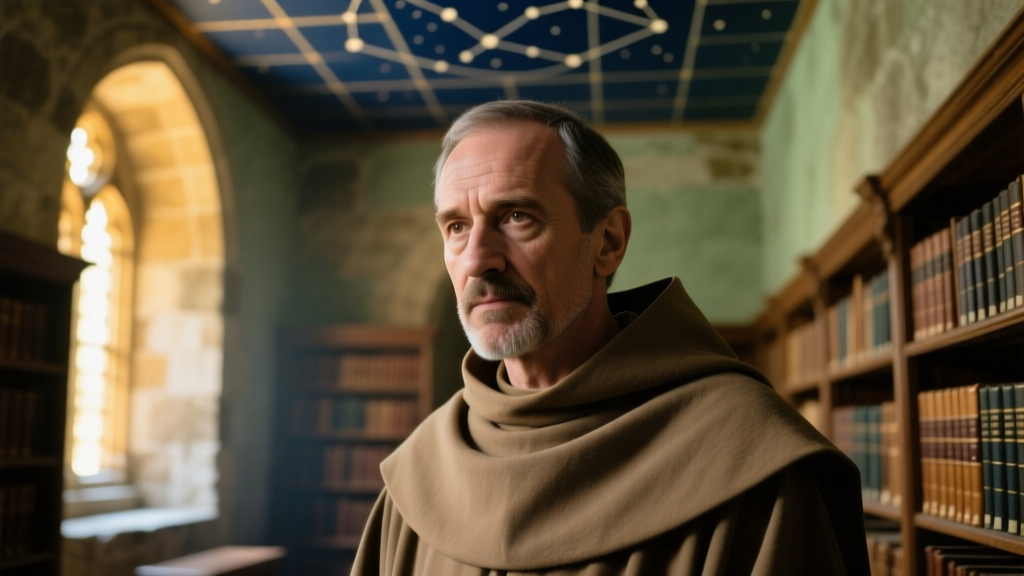
Saint Augustine of Hippo (354–430 CE) remains a foundational architect of Western introspective thought. Long before the advent of modern psychoanalysis or cognitive behavioral frameworks, Saint Augustine mapped the labyrinth of the human psyche, pioneering the spiritual autobiography as a tool for profound psychological excavation. For seekers of esoteric knowledge and spiritual depth, his synthesis of Christian mysticism and Neoplatonic philosophy offers a rigorous methodology for inner work. Rather than viewing the divine as an external entity to be petitioned, he positioned the ultimate reality within the deepest chambers of human consciousness. This guide deconstructs his philosophical architecture, exploring how his insights into memory, time, and the will provide actionable frameworks for modern spiritual and psychological development.
The Neoplatonic Bridge to Interiority
Before his ultimate theological alignment, Augustine underwent a profound intellectual crisis, documented meticulously in his Confessions. The turning point occurred upon his encounter with the 'books of the Platonists'—Latin translations of works by Plotinus and Porphyry. According to the Stanford Encyclopedia of Philosophy, this Neoplatonic framework provided the crucial metaphysical bridge that allowed him to conceptualize a non-material, spiritual reality.
The Ascent of the Soul
Neoplatonism posits that the material world is an emanation of the 'One', and that the soul's journey requires an inward turn followed by an upward ascent. Augustine adapted this into his doctrine of interiority. He realized that the divine was not spatially located in the physical cosmos but resided within the mind. His famous injunction, 'Return to yourself; in the inner man dwells truth,' shifted the spiritual paradigm from external ritual observance to rigorous psychological self-inquiry. For modern practitioners, this establishes the premise that spiritual awakening requires confronting the shadow elements of one's own psyche before achieving union with the transcendent.
The Psychological Architecture of Saint Augustine
In Book X of the Confessions, Augustine executes a staggering analysis of human memory (memoria). He does not treat memory merely as a storage facility for past events, but as a vast, subterranean landscape that houses sensory data, intellectual concepts, and the latent presence of the divine. This exploration predates Jung's collective unconscious by over a millennium.
Mapping the Tripartite Mind
Augustine conceptualized the human mind as a trinity of functions: Memory, Intellect, and Will. He argued that these three are distinct yet inseparable, forming a single psychological substance. Understanding this triad is essential for anyone utilizing his methods for shadow work and spiritual integration.
| Augustinian Faculty | Function & Spiritual Role | Modern Psychological Equivalent |
|---|---|---|
| Memoria (Memory) | Storehouse of experience and latent divine truth; the site of introspective excavation. | The Unconscious / Subconscious Mind |
| Intellectus (Intellect) | The capacity for rational illumination and grasping eternal, non-material truths. | Cognitive Processing / Ego Awareness |
| Voluntas (Will) | The driving force of desire and love; the mechanism that aligns the soul with truth or distracts it. | Libido / Volition / Motivational Drive |
When the Will is fractured by competing desires—a state Augustine termed akrasia or weakness of will—the psyche experiences profound distress. His famous prayer, 'Grant me chastity and continence, but not yet,' perfectly encapsulates the psychological friction between higher spiritual aspirations and base biological drives.
The Deconstruction of Time and Consciousness
In Book XI, Augustine tackles the ontology of time, arriving at a conclusion that aligns remarkably with modern phenomenological psychology. He rejects the Aristotelian view that time is merely the measurement of celestial motion. Instead, he argues that time is a distentio animi—a distension or stretching of the mind itself.
According to the Internet Encyclopedia of Philosophy, Augustine posits that the past exists only as memory, the future exists only as expectation, and the present exists only as attention. Therefore, time is entirely subjective and rooted in human consciousness. For the spiritual seeker, this philosophical breakthrough is highly actionable: it implies that anxiety (fear of the future) and regret (fixation on the past) are failures of present-moment attention. Mastery over one's spiritual state requires collapsing the distension of the mind into a singular, focused point of present awareness, a concept that mirrors modern mindfulness and meditative practices.
The Dichotomy of Love and Ego Dissolution
At the core of Augustinian psychology is the understanding that human beings are defined by their loves. He famously delineated two cities built upon two distinct psychological orientations: the love of self extending to the contempt of God (the Earthly City), and the love of God extending to the contempt of self (the City of God). In modern esoteric terms, this is a precise description of ego dissolution. The 'contempt of self' does not mean pathological self-hatred; rather, it signifies the systematic dismantling of the ego's false identifications. When the voluntas is entirely captivated by transient, material objects, the psyche fractures. Healing occurs only when the will is reoriented toward the infinite, thereby integrating the fragmented self. This framework provides a diagnostic tool for spiritual seekers: analyze your attachments to determine whether they are consolidating your ego or dissolving it into a broader, universal awareness.
Practical Frameworks for Inner Work
Translating Augustinian philosophy into contemporary spiritual practice requires moving beyond theological dogma and engaging with his methodology of introspection. Here are specific, actionable frameworks derived from his writings:
- The Practice of Radical Confession: Augustine invented the literary genre of the confessional autobiography not to inform God of his sins, but to force his own mind to articulate its hidden motivations. Modern application: Maintain a daily 'shadow journal' where you ruthlessly document your cognitive dissonances, hidden resentments, and ego-driven rationalizations without judgment.
- Attention Training (Controlling the Distentio): Since time and suffering are linked to the mind's scattering across past and future, practice strict attentional control. Dedicate 20 minutes daily to sensory grounding, actively pulling the voluntas (will) away from memory and expectation, anchoring it solely in immediate perception.
- Consulting the Inner Teacher: Augustine argued that true understanding does not come from external authorities, but from the 'Inner Teacher' (the divine Logos residing within the intellect). When faced with ethical or spiritual dilemmas, bypass immediate external validation and engage in deep contemplative silence to access innate intuitive wisdom.
Legacy in Mystical and Esoteric Traditions
The psychological depth of Saint Augustine laid the subterranean groundwork for centuries of Western mysticism. His emphasis on interiority directly influenced the contemplative methods of Teresa of Ávila in her Interior Castle, and later, 20th-century thinkers like Thomas Merton. As noted by Encyclopædia Britannica, his ability to synthesize rigorous intellectual inquiry with profound emotional vulnerability created a template for the mystical journey that remains unmatched in its psychological realism.
By treating the human mind as a sacred, albeit deeply flawed, landscape requiring meticulous exploration, Augustine provided a timeless map for the soul. His work demands that seekers do not look to the stars or external gurus for salvation, but rather brave the terrifying, expansive depths of their own consciousness to locate the eternal.