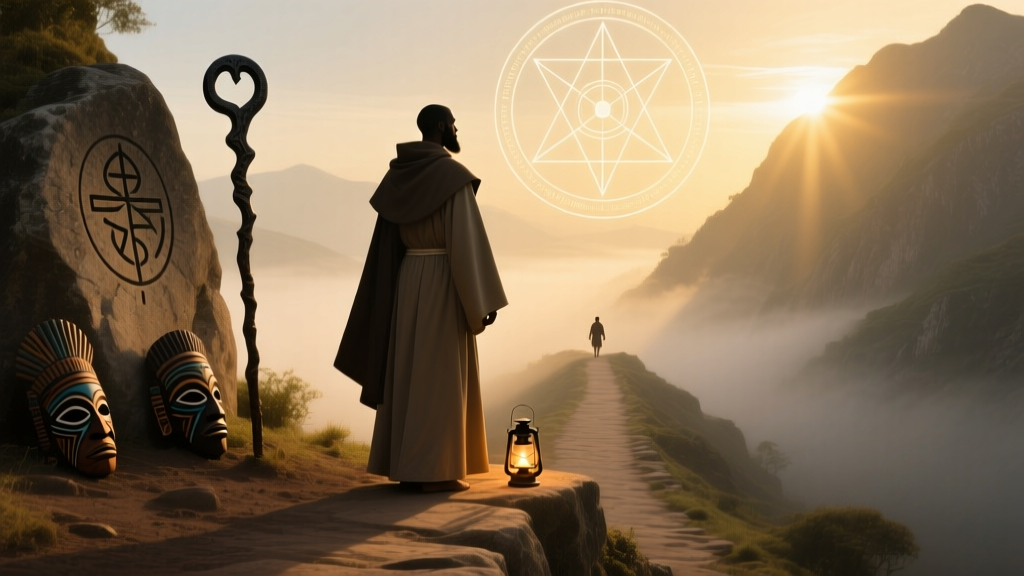
The veneration of Saint James extends far beyond orthodox hagiography, embedding itself deeply into Western esotericism, alchemical symbolism, and Afro-Caribbean syncretism. Known esoterically as the Warrior-Pilgrim, Saint James represents the synthesis of martial protection and spiritual wandering. For modern practitioners of mythology, ritual magic, and sacred geography, understanding this archetype requires examining his spiritual mechanics against alternative figures and sacred routes. This analysis deconstructs the esoteric attributes of Saint James, compares his syncretic equivalents like Ogun, and evaluates alternative pilgrimage frameworks for those seeking profound liminal transformation.
The Esoteric Archetype of Saint James
In occult and mythological traditions, figures often possess dual natures, and Saint James is no exception. He is simultaneously Santiago Peregrino (the Pilgrim) and Santiago Matamoros (the Moorslayer or Warrior). This duality maps perfectly onto the alchemical process of calcination and coagulation—the breaking down of the ego through the arduous physical journey, followed by the crystallization of spiritual authority.
The primary symbol of the pilgrim, the scallop shell (Pecten maximus), is frequently misunderstood as a mere geographic marker of the Galician coast. In hermetic alchemy, the shell's radiating ridges represent the emanation of divine light into the material plane, while its aquatic origin grounds it in the subconscious, emotional waters of the psyche. It is a vessel of rebirth. Conversely, the sword of the warrior aspect represents the axis mundi, the divine will severing illusion from truth. According to Britannica's historical analysis of Saint James the Apostle, the martial mythos was heavily amplified during the Spanish Reconquista, specifically following the legendary Battle of Clavijo in 844 AD, transforming a fisherman-apostle into an astral general.
Syncretic Equivalents: Saint James vs. Afro-Caribbean Orishas
During the transatlantic slave trade, enslaved Africans systematically masked their veneration of Yoruba Orishas behind the iconography of Catholic saints. Saint James became a primary vessel for this spiritual preservation, but his syncretic mapping varies significantly based on which aspect of his archetype is being invoked.
In Cuban Santería (Lucumí), the image of Santiago Matamoros—mounted on a white horse with a sword raised high—is syncretized with Shango, the Orisha of thunder, lightning, and royal justice. The downward strike of the sword visually and energetically mirrors the strike of lightning. In contrast, in Brazilian Candomblé and certain Puerto Rican traditions, the martial, path-clearing energy of the saint's sword and the iron of his weaponry align him with Ogun, the deity of iron, labor, and war. Understanding these distinctions is critical for practitioners engaging in cross-traditional ritual work.
| Archetype / Figure | Tradition | Core Domain | Esoteric Correspondence | Primary Ritual Focus |
|---|---|---|---|---|
| Saint James (Santiago) | Christian / Hermetic | Protection, Journeying, Thunder | Scallop Shell (Water/Rebirth), Iron Sword | Red wine, silver, physical pilgrimage |
| Ogun | Yoruba / Santería / Candomblé | Iron, War, Labor, Clearing Paths | Iron tools, Machete, Green/Black | Rum, cigars, palm oil, yams |
| Shango | Yoruba / Lucumí | Thunder, Lightning, Royal Justice | Double-headed axe (Oshe), Red/White | Apples, bananas, red wine, drumming |
| Archangel Michael | Abrahamic / Occult | Divine Will, Spiritual Warfare | Flaming Sword, Scales, Sun | Frankincense, white candles, psalms |
Pilgrimage Alternatives to the Camino de Santiago
The Camino de Santiago is globally renowned for its telluric energy lines, often mapped by esoteric geographers alongside European ley lines. As documented by The Confraternity of Saint James, the route has facilitated millions of spiritual journeys. However, its modern commercialization has led many serious practitioners to seek alternative sacred routes that offer deeper isolation and distinct energetic mechanics.
- Kumano Kodo (Japan): The only other pilgrimage route recognized by UNESCO alongside the Camino. It is rooted in Shugendō, a syncretic religion blending Shinto, Buddhism, and Taoism. Unlike the linear, destination-focused Camino, the Kumano Kodo relies on mountain asceticism designed to induce altered states through physical exhaustion and direct communion with kami (nature spirits).
- Shikoku 88 Temple Pilgrimage (Japan): A 1,200-kilometer circular route. Esoterically, the circle represents the cycle of samsara and the mandala of awakening. The pilgrim walks the perimeter of the island, symbolizing the containment and transmutation of karmic debt, contrasting sharply with the linear vector of the Camino.
- Via Francigena (Italy): The route from Canterbury to Rome. While the Camino is associated with the liminal wandering of James, the Via Francigena is energetically tethered to the ecclesiastical authority, martyrdom, and foundational grounding of Saint Peter. It is suited for those seeking institutional spiritual alignment rather than wild, liminal wandering.
Invoking Warrior Energy: Saint James vs. Archangel Michael
When practitioners require spiritual defense, the severing of karmic ties, or the courage to face immense life transitions, both Saint James and Archangel Michael are frequently invoked. However, their energetic footprints operate on different metaphysical planes.
Saint James is fundamentally earthy and physical. His energy is tied to the dust of the road, the physical endurance of the body, and the immediate, visceral reality of iron and blood. He is the patron of the physical vehicle moving through hostile territory. Archangel Michael, conversely, is celestial and intellectual. His domain is cosmic order, divine law, and mental clarity. Michael's flaming sword burns away spiritual deception, whereas James's iron sword physically cleaves through material obstacles.
Ritual Application and Correspondences
For practical ritual work, aligning your correspondences with the specific archetype is essential for efficacy:
- Saint James Correspondences: Feast days on July 25 (Summer) and December 30 (Winter). Colors: Red, Gold, and Silver. Elements: Water (the shell) and Fire (the warrior). Use iron talismans, scallop shells, and red wine for grounding and physical protection during travel.
- Archangel Michael Correspondences: Feast day on September 29 (Michaelmas). Colors: White, Gold, and Deep Blue. Elements: Air and Fire. Use frankincense, clear quartz, and solar invocations for mental clarity, psychic defense, and spiritual warfare.
Choosing Your Spiritual Patron and Path
Selecting between the veneration of Saint James, his syncretic equivalents, or alternative pilgrimage routes requires a precise diagnosis of your current spiritual crisis. Use the following decision framework to align your practice:
Choose the Camino de Santiago and Saint James if: Your primary need is physical grounding, endurance through a prolonged life transition, and the integration of emotional waters (represented by the scallop shell) with martial discipline. This path is optimal for those who need to physically walk through their grief or confusion.
Choose Ogun and the Kumano Kodo if: You are facing systemic, material blockages that require aggressive, relentless clearing. Ogun's iron energy combined with the brutal physical asceticism of Shugendō mountain rituals will shatter stagnation and forge new material realities.
Choose Shango and the Shikoku 88 if: Your journey requires the burning away of karmic debt and the restoration of personal sovereignty. The cyclical nature of the Shikoku route, paired with the thunderous, justice-oriented energy of Shango, facilitates profound spiritual death and rebirth.
By moving beyond surface-level hagiography and engaging with the deep mythological and esoteric mechanics of these figures, practitioners can harness precise spiritual technologies for profound inner alchemy. For further exploration of sacred routes, the official Tanabe City Kumano Kodo guide provides extensive geographical and spiritual mapping for the ascetic practitioner.