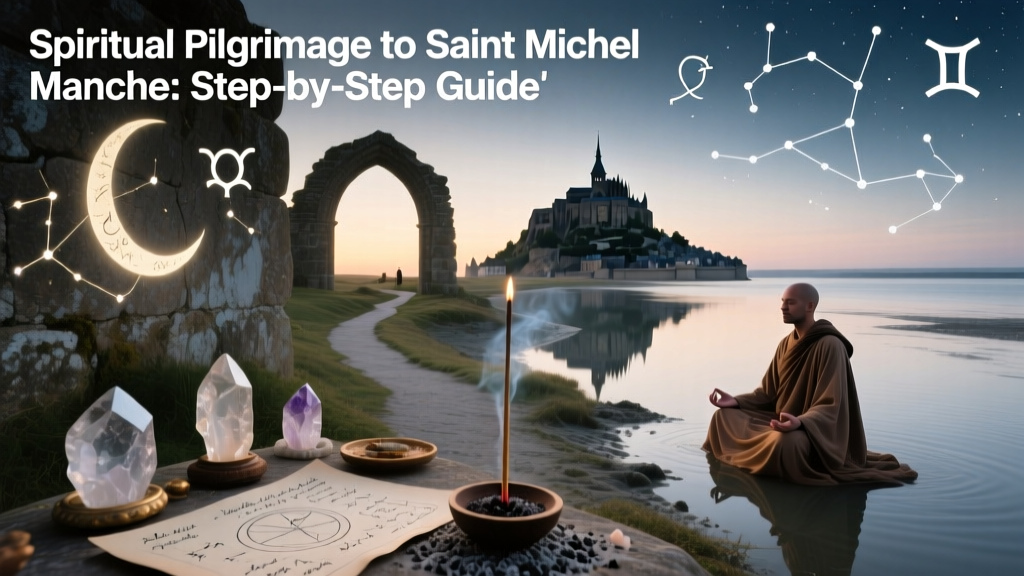
The coastal department of Normandy holds one of the most powerful energetic vortexes in Europe. For spiritual seekers and esoteric historians, a journey to saint michel manche is far more than a standard tourist excursion; it is a profound initiatory pilgrimage. Situated on a tidal island, Mont Saint-Michel serves as the French anchor of the legendary St. Michael Ley Line, a precise geometric alignment of sacred sites stretching across the continent. Navigating this terrain requires more than a map; it demands an understanding of tidal rhythms, architectural esotericism, and archangelic resonance. This guide provides a precise, step-by-step methodology for undertaking a spiritual pilgrimage to this monumental nexus.
Understanding the Esoteric Geometry of Saint Michel Manche
Before initiating the physical journey, practitioners must understand the energetic topography of the region. Mont Saint-Michel is not arbitrarily placed; it sits exactly on the St. Michael Line (often correlated with the ancient Apollo Line). This ley line connects seven major sanctuaries dedicated to the Archangel Michael: Skellig Michael in Ireland, St. Michael's Mount in Cornwall, Mont Saint-Michel in the Manche department, Sacra di San Michele in Piedmont, Monte Sant'Angelo in Puglia, the Monastery of the Taxiarches in Greece, and Mount Carmel in Israel.
Mythologically, this alignment represents the strike of the Archangel Michael’s sword upon the earth, subduing chaotic, primal energies (symbolized by the dragon or the serpent) and establishing a conduit of divine, ordering light. In esoteric traditions, the Manche bay acts as a massive energetic lung. The extreme tidal fluctuations—reaching up to 14 meters in amplitude—create a rhythmic pumping mechanism that clears stagnant etheric energy from the landscape, making it an ideal environment for deep spiritual purging and renewal.
Step 1: Aligning Your Pilgrimage with Celestial and Tidal Cycles
Timing is the most critical variable in energetic work. Arriving at the island during peak summer tourist season dilutes the spiritual atmosphere and disrupts the subtle frequencies required for deep meditation. To maximize the archangelic connection, your pilgrimage must align with specific astronomical and tidal events. The Archangel Michael is traditionally associated with the element of fire, the direction of the South, and the protection of the divine will.
| Cycle Type | Optimal Timing | Spiritual Focus |
|---|---|---|
| Michaelmas | September 29 | Archangelic connection, protection, courage, and the harvest of spiritual fruits. |
| Spring Equinox | March 20-21 | Balance, new beginnings, and the triumph of light over the darkness of winter. |
| Great Tides (Vives-eaux) | 36-48 hours post-full/new moon | Emotional clearing, deep subconscious release, and energetic washing of the aura. |
| Winter Solstice | December 21 | Inner alchemy, shadow work, and finding the divine spark in the deepest darkness. |
Consult the official tidal coefficients provided by the Official Mont Saint-Michel Tourism Board. Aim for a tidal coefficient above 90 if you intend to witness the rapid encroachment of the sea, a powerful metaphor for the overwhelming nature of divine grace.
Step 2: The Barefoot Bay Crossing (Earthing Ritual)
Historically, pilgrims did not arrive via the modern causeway; they crossed the treacherous bay on foot. To replicate this initiatory rite, you must engage in a barefoot bay crossing, ideally guided by a certified local expert due to the presence of quicksand (tangue) and shifting channels. From an esoteric perspective, this is a massive grounding exercise.
The bay's sediment is a highly conductive mixture of marine clay, sand, and mineral salts. Walking barefoot across this expanse facilitates direct electron transfer from the earth to the body, neutralizing excess positive ions accumulated from modern electromagnetic environments. As you walk, focus on the physical sensation of the mud pulling stagnant energy down through your root chakra and into the earth. The physical exertion required to pull your feet from the suction of the mud mirrors the psychological effort required to detach from material addictions. By the time you reach the island's shores, your nervous system will be deeply regulated, and your energetic field will be primed for higher-frequency reception.
Step 3: The Ascent and Architectural Initiation
Upon reaching the island, the physical ascent mirrors the soul's journey through the planes of existence. The village at the base, with its narrow, winding streets and commercial density, represents the material plane and the distractions of the ego. As you climb the Grande Rue, consciously practice detachment. Do not linger in the lower shops; keep your eyes fixed upward on the spire.
The architecture of the abbey itself is a masterclass in esoteric geometry, as documented by the Centre des Monuments Nationaux. The lower levels, including the heavy, thick-walled Romanesque crypts, represent the subconscious mind and the foundational, grounded aspects of the self. As you ascend into the Gothic structures, the stone becomes lighter, the vaults reach higher, and the windows expand. This architectural transition from Romanesque weight to Gothic etherealism is designed to physically induce a shift in consciousness, moving the pilgrim from earthly concerns to celestial awareness.
Key Meditation Nodes Within the Abbey
Once inside the abbey, bypass the main tourist flow and seek out these specific energetic nodes for your practice:
- The Crypt of the Thirty Candles (Crypte des Trente Cierges): Located beneath the choir, this space possesses unique acoustic properties. The low, resonant frequencies generated by chanting or deep toning here stimulate the vagus nerve and activate the root and sacral chakras.
- The Cloister (Le Cloître): Featuring staggered arches and an open-air garden, this space represents the heart chakra and the integration of the elements. The acoustic design creates a subtle, continuous white noise from the wind, ideal for mindfulness and centering.
- The Refectory: A long, narrow hall with slit windows that allow precise blades of light to enter. This space is associated with the throat chakra, the ingestion of spiritual wisdom, and the discipline of silence.
Step 4: Conducting the Archangelic Invocation
The apex of the pilgrimage occurs at the very top of the spire, near the statue of the Archangel Michael slaying the dragon. This is the crown chakra of the island. To conduct the invocation, arrive either at dawn before the gates fully open to the masses, or during the late evening if you are staying at an on-island abbey retreat.
Face South, the traditional direction of fire and the Archangel Michael. Visualize a pillar of brilliant, electric blue light descending from the solar logos, striking the tip of Michael’s sword, and traveling down through the spire, through your own central channel, and anchoring deep into the bedrock of the Manche bay. Use the traditional invocation of protection, focusing not on the destruction of external enemies, but on the severing of internal etheric cords, karmic ties, and limiting beliefs. The blue ray of Michael is the frequency of divine will and absolute truth; ask for the clarity to cut away what no longer serves your highest evolution.
Post-Pilgrimage Integration
The energy of the saint michel manche vortex is highly potent and heavily Yang (active, masculine, protective). Returning to standard daily life immediately after the invocation can result in energetic burnout or irritability. Integration requires grounding this high-frequency archangelic energy into the physical body. Upon leaving the island, consume dense, root-based foods (potatoes, beets, carrots) and engage in heavy physical labor or resistance training. Avoid consuming alcohol or engaging in chaotic social environments for at least 72 hours post-pilgrimage. Document your insights in a dedicated journal, allowing the structural clarity of the Archangel Michael to organize your spiritual revelations into actionable, worldly discipline.