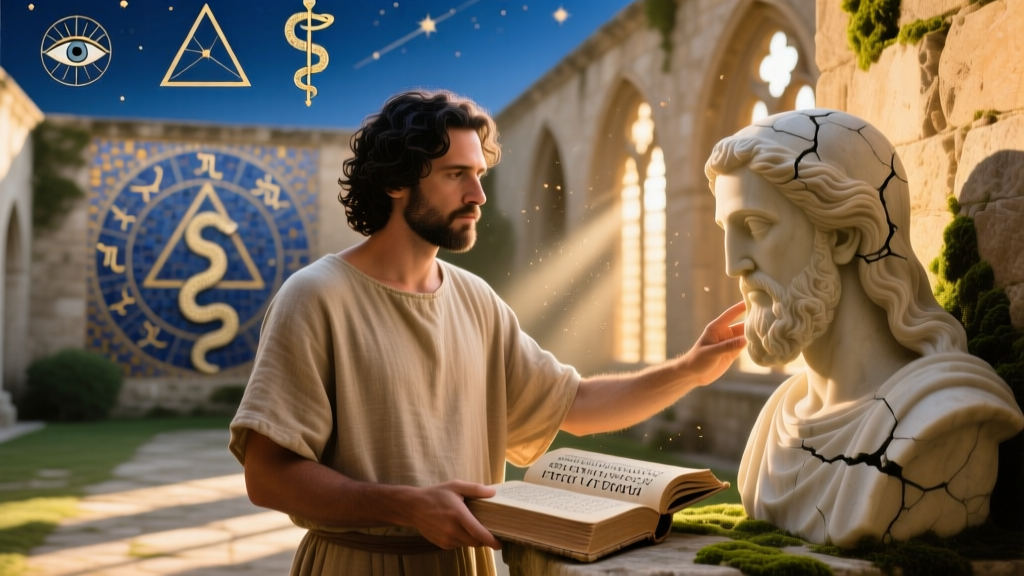
When exploring the intersection of early Christian mysticism and personality archetypes, few figures offer as much psychological depth as Saint Thomas. Often reduced to a single moment of skepticism in popular culture, Thomas represents a vital spiritual pathway: the empirical seeker. For modern spiritual practitioners, understanding Saint Thomas provides a framework for integrating doubt, intellectual rigor, and mystical experience. This guide breaks down the historical, esoteric, and psychological dimensions of this complex figure, offering actionable insights for those on a non-traditional spiritual path.
The Historical and Biblical Saint Thomas
Born as Didymus Judas Thomas (both "Didymus" in Greek and "Thomas" in Aramaic translate to "The Twin"), he was one of the twelve primary apostles. Beyond the canonical gospels, historical traditions trace his extensive missionary work to the Malabar Coast of India. Here, he established the community known as the Saint Thomas Christians, which still exists today. According to the Catholic Encyclopedia, his martyrdom in Mylapore around 72 CE cemented his legacy as a foundational pillar of Eastern Christianity. This historical reality paints a picture not of a timid doubter, but of a radical, well-traveled mystic who took his spiritual convictions to the edges of the known world.
The Mythological Motif of the Divine Twin
In comparative mythology, the concept of the "twin" carries profound esoteric weight. In the Syriac Acts of Thomas, this is taken to its mystical extreme: Thomas is portrayed as the identical twin brother of Jesus. From a Jungian perspective, this represents the psychological concept of the Self and the Ego, or the divine spark trapped in the material world mirroring the transcendent source. This motif parallels the Greek myth of the Dioscuri (Castor and Pollux), where one twin is mortal and the other immortal, symbolizing the human struggle to reconcile our earthly limitations with our divine potential. Understanding this mythological layer elevates Thomas from a mere historical disciple to a universal symbol of the human condition.
The "Doubting Thomas" Archetype in Personality Psychology
In personality psychology and Jungian analysis, the "Doubting Thomas" is not a pejorative term; it is a recognized cognitive and spiritual archetype. This archetype embodies the empirical mind—the part of the psyche that refuses blind acceptance and demands experiential proof. When individuals undergo a spiritual awakening or a "dark night of the soul," the Thomas archetype often activates. It acts as a psychological immune system, preventing the ego from being overwhelmed by ungrounded mystical experiences or dogmatic manipulation.
Furthermore, in an era saturated with "New Age" commodification, the Thomas archetype serves as a necessary defense mechanism against spiritual bypassing. Many seekers fall prey to the Dunning-Kruger effect in spiritual circles, adopting complex metaphysical beliefs without the foundational inner work. The empirical skepticism inherent in the Thomas energy forces the practitioner to ground their mystical experiences. It demands that a profound vision or psychic download be tested against the reality of one's daily behavior, relationships, and emotional regulation. If a spiritual insight does not yield tangible psychological integration, the Thomas archetype discards it as mere spiritual entertainment.
Core Traits of the Thomas Archetype
- Empirical Verification: A deep-seated need to test spiritual concepts through direct, lived experience rather than accepting second-hand dogma.
- Intellectual Honesty: The courage to voice doubts in environments that demand blind faith, prioritizing truth over social conformity.
- Somatic Grounding: A tendency to seek physical or tangible evidence of spiritual realities, bridging the gap between the ethereal and the material.
- Transformative Surrender: Once proof is attained, the Thomas archetype exhibits absolute, unwavering devotion, as seen in Thomas’s ultimate declaration, "My Lord and my God."
The Esoteric Gospel of Thomas
For esoteric scholars and spiritual seekers, the most fascinating text associated with this apostle is the Gospel of Thomas. Unearthed in 1945 near Nag Hammadi, Egypt, this non-canonical text contains 114 secret sayings attributed to Jesus. Unlike the narrative gospels, it lacks a passion narrative, miracles, or a resurrection story. Instead, it focuses entirely on inner enlightenment, non-dual consciousness, and the divine spark within humanity. The British Library's analysis of the Gnostic Gospels highlights how this text shifts the focus from external salvation to internal realization.
Key Sayings and Esoteric Meanings
The Gospel of Thomas reads more like a Zen koan collection or a Hermetic manual than a traditional religious text. Consider Saying 70: "If you bring forth what is within you, what you bring forth will save you. If you do not bring forth what is within you, what you do not bring forth will destroy you." This aligns perfectly with modern depth psychology and shadow work, suggesting that spiritual salvation is achieved through radical self-integration rather than external grace. You can explore the full translated text via the Early Christian Writings archive.
Canonical vs. Esoteric Traditions: A Structural Comparison
To understand the multifaceted nature of this figure, it is necessary to compare how different early Christian movements utilized his persona. The table below outlines the primary textual traditions surrounding the apostle.
| Textual Tradition | Primary Focus | Portrayal of Thomas | Theological Paradigm |
|---|---|---|---|
| Canonical Gospels (John) | Physical Resurrection | The Skeptic who demands physical proof | Orthodox, faith through apostolic witness |
| Gospel of Thomas | Inner Enlightenment | The receiver of secret, non-dual wisdom | Gnostic, salvation through self-knowledge |
| Acts of Thomas (Syriac) | Asceticism & Miracles | The "Twin" of Jesus, an ascetic mystic | Encratite, salvation through strict purity |
Practical Spirituality: Embracing Your Inner Thomas
Integrating the energy of Saint Thomas into your modern spiritual practice requires moving beyond the guilt often associated with religious doubt. Doubt is not the opposite of faith; it is the crucible in which authentic faith is forged. By adopting the Thomas archetype, you protect yourself from spiritual bypassing and cultic dynamics.
Actionable Steps for the Empirical Seeker
- Implement "Proof Journals": When exploring a new spiritual modality (e.g., meditation, energy work, astrology), document your baseline state, the practice, and the empirical results. Track physiological markers like sleep quality or heart rate variability alongside subjective mood shifts.
- Practice Somatic Shadow Work: Drawing on Saying 70 of the Gospel of Thomas, engage in active imagination or somatic experiencing to "bring forth" repressed emotions. Do not rely solely on intellectual journaling; use breathwork or movement to process stored trauma.
- Audit Your Spiritual Teachers: Channel the skepticism of Thomas by demanding transparency from spiritual leaders. A healthy teacher will welcome your empirical questions, whereas a toxic authority figure will label your inquiries as a "lack of faith."
- The "Twin" Integration Meditation: In the Syriac Acts of Thomas, the apostle is described as the twin of the divine. Use this as a visualization framework: meditate on integrating your highest, most realized self (the divine twin) with your grounded, skeptical, human ego.
- Engage in "Via Negativa" (Apophatic) Meditation: Thomas’s journey is ultimately about moving past the physical form of the divine to recognize the formless essence. Practice meditation techniques that focus on what the divine is not. Strip away visualizations, mantras, and dogmas until you are left with pure, unadulterated awareness. This aligns with the Gnostic pursuit of the unnameable source.
Ultimately, the legacy of Saint Thomas teaches us that the most profound spiritual truths are not those handed down by authority, but those we are brave enough to question, test, and ultimately realize within ourselves.