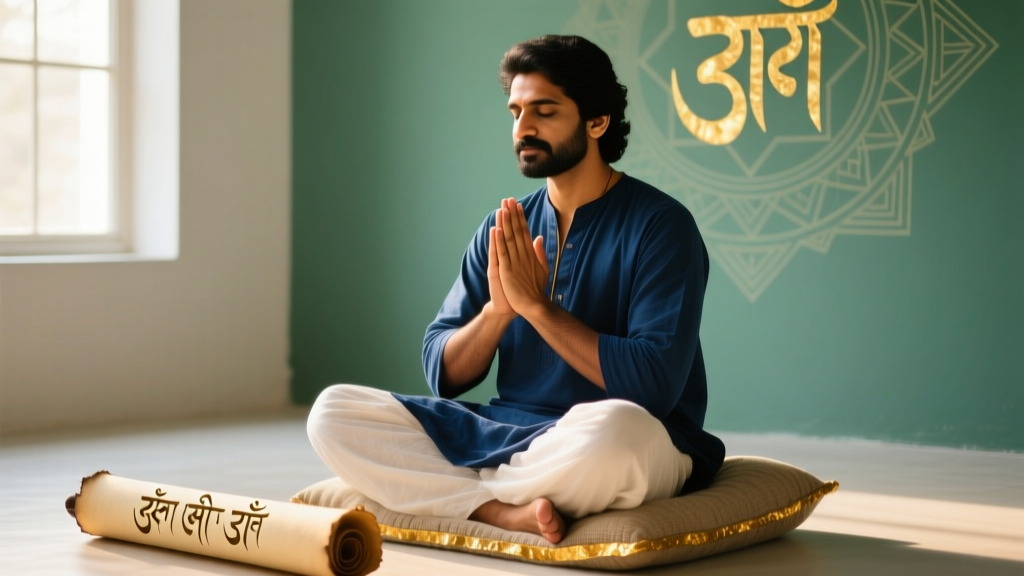
The exploration of ancient mantras and meanings requires moving past the modern reduction of these sacred syllables into mere positive affirmations. In Vedic and Tantric traditions, a mantra is a highly calibrated acoustic formula. When we analyze classical mantras and meanings, we are engaging with Nada Brahma—the principle that the universe is fundamentally composed of sound vibrations. This expert analysis deconstructs the phonetic architecture, neurological impacts, and precise application protocols of traditional Sanskrit and Tibetan seed syllables, providing practitioners with a rigorous framework for spiritual and cognitive alignment.
The Acoustic and Neurological Science of Sacred Syllables
Unlike casual speech, classical Sanskrit is structured as a vibrational language where phonetic architecture directly correlates with physiological and neurological responses. The repetition of specific Bija (seed) mantras, such as Lam, Vam, Ram, Yam, Ham, and Om, generates targeted mechanical resonance within the cranial sinuses, the hard palate, and the vagus nerve. Each seed syllable is mapped to a specific chakra (energy center), functioning as an acoustic key to stimulate the corresponding endocrine gland.
The physiological impact of this resonance is measurable. Research published by the National Institutes of Health (NIH) highlights that rhythmic chanting and humming (such as in Bhramari Pranayama or the prolonged 'M' sound in Om) increase nasal nitric oxide production up to 15-fold. Nitric oxide is a potent vasodilator; its elevated presence enhances oxygen uptake, reduces systemic inflammation, and rapidly shifts the autonomic nervous system into a parasympathetic (rest-and-digest) state. Therefore, the physical act of chanting alters neurochemistry and brainwave states, shifting the brain from active Beta waves to meditative Alpha and Theta waves.
Core Vedic Mantras and Meanings: An Expert Breakdown
To utilize these tools effectively, one must understand the metrical structure (Chhandas) and the precise linguistic translation. Below is a technical breakdown of foundational Vedic formulas, moving beyond surface-level translations to their structural mechanics.
| Mantra | Literal Translation | Metrical Structure (Chhandas) | Neurological / Spiritual Target |
|---|---|---|---|
| Gayatri Mantra | May the divine light illuminate our intellect | Anushtubh (24 syllables, 4 lines of 8) | Ajna (Third Eye); stimulates pineal gland and cognitive clarity |
| Mahamrityunjaya | Adoration to the three-eyed one; may we be freed from death | Trishtubh (44 syllables, complex rhythmic cadence) | Manipura (Solar Plexus); deep cellular healing and fear eradication |
| Om Namah Shivaya | Adoration to Shiva (the inner Self / pure consciousness) | Panchakshari (5 syllables: Na-Ma-Shi-Va-Ya) | Anahata (Heart); balances the five elements (earth, water, fire, air, ether) |
| Om Shanti Shanti Shanti | Om, peace in body, peace in environment, peace in soul | Prose invocation (repeated 3 times for 3 planes) | Vishuddha (Throat); clears vocal cord tension and communicative blocks |
According to the Oxford Centre for Hindu Studies, the efficacy of these mantras is intrinsically tied to their Chhandas (meter). The mathematical arrangement of syllables creates a specific rhythmic frequency that synchronizes the practitioner's heartbeat and respiration to the natural frequencies of the earth.
Pro Tips for Maximizing Mantric Resonance
Executing a mantra without proper technique yields minimal results. Advanced practitioners employ specific protocols to amplify the vibrational impact of their practice.
1. The Three Tiers of Japa (Repetition)
The Kularnava Tantra categorizes mantra repetition (Japa) into three distinct tiers, each exponentially more potent than the last:
- Vachika (Verbal): Chanting aloud. This is the foundational stage used to memorize the pronunciation and meter. It primarily affects the physical body and the immediate environment.
- Upamshu (Whispered): Chanting with lip movement but no audible sound. This directs the vibrational energy inward, stimulating the subtle energy channels (nadis).
- Manasika (Mental): Chanting entirely within the mind with absolute focus. Considered 1,000 times more powerful than verbal chanting, mental Japa directly rewires neural pathways and alters deep-seated subconscious conditioning (samskaras).
2. The Mathematics of the 108-Bead Mala
Traditional practice dictates 108 repetitions per session. This is not an arbitrary number but a mathematical constant reflecting cosmic geometry. The distance between the Earth and the Sun is roughly 108 times the Sun's diameter. Similarly, the distance between the Earth and the Moon is roughly 108 times the Moon's diameter. Using a 108-bead mala (traditionally made of Rudraksha for Shiva mantras or Tulsi for Vishnu mantras) aligns the practitioner's microcosmic rhythm with the macrocosmic orbital mechanics of the solar system.
3. Establishing the Sankalpa (Intention)
Before beginning a session, experts establish a Sankalpa. This is a precise, one-sentence resolution formulated in the present tense. The mantra acts as the acoustic vehicle, while the Sankalpa acts as the steering mechanism. Without a clear Sankalpa, the generated vibrational energy dissipates into the environment rather than being directed toward a specific cognitive or spiritual goal.
Common Misalignments and Corrective Protocols
Even seasoned practitioners frequently make technical errors that neutralize the efficacy of their practice. Identifying and correcting these misalignments is critical for advanced work.
Ignoring Aspiration and Retroflexion
Sanskrit phonetics are highly specific. Mispronouncing an unaspirated consonant as an aspirated one changes the meaning and vibrational output entirely. For example, the dental 't' (tongue touching the back of the teeth) produces a different acoustic resonance than the retroflex 'T' (tongue curled back to touch the hard palate). In the Gayatri Mantra, the word dhimahi requires an aspirated 'dh' and a soft 'h'. Slurring these sounds collapses the metrical structure. Practitioners must study the International Alphabet of Sanskrit Transliteration (IAST) to ensure phonetic accuracy. Resources like the American Institute of Vedic Studies provide essential audio guides for mastering these subtle phonetic distinctions.
Neglecting Pranayama (Breath Synchronization)
A mantra should never be chanted on a shallow, erratic breath. The inhalation must be deep and diaphragmatic, and the exhalation (during which the mantra is chanted) must be slow, steady, and controlled. The ratio of inhalation to exhalation should ideally be 1:2. If it takes 4 seconds to inhale, the exhalation and the accompanying mantra chant should last for 8 seconds. This specific respiratory ratio maximizes heart rate variability (HRV) and induces deep neurological coherence.
Integrating Mantras into Daily Sadhana
Consistency supersedes duration. A rigorous daily practice (Sadhana) of 108 repetitions performed at the exact same time and in the exact same physical location creates a localized morphic field. The environment begins to hold the vibrational imprint of the mantra, making it exponentially easier to drop into a meditative state upon sitting down. Choose a specific asana (seat) made of natural fibers like wool or cotton, which act as insulators to prevent the downward dissipation of bio-electric energy generated during deep meditation. By treating the study of mantras and meanings as an exact acoustic science rather than a casual hobby, practitioners unlock the profound transformative potential encoded within these ancient syllables.