Scorpio Creative Talents
Scorpio — the eighth sign of the zodiac, ruled by Pluto (and traditionally Mars), born between October 24 and November 21 — is often misunderstood as merely intense or secretive. Yet beneath that enigmatic surface lies one of astrology’s most potent creative forces. Scorpio doesn’t create for decoration or distraction; they create to excavate truth, transmute pain into power, and reveal what others dare not name. Their creative talent is rooted not in lightness or whimsy, but in psychological acuity, emotional stamina, and an almost alchemical ability to transform raw experience into resonant art.
Unlike Gemini’s playful ideation or Libra’s harmonious composition, Scorpio’s creativity emerges from the depths — the subconscious, the taboo, the buried memory, the unspoken wound. Psychologist Carl Gustav Jung, whose work profoundly informs modern depth psychology and archetypal astrology, described the Scorpio archetype as embodying the psychological process of death and rebirth — a core engine of authentic artistic evolution. In his seminal work Psychology and Alchemy, Jung wrote: “The descent into the depths always seems to precede the ascent.” This descent is where Scorpio artists begin — not with a blank canvas, but with a charged void waiting to be named.(Jung, 1968)
Neuroscientific research supports this link between emotional intensity and creative output. A 2021 study published in Frontiers in Psychology found that individuals scoring high on measures of emotional depth and introspective sensitivity — traits strongly correlated with Scorpio’s planetary rulership by Pluto — demonstrated significantly greater originality in divergent thinking tasks, especially when given thematic prompts involving transformation, loss, or identity reconstruction.(Zhang et al., 2021) Scorpio’s brain isn’t wired for superficial novelty; it’s optimized for meaning-making under pressure — a trait that fuels everything from haunting lyricism to visceral visual storytelling.
Their creative talents are rarely flashy in the conventional sense. You won’t typically find Scorpios dominating TikTok dance trends or producing viral meme content — not because they lack technical skill, but because their impulse is toward resonance over reach. Their talent manifests in sustained focus: the novelist who spends seven years rewriting a single chapter until its subtext vibrates with unspoken grief; the filmmaker who shoots 47 takes of a silent close-up to capture the micro-shift of betrayal in the eyes; the composer who layers twelve overlapping vocal tracks to evoke the sensation of drowning and resurfacing simultaneously.
This depth comes with a distinct creative rhythm. Scorpio creators often operate in cycles — long periods of internal gestation (sometimes months or years) followed by explosive, highly focused bursts of production. They thrive on deadlines that carry existential weight — a gallery opening tied to personal healing, a song release timed with a family reconciliation, a book manuscript due the week after a major life transition. External accountability matters less than internal necessity. As astrologer Erin Sullivan notes in Dynamic Astrology: Working with the Planets: “Scorpio creates not to be seen, but to be felt — and felt deeply, even uncomfortably.”(Sullivan, 2005)
Artistic Style and Aesthetic Preferences
Walk into a Scorpio’s studio, scroll through their mood board, or listen to their curated playlist, and you’ll immediately recognize a consistent aesthetic language — one defined by contrast, texture, symbolism, and controlled intensity. Scorpio’s artistic style is never neutral. It is deliberately saturated — emotionally, chromatically, thematically.
Visually, Scorpio gravitates toward rich, complex palettes: deep emerald greens, bruised purples, volcanic reds, obsidian blacks, and metallic accents like tarnished silver or hematite grey. White is rarely pure — it’s bone, ash, or cracked porcelain. Their compositions favor asymmetry, layered textures (think cracked paint, charred wood, distressed leather, velvet over rusted metal), and strategic negative space that feels charged rather than empty. Think of the chiaroscuro technique mastered by Caravaggio — dramatic light piercing profound shadow — which remains a quintessential Scorpio visual motif.
Thematically, Scorpio aesthetics revolve around five core motifs:
- Metamorphosis: Imagery of moths emerging from cocoons, snakes shedding skin, phoenixes rising, or roots breaking concrete.
- Thresholds & Liminality: Doorways ajar, mirrors reflecting alternate realities, water surfaces dividing worlds, fog-shrouded forests.
- Hidden Structures: X-rays, anatomical diagrams, circuit boards beneath skin, geological strata, architectural blueprints overlaid on portraits.
- Sacred Profanity: Religious iconography fused with eroticism or decay — stigmata bleeding ink, saints holding scalpels, rosaries made of barbed wire.
- Resonant Silence: A single drop of water in an empty room, a paused film reel, a breath held just before speech — the tension before revelation.
Scorpio’s relationship with beauty is fundamentally different from Libra’s pursuit of harmony or Taurus’s love of sensual abundance. For Scorpio, beauty is inseparable from truth — and truth is often uncomfortable, unsettling, or even grotesque. Their aesthetic asks: What does it cost to be real? What does power look like when stripped of performance? Where does desire live when fear is present?
This translates into a preference for mediums and forms that allow for complexity and ambiguity. Scorpio rarely embraces minimalist design unless it serves a deeper purpose — e.g., a stark white gallery wall highlighting a single, violently textured sculpture. They favor mixed media, collage (especially with archival or found materials), analog photography with chemical manipulation, and writing that employs unreliable narration or fragmented timelines.
Below is a comparative overview of Scorpio’s aesthetic preferences versus three other water signs — Cancer, Pisces, and themselves across evolutionary stages — highlighting how Scorpio’s creative signature distinguishes itself:
| Aesthetic Dimension | Scorpio | Cancer | Pisces | Evolved Scorpio (Plutonian Integration) |
|---|---|---|---|---|
| Color Palette | Deep jewel tones, metallics, blood red, void black | Soft creams, seafoam, warm terracotta, mother-of-pearl | Washed lavenders, misty greys, translucent aquamarines, iridescent pearl | Same base palette, but with intentional gold leaf, luminous resin, or bioluminescent pigments — darkness infused with inner light |
| Primary Texture | Cracked, scarred, layered, tactile resistance | Soft knits, worn linen, smooth river stones, warm wood grain | Fluid silk, watercolor bleed, gauzy veils, fog, smoke | Contrast textures: rough basalt next to polished obsidian; raw silk over forged steel |
| Symbolic Focus | Power dynamics, hidden motives, psychological transformation, ancestral wounds | Nurturance, home, memory, lineage, emotional safety | Dream logic, collective unconscious, dissolution of boundaries, spiritual surrender | Regeneration, ethical sovereignty, sacred intimacy, empowered vulnerability |
| Composition Principle | Centered tension, deliberate imbalance, focal point of intensity | Enclosed frames, circular motifs, nesting shapes, protective borders | Flowing lines, dissolving edges, overlapping transparencies, dreamlike scale shifts | Structured chaos — geometric frameworks containing organic, evolving forms |
| Risk Tolerance | High — willing to alienate, provoke, disturb to convey truth | Low-Medium — prioritizes emotional resonance over shock value | Medium-High — embraces ambiguity but avoids deliberate cruelty | Strategic — uses provocation only as catalyst for collective healing, not personal catharsis alone |
This table reveals a crucial insight: Scorpio’s aesthetic isn’t static. It evolves with consciousness. The unevolved Scorpio may lean into shock, obsession, or control — using art as a weapon or shield. The evolved Scorpio wields the same intensity as a scalpel — precise, respectful, and ultimately life-giving. Their mature aesthetic doesn’t reject darkness; it integrates it with luminosity, creating art that doesn’t just unsettle, but initiates.
Best Creative Outlets for Scorpio
Not all creative outlets serve Scorpio equally. Some mediums amplify their gifts; others dilute or distort their energy. Choosing the right outlet isn’t about talent alone — it’s about finding a vessel that can hold their depth, withstand their intensity, and support their need for transformative impact. Below are the top five creative outlets uniquely suited to Scorpio’s nature — ranked by alignment, with specific implementation strategies.
1. Narrative Writing (Especially Psychological Fiction & Memoir)
Scorpio’s mastery of subtext, obsession with motive, and comfort with moral ambiguity make them exceptional storytellers. But not all writing genres fit. Romance novels focused on idealized love? Too superficial. High fantasy with clear good-vs-evil binaries? Lacks psychological nuance. Instead, Scorpio thrives in:
- Slow-burn psychological thrillers where the real monster is the protagonist’s repressed self;
- Intergenerational family sagas exposing how trauma echoes across bloodlines;
- Hybrid memoirs blending personal narrative with archival research, forensic detail, and poetic fragmentation (e.g., Maggie Nelson’s The Argonauts or Ocean Vuong’s On Earth We’re Briefly Gorgeous).
Actionable Practice: Adopt the “Three-Layer Draft” method. First draft: raw, unfiltered excavation (stream-of-consciousness, no editing). Second draft: structural surgery — identify the central wound/transformation and ruthlessly cut all scenes that don’t serve it. Third draft: symbolic layering — embed recurring motifs (e.g., water, mirrors, specific animals) that operate on subconscious levels. Use tools like Scrivener’s corkboard view to map emotional arcs alongside plot points.
2. Visual Art with Material Transformation
Scorpio needs to do something to the material. Painting a serene landscape? Unfulfilling. But burning, burying, acid-etching, casting in resin, or embedding objects within layers of wax? That’s Scorpio territory. Techniques like encaustic painting (molten beeswax + pigment), metal-smithing, ceramic raku firing (rapid heating/cooling causing cracks and metallic sheens), or experimental printmaking (chine-collé with decaying botanicals) provide the physical ritual Scorpio craves.
Actionable Practice: Commit to a “Year of One Material” challenge. Choose a substance with inherent transformative potential — copper (oxidizes to verdigris), raw clay (shatters if dried too fast), raw silk (frays dramatically), or charcoal (smudges, erases, rebuilds). Document its changes daily. Let the material’s behavior dictate form. This builds tolerance for uncertainty and teaches Scorpio to collaborate with, not dominate, their medium — a key step in evolving beyond control-based creation.
3. Sound Design & Experimental Music Production
Sound is inherently invisible, emotional, and capable of bypassing conscious filters — making it a perfect Scorpio medium. They excel not in crafting catchy pop hooks, but in building immersive sonic environments: field recordings of abandoned hospitals layered with distorted lullabies; granular synthesis that turns a whispered confession into a cavernous echo; composing scores where silence is as loaded as the notes.
Actionable Practice: Use free software like Sonic Visualiser to analyze the spectrogram of emotionally charged audio (a heated argument, a birth recording, a funeral eulogy). Then, recreate its emotional contour using synthesizers — translating spikes of stress into high-frequency glitches, sustained low tones into bass drones, pauses into reversed reverb tails. This trains Scorpio to translate psychological data into aesthetic form.
4. Ritual-Based Performance Art
Scorpio’s connection to initiation rites and sacred thresholds makes performance art — particularly durational, participatory, or site-specific work — deeply resonant. Think Marina Abramović’s The Artist Is Present, where silent eye contact became a conduit for shared vulnerability, or Guillermo Gómez-Peña’s border-crossing interventions challenging identity politics.
Actionable Practice: Design a 12-minute solo ritual performance (Scorpio’s ruling number is 8, but its karmic number is 12). Structure it in three 4-minute acts: Descent (removing layers — clothing, voice, light), Confrontation (holding a charged object or image, maintaining stillness), Integration (reincorporating one element transformed — e.g., speaking a single word, lighting a candle, placing the object in water). Record it. Watch without judgment. Note where energy peaked — that’s your authentic creative pulse.
5. Archival & Investigative Art
In an age of digital ephemerality, Scorpio’s instinct to unearth, preserve, and reinterpret history is vital. This includes creating art from declassified documents, oral histories of marginalized communities, forensic anthropology reconstructions, or genealogical research made visceral through installation.
Actionable Practice: Partner with a local historical society or community archive. Request access to uncatalogued boxes related to a theme of personal resonance (e.g., “1970s mental health institutions,” “Immigrant garment worker strikes”). Spend 10 hours physically handling the materials — letters, photos, ledgers. Create one artwork directly responding to a single discovered artifact (e.g., embroider a redacted section of a letter onto black silk; cast a fragile photo negative in bronze). This grounds Scorpio’s intensity in service and context.
Famous Scorpio Artists and Creatives
Studying Scorpio artists isn’t about celebrity worship — it’s about recognizing archetypal patterns in action. These figures demonstrate how Scorpio’s core drives manifest across disciplines, eras, and cultural contexts. Their lives and works offer tangible case studies in navigating creative power, shadow integration, and legacy-building.
Leonardo da Vinci (April 15, 1452 — though some sources cite April 14; his Scorpio Sun is widely accepted in traditional biographical astrology)
Often cited as a quintessential Renaissance man, da Vinci’s Scorpio Sun illuminates his relentless drive to penetrate surfaces — whether dissecting cadavers to map musculature, studying water vortices to understand flow, or employing sfumato to blur edges and suggest psychological ambiguity in the Mona Lisa’s smile. His notebooks, filled with mirrored script (requiring a mirror to read), embody Scorpio’s love of hidden knowledge and coded communication. His unfinished works — like the Battle of Anghiari — reflect Scorpio’s struggle with perfectionism rooted in fear of exposure.
Georgia O’Keeffe (November 15, 1887)
O’Keeffe transformed Scorpio’s fascination with biological interiors into iconic, magnified floral paintings. Critics reduced them to mere sexual metaphors, missing her deeper intent: to reveal the fierce, structural beauty of life processes — pollination, decay, resilience. Her decades-long commitment to painting New Mexico’s bones, cliffs, and skies shows Scorpio’s capacity for sustained focus on a singular, transformative landscape. Her famous quote — “I found I could say things with color and shapes that I couldn’t say any other way — things I had no words for.” — is pure Scorpio: art as essential, non-verbal truth-telling.
Dr. Maya Angelou (April 4, 1928 — Sun in Aries, but with Scorpio Rising and dominant Scorpio placements including Moon and Venus)
While her Sun sign was Aries, Angelou’s Scorpio Rising (the mask she presented to the world) and deeply embedded Scorpio planets defined her artistic signature. Her memoir I Know Why the Caged Bird Sings is a masterclass in Scorpio creative courage: confronting childhood sexual abuse, racism, and shame with unflinching honesty, then alchemizing that pain into lyrical, soaring language. Her performances — commanding, still, radiating immense contained power — embodied Scorpio’s magnetic presence. She didn’t just tell stories; she initiated listeners into collective healing.
Tracy Chapman (March 30, 1964 — Sun in Aries, but with Scorpio Moon and Ascendant)
Chapman’s quiet intensity and profound empathy in songs like “Fast Car” and “Talkin’ ‘Bout a Revolution” stem from her Scorpio Moon — the seat of her emotional processing and creative wellspring. Her sparse arrangements force attention on the weight of each lyric and the vulnerability in her voice. She famously shuns fame, protecting her inner world fiercely — a classic Scorpio boundary strategy that preserves creative integrity.
Contemporary Example: Jordan Peele (February 21, 1979 — Sun in Pisces, but with Scorpio Moon and Mercury)
Peele’s meteoric rise with Get Out and Us showcases modern Scorpio creativity: using genre (horror) as a scalpel to dissect systemic racism, surveillance culture, and the duality of American identity. His meticulous research, layered symbolism (the sunken place, the tethered), and refusal to offer easy answers exemplify Scorpio’s commitment to uncomfortable truth. He leverages his Pisces Sun’s empathy to make the horror feel human, while his Scorpio Moon provides the ruthless analytical framework.
These examples underscore a vital truth: Scorpio’s creative power isn’t dependent on having the Sun in Scorpio. Dominant Scorpio placements — Moon, Ascendant, Mercury, or key aspects to Pluto — activate the same deep-well, transformative creative impulse. Studying them reveals patterns: a reverence for craft paired with radical honesty, a willingness to sit with discomfort longer than others, and an understanding that true artistry requires showing up, fully, for the darkest parts of the human experience — and finding the light within them.
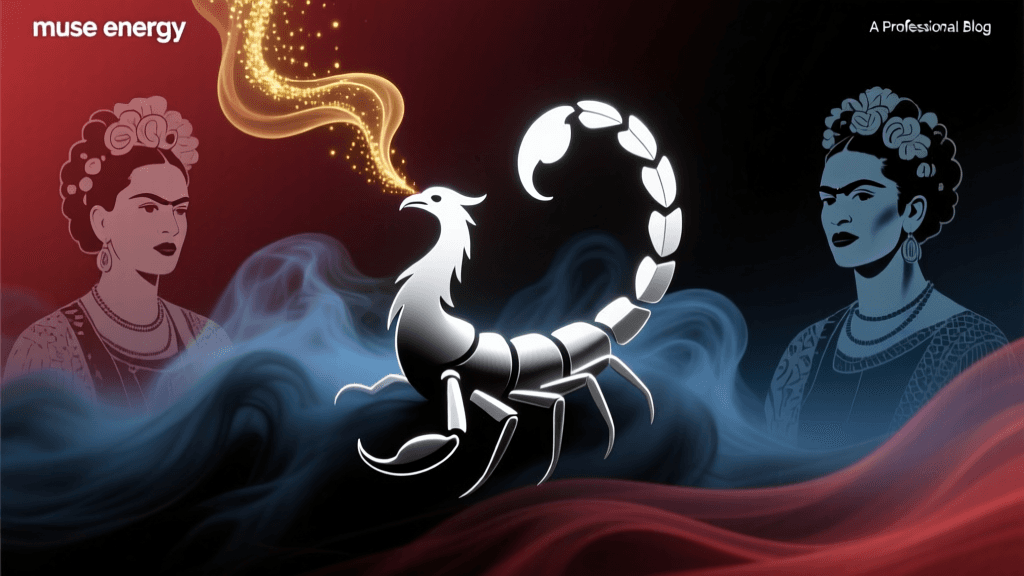
Scorpio as a Muse and Inspiration
Scorpio doesn’t just create art — they *are* art. Their very presence functions as a catalytic muse, not through conventional charm or ease, but through an irresistible gravitational pull toward depth. To be inspired by Scorpio is to feel compelled to go deeper, dig harder, speak truer. They are the muse of the unvarnished, the unresolved, the regenerative.
This muse energy operates on multiple levels:
The Mirror Muse
Scorpio’s legendary perceptiveness makes them unparalleled mirrors. They don’t flatter; they reflect. A Scorpio friend might say, after hearing your story, “What you’re describing as ‘stress’ sounds like unprocessed grief from your father’s absence. Want to explore that?” This isn’t criticism — it’s an invitation to authenticity. For creatives, this mirroring is invaluable. It cuts through self-deception and forces confrontation with the core emotional truth fueling the work. Many artists report breakthroughs occurring during intense, honest conversations with Scorpio friends or partners — moments where a character’s motivation suddenly clarifies, or a painting’s central tension becomes visible.
The Threshold Muse
Scorpio embodies the liminal space — the doorway between states. This makes them the ultimate muse for artists working on themes of transition: recovery from illness, coming out, leaving a toxic relationship, spiritual awakening, or ecological collapse. Their presence signifies that the old structure is dying and the new one hasn’t yet formed — the fertile, terrifying ground where the most potent art is born. Collaborating with a Scorpio (as a director, editor, producer, or even a demanding critic) often pushes projects past safe, familiar territory into genuinely new creative territory.
The Alchemical Muse
Perhaps most powerfully, Scorpio inspires through their own process of transformation. Witnessing a Scorpio navigate a crisis — a betrayal, a loss, a professional failure — and emerge not broken, but remade, with hard-won wisdom and renewed creative fire, is profoundly inspiring. Their journey models the creative act itself: destruction of the old form, descent into the unknown, and emergence of something integrated and stronger. This is why so many artists cite surviving profound personal darkness as the crucible for their most significant work. Scorpio doesn’t just inspire *what* to create; they inspire *why* — reminding us that creation is an act of survival and sovereignty.
“The artist’s task is not to look away. Scorpio’s gift is to teach us how to look — deeply, steadily, without blinking — at the heart of the matter, and then to translate that gaze into form.” — Adapted from a lecture by Dr. Clarissa Pinkola Estés, Jungian analyst and author of Women Who Run With the Wolves(Estés, 1992)
For non-Scorpios seeking to tap into this muse energy, the practice is simple but demanding: cultivate radical honesty in your own creative process. Before starting a new project, ask: What am I avoiding feeling about this subject? What part of myself do I need to integrate to tell this story truthfully? What would this piece look like if it held zero secrets? Then, create from that answer — not the comfortable one, but the necessary one. That is channeling Scorpio’s muse.
Developing Your Creative Practice
Building a sustainable, evolving creative practice as a Scorpio requires honoring their unique rhythms and vulnerabilities. Generic advice — “just show up and write!” — fails them. Scorpio needs structure that accommodates depth, rituals that honor process, and boundaries that protect their wellspring. Here is a comprehensive, actionable 12-week framework designed specifically for Scorpio creators:
Phase 1: Foundation & Containment (Weeks 1-3)
Goal: Establish sacred space and define core intention — not a project goal, but a soul-level question the work will explore.
- Weekly Ritual: Dedicate one hour to creating a “Shadow Journal.” Not for ideas, but for raw, unedited feelings, fears, and half-formed questions related to your creative work. Burn or bury the pages monthly — a symbolic release.
- Boundary Practice: Implement a “Scorpio Shield”: Before any creative session, state aloud: “I am here to serve the truth of this work, not external validation.” Write it on a card and place it on your workspace.
- Tool: Use a physical notebook with a lock (or a password-protected digital file) exclusively for this phase. Secrecy is fuel.
Phase 2: Descent & Research (Weeks 4-6)
Goal: Dive into the material, historical, emotional, or technical research needed to give the work authentic weight.
- Weekly Ritual: Conduct one “Deep Dive Interview.” Speak with someone who holds lived experience related to your theme (e.g., a trauma therapist for a piece on healing; a geologist for a work about erosion; a historian for a period piece). Record (with permission) and transcribe key phrases.
- Boundary Practice: Set a “No Output” rule. Weeks 4-6 are for intake only. No drafting, sketching, or composing — only gathering, annotating, and connecting dots.
- Tool: Create a physical “Research Altar” — a dedicated shelf or box holding artifacts, quotes, images, and objects that resonate with your core question.
Phase 3: Emergence & Embodiment (Weeks 7-9)
Goal: Translate research and feeling into tangible form, prioritizing sensory experience over polish.
- Weekly Ritual: Engage in one “Embodied Creation” session: Create using your body as the primary tool — clay modeling blindfolded, dancing to compose movement, writing with your non-dominant hand, singing melodies without lyrics. Capture the raw output.
- Boundary Practice: Share only one small, vulnerable piece of work-in-progress with one trusted person per week. Receive feedback focused solely on: “What emotion did this evoke in you? What question did it raise?” — not critique.
- Tool: Use analog tools exclusively for this phase (typewriter, film camera, acoustic instruments) to slow down and deepen connection.
Phase 4: Integration & Offering (Weeks 10-12)
Goal: Refine the work with intention, then release it with conscious ceremony — acknowledging its completion as a death and rebirth.
- Weekly Ritual: Perform a “Completion Ceremony.” Light a black candle. Read your Shadow Journal entries from Week 1. Acknowledge the transformation that occurred. Extinguish the candle. Then, light a red candle and declare the work complete and offered to the world.
- Boundary Practice: Define the “Sacred Release”: How will you share this work? A private reading? A gallery show? An online launch? Plan the container for its first encounter with others — ensuring it aligns with the work’s energy.
- Tool: Create a “Legacy Statement”: One paragraph defining what you hope this work contributes to the collective understanding of its theme. Keep it. Revisit with future projects.
This framework respects Scorpio’s need for cyclical, ritualized process. It moves beyond linear productivity to honor the sign’s innate understanding that creation is a sacred, initiatory act — not a commodity to be produced.
FAQ
Why do Scorpios often struggle with sharing their art?
Sharing art feels like exposing their psychological infrastructure — their vulnerabilities, fears, and deepest truths — to potential judgment or misuse. For Scorpio, art isn’t separate from their core self; it’s a direct emanation of it. This isn’t insecurity, but a profound sense of responsibility. As psychoanalyst Otto Kernberg noted in his work on borderline personality structure (which shares diagnostic overlap with unevolved Scorpio traits), the fear isn’t of criticism, but of annihilation — the terror that revealing the authentic self will lead to rejection so total it erases their sense of existence.(Kernberg, 2012) Healthy Scorpio creators learn to share selectively, choosing containers (galleries, publishers, communities) that honor depth and confidentiality.
Can Scorpio’s intensity ever be detrimental to creativity?
Yes — when unbalanced. Obsession can morph into perfectionism that paralyzes completion. Depth can become rumination that blocks forward motion. Power can manifest as control that stifles collaboration or rejects necessary feedback. The antidote is conscious integration: using Pluto’s gift of regeneration to periodically “kill off” outdated creative habits (e.g., abandoning a project that no longer serves growth) and consciously choosing new, more expansive expressions. Therapy, especially somatic or Jungian approaches, is highly recommended.
What colors should Scorpio avoid in their creative environment?
While Scorpio can work with any color, certain palettes actively drain their energy or trigger defensiveness. Avoid overwhelming, flat, synthetic neons (electric pink, lime green) — they lack the depth and texture Scorpio craves and can feel psychologically abrasive. Similarly, sterile, over-bright whites and generic beige can induce numbness or dissociation, severing their connection to visceral feeling. Instead, opt for complex neutrals: charcoal with blue undertones, warm greys with umber hints, or deep navies that shift in light. These provide grounding without suppression.
Is Scorpio better suited to solo or collaborative art?
Both — but collaboration must be approached with extreme discernment. Scorpio thrives in deep, long-term creative partnerships built on absolute trust, shared values, and mutual respect for boundaries (e.g., David Lynch and Mark Frost on Twin Peaks; Beyoncé and Jay-Z on Everything Is Love). They flounder in large, hierarchical teams or committees where power dynamics are unclear or decisions are made by consensus. If collaborating, Scorpio needs clearly defined roles, protected creative autonomy within the partnership, and a shared understanding that the work’s integrity is non-negotiable.
How can non-Scorpios respectfully engage with Scorpio’s creative process?
Respect their need for privacy and process. Don’t demand early access or premature feedback. Ask permission before offering critique — and if invited, focus feedback on emotional resonance and thematic coherence, not surface-level suggestions (“make the font bigger”). Acknowledge their courage in tackling difficult subjects. Celebrate their depth, not just their output. And above all, honor their boundaries without taking it personally. As the saying goes: “You don’t get to see the chrysalis. You only get to witness the wings.”