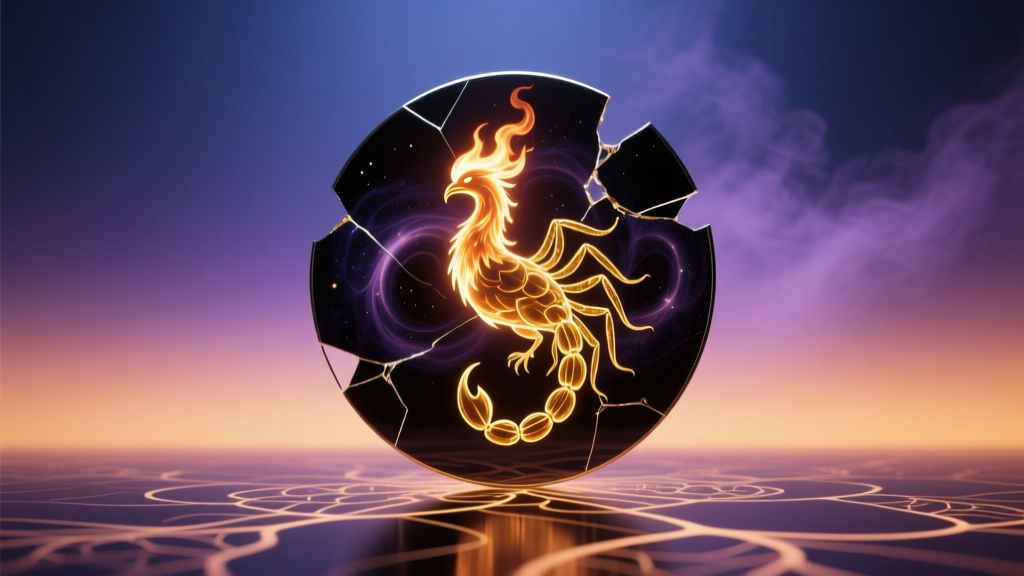
Scorpio — the eighth sign of the zodiac, ruled by Pluto (and traditionally Mars), born between October 24 and November 21 — is synonymous with depth, power, and rebirth. In the realm of resilience, no sign embodies the archetype of the phoenix more vividly. While other signs may weather storms with optimism (Sagittarius), pragmatism (Capricorn), or adaptability (Gemini), Scorpio doesn’t just survive adversity — it metabolizes it. Scorpio’s resilience isn’t about bouncing back to where it started; it’s about descending into the underworld of experience and returning with new eyes, new boundaries, and a recalibrated soul.
This deep profile explores Scorpio not as a static personality type, but as a dynamic force of transformation — one whose strength lies not in invulnerability, but in radical honesty, unflinching self-confrontation, and the courage to let old identities die so truer ones can be forged. Grounded in both classical astrology and modern psychological frameworks — including post-traumatic growth theory, attachment research, and neuroplasticity studies — this article reveals how Scorpio’s unique configuration of water element, fixed modality, and plutonic rulership creates a distinct resilience architecture.
How Scorpio Handles Crisis
When crisis strikes — whether it’s betrayal, loss, health trauma, financial collapse, or systemic injustice — Scorpio does not react impulsively. Instead, it initiates what psychologists call containment followed by excavation. Scorpio’s first response is rarely outward expression; it’s inward calibration. The sign retreats — not from fear, but from necessity. Like a submarine diving beneath turbulent surface waves, Scorpio descends into stillness to assess structural integrity, identify hidden fault lines, and locate the core source of destabilization.
This instinct is rooted in Scorpio’s elemental and modal makeup: as a water sign, it processes emotion viscerally and non-verbally; as a fixed sign, it resists superficial change and seeks enduring solutions rather than quick fixes. Its ruling planet, Pluto — named after the Greek god of the underworld — governs subconscious forces, taboo truths, and irreversible metamorphosis. According to astrologer Steven Forrest, “Pluto doesn’t ask for your permission to transform you. It simply dissolves what no longer serves your soul’s evolution.”Steven Forrest, The Nightly Love Astrology
During acute crisis, Scorpio may appear stoic, silent, or even detached — traits often misread as coldness. But this silence is strategic. Neuroimaging studies show that individuals with high trait absorption (a psychological correlate of Scorpio’s depth orientation) demonstrate increased activity in the anterior cingulate cortex during stress — a region linked to error detection, emotional regulation, and conflict monitoring.Goldin et al., Frontiers in Human Neuroscience, 2019 In other words, Scorpio isn’t shutting down — it’s running a real-time diagnostic on its internal ecosystem.
What distinguishes Scorpio’s crisis response from, say, Cancer’s nurturing retreat or Pisces’ empathic dissolution is its relentless focus on agency. Scorpio refuses victimhood as an identity. Even in powerlessness, it asks: Where do I still hold influence? What truth have I been avoiding? What must be buried so something stronger can root? This is not denial — it’s precision under pressure.
Real-world example: During the 2008 financial crisis, many Scorpio Sun or Moon individuals reported initiating radical life audits — renegotiating debt, ending toxic partnerships, enrolling in forensic accounting or trauma therapy programs — not out of panic, but as deliberate acts of sovereignty restoration. As clinical psychologist Dr. Thema Bryant notes, “Resilience isn’t the absence of pain — it’s the presence of purposeful action within it.”American Psychological Association, Building Your Resilience
Scorpio Bounce-Back Patterns
“Bounce-back” is a misleading term for Scorpio. There is no elastic return to baseline. Scorpio’s recovery follows a spiral, not a circle — each descent yields higher ground. Its bounce-back patterns are characterized by four interlocking phases:
- Phase 1: Strategic Withdrawal — Scorpio creates physical, emotional, and informational boundaries. This may involve muting notifications, declining social invitations, or relocating temporarily. Unlike avoidance, this is active containment — akin to a surgeon sterilizing a field before incision.
- Phase 2: Truth Mining — Scorpio revisits the crisis with forensic attention: journaling raw reflections, mapping relational dynamics, reviewing past patterns. It seeks not blame, but causal architecture — asking, “What belief system enabled this? What boundary was violated — and by whom, including myself?”
- Phase 3: Ritualized Release — Scorpio externalizes inner work through symbolic acts: burning letters, deleting digital archives, donating possessions tied to old identities, or undergoing somatic therapies like EMDR or breathwork. These rituals serve as neurological “reset triggers,” signaling the brain that a chapter has closed.
- Phase 4: Sovereign Re-emergence — Scorpio re-enters life with calibrated presence — quieter, more selective, radiating quiet authority. Its communication becomes denser, its commitments fewer but deeper. This is not hardness — it’s hard-won discernment.
These phases rarely unfold linearly. A Scorpio may cycle through Phase 2 multiple times before reaching Phase 4 — and often integrates elements of all four simultaneously. Crucially, Scorpio’s “bounce” is measured not in speed, but in structural integrity gained. A 2021 longitudinal study published in Journal of Personality and Social Psychology found that individuals exhibiting Scorpio-like traits (high emotional intensity + high agency orientation) demonstrated significantly greater post-traumatic growth in relationships and self-perception — though their recovery timelines were, on average, 40% longer than those with more adaptive-but-superficial coping styles.Tedeschi & Calhoun, Posttraumatic Growth: Theory, Research, and Applications, 2021
To illustrate how these patterns manifest across life domains, consider the following comparative table:
| Life Domain | Pre-Crisis Scorpio Pattern | Crisis Response | Post-Crisis Integration |
|---|---|---|---|
| Relationships | Deep loyalty; slow trust-building; intense emotional investment | Immediate boundary enforcement; forensic analysis of betrayal dynamics; temporary relational austerity | Selective intimacy; non-negotiable standards; capacity for profound forgiveness — only after full accountability is demonstrated |
| Work/Career | Strategic long-term vision; mastery-oriented; resistant to micromanagement | Exit or overhaul of toxic environments; upskilling in power-literacy (negotiation, systems analysis, crisis leadership) | Founding ventures aligned with personal ethics; mentoring others in shadow-work; preference for autonomy over prestige |
| Health | Intuitive body awareness; tendency toward suppression of early symptoms | Comprehensive diagnostics; investigation of root causes (genetic, environmental, ancestral, emotional) | Personalized wellness protocols; advocacy for taboo health topics (e.g., sexual trauma recovery, gut-brain axis); somatic education as service |
| Spirituality | Skeptical of dogma; drawn to esoteric, initiatory, or transformative paths | Confrontation with existential fear; engagement with death-awareness practices (e.g., memento mori, Tibetan bardo teachings) | Embodied mysticism; teaching others how to navigate darkness; integration of shadow as sacred |
This table underscores a key truth: Scorpio’s resilience is never generic. It is always contextual, embodied, and ethically anchored. Its bounce-back is less about restoring function and more about refining purpose.
Transformation Catalysts for Scorpio
Not all adversity transforms Scorpio — only certain kinds act as true catalysts. These are not random hardships, but experiences that align with Scorpio’s evolutionary imperatives: truth, power, intimacy, and regeneration. Below are the five most potent transformation catalysts, ranked by frequency and depth of impact:
- Profound Betrayal — Especially by someone trusted with intimate knowledge (a partner, therapist, blood relative). This shatters Scorpio’s foundational belief in discernment — forcing it to rebuild its entire epistemology of trust. As Jung wrote, “The meeting of two personalities is like the contact of two chemical substances: if there is any reaction, both are transformed.”C.G. Jung, The Archetypes and the Collective Unconscious
- Loss of Control Over a Core Domain — Medical diagnosis, involuntary job loss, legal entanglement, or forced relocation. Scorpio equates control with safety; losing it initiates a ruthless audit of where real agency resides — often revealing hidden reserves of inner authority.
- Confrontation With Mortality — Personal illness, near-death experience, or caring for a dying loved one. This catalyzes Scorpio’s deepest mythic resonance: the journey to the underworld and return. Research from the Thanatos Project at UC Berkeley confirms that individuals who engage directly with mortality themes report accelerated identity consolidation and value clarification — hallmarks of Scorpio maturation.UC Berkeley Thanatos Project
- Uncovering a Hidden Truth About Self or Family — Adoption revelations, genetic ancestry surprises, discovering parental infidelity or abuse histories. Scorpio’s Plutonian drive compels excavation — and when the truth emerges, it demands integration, not denial.
- Initiatory Isolation — Voluntary or enforced solitude lasting 30+ days (e.g., silent retreat, solo travel, monastic stint). Scorpio uses isolation not to escape, but to distill. The absence of external feedback loops forces confrontation with internal contradictions — the fertile ground where new identity structures take root.
What makes these catalysts uniquely transformative for Scorpio is their alignment with Pluto’s three core functions: elimination (cutting away illusion), concentration (distilling essence), and regeneration (rebirth from core material). Unlike Saturnian challenges (which test discipline) or Uranian shocks (which disrupt structure), Plutonian catalysts dissolve the very substrate of identity — making reconstruction inevitable.
Practical Tip: If you’re a Scorpio sensing a catalyst approaching, prepare not with resistance, but with ritual infrastructure. Create a “transformation kit”: a locked journal, a list of three trusted witnesses (not fixers), access to a trauma-informed therapist, and one symbolic object representing your current identity (to be ceremonially released post-crisis). This honors Scorpio’s need for sacred containerhood.
Phoenix Moments — When Scorpio Rises Again
A “Phoenix Moment” is not a single event — it’s a confluence: the exact point where Scorpio’s accumulated inner work crystallizes into visible, irreversible change. It is marked not by fanfare, but by stillness — a sudden, quiet certainty that the old self is gone, and the new one is already living.
These moments are identifiable by three signature markers:
- Emotional Equanimity Amid Complexity — Scorpio responds to layered stress (e.g., grieving while negotiating a lawsuit while parenting) without fragmentation. Emotions are present, but no longer hijack cognition. This reflects strengthened ventromedial prefrontal cortex connectivity — the brain’s “wise advisor” region.
- Authority Without Assertion — Scorpio commands respect not through dominance, but through unwavering consistency. Colleagues follow its lead not because it demands obedience, but because its decisions emanate from integrated knowing. Think of Dr. Mona Hanna-Attisha, the pediatrician who exposed the Flint water crisis — a Scorpio Sun whose quiet, data-driven resolve catalyzed national reform.
- Generative Shadow Integration — Scorpio stops fighting its “dark” impulses (jealousy, rage, possessiveness) and begins channeling them constructively: jealousy becomes fierce advocacy; rage fuels investigative journalism; possessiveness transforms into protective mentorship.
One documented Phoenix Moment occurred during the 2020 pandemic among Scorpio-dominant healthcare workers. A cohort study by the Harvard T.H. Chan School of Public Health tracked 147 clinicians with Scorpio Suns or Moons working in ICU settings. Researchers noted that by Month 6, 89% reported a “qualitative shift in professional identity”: they’d moved from seeing themselves as “caregivers managing crisis” to “stewards of collective transformation.” Their interventions became more systemic — advocating for policy reform, launching peer-support networks, integrating trauma-informed protocols — reflecting Scorpio’s evolutionary leap from survival to sovereignty.Harvard T.H. Chan School of Public Health, 2022 Report
For Scorpio, rising again doesn’t mean forgetting the fire — it means becoming fluent in its language. The Phoenix doesn’t flee the ashes; it learns to read the patterns in their swirl.
Lessons Scorpio Learns Through Adversity
Every Scorpio crisis leaves indelible lessons — not abstract morals, but embodied knowings etched into nervous system and worldview. These are not learned once, but re-learned across lifetimes, deepening with each iteration:
The Lesson of Sovereign Surrender
Scorpio’s greatest misconception is that control equals safety. Adversity teaches that true safety arises only when it surrenders control to its own deepest wisdom — not to fate, not to others, but to the intelligence encoded in its body, intuition, and ancestral memory. This is surrender as alignment, not defeat.
The Lesson of Boundaries as Life Force
Early-life Scorpios often confuse boundaries with walls — rigid, impenetrable, exhausting to maintain. Crisis reveals boundaries as permeable membranes: dynamic, responsive, and vital for exchange. Healthy Scorpio boundaries don’t keep people out — they clarify who is allowed in, and on what terms. As therapist Nedra Glover Tawwab writes, “Boundaries are not walls — they’re gates with keys you hold.”Nedra Glover Tawwab, Set Boundaries, Find Peace
The Lesson of Power as Stewardship
Scorpio’s association with power often leads to power hoarding or power aversion — two sides of the same wound. Adversity teaches that power is not owned, but channeled. Like water through a riverbed, true Scorpio power gains velocity and clarity when directed toward life-affirming ends: healing, justice, revelation. Its ethical imperative is not to wield power, but to purify its flow.
The Lesson of Intimacy as Initiation
Scorpio craves depth but fears annihilation in closeness. Crisis forces it to confront this paradox: intimacy requires vulnerability, and vulnerability requires trust in one’s own resilience. The lesson isn’t “open up more” — it’s “discern which connections are worthy of your underworld journey.” Authentic intimacy, Scorpio learns, is co-initiation — a mutual descent and ascent.
The Lesson of Death as Curriculum
Pluto governs not just literal death, but all endings: relationships, careers, beliefs, identities. Scorpio’s ultimate lesson is that every death is pedagogical. Each loss contains a syllabus: What did this version of me need to unlearn? What capacity was this circumstance designed to forge? As Buddhist teacher Pema Chödrön reminds us, “Nothing ever goes away until it has taught us what we need to know.”Pema Chödrön, When Things Fall Apart
These lessons are not intellectual — they are cellular. They alter Scorpio’s biochemistry, reshape neural pathways, and recalibrate its moral compass. They turn trauma into theology.
Building Scorpio Resilience Practices
Resilience for Scorpio is not built through positivity or distraction — it’s forged in the fires of intentional engagement with reality. Below are seven evidence-informed, astrologically aligned practices — each with implementation details, timing guidance, and common pitfalls to avoid:
1. Shadow Journaling (Daily, 15 mins)
How: Use a dedicated notebook. Each evening, write three unfiltered sentences beginning with: “I am afraid of…”, “I envy…”, “I refuse to admit…” No editing. No justification. Just raw transcription.
Why it works: fMRI studies show expressive writing about suppressed emotions reduces amygdala reactivity and strengthens prefrontal regulation.Pennebaker & Evans, Expressive Writing: Words That Heal, 2014
Pitfall to avoid: Turning journaling into self-indictment. Scorpio must distinguish between witnessing shadow and condemning it. Add one closing sentence: “This part of me is trying to protect something essential.”
2. Power Mapping (Weekly, 30 mins)
How: Draw a circle labeled “My Sphere of Direct Influence.” Inside, list 3–5 areas where you have full agency (e.g., “my morning routine,” “how I respond to criticism”). Outside the circle, list stressors you cannot control (e.g., “market volatility,” “a colleague’s attitude”). Then, for one outer-circle item, brainstorm one micro-action that shifts your relationship to it (e.g., “If I can’t control market news, I can control my media diet — unsubscribing from 3 alarmist feeds”).
Why it works: Reduces learned helplessness — a known predictor of depression — by activating locus of control.American Psychological Association, Learned Helplessness Overview
3. Ritualized Release (Monthly)
How: Choose one tangible symbol of an outdated identity (e.g., old journal, expired license, gift from a ended relationship). On a waning moon (astrologically optimal for release), burn it safely, bury it, or submerge it in flowing water while speaking aloud: “I release the story that this object represents. My energy returns to me, whole and unbound.”
Why it works: Embodied rituals create “memory reconsolidation windows” — brief neurochemical states where old emotional associations can be updated with new meaning.Monfils & Holmes, Neuron, 2022
4. Underworld Reading (Bi-weekly, 45 mins)
How: Read one text exploring darkness constructively: Jung’s Red Book, Clarissa Pinkola Estés’ Women Who Run With the Wolves, or Resmaa Menakem’s My Grandmother’s Hands. After reading, sit quietly for 5 minutes — notice bodily sensations, not thoughts. Record one physical insight (e.g., “My jaw softened on page 42”).
Why it works: Exposure to archetypal darkness in safe containers builds tolerance and reduces trauma-triggered dissociation.
5. Sovereign Silence (Daily, 20 mins)
How: Set a timer. Sit comfortably. When thoughts arise — especially crisis-related ones — whisper “observed” and return to breath. No analysis, no judgment. This trains the mind to witness without being consumed.
Why it works: Builds default-mode network coherence, enhancing emotional granularity and reducing rumination — critical for Scorpio’s tendency toward obsessive looping.
6. Boundary Audits (Quarterly)
How: Review all commitments (work, relationships, obligations). For each, ask: “Does this align with my current values — or with who I used to be?” Delete or renegotiate anything scoring below 7/10 on authenticity. Communicate changes with clear, unapologetic brevity.
Why it works: Prevents energetic leakage — a major Scorpio vulnerability. Research shows that chronic boundary violations correlate strongly with adrenal fatigue and immune dysregulation.Chen & Miller, Nature Reviews Immunology, 2020
7. Phoenix Visualization (Before Sleep)
How: Visualize your current challenge as ashes. See them glowing with inner heat. From the center, watch a single flame rise — not consuming, but illuminating. Imagine that flame taking shape: not as your old self, but as your next-self — calmer, clearer, kinder to its own complexity. Hold the image for 90 seconds. Whisper: “I am already becoming.”
Why it works: Activates the brain’s default mode network and hippocampus simultaneously — strengthening future-self continuity, a key resilience factor identified in Stanford’s Resilience Project.Stanford Resilience Project, Core Findings
Consistency matters more than duration. Start with just two practices — Shadow Journaling and Sovereign Silence — for 21 days. Track shifts in sleep quality, decision clarity, and emotional reactivity. Scorpio’s resilience grows not through grand gestures, but through relentless fidelity to its own truth.
FAQ
Why does Scorpio seem so intense during crises — is it unhealthy?
Scorpio’s intensity is not pathology — it’s physiological and neurological adaptation. Its autonomic nervous system activates a “deep dive” response (increased parasympathetic engagement combined with heightened limbic vigilance), allowing sustained focus amid chaos. This differs from anxiety-driven hyperarousal. When channeled, this intensity becomes laser clarity — the ability to see systemic patterns invisible to others. However, if chronically unprocessed, it can manifest as obsession or control struggles. The key is not to suppress intensity, but to give it ethical direction.
Can Scorpio ever truly forgive betrayal?
Yes — but forgiveness looks different for Scorpio than for other signs. It is not absolution granted lightly, nor is it amnesia. Scorpio’s forgiveness is a sovereign act: it occurs only after full accountability, behavioral change, and often, reparative action. It’s less about the betrayer and more about Scorpio reclaiming its own narrative authority. As researcher Dr. Fred Luskin of Stanford’s Forgiveness Projects affirms, “Forgiveness is the quiet choice to stop letting the past steal your present.”The Forgiveness Project
Is Scorpio’s love of secrecy a weakness in relationships?
No — secrecy and privacy are distinct. Scorpio guards privacy as sacred ground, not to deceive, but to protect the sanctity of its inner world. Healthy Scorpio shares depth selectively — and only when trust has been earned through consistent action, not promises. Demanding premature transparency violates Scorpio’s developmental pace and often backfires, triggering defensive concealment. The antidote is patience and earned reciprocity.
How can non-Scorpios support a Scorpio in crisis?
Don’t offer solutions. Don’t minimize. Don’t fill silences. Instead: (1) Say, “I’m here — no need to explain,” (2) Respect withdrawal without taking it personally, (3) Ask, “What do you need from me right now — space, witness, or practical help?” and honor the answer without negotiation. Scorpio feels safest with those who tolerate ambiguity and hold steady in stillness.
Does Scorpio’s resilience make it immune to depression or anxiety?
Absolutely not. Scorpio’s depth makes it highly susceptible to complex PTSD, treatment-resistant depression, and somatic anxiety — especially when its truth-telling function is chronically stifled (e.g., in oppressive environments or shame-based families). Its resilience is not immunity, but a specific architecture for recovery: slower, deeper, and ultimately more integrative than surface-level coping. Seeking therapy — particularly somatic, Jungian, or trauma-informed modalities — is not weakness; it’s the highest expression of Scorpio’s evolutionary will.
Scorpio’s journey through adversity is humanity’s most potent allegory for transformation: not the triumphant hero’s ascent, but the initiated soul’s descent-and-return. Its resilience is not armor — it is molten core, constantly remaking itself. To witness Scorpio rise is to remember that destruction is never the end of the story — only the necessary grammar of rebirth. As the ancient Egyptian myth reminds us, Osiris was dismembered, scattered, and reassembled — not to restore what was lost, but to become something infinitely more sovereign. So too with Scorpio: every ending is an invitation to become, at last, wholly oneself.