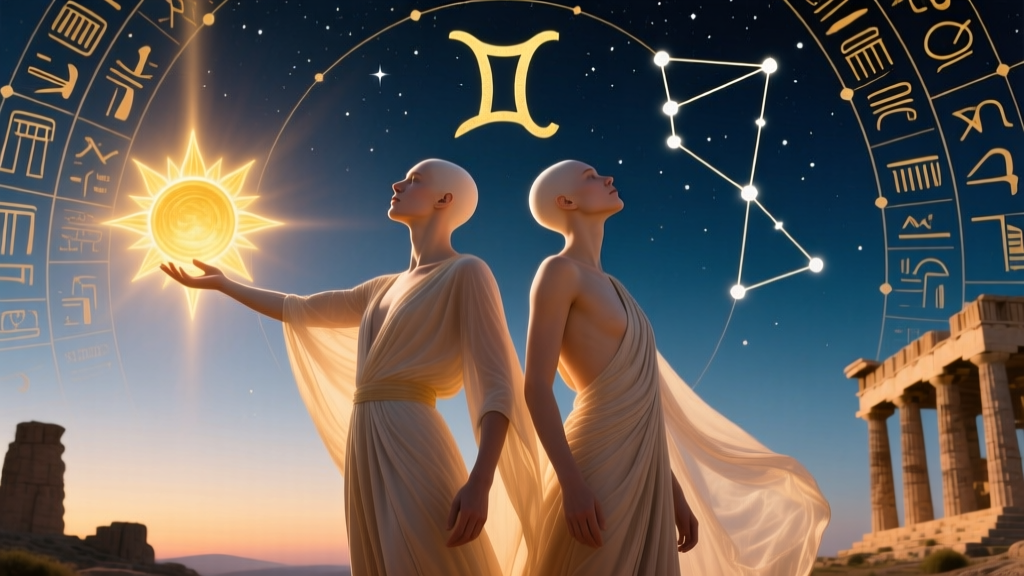
The Star Sign for 15 June: Gemini and the Ancient Twins
Individuals researching the star sign for 15 June are looking at the heart of the Gemini constellation. In the tropical zodiac system utilized by Western astrologers, this date falls squarely within the domain of the Twins. However, the modern interpretation of this air sign barely scratches the surface of its rich historical tapestry. To truly understand the astrological DNA of a mid-June birth, we must trace its lineage back through Hellenistic mythology, Babylonian star catalogs, and the intricate system of decan rulership that ancient astrologers used to map the heavens. This exploration reveals how ancient skywatchers defined the exact energetic signature of this specific calendar date.
Babylonian Roots: The Great Twins of Mesopotamia
Long before the Greeks assigned the myth of Castor and Pollux to this sector of the sky, the ancient Babylonians cataloged these stars in the MUL.APIN (compiled around 1100 BCE). In Mesopotamian astronomy, the constellation was known as the 'Great Twins' (Meshlamtaea and Lugalirra). Unlike the playful, communicative archetype of modern Gemini, these Babylonian twins were deeply associated with the underworld. They were minor gods linked to Nergal (the god of plague and the underworld) and Ninazu (the god of healing and the underworld). This historical origin provides a fascinating layer of depth to the 15 June personality: beneath the sociable, air-sign exterior lies a profound capacity for psychological depth, transformation, and navigating the 'underworld' of human crises. The duality of the Twins was originally a representation of the duality of life and death, not just a split personality.
The Hellenistic Shift: The Dioscuri
During the Hellenistic period, Alexandrian astrologers syncretized Babylonian observations with Greek mythology. The Twins became the Dioscuri, Castor and Pollux. Castor was mortal, while Pollux was immortal. When Castor died, Pollux begged Zeus to let him share his immortality, resulting in the two brothers spending alternate days in the heavens and the underworld. This mythological framework established the core astrological tenets of Gemini: the oscillation between two extremes, the bridge between the mundane and the divine, and the concept of the 'peer' or 'equal'. For those born on June 15, this ancient myth manifests as an internal drive to balance practical, earthly responsibilities with high-minded, intellectual pursuits.
The Fixed Star Pollux: Martial and Mercurial Fire
In traditional astrological lore, the physical stars within the constellation impart specific influences when conjunct the Sun or planets. The star Pollux (Beta Geminorum) is one of the most prominent fixed stars in the sky. According to the 2nd-century astrologer Claudius Ptolemy, the nature of Pollux is 'Martial and Mercurial.' This means it carries the aggressive, pioneering drive of Mars combined with the intellectual agility of Mercury. For individuals born on June 15, the Sun is historically approaching the conjunction with this fixed star. This specific celestial mechanics adds a layer of assertiveness and debate-oriented energy to the native. Unlike the stereotypical, people-pleasing Gemini, the mid-June native possesses the rhetorical firepower to argue their point relentlessly, a direct inheritance from the Martial influence of the Pollux star.
Decan Astrology: The Hidden Ruler of Mid-June
Generic horoscopes treat all Geminis identically, but traditional Hellenistic and Chaldean astrology divided each 30-degree sign into three 10-degree 'decans'. The Sun enters Gemini around May 21. By June 15, the Sun has progressed to approximately 24 degrees of Gemini, placing this birthdate firmly in the Third Decan of Gemini.
In the traditional triplicity system, the third decan of an Air sign is sub-ruled by Aquarius. This introduces a Saturnian (and in modern astrology, Uranian) undertone to the Mercurial nature of Gemini. The result is a highly specific psychological profile: the 'Systemic Rebel'.
| Gemini Decan | Date Range (Approx) | Sub-Ruler (Triplicity) | Historical Planet | Core Archetype |
|---|---|---|---|---|
| First Decan | May 21 – May 31 | Gemini | Mercury | The Pure Communicator |
| Second Decan | June 1 – June 10 | Libra | Venus | The Social Diplomat |
| Third Decan (15 June) | June 11 – June 20 | Aquarius | Saturn / Uranus | The Systemic Rebel |
While early June Geminis are driven by Venusian harmony and late May Geminis by pure Mercurial curiosity, the 15 June native operates with the structural, avant-garde frequency of Aquarius. They are less interested in small talk and more focused on systemic change, technological innovation, and intellectual rebellion. Saturn’s historical rulership of this decan grants mid-June Geminis a level of mental endurance and focus that is often missing in other degrees of the sign.
The Precession of the Equinoxes: Astronomical Reality vs. Tropical Zodiac
To provide complete historical context, we must address the astronomical reality of June 15. Due to the precession of the equinoxes—a slow wobble of the Earth's axis that shifts the celestial equator over a 26,000-year cycle—the Sun is no longer in the constellation of Gemini on this date. In the actual night sky, the Sun is transiting through the constellation of Taurus in mid-June.
Western astrology, however, utilizes the Tropical Zodiac, which is anchored to the seasons (the Vernal Equinox) rather than the shifting sidereal constellations. The Babylonian and Hellenistic architects of the zodiac intentionally aligned the signs with the seasonal cycle of light and dark. Therefore, the 'star sign' for 15 June remains Gemini in Western practice, representing the peak of spring's intellectual blossoming, even if the physical backdrop of stars has shifted to the Bull.
Actionable Synthesis: Applying Historical Gemini Traits Today
Understanding the Babylonian underworld connections and the Aquarian decan rulership provides a distinct advantage for personal and professional development. Here is how to leverage this specific historical astrological profile:
- Leverage the 'Underworld' Depth: Do not shy away from crisis management or psychological fields. The Meshlamtaea and Lugalirra origins indicate a hidden talent for navigating high-stress environments and guiding others through transitional crises.
- Channel the Aquarian Decan: Avoid purely social or superficial networking. Your third-decan energy thrives when building communities around shared, progressive ideologies or technological innovations. Focus on mastermind groups rather than casual social clubs.
- Bridge the Dualities: Emulate the Dioscuri myth by intentionally dividing your time between 'earthly' routines (Castor) and 'visionary' projects (Pollux). A 50/50 split between practical execution and theoretical brainstorming will prevent the mental burnout common to this degree.
- Harness Martial Rhetoric: Use the fixed star Pollux influence for careers in law, debate, or systemic advocacy. Your ability to combine Mercurial data-gathering with Martial assertiveness makes you a formidable opponent in negotiations.
The star sign for 15 June is not merely a symbol of duality; it is a complex historical artifact blending Mesopotamian depth, Hellenistic mythology, and Saturnian structure. Recognizing these layers transforms a basic sun-sign reading into a precise tool for self-mastery and historical astrological alignment.