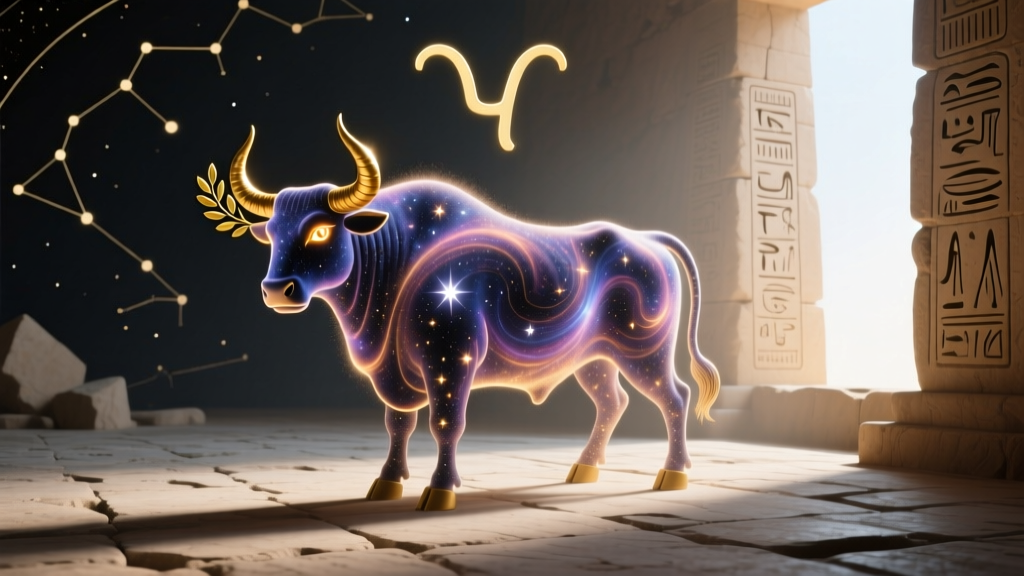
The star sign 2 May corresponds to the tropical zodiac placement of the Sun at approximately 11 degrees of Taurus. Far from being a mere modern horoscope category, this specific degree carries thousands of years of astronomical observation, agrarian timekeeping, and mythological weight. To understand the psychological and spiritual blueprint of individuals born on this date, we must excavate the ancient Mesopotamian, Egyptian, and Hellenistic records that forged the Taurus archetype.
Mesopotamian Roots: GUD.AN.NA and the Bull of Heaven
The origin of the Taurus constellation does not begin in Greece or Rome, but in the cradle of civilization. In ancient Sumer and Babylon, this region of the sky was known as GUD.AN.NA, or 'The Bull of Heaven.' According to the World History Encyclopedia, the Bull of Heaven plays a central antagonistic role in the Epic of Gilgamesh. When the hero Gilgamesh rejects the romantic advances of the goddess Ishtar, she unleashes the celestial Bull to destroy his crops and dry up the rivers of Mesopotamia. Gilgamesh and his companion Enkidu must slay the beast, an act that ultimately triggers the tragic second half of the epic.
This mythological narrative reflects early agrarian anxieties. The stars of Taurus, particularly the bright red giant Aldebaran (the 'eye' of the bull), were closely monitored by Babylonian astronomers. The compilation known as the MUL.APIN (circa 1000 BCE) meticulously tracked the heliacal rising of these stars to dictate the agricultural calendar, signaling when the Euphrates and Tigris rivers would flood and when the barley harvest must begin.
The Precession of the Equinoxes and the First Sign
To understand the historical dominance of the Bull, one must account for the precession of the equinoxes. Due to the slow wobble of the Earth's axis, the vernal equinox (the first day of spring) shifts backward through the zodiacal constellations over a 25,772-year cycle. During the Early Bronze Age (roughly 3000 BCE to 1700 BCE), the Sun was located in the constellation of Taurus during the spring equinox.
Consequently, Taurus was originally considered the 'first sign' of the zodiac by early astrologers, marking the true beginning of the astrological new year and the explosion of springtime fertility. It was only during the Classical Greek era that the equinox precessed into Aries, shifting the zodiacal starting point. However, the Taurean association with the genesis of life, material manifestation, and the fertile earth remained permanently embedded in the astrological tradition.
Decoding the Star Sign 2 May: The Mercurial Decan
Hellenistic and Egyptian astrologers divided each of the twelve 30-degree signs into three 10-degree segments called 'decans.' The star sign 2 May falls squarely into the second decan of Taurus (10° to 19°59'). While Taurus is universally ruled by Venus—governing aesthetics, resources, and physical comfort—the Chaldean decan system assigns a sub-ruler to each segment. The second decan of Taurus is historically ruled by Mercury.
This Mercurial undercurrent drastically alters the standard Taurean profile. Where the first decan of Taurus is purely focused on physical survival and tactile pleasure, the May 2 native possesses an intellectualized approach to material security. They are the scribes, the merchants, and the architects of the zodiac. They do not merely hoard resources; they calculate, trade, and optimize them.
| Decan | Degree Range | Approximate Dates | Classical Sub-Ruler | Historical Archetype |
|---|---|---|---|---|
| First | 0° - 9°59' | Apr 20 - Apr 29 | Venus | The Plowman / Cultivator |
| Second | 10° - 19°59' | Apr 30 - May 10 | Mercury | The Scribe / Merchant |
| Third | 20° - 29°59' | May 11 - May 20 | Saturn | The Builder / Mason |
Greek Mythological Synthesis: Europa and the Minoan Cults
As astrological knowledge transferred from Babylon to Alexandria and eventually to the Greco-Roman world, the Bull of Heaven was syncretized with Greek mythology. Britannica notes that the constellation is most famously linked to the myth of Zeus and Europa. To bypass the watchful eyes of his wife Hera, Zeus transformed himself into a magnificent, docile white bull. When the Phoenician princess Europa approached the beast and climbed onto its back, Zeus bolted across the sea to Crete, where she bore him three sons, including Minos.
However, modern archaeological findings suggest this myth is a Hellenistic rationalization of much older Minoan religious practices. The Minoan civilization on Crete (circa 2700–1100 BCE) centered its worship around the bull. The famous frescoes at Knossos depict taurokathapsia (bull-leaping), a highly dangerous ritual where acrobats vaulted over the horns of a charging bull. For the Minoans, the bull was not merely a divine disguise, but a living conduit of seismic and earthly power—a fitting parallel to the 'fixed earth' modality of Taurus, which governs both the stability of the ground and the terrifying, destructive force of earthquakes (historically attributed to subterranean bulls shifting their weight).
Agrarian Calendars and the Pleiades Cluster
The Taurus constellation houses the Pleiades star cluster (M45), known in antiquity as the 'Seven Sisters.' For ancient Mediterranean and Near Eastern cultures, the Pleiades served as the ultimate celestial clock. The Greek poet Hesiod, in his 8th-century BCE work Works and Days, explicitly used the rising and setting of the Pleiades to dictate the farming year.
When the Pleiades set heliacally (disappearing into the dawn glare) in November, it signaled the time to plow and sow. When they rose heliacally in May, it signaled the time to sharpen the sickles and begin the harvest. The date of May 2 sits precisely in the energetic window where the ancient world prepared for the culmination of the growing season. The Taurean archetype of 'patience yielding a harvest' is not a metaphor; it is a literal translation of the agricultural reality experienced by our ancestors when the Sun occupied this sector of the sky.
Practical Application of the May 2 Archetype
Understanding the historical and astronomical origins of the May 2 placement provides a concrete framework for personal and professional alignment. Modern individuals born under this specific degree can leverage their historical archetypes in the following ways:
- Leverage the Mercurial Decan: Because the 11th degree of Taurus is governed by Mercury, May 2 is an auspicious date for signing long-term financial contracts, negotiating property deals, or establishing business partnerships. The energy supports intellectual scrutiny applied to material assets.
- Align with Agrarian Cycles: Project management should mirror the ancient Pleiades calendar. Use the late April and early May period not for planting new ideas (Aries), but for auditing existing resources, consolidating gains, and preparing the infrastructure for the 'harvest' phase of late summer.
- Honor the Fixed Earth Modality: The Minoan and Babylonian reverence for the bull highlights the necessity of physical grounding. Somatic practices, weight-bearing exercises, and direct interaction with soil or raw materials are historically validated methods for regulating the nervous system of a May 2 native.
By stripping away modern pop-astrology generalizations and returning to the Babylonian, Hellenistic, and agrarian roots of the zodiac, the true depth of the May 2 placement is revealed. It is a coordinate of ancient timekeeping, marking the precise intersection of intellectual strategy, material accumulation, and the enduring power of the earth.