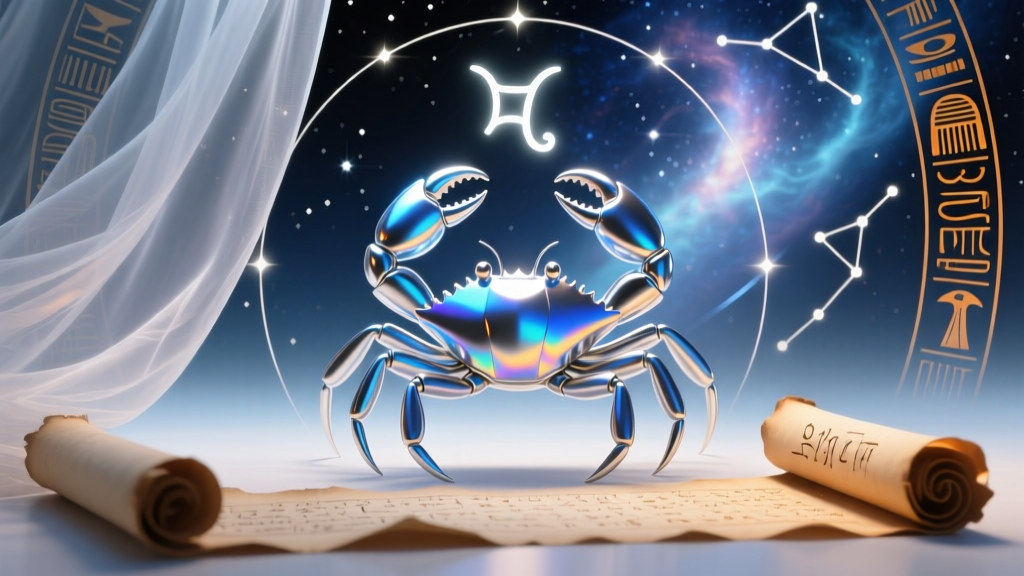
Individuals researching the star sign for 23rd june are looking at the astrological domain of Cancer. While modern horoscopes often reduce this water sign to mere emotional tropes or domestic stereotypes, the historical and mythological origins of Cancer reveal a profoundly complex archetype. This sign is deeply rooted in ancient Mesopotamian astronomy, Egyptian solar mythology, and Greek catasterism. Born just days after the summer solstice, those with a June 23rd birthday inherit a zodiacal legacy tied to the 'Gate of Men' and the primordial waters of creation. To understand the true psychological and spiritual blueprint of this placement, we must excavate its 4,000-year-old origin story and examine how ancient civilizations mapped this specific sector of the ecliptic.
The Mesopotamian Roots: MUL.AL.LUL and the Primordial Waters
The earliest recorded origins of the Cancer constellation are found in the Babylonian astronomical compendium known as the MUL.APIN, compiled around 1000 BCE. The Babylonians identified this cluster of stars as MUL.AL.LUL, which translates to 'the Crab' or 'the Crayfish'. However, this was not merely a zoomorphic observation; it held deep cosmological significance regarding the origins of the universe.
In Mesopotamian mythology, the universe was born from the mingling of two primordial bodies of water: Apsu (the sweet, fresh water) and Tiamat (the salt, chaotic water). The crab, an amphibious creature that thrives in the muddy, liminal boundaries where fresh water meets the sea, was viewed as a sacred guardian of these threshold spaces. According to records preserved in the Open Richly Annotated Cuneiform Corpus (Oracc), the constellation of the Crab was associated with the god Ningishzida, a deity of the underworld and vegetation who governed the transition between the realms of the living and the dead. Therefore, the ancient archetype of the June 23rd native is not merely 'emotional,' but rather a guardian of liminal spaces and a navigator of the unconscious mind.
Egyptian Syncretism: Khepera and the Solar Scarab
Before the Hellenistic synthesis of the zodiac, the ancient Egyptians associated this specific sector of the ecliptic with the scarab beetle, known as Khepera. The scarab was a potent symbol of rebirth, cycles, and the protective amniotic fluid of creation. Egyptian priests observed the dung beetle rolling balls of matter across the earth, which they interpreted as a terrestrial mirror of the god Khepera pushing the sun across the sky.
When the Greeks later adopted and formalized the zodiac, the hard-shelled, water-adjacent scarab seamlessly morphed into the crab. Both creatures share a biological imperative to protect their soft, vulnerable interiors with calcified armor, and both are intrinsically linked to the mud, water, and the cyclical nature of life and decay. This historical syncretism explains why modern Cancer is ruled by the Moon (governing cycles and tides) but retains a deeply solar, life-giving undertone related to the incubation of the soul.
Greek Mythology: Karkinos, the Hydra, and Catasterism
The most famous mythological origin story of Cancer in the Western esoteric tradition centers on the creature known as Karkinos. During the second of his twelve labors, the hero Heracles was tasked with slaying the Lernean Hydra, a multi-headed serpent dwelling in a toxic swamp. Recognizing Heracles' brute strength, the goddess Hera sent a giant crab, Karkinos, to assist the Hydra by distracting the hero.
Karkinos emerged from the mud and clamped onto Heracles' foot. The hero, enraged, crushed the crab beneath his heel. However, as detailed in the mythological archives of the Theoi Project, Hera honored the creature's loyalty, strategic flank-attack, and ultimate sacrifice. She elevated Karkinos to the heavens through a process known as catasterism (star-placement). This myth establishes the core psychological framework of the Cancer archetype: it is not the direct, aggressive force of Aries or Leo, but the strategic protector, the flanker, and the fiercely loyal guardian who will sacrifice its own safety to defend its chosen allies.
Decoding the star sign for 23rd june: The Solstice Connection
The date of June 23rd falls immediately in the wake of the summer solstice, a period of immense astronomical and spiritual importance in antiquity. In Hellenistic astrology, as rigorously documented in Claudius Ptolemy's foundational text, the Tetrabiblos, Cancer marked the 'Gate of Men'.
Ancient astrologers believed that the solstice points were literal portals in the celestial sphere. Souls descended into physical incarnation through the Gate of Men (Cancer) during the summer solstice, when the sun reaches its peak and begins its downward trajectory toward winter and physical manifestation. Conversely, Capricorn marked the 'Gate of Gods,' where souls ascended back to the divine realm. This esoteric framework dictates that individuals born under this sign are natural anchors, designed to draw spiritual concepts down into physical, tangible reality.
Evolution of the Cancer Archetype
Understanding how the interpretation of this sign has shifted over millennia provides critical context for modern practitioners.
| Era | Core Symbol | Primary Archetype | Societal Role |
|---|---|---|---|
| Babylonian (c. 1000 BCE) | MUL.AL.LUL (Crab) | Guardian of the Threshold | Navigating the boundary of sweet/salt waters |
| Egyptian (c. 1500 BCE) | Khepera (Scarab) | Solar Incubator | Pushing the cycle of rebirth and life |
| Hellenistic (c. 150 CE) | Karkinos / Gate of Men | Soul Descender / Protector | Anchoring spirit into physical matter |
| Modern Psychological | The Crab | Nurturer / Empath | Emotional regulation and domestic security |
Practical Application: Leveraging Historical Traits Today
By stripping away modern pop-astrology fluff and returning to the historical origins of the star sign for 23rd june, individuals can apply these ancient frameworks to contemporary life with high precision.
- Boundary Architecture (The Calcified Shell): Instead of viewing the crab's shell as a tendency to 'hide' or 'withdraw,' reframe it as necessary boundary architecture. Just as Karkinos possessed a hardened exterior to survive the toxic waters of the Lernean swamp, June 23 natives must consciously design environments and social boundaries that protect their highly permeable emotional nervous systems. Actionable step: Implement strict 'decompression protocols' after high-stimulus social or professional events to prevent empathic burnout.
- Liminal Navigation (The Amphibious Nature): Drawing from the Babylonian association with the mingling of Apsu and Tiamat, this placement excels in transitional phases. Whether managing corporate mergers, guiding individuals through grief, or navigating personal life pivots, the native thrives in the 'mud.' Actionable step: Seek career or volunteer roles that involve crisis management, mediation, or transitional coaching, where the ability to remain grounded in chaotic environments is a premium asset.
- Ancestral Anchoring (The Gate of Men): Because Cancer represents the descent of the soul into the material bloodline, June 23 natives possess a unique capacity for ancestral work. Actionable step: Engage in genealogical research, establish new family traditions, or practice somatic therapies that address generational trauma. You are historically positioned to be the circuit-breaker for inherited familial patterns, transforming chaotic 'salt water' into nourishing 'sweet water' for future generations.
The history of the star sign for 23rd june reveals a profound archetype of protection, transition, and cosmic anchoring. By integrating the wisdom of Babylonian threshold guardians, Egyptian solar cycles, and Hellenistic soul-portals, the modern Cancer native can transcend superficial horoscopes and step into their true historical power.