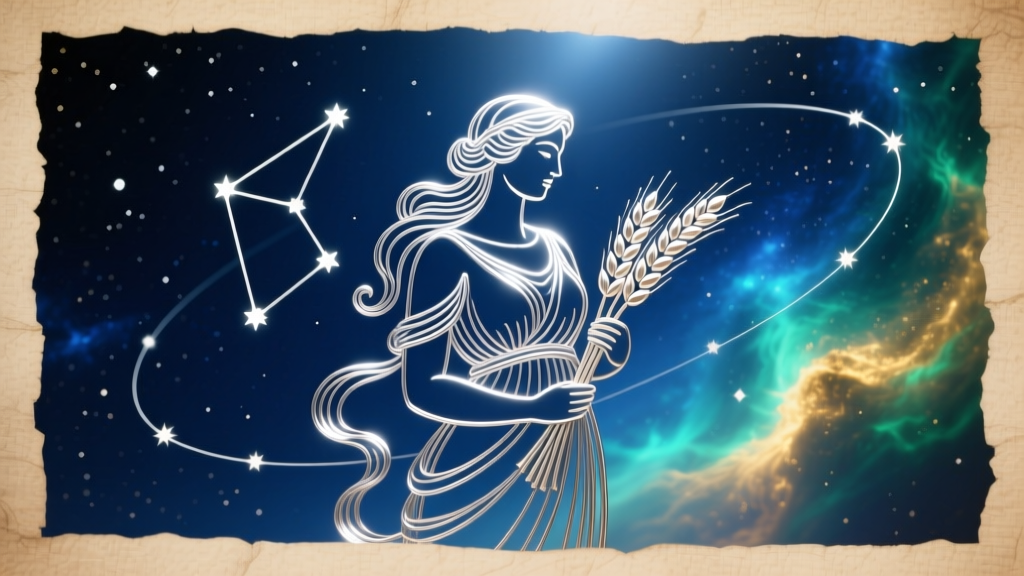
The Astronomical Reality: What is the Star Sign for 24 August?
When examining the star sign for 24 August, we are looking at the very early degrees of Virgo in the Western tropical zodiac system. Unlike modern pop-astrology that relies on generalized daily horoscopes, the historical origin of this specific astrological placement is deeply rooted in ancient Mesopotamian agriculture and Hellenistic astronomy. Individuals born on this date fall under the First Decan of Virgo. To understand the true esoteric and historical weight of this placement, we must trace the constellation’s evolution from the Babylonian harvest fields to the Greco-Roman maiden, and examine how early astronomers mathematically codified these seasonal boundaries in the sky.
Babylonian Origins: The Furrow and the Goddess Shala
Long before the Greeks personified the zodiac as human figures, the Babylonians mapped the ecliptic based on agricultural cycles. According to the MUL.APIN, a comprehensive compendium of Babylonian astronomy compiled around 1000 BCE, the region of the sky we now call Virgo was originally known as the Širū, or The Furrow. As documented by the World History Encyclopedia, this celestial furrow was intrinsically linked to Shala, the ancient Mesopotamian goddess of grain and agriculture.
The most critical data point in this historical mapping is the star Spica (Alpha Virginis). In Babylonian star catalogs, Spica was explicitly recorded as the ear of barley or wheat held by the goddess. The heliacal rising and setting of Spica served as a precise calendrical marker for the planting and harvesting seasons in the Tigris-Euphrates river system. For those born on August 24, this ancient connection to the exact timing of the harvest remains a foundational archetype of the Virgo personality: meticulous, resource-oriented, and deeply tied to the rhythms of the earth.
Hellenistic Astrology and the Erigone Myth
As astrological knowledge transferred from Babylon to Alexandria and Athens during the Hellenistic period (roughly 323 to 31 BCE), the visual representation of the constellation shifted. The Greeks overlaid their own mythology onto the Babylonian framework. According to Britannica's astronomical archives, the poet Eratosthenes and later the Roman mythographer Hyginus associated the figure with Erigone, the daughter of Icarius, or with Demeter and Persephone.
The tragedy of Erigone, who took her own life in grief after her father was killed by drunken shepherds, led Zeus to place her in the stars. This narrative introduced themes of mourning, purity, and the tragic consequences of ignorance—themes that often manifest in the Virgo archetype as a deep-seated fear of making mistakes and a drive for flawless execution. This mythological shift changed the focus from the raw agricultural output to the personification of the harvest maiden holding the sheaf of wheat, emphasizing analysis, service, and the purification of resources.
The Precession of the Equinoxes: Tropical vs. Sidereal Boundaries
A critical area of expertise often missing from mainstream astrological discourse is the astronomical reality of the zodiacal boundaries. The star sign for 24 August is Virgo in the Western tropical system, but it is fundamentally important to recognize that the Sun is physically located in the constellation of Leo on this date. This discrepancy is due to the precession of the equinoxes, a slow wobble of the Earth’s rotational axis discovered by the Greek astronomer Hipparchus in 127 BCE.
Because the Earth's axis completes a precessional cycle approximately every 25,772 years, the background stars shift westward by about one degree every 72 years. Consequently, the tropical zodiac (which is anchored to the seasons and the vernal equinox) and the sidereal zodiac (which is anchored to the actual background stars) have drifted apart by roughly 24 degrees over the last two millennia.
| Astrological System | Sign on August 24 | Approximate Sun Degree | Historical Origin |
|---|---|---|---|
| Tropical (Western) | Virgo | 1° to 2° Virgo | Ptolemaic (2nd Century CE) |
| Sidereal (Vedic/Jyotish) | Leo (Simha) | 7° to 8° Leo | Ancient Indian (Vedanga Jyotisha) |
| Astronomical (IAU) | Leo | ~10° Leo | Modern Constellation Borders (1930) |
Ptolemy’s Tetrabiblos and the Codification of the Zodiac
The definitive codification of the August 24 boundary as early Virgo occurred in the 2nd century CE with Claudius Ptolemy. In his foundational text, the Tetrabiblos, Ptolemy made a deliberate mathematical decision to anchor the tropical zodiac to the equinoxes and solstices rather than the shifting constellations. He fixed the vernal equinox at exactly 0° Aries.
By locking the zodiac to the seasons, Ptolemy ensured that the Sun's entry into Virgo would always coincide with the late summer harvest period in the Northern Hemisphere, regardless of where the actual constellation of Virgo was located in the sky. Therefore, the star sign for 24 August is permanently tethered to the seasonal transition of late summer, prioritizing the Earth-Sun geometric relationship over the backdrop of distant stars.
Actionable Observation: Tracking Spica's Historical Markers
To connect with the ancient observational astronomy that defined this sign, modern practitioners can track Spica, the alpha star of Virgo. The International Astronomical Union (IAU) notes that Spica is one of the brightest stars in the night sky and a key vertex of the Spring Triangle. Here is how to locate and utilize this historical marker:
- Locate the Big Dipper: Find the arc of the Dipper's handle in the northern hemisphere sky during spring and early summer.
- Follow the Arc to Arcturus: Extend the curve of the handle away from the bowl until you hit the bright orange star Arcturus (in the constellation Boötes).
- Speed on to Spica: Continue that exact same arc for another 20 degrees to find the brilliant blue-white star Spica.
- Calculate Historical Harvests: In ancient Egypt and Mesopotamia, the heliacal rising of Spica just before dawn signaled the imminent flooding of the Nile or the preparation of the autumn sowing. Observing this star provides a tangible link to the empirical origins of the Virgo archetype.
Decanate Astrology: The First Decan Influence on August 24
In Hellenistic and Chaldean astrology, the 30-degree span of Virgo is divided into three decans of 10 degrees each. The Sun occupies the First Decan of Virgo from approximately August 23 to September 2. Therefore, an individual born on August 24 is situated at the very genesis of the Virgo energy, specifically around 1° to 2° of the sign.
The First Decan is ruled by Mercury, which is also the traditional domicile ruler of Virgo. This creates a compounding Mercurial influence. Historically, this specific degree was associated with the manifestation of pure intellect, analytical precision, and the initiation of systematic processes. This Mercurial dominance explains why late August births often exhibit a highly nervous, cerebral energy. The mind is constantly sorting, filtering, and organizing environmental inputs. In ancient medical astrology, this degree was linked to the digestive system and the nervous system, reflecting the physical manifestation of Mercury's sorting mechanism within the human body.
Historical Degree Sabians: The Symbolism of 1° Virgo
While the Sabian Symbols were developed much later (in 1925 by Marc Edmund Jones and Elsie Wheeler), they provide a fascinating psychological overlay for specific degrees. The symbol for 1° Virgo is 'In A Portrait, The Significant Features Of A Man's Head Are Artistically Emphasized.' This aligns perfectly with the historical Virgo mandate: the ability to separate the essential from the non-essential, refining raw data into a clear, comprehensible, and useful format. For the August 24 native, the historical imperative is to act as the editor of reality, preserving what is functional and discarding what is superfluous.