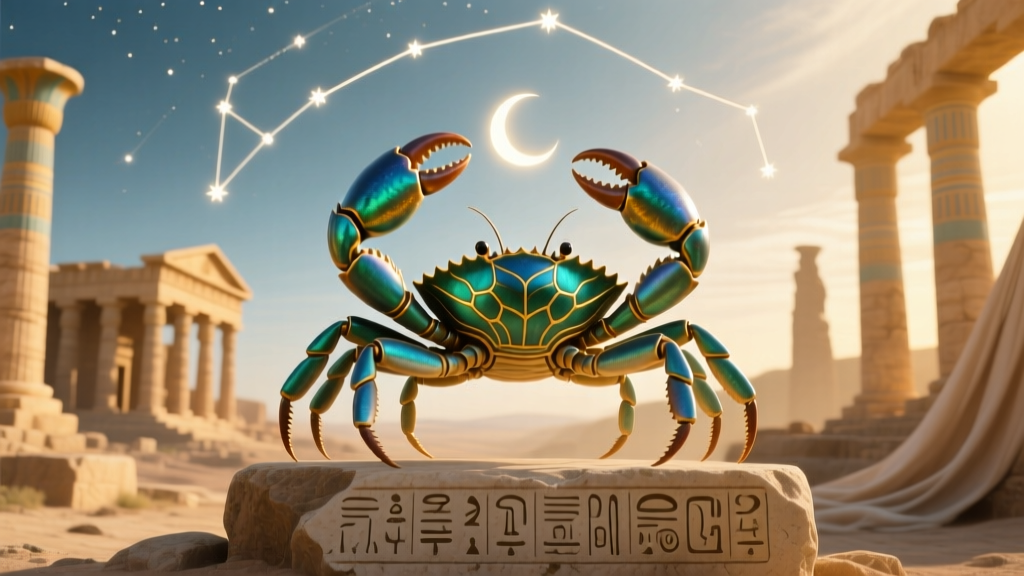
Individuals researching the star sign 7 july are examining the second decan of Cancer, a placement steeped in ancient astronomical observation and mythological syncretism. Far from modern pop-astrology tropes, the historical origin of this specific birth date traces back to Babylonian star catalogues and Hellenistic decan systems. By examining the astrological frameworks of antiquity, we uncover how ancient scholars interpreted the celestial mechanics of early July. They transformed a simple crustacean into a symbol of cosmic gates, emotional fortitude, and martial endurance, offering a radically different lens through which to view this mid-summer placement.
The Babylonian Roots: MUL.AL.LUŠ and the Cosmic Gate
The earliest recorded origins of the Cancer constellation do not depict a crab, but rather a turtle or a hybrid water-creature known as MUL.AL.LUŠ (the Alluttu). Documented in the MUL.APIN cuneiform tablets compiled around 1000 BCE, this constellation held profound theological significance in ancient Mesopotamia. The Babylonians recognized the summer solstice—the point the sun occupies in late June and early July—as the 'Gate of Men.' This was the cosmic threshold through which souls descended from the heavenly realm into physical incarnation.
For a child born on July 7, the sun is firmly positioned within this descending gate. The Alluttu, with its hard shell and amphibious nature, was associated with the god Ningishzida, a deity of the underworld and vegetation who mediated between the earthly and divine spheres. The historical archetype of the July 7 birth is therefore not merely 'emotional' or 'nurturing,' but deeply liminal. These individuals were historically viewed as psychopomps or boundary-walkers, possessing an innate understanding of the transition between the conscious and unconscious mind, mirroring the crab's ability to navigate both land and sea.
Hellenistic Astrology and the Decan of the Star Sign 7 July
To understand the specific historical nuance of July 7, we must look to the Hellenistic astrologers of Alexandria, such as Vettius Valens and Claudius Ptolemy. In the Tetrabiblos and subsequent decan texts, the zodiac was divided into 36 decans (10-degree segments). July 7 typically corresponds to the 14th degree of Cancer, placing it dead center in the second decan of Cancer.
While the sign of Cancer is traditionally ruled by the Moon, the triplicity-based decan system assigns the second decan (10° to 20° Cancer) to the sub-rulership of Mars, via its association with the water sign Scorpio. This creates a fascinating historical paradox: a Mars-ruled decan operating within a Moon-ruled sign. Vettius Valens, in his Anthology, described this specific decan as bringing 'toils, dangers, and struggles, but ultimate victory through endurance.' The historical interpretation of the July 7 native was one of intense emotional armor. Unlike the first decan of Cancer, which is purely lunar and receptive, the July 7 native possesses a martial, protective undercurrent. They do not just feel; they defend, strategize, and fortify their emotional inner sanctum.
The Astronomical Reality: Sirius and the Summer Heat
Ancient Egyptian astrology provides another layer to the July 7 origin story. In the pre-Julian Egyptian calendar, early July roughly coincided with the heliacal rising of Sirius (Sopdet), the brightest star in the night sky. This astronomical event signaled the imminent inundation of the Nile River. The crab and the turtle were venerated as creatures that knew how to survive and navigate the flooding waters. The 'hard shell' of the Cancerian archetype was historically derived from the necessity of surviving the chaotic, life-giving, yet destructive floodwaters of the Sothic cycle. The July 7 native inherits this historical mandate: the ability to remain grounded and protected during periods of massive environmental or emotional upheaval.
Mythological Syncretism: Karkinos and the Lunar Chariot
The Greek mythological origin of the Cancer constellation centers on Karkinos, the giant crab sent by Hera to distract Heracles during his battle with the Lernaean Hydra. While modern interpretations often dismiss Karkinos as a minor, easily crushed nuisance, Hellenistic scholars like Eratosthenes in his Catasterismi viewed the crab's placement in the stars as a reward for its sacrificial loyalty and tactical distraction.
Furthermore, Cancer is the constellation of the Moon's chariot. In ancient cosmological models, the Moon was the fastest-moving celestial body, responsible for the immediate transmission of planetary decrees to the earthly realm. The July 7 placement, sitting in the Mars-ruled decan of the Moon's domicile, suggests a historical archetype of the 'messenger in armor.' These individuals were expected to deliver difficult emotional truths or protect their lineage with fierce, calculated loyalty.
Historical Evolution of the July 7 Archetype
The interpretation of the July 7 birth date has shifted dramatically across different astrological epochs. The following table outlines how the core archetype has evolved from antiquity to the modern era.
| Era | Astrological System | Ruling Planet/Deity | Core Historical Meaning |
|---|---|---|---|
| Babylonian (c. 1000 BCE) | MUL.APIN Constellations | Ningishzida / Shamash | The Gate of Men; liminality; descent of the soul into matter. |
| Hellenistic (1st-3rd Century) | Chaldean Decans | Moon (Sign) / Mars (Decan) | Emotional fortitude; strategic defense; victory through endurance. |
| Medieval (12th Century) | Arabic Lots & Mansions | Jupiter / Moon | Protection of the household; accumulation of ancestral wealth. |
| Modern (20th Century+) | Psychological Astrology | Moon / Pluto (Octile) | Deep psychic sensitivity; subconscious boundary setting. |
Applying Ancient Decan Wisdom to Modern Practice
Understanding the historical and decanic origins of the star sign 7 july provides a highly actionable framework for personal development. Modern astrology often flattens Cancer into a purely nurturing, passive archetype. By reclaiming the Mars-ruled second decan and the Babylonian 'Gate' mythology, individuals born on this date can optimize their innate strengths through the following practices:
- Strategic Boundary Fortification: Recognize that your emotional sensitivity requires a 'hard shell.' Do not view boundary-setting as a betrayal of your nurturing nature. Historical astrology dictates that your Mars-sub-ruled decan demands active, unapologetic defense of your inner circle and emotional energy.
- Liminal Navigation: Leverage the Babylonian 'Gate of Men' archetype. You possess a natural aptitude for transitioning between disparate groups, mediating conflicts, and acting as a psychopomp for others during grief or major life transitions. Seek roles in counseling, crisis management, or organizational psychology where navigating liminal spaces is required.
- Channeling Martial Endurance: When faced with emotional burnout, recall the Vettius Valens decree of 'victory through endurance.' Your historical archetype is not designed to avoid emotional toil, but to outlast it. Implement physical endurance practices—such as long-distance swimming or martial arts—to ground your Mars-ruled decan energy in the physical body.
By anchoring the July 7 birth date in its rich historical context, we move beyond superficial horoscopes and engage with a profound, ancient technology of self-understanding. The true legacy of the mid-summer Cancerian is not fragility, but an impenetrable, strategic, and deeply historical resilience.