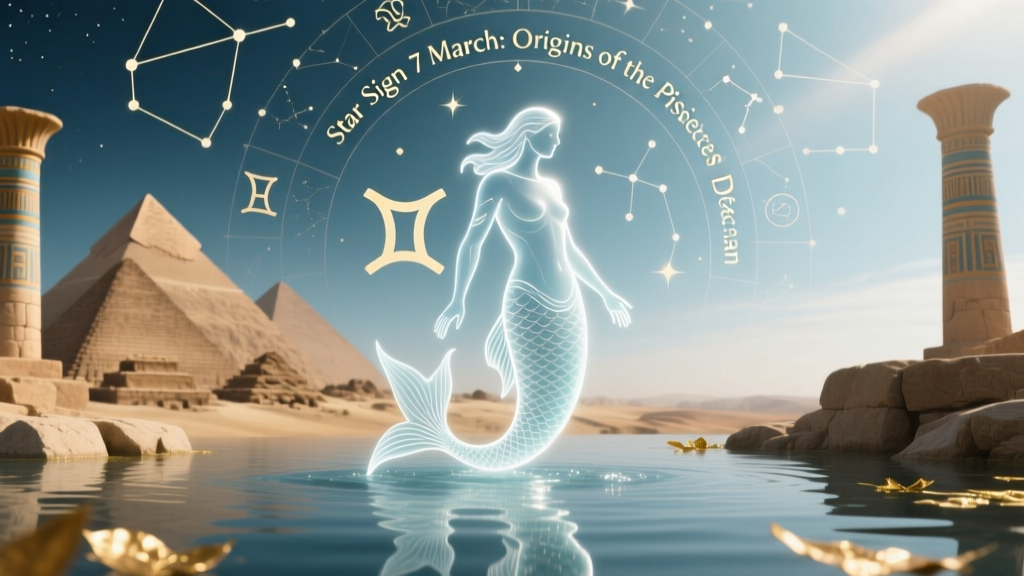
Individuals researching the star sign 7 March are investigating the second decan of Pisces, a placement steeped in ancient Mesopotamian astronomy and Hellenistic esoteric traditions. Born between the 10th and 20th degrees of the mutable water sign, these natives are governed by celestial mechanics that predate modern horoscopes by millennia. To understand the exact astrological DNA of this date, one must bypass contemporary pop astrology and examine the cuneiform tablets of Babylon, the decan systems of Alexandria, and the mythological frameworks of classical antiquity.
The Babylonian Origins: MUL.APIN and the Great Tails
The earliest recorded iteration of the Pisces constellation originates in Babylonian astronomy, specifically documented in the MUL.APIN compendium compiled around 1000 BCE. The Babylonians did not recognize the "fishes" as the Greeks later did. Instead, they identified this region of the ecliptic as KUN.MES, meaning "The Tails" or the "Great Tails." This designation referred to the intersection point of the ecliptic and the celestial equator, which at that time was located near the modern-day March 7th zone.
In the Babylonian calendar, this region marked the final stages of the agricultural year, associated with the flooding of the Tigris and Euphrates rivers. The water symbolism inherent in modern Pisces is a direct historical descendant of these Mesopotamian river-flood observations. Astronomers like Naburimannu (c. 5th century BCE) calculated the movements of these stars to predict agricultural yields, embedding a deep association with nourishment, fluidity, and collective resources into the astrological archetype.
Hellenistic Astrology: Decans and the Star Sign 7 March
Following Alexander the Great’s conquests, Babylonian astronomy merged with Egyptian and Greek philosophical systems, birthing Hellenistic astrology in Ptolemaic Egypt. It was here that the zodiac was mathematically divided into 36 decans (10-degree segments). The star sign 7 March falls precisely within the second decan of Pisces (10° to 20°). According to the Chaldean decan rulership system, detailed extensively in Skyscript's historical analysis of decans, this specific 10-degree slice is sub-ruled by the Moon.
This lunar sub-rulership profoundly alters the expression of Jupiter-ruled Pisces, introducing themes of maternal instinct, tidal emotional rhythms, and deep psychological receptivity. Ptolemy’s foundational text, the Tetrabiblos (c. 150 CE), outlines how the mutable water nature of Pisces combines with the lunar influence of Cancer (the Moon's domicile) in this specific decan.
| Decan | Degree Range | Ruler (Chaldean) | Historical Archetype | Calendar Approximation |
|---|---|---|---|---|
| First Decan | 0° - 10° Pisces | Jupiter | The Bound Fishes | Feb 19 - Feb 28 |
| Second Decan | 10° - 20° Pisces | Moon | The Submerged Net | Mar 1 - Mar 10 (Includes 7 March) |
| Third Decan | 20° - 30° Pisces | Mars | The Cord of Destiny | Mar 11 - Mar 20 |
The historical imagery associated with the second decan, often depicted in the Picatrix (an 11th-century Arabic grimoire translating earlier Hellenistic sources) as a woman adorned with shells or a submerged fishing net, highlights the historical focus on capturing elusive truths and navigating the subconscious depths.
The Typhon Myth: Aphrodite, Eros, and the Cord
The mythological origin story of Pisces, which heavily influences the archetypal understanding of those born on March 7th, is rooted in Ovid’s Metamorphoses and earlier Greek oral traditions. The narrative centers on the monstrous storm giant Typhon, who assaulted Mount Olympus. To escape his wrath, Aphrodite (Venus) and her son Eros (Cupid) leaped into the Euphrates River and transformed into fish. To ensure they would not lose one another in the turbulent, dark waters, they tied themselves together with a cord.
This "Cord of Pisces" (the asterism connecting the two fish, Alpha Piscium) is the defining mythological anchor for the sign. For the star sign 7 March, located in the decan ruled by the Moon (associated with maternal bonds), the Aphrodite-Eros myth takes on a specific historical resonance. It speaks to the ancient Hellenistic understanding of sympatheia—the cosmic sympathy and unbreakable emotional tethers that bind individuals to their loved ones, their pasts, and their spiritual callings. The historical emphasis here is not merely on escapism, but on the preservation of love and identity amidst chaos.
The Precession Schism: Tropical vs. Sidereal History
A critical juncture in the history of the star sign 7 March occurred in 127 BCE, when the Greek astronomer Hipparchus of Nicaea discovered the precession of the equinoxes. He observed that the vernal equinox point was slowly drifting backward through the zodiac at a rate of approximately one degree every 72 years. This discovery fractured astrological history into two distinct branches: the Sidereal zodiac (used in Vedic/Jyotish astrology, which tracks the actual, observable constellations) and the Tropical zodiac (used in Western astrology, which tracks the Earth's seasonal relationship to the Sun).
Because of precession, the physical constellation of Pisces no longer aligns with the tropical sign of Pisces. An individual born on March 7th today is a tropical Pisces, but astronomically, the Sun is physically transiting the constellation of Aquarius. Western astrologers maintained the Tropical system to preserve the seasonal integrity of the signs. Thus, the "water" nature of the March 7th star sign is a historical artifact of the Earth's axial tilt and the seasonal transition toward the Northern Hemisphere's spring equinox, rather than the literal stars overhead.
Applying Historical Pisces Data to Modern Natal Analysis
Understanding the ancient mechanics of the star sign 7 March provides a rigorous framework for modern chart interpretation. When analyzing a natal chart featuring a March 7th Sun, practitioners should look beyond generic Pisces traits and apply the historical decan rulerships.
- Evaluate Lunar Aspects: Because the second decan is Moon-ruled, the condition of the natal Moon (its sign, house, and aspects) will act as a secondary dispositor for the March 7th Sun, heavily dictating the individual's emotional baseline.
- Examine the Nodes: The myth of the "Cord" tying the two fishes together aligns historically with the Lunar Nodes (Rahu and Ketu). A March 7th native often exhibits a pronounced nodal axis, representing the tension between spiritual dissolution (South Node) and material anchor points (North Node).
- Assess Water Trines: The Babylonian association with river flooding suggests that historical Pisces placements thrive when forming trines to other water placements (Cancer/Scorpio), creating a closed hydrological loop that prevents emotional stagnation.
By anchoring interpretations in the MUL.APIN records, Hellenistic decan theory, and classical mythology, astrologers can deliver highly specific, historically validated insights for this unique natal placement.