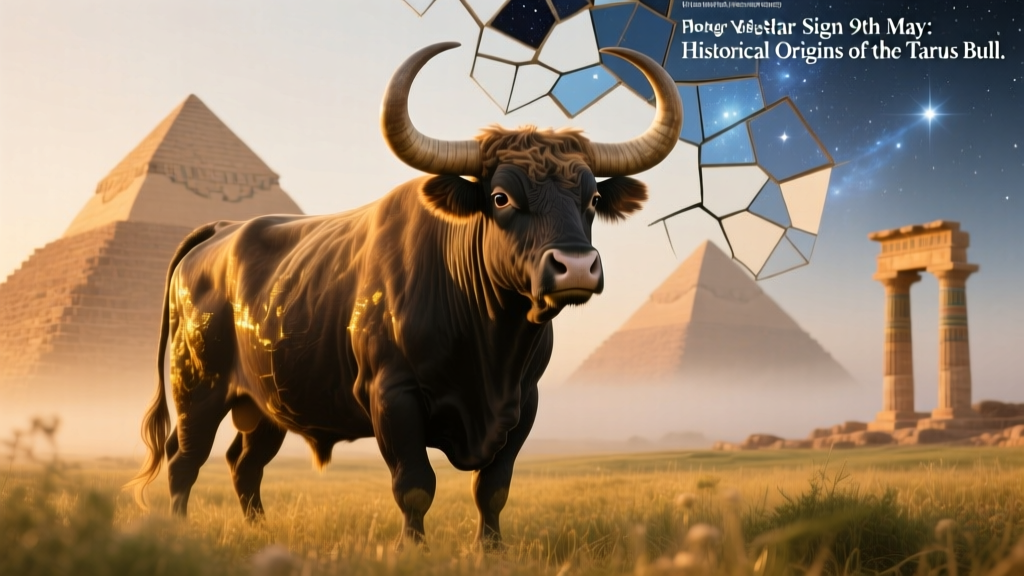
The Historical Roots of the Star Sign 9th May
Individuals born under the star sign 9th May fall squarely within the second decan of Taurus, an earth sign historically anchored by the Babylonian Bull of Heaven. Rather than viewing this zodiac placement through modern pop-astrology tropes, examining the ancient Mesopotamian and Hellenistic origins reveals a complex archetype tied to agricultural cycles, celestial mechanics, and underworld mythology. The sun reaches approximately 18 degrees of Taurus on this date, a degree that held profound mathematical and mythological significance for ancient astrologers tracking the precession of the equinoxes and the heliacal rising of specific fixed stars. This historical foundation shapes the psychological and material profile of the mid-Taurus native, blending terrestrial stability with mercurial calculation.
Babylonian Origins: Gugalanna and the Heavenly Bull
The origins of the Taurus constellation and its corresponding zodiacal sector trace back to Sumerian and Babylonian astronomy, specifically the MUL.APIN star catalog compiled around 1000 BCE. In this ancient text, the constellation was designated as GU4.AN.NA, translating to The Bull of Heaven. This celestial bull was deeply intertwined with the Epic of Gilgamesh, representing the divine beast sent by the goddess Ishtar to punish the hero. However, beyond mythology, the Bull of Heaven served a critical agrarian function. The sun's transit through the mid-degrees of Taurus in May signaled the climax of the spring harvest in Mesopotamia. The 18th degree, occupied by the sun on May 9th, marked a critical threshold where the initial labor of planting transitioned into the meticulous accounting of early yields.
Ancient Babylonian priests observed the sky to predict the flooding of the Tigris and Euphrates rivers. The stars comprising the face and horns of the Bull were used as temporal markers. The practical reality of ancient survival meant that the Taurus archetype was not merely about indulgence or stubbornness; it was fundamentally about resource management, the preservation of grain, and the mathematical tracking of agricultural surplus. This historical context explains the innate drive for material security and systemic organization found in those born on this date.
The Astronomical Shift: Precession and the Watcher of the East
To understand the specific energetic signature of May 9th, one must account for the precession of the equinoxes. In the tropical zodiac used by Western astrology, the sun is at 18 degrees Taurus. However, looking back to the dawn of astrological history (circa 3000 BCE), this specific sector of the ecliptic aligned closely with the Hyades star cluster and the brilliant red giant star, Aldebaran. Aldebaran was known in Persian astrology as one of the four Royal Stars, specifically the Watcher of the East. It marked the Vernal Equinox during the Age of Taurus.
Although precession has shifted Aldebaran into the early degrees of sidereal Gemini today, the historical imprint of this fixed star remains embedded in the esoteric anatomy of the mid-Taurus decan. Aldebaran confers a drive for honor, high ideals, and the establishment of enduring structures. The native born on May 9th inherits this ancient stellar mandate: to build systems that outlast their immediate temporal reality, acting as a guardian of long-term resources and community stability.
Hellenistic Astrology and the Second Decan
During the Hellenistic period, astrologers such as Vettius Valens and Claudius Ptolemy synthesized Babylonian omen lore with Greek geometry and Hermetic philosophy. They divided each of the twelve signs into three decans (or faces), each spanning ten degrees. The sun's position on May 9th places it in the second decan of Taurus (10° to 19°). According to the Chaldean decan system, this sector is co-ruled by Mercury and the sign of Virgo.
This Mercurial-Virgo overlay profoundly modifies the baseline Venusian nature of Taurus. While the first decan of Taurus is purely about physical sensation and Venusian fertility, the second decan introduces analytical rigor, categorization, and practical intellect. The historical astrologer Vettius Valens described this specific face as one of 'calculation, measurement, and the careful stewardship of the earth.' This explains why individuals born on May 9th often possess a sharper analytical mind and a more critical eye for detail than other Taurus natives. They do not just accumulate wealth; they audit it, optimize it, and build logistical frameworks to protect it.
| Decan | Degree Span | Chaldean Ruler | Historical and Agricultural Function |
|---|---|---|---|
| First | 0° - 9° Taurus | Moon (Cancer) | Plowing, initial sowing, Floralia festivities, pure physical cultivation. |
| Second (May 9th) | 10° - 19° Taurus | Mercury (Virgo) | Crop accounting, resource allocation, Aldebaran transit, systemic optimization. |
| Third | 20° - 29° Taurus | Saturn (Capricorn) | Harvest preservation, chthonic rituals, granary fortification, winter preparation. |
Roman Festivals and the May 9th Archetype
The historical calendar of the Roman Republic provides another layer of meaning to the May 9th birth date. According to Ovid's Fasti, May 9th marked the commencement of Lemuria, a three-day festival dedicated to the exorcism of the lemures—restless, malevolent spirits of the dead who might blight the crops or bring misfortune to the household. The paterfamilias would walk barefoot through the house at midnight, casting black beans over his shoulder to appease and expel these entities.
While modern astrology rarely intersects zodiac signs with specific daily Roman festivals, the thematic resonance is striking. Taurus governs the physical vessel, the home, and the soil. The Lemuria festival represents the necessary purging of energetic parasites that threaten material stability. The mid-Taurus native, born on the exact initiation of this festival, often exhibits a psychological imperative to 'clear the rot' from their environment. They possess an innate radar for inefficiencies, toxic attachments, or systemic flaws that threaten the foundation of their home or business. The historical synthesis of the fertile Taurus earth and the purifying Lemuria ritual creates an archetype that builds wealth by first ruthlessly eliminating waste and spiritual or material clutter.
Applied Historical Astrology: Star Sign 9th May Protocols
Rather than relying on generic horoscopic advice, applying the historical context of the second decan and the Lemuria festival yields specific, actionable behavioral frameworks for the May 9th native. By aligning with the ancient functions of this astrological sector, individuals can optimize their natural inclinations.
- Mercurial Resource Auditing: Leverage the Virgo/Mercury decan rulership by implementing rigorous quarterly audits of both financial and energetic resources. The historical function of this decan is measurement. Utilize spreadsheet modeling, time-tracking software, and strict caloric or budgetary metrics to satisfy the innate psychological need for categorized data. Vague goals will cause friction; quantified targets will generate momentum.
- Chthonic Grounding (Lemuria Synthesis): Honor the May 9th Roman festival by establishing a biannual 'clearing' protocol. This involves the physical removal of unused assets, the legal dissolution of dead-end contracts, and the deliberate severing of parasitic social ties. Treat the elimination of waste not as a chore, but as a sacred requirement for future agricultural (financial) yield.
- Aldebaran Vision Casting: Channel the ancient influence of the Watcher of the East by anchoring your career or life mission to a single, uncompromising ethical standard. Aldebaran's historical mandate demands honor over expediency. When faced with a lucrative but ethically compromised opportunity, default to the long-term preservation of your reputation, mirroring the Babylonian focus on enduring legacy over temporary gain.
Authoritative Sources and Further Reading
- Houlding, D. (2023). The Decans and Faces in Traditional Astrology. Skyscript. Provides comprehensive translations of Hellenistic and medieval texts regarding the Chaldean decan system.
- Wiseman, J. (Trans.). (1931). Ovid: Fasti (Book V). LacusCurtius, University of Chicago. The primary historical source detailing the agrarian and spiritual mechanics of the Roman Lemuria festival.
- Hunger, H., & Pingree, D. (1989). MUL.APIN: An Astronomical Compendium in Cuneiform. Archiv für Orientforschung / Encyclopedia Britannica. The definitive academic translation and analysis of the Babylonian star catalogs that established the Bull of Heaven archetype.