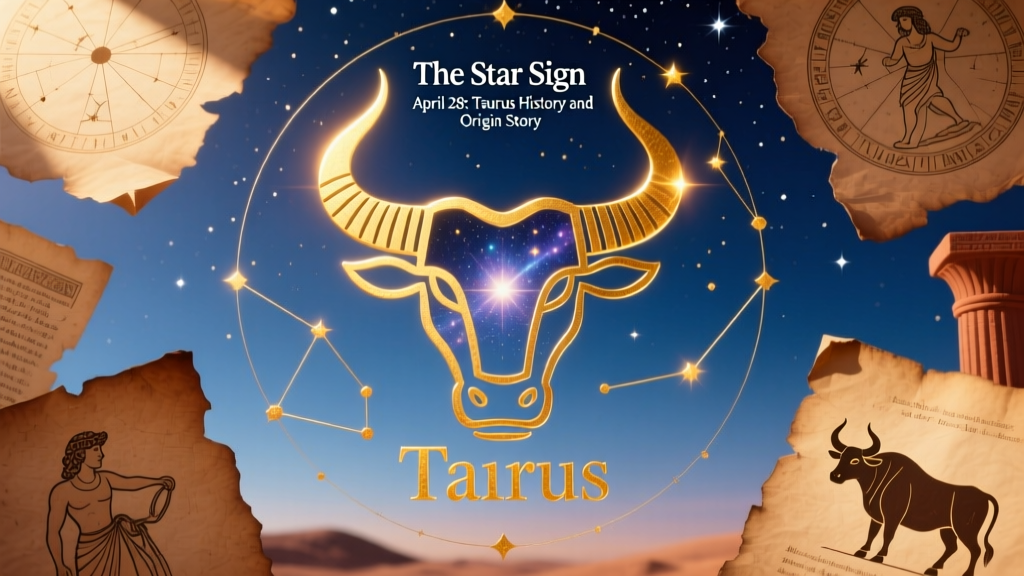
Individuals researching the star sign for April 28 are looking at the heart of the Taurus archetype. Falling in the middle of the bull’s domain, this date represents a stabilizing, earth-bound energy that has fascinated astrologers and astronomers for millennia. Long before modern horoscopes, the celestial bull dictated agricultural cycles and mythological narratives across ancient civilizations. To understand the true depth of this placement, we must bypass modern personality quizzes and examine the archaeological, mythological, and astronomical origins of the Taurus constellation. This historical analysis reveals how ancient paradigms continue to shape the foundational traits of those born on this specific date.
The Age of Taurus and Babylonian Astronomy
The origins of the Taurus zodiac sign do not begin with the Greeks, but rather in the cradle of civilization: ancient Mesopotamia. Between 4000 BCE and 1800 BCE, the vernal equinox occurred in the constellation of Taurus. This epoch, known in astrological history as the Age of Taurus, established the bull as the ultimate symbol of fertility, agricultural abundance, and the start of the new year.
Babylonian astronomers meticulously cataloged these stars in the MUL.APIN compendium (c. 1200 BCE). They identified the constellation as GU4.AN.NA, or 'The Bull of Heaven.' This was not merely a mythical beast, but a vital celestial clock. The heliacal rising of the Pleiades star cluster (known as MUL.MUL) and the Hyades cluster within Taurus signaled the critical spring plowing season. According to the European Space Agency's stellar archives, the brightest star in the constellation, Aldebaran (Alpha Tauri), served as a primary navigational anchor for ancient sky-watchers, marking the eye of the bull and the watcher of the Eastern sky.
For those born on April 28, this Babylonian heritage translates into an innate, almost ancestral drive toward cultivation, resource management, and the steady accumulation of tangible wealth. The ancient bull was the engine of agrarian survival; today, this manifests as a psychological imperative to build secure, lasting foundations.
Star Sign for April 28: The Second Decan and Fixed Earth
To understand the specific nuances of April 28, we must look to Hellenistic astrology and the system of decans. The zodiac is divided into 36 decans, each spanning 10 degrees. April 28 typically falls around 8 degrees of Taurus, placing it firmly in the second decan of the sign.
In the Chaldean decan system, documented extensively by traditional astrology historians at Skyscript, the first decan of Taurus is ruled by the Moon, emphasizing raw physical growth. However, the second decan is co-ruled by Virgo and its planetary lord, Mercury. This introduces a fascinating layer of complexity to the April 28 personality. While the overarching sign of Taurus is governed by Venus (focusing on aesthetics, comfort, and harmony), the Mercurial influence of the second decan grants individuals born on this day a highly analytical approach to their material world. They are not just accumulators of wealth; they are strategists, capable of organizing resources with meticulous, earth-bound precision. This specific historical overlay explains the unique blend of sensual appreciation and sharp, practical intellect found in late-April Taurus natives.
Mythological Origins: The Cretan Bull and Mithraism
The mythological framework of Taurus shifted dramatically as the vernal equinox precessed into Aries around 1800 BCE. The bull transitioned from the supreme ruler of the heavens to a beast that needed to be tamed or sacrificed, reflecting the changing astronomical ages.
In Greek mythology, the most prominent Taurus narrative is the abduction of Europa by Zeus, who disguised himself as a magnificent white bull. According to the Theoi Project, this Cretan Bull later became one of the Twelve Labors of Heracles. The myth symbolizes the untamed, primal forces of nature (the bull) being directed by divine will and human effort. For the April 28 individual, this mythological root highlights an internal dynamic: the need to harness immense, stubborn physical or emotional stamina and channel it into productive, civilizing endeavors.
Centuries later, the Roman cult of Mithras centered on the Tauroctony—the image of Mithras slaying the cosmic bull. Modern historical astrologers interpret this imagery as an allegorical representation of the precession of the equinoxes, marking the end of the Age of Taurus and the dawn of the Age of Aries. The bull's sacrifice released cosmic life force, fertilizing the earth. This reinforces the core Taurus archetype: transformation through endurance, and the understanding that true value is generated through sustained, sometimes arduous, physical effort.
Historical Timeline of the Taurus Archetype
The interpretation of the bull has evolved alongside human civilization. The table below outlines how the core themes of Taurus were utilized across different historical epochs.
| Era | Civilization | Taurus Symbolism & Function |
|---|---|---|
| c. 4000 - 1800 BCE | Sumerian / Akkadian | Gugalanna (Bull of Heaven); marker of the Vernal Equinox and new year. |
| c. 1200 BCE | Babylonian | MUL.APIN catalogs; agricultural timing via the Pleiades and Aldebaran. |
| c. 800 - 300 BCE | Classical Greek | Zeus and Europa; the Cretan Bull representing primal elemental forces. |
| c. 1st - 4th Century CE | Roman (Mithraism) | Tauroctony; esoteric symbol of astral precession and cosmic fertility. |
| 8th - 15th Century CE | Islamic / Medieval | Aldebaran as a royal star; Taurus linked to the throat, neck, and vocal cords in medical astrology. |
Applying Historical Taurus Wisdom to Modern Life
Understanding the ancient lineage of the star sign for April 28 provides a highly actionable framework for personal development. Modern astrology often reduces Taurus to mere stubbornness or a love of luxury. Historical analysis reveals a much more profound archetype: the steward of the earth and the architect of enduring systems.
Individuals born on this date can leverage their historical archetype through specific, grounded practices:
- Lunar Alignment: In Hellenistic astrology, the Moon is 'exalted' in Taurus, meaning it operates at peak efficiency here. April 28 natives should schedule critical financial decisions, property investments, or contract signings during the waxing moon phases to align with their innate astrological strengths.
- Agrarian Grounding: The Babylonian connection to the soil is literal. Engaging in tactile, earth-based hobbies—such as horticulture, ceramics, or landscape architecture—acts as a neurological reset for the Taurus nervous system, reducing the anxiety that arises when they are confined to purely abstract or digital environments.
- Mercurial Strategy: Honoring the second decan's influence, individuals born on this day should avoid relying solely on brute force or stubborn persistence. Instead, they must apply Mercurial analysis to their resources. Implementing detailed spreadsheet tracking for long-term investments or utilizing data-driven approaches to resource management will yield exponential results compared to intuitive guesswork.
- Vocal Resonance: Medieval medical astrology assigned the throat and vocal cords to Taurus. April 28 natives possess a historical predisposition for vocal influence. Practicing vocal resonance exercises, singing, or engaging in public speaking can physically align their somatic experience with their astrological rulership, boosting confidence and interpersonal authority.
By anchoring their modern lives in the deep historical and astronomical roots of the celestial bull, those born on April 28 can transcend superficial horoscope tropes. They step into their true historical role: the stabilizing force that cultivates, preserves, and strategically expands the material world.