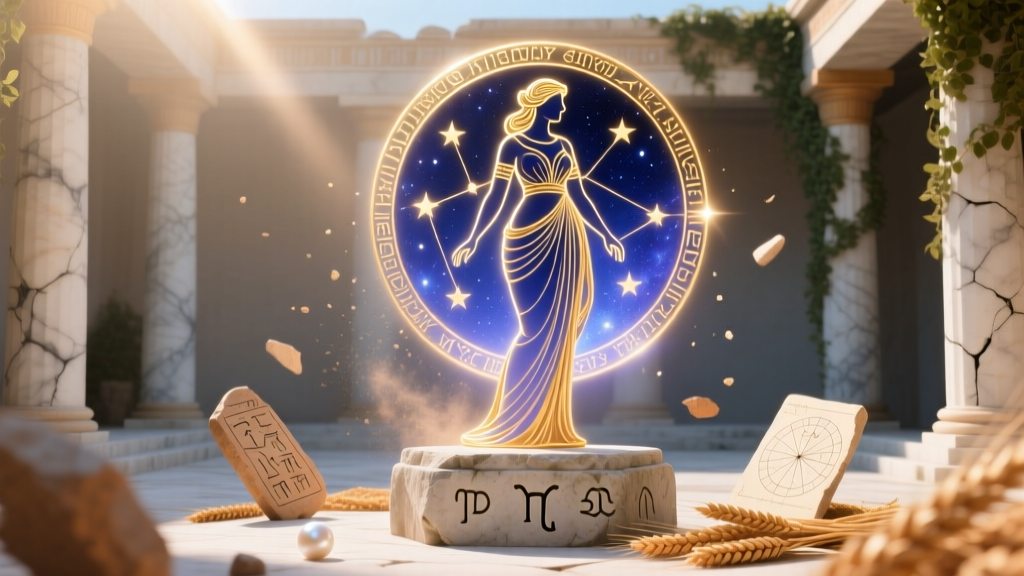
Individuals researching the star sign for 14th September are investigating the astrological profile of Virgo, specifically the sun's transit through the 21st and 22nd degrees of the zodiac. Far from the modern reduction of Virgo to mere tidiness or anxiety, the historical and astronomical origins of this sign reveal a complex archetype rooted in ancient agrarian survival, celestial justice, and Hellenistic syncretism. To accurately interpret a natal chart featuring a September 14th solar placement, one must bypass contemporary psychological astrology and examine the primary source texts of Mesopotamian and Greco-Roman astral sciences.
Babylonian Origins: The Furrow and the Goddess Shala
The foundational framework for Western astrology was established in ancient Mesopotamia. According to the Babylonian astronomical compendiums, specifically the MUL.APIN (compiled circa 1000 BCE), the constellation we now call Virgo was designated as AB.SIN, which translates directly to 'The Furrow'. This designation was not merely decorative; it was an agricultural imperative. The heliacal rising of the constellation's brightest star, Spica (Alpha Virginis), served as a critical celestial marker for the autumnal planting of winter crops in the Tigris-Euphrates river system.
The Furrow was personified by the goddess Shala, a deity of grain and agriculture, who was depicted holding an ear of corn. This imagery survives today in the traditional iconography of Virgo as the maiden bearing a sheaf of wheat. For an individual born on September 14th, the underlying archetype is intrinsically linked to resource management, cyclical preparation, and the cultivation of sustenance. The Babylonian astrologers viewed this sector of the ecliptic as a zone of pragmatic labor and earthly yield, stripping away any ethereal detachment and grounding the sign's energy in tangible, material productivity.
Hellenistic Synthesis: Astraea, Dike, and the Cosmic Scales
When Babylonian astral science was transmitted to the Hellenistic world following the conquests of Alexander the Great, Greek astrologers and poets syncretized the Mesopotamian data with their own mythological pantheon. The Greek poet Aratus, in his 3rd-century BCE didactic poem Phaenomena, identified the constellation as Dike, the personification of moral justice and fair dealing. Dike was the daughter of Zeus and Themis, tasked with overseeing human morality during the mythical Golden Age.
According to the mythological framework detailed by Hesiod in Works and Days, as humanity descended into the Bronze and Iron Ages, becoming increasingly violent and corrupt, Dike grew disgusted with mortal affairs. She abandoned the earth and ascended into the heavens, taking her place among the stars as the constellation Virgo, while her scales became the adjacent constellation of Libra. This mythological layer introduces a profound ethical dimension to the Virgo archetype. The September 14 native inherits this Hellenistic imprint: an innate, often uncompromising drive for systemic fairness, ethical purification, and the correction of earthly imbalances. As noted by researchers at Encyclopædia Britannica, this fusion of the agricultural maiden and the goddess of justice created the dual-natured Virgo archetype that dominated medieval and Renaissance astrology.
Defining the Star Sign for 14th September: Decans and Fixed Stars
To achieve precise astrological granularity, one must analyze the specific degree of the zodiac occupied by the sun on September 14th. The sun typically occupies the 21st or 22nd degree of Virgo on this date. In the Chaldean system of decans, which divides each sign into three ten-degree sectors, this placement falls squarely within the Third Decan of Virgo (20° to 30°).
While the primary ruler of Virgo is Mercury, the Chaldean sub-ruler of the Third Decan is Venus. This Venusian influence profoundly alters the expression of the September 14 native. The Picatrix, an 11th-century Arabic grimoire of astrological magic, describes the talismanic image of this specific decan as a woman holding a sheaf of wheat, accompanied by a hunting dog. The Venusian sub-rulership softens the mercurial and saturnine edges of Virgo, introducing themes of aesthetic refinement, diplomatic harvest, and relational cultivation. These individuals often possess a unique capacity to merge analytical rigor with aesthetic grace, utilizing their critical faculties to cultivate beauty and harmony rather than merely to critique.
Furthermore, the historical position of the fixed star Spica is crucial. In antiquity, Spica was located near the end of Virgo. However, due to the precession of the equinoxes—a phenomenon first calculated by Hipparchus by observing Spica's shifting longitude against the autumnal equinox—the star has since migrated into the early degrees of Libra. Modern astrologers tracking historical fixed-star influences must adjust for this precession, noting that the 'harvest' energy of Spica now projects into the relational and contractual sphere of Libra, rather than the analytical sphere of Virgo.
| Historical Era | Designation | Ruling Deity / Concept | Primary Symbolism |
|---|---|---|---|
| Babylonian (c. 1000 BCE) | AB.SIN (The Furrow) | Shala (Goddess of Grain) | Agrarian survival, planting cycles, material yield |
| Hellenistic (c. 200 BCE) | Parthenos (The Maiden) | Dike / Astraea (Justice) | Ethical purity, cosmic law, departure from corruption |
| Medieval Islamic (c. 1000 CE) | Sunbula (The Ear of Corn) | Mercury / Venus (Decan) | Botanical knowledge, alchemical refinement, diplomacy |
| Renaissance (c. 1500 CE) | Virgo (The Virgin) | Ceres / Erigone | Agricultural bounty, seasonal transitions, service |
Actionable Frameworks for Modern Astrological Analysis
Integrating these historical and astronomical data points provides a robust framework for interpreting the natal charts of individuals born on September 14th. Astrologers and serious students should apply the following specific methodologies:
- Assess Venusian Dignity in the Third Decan: Because the sun falls in the Venus-ruled decan of Virgo, evaluate the condition of Venus in the natal chart. A well-aspected Venus will manifest the 'diplomatic harvest' archetype, allowing the individual to negotiate complex logistical or corporate environments with grace. An afflicted Venus may indicate friction between the native's desire for harmony and their inherent mercurial need to critique and optimize.
- Track the Vindemiatrix Indicator: The star Vindemiatrix (Epsilon Virginis), historically known as the 'grape gatherer,' marked the beginning of the vintage in ancient Rome. While its longitude has shifted, utilizing historical fixed-star software to track when transiting planets activate the native's specific fixed-star nodes can pinpoint exact windows for 'harvesting' the results of long-term labor.
- Apply the Agrarian Profection Cycle: In Hellenistic time-lord techniques, annual profections assign a specific house to each year of life. For September 14 natives, framing their profection years through the lens of the AB.SIN 'Furrow' archetype yields highly accurate predictive insights. Years activating the 2nd, 6th, or 10th houses should be interpreted as periods of active sowing and reaping, requiring rigorous resource management rather than passive waiting.
- Recontextualize the 'Perfectionism' Trope: When counseling a September 14 client, reframe their analytical tendencies not as neurotic anxiety, but as the ancient, survival-based imperative of Dike and Shala. Their attention to detail is a mechanism for ensuring systemic fairness and securing the community's winter stores, elevating their psychological profile from a modern cliché to a vital historical function.