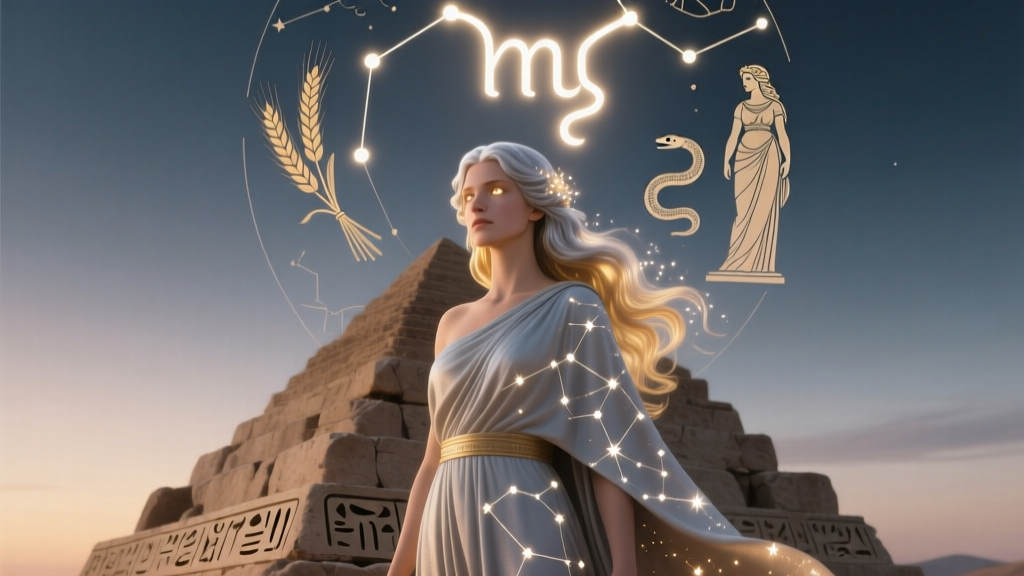
Determining the star sign for august 29 means examining the very first decan of Virgo, an earth sign steeped in millennia of astronomical observation and mythological evolution. Far from the simplified daily horoscopes of the modern era, the historical Virgo represents a complex synthesis of Babylonian agriculture, Greek divine justice, and Hellenistic planetary rulership. Born on the cusp of the Maiden’s domain, those marked by this specific date inherit a lineage tied to the harvest, the intellect, and the cosmic ordering of civilization. To truly understand this placement, one must excavate the ancient strata of astrological history and trace the Maiden's origins across early human empires.
The Babylonian Origins: The Furrow and the Goddess Shala
Long before the Hellenistic astrologers formalized the twelve-sign zodiac, the ancient Mesopotamians mapped the heavens to reflect their agrarian society. According to the MUL.APIN, a comprehensive Babylonian star catalog compiled around 1000 BCE, the constellation we now call Virgo was originally known as AB.SIN, meaning 'The Furrow.' This celestial furrow was inextricably linked to the goddess Shala, a deity of grain and agriculture, who was depicted holding a massive ear of barley or wheat.
This agricultural origin is crucial for understanding the core archetype of the sign. The Babylonians observed the heliacal rising of specific stars in this region to determine the optimal times for planting and harvesting. The brightest star in the constellation, Spica (Alpha Virginis), literally translates to 'ear of grain' in Latin, preserving the ancient Babylonian association. For those born under this sign, the foundational energy is not merely about perfectionism, as modern pop astrology often claims, but about cultivation, resource management, and the sacred duty of sustaining the community through meticulous labor.
Hellenistic Astrology and the Maiden Archetype
When Babylonian astrology was absorbed and adapted by the Greeks and later the Romans, the agrarian Furrow transformed into the anthropomorphic Maiden (Parthenos). This shift reflected the Greek tendency to project their complex pantheon and mythological narratives onto the stars. According to Ian Ridpath's Star Tales, ancient astronomers like Eratosthenes and Hyginus debated the exact identity of the celestial Maiden, resulting in a rich tapestry of competing mythologies that inform the sign's psychological depth.
Astraea, Erigone, and Demeter: Competing Mythologies
The most prominent Greek association is with Astraea, the goddess of innocence and divine justice. According to the myth, Astraea lived among humans during the Golden Age, but as humanity grew corrupt and violent through the Bronze and Iron Ages, she fled to the heavens in disgust, becoming the Virgo constellation. She sits directly adjacent to Libra, the scales of justice, symbolizing her eternal role as the cosmic arbiter of fairness and moral order.
Another tragic origin story links the constellation to Erigone, an Athenian maiden who took her own life after discovering her father, Icarius, had been murdered by drunken shepherds. Dionysus placed her in the stars to honor her filial piety. Finally, many scholars link the Maiden to Demeter, the goddess of the harvest, whose grief over the abduction of her daughter Persephone created the cycle of the seasons. These layered myths provide a profound psychological framework: the Virgo archetype encompasses the pursuit of justice, the pain of earthly corruption, and the cyclical nature of loss and agricultural renewal.
Decoding the star sign for august 29: The First Decan
To achieve true astrological specificity, we must look beyond the general sun sign and examine the decan system, a Hellenistic and ancient Egyptian method of dividing each 30-degree zodiac sign into three 10-degree sectors. The star sign for august 29 falls squarely in the first decan of Virgo (0 to 10 degrees).
In the traditional Chaldean order and the Hellenistic texts referenced in Ptolemy's Tetrabiblos, the first decan of Virgo is ruled by Mercury. This planetary sub-rulership heavily modifies the baseline earthy nature of Virgo, injecting a highly analytical, communicative, and cerebral frequency. Historically, the astrological image associated with this specific decan was that of a scribe or a scholar holding a ledger. Individuals born on this date possess a Mercurial-earth constitution: they are the data analysts, the systemic editors, and the meticulous record-keepers of the zodiac. Their historical mandate is to bring intellectual order to physical chaos.
| Cultural Origin | Constellation Name | Primary Archetype | Key Symbolism |
|---|---|---|---|
| Babylonian | AB.SIN (The Furrow) | Goddess Shala | Agriculture, harvest, sustenance |
| Greek | Parthenos (The Maiden) | Astraea / Demeter | Divine justice, purity, seasonal cycles |
| Egyptian | Isis / Erigone | The Devoted Mother/Maiden | Filial piety, mourning, magical protection |
| Hellenistic Decan | First Decan (0-10°) | The Scribe | Mercurial intellect, data, systemic order |
The Navigational Power of Spica (Alpha Virginis)
Any historical analysis of this constellation must address Spica, the 16th brightest star in the night sky. Spica is actually a binary star system located approximately 250 light-years from Earth. In antiquity, the heliacal setting of Spica was a critical marker for ancient mariners and farmers. According to Encyclopedia Britannica, the star's position helped ancient navigators determine their latitude and signaled the impending shift in Mediterranean weather patterns.
Astrologically, Ptolemy noted that Spica carries the nature of Venus and Mars, though later medieval astrologers aligned it more closely with Venus and Mercury, emphasizing its connection to intellectual brilliance, honor, and agricultural bounty. For those born on August 29, the proximity of the Sun to the celestial longitude of Spica (accounting for the precession of the equinoxes over millennia) imbues their historical archetype with a drive for high achievement, academic recognition, and the cultivation of rare, valuable skills.
Practical Application: Leveraging Historical Virgo Traits
Understanding the deep history of your zodiac placement offers actionable frameworks for personal and professional development. By discarding the superficial neurotic stereotypes of modern Virgo, individuals born on August 29 can align with their authentic historical mandate.
- Embrace the Mercurial Scribe: Lean into the first decan's affinity for data and systems. Careers in technical writing, archival science, database architecture, or forensic accounting resonate deeply with the ancient scribe archetype.
- Cultivate the Furrow: Adopt the Babylonian approach to resource management. Focus on long-term, sustainable investments—whether in financial portfolios, soil health for gardening, or compounding knowledge through rigorous daily study habits.
- Channel Astraea’s Justice: Use your innate analytical precision for advocacy. The Maiden’s connection to divine justice makes this placement ideal for roles in compliance, auditing, environmental law, or any field requiring the meticulous application of ethical standards.
Ultimately, the ancient origins of this sign reveal a profound truth: the meticulous nature of Virgo is not a flaw or a source of anxiety, but a sacred, civilizing force. By honoring the Babylonian harvest and the Greek pursuit of justice, those born on this date can transform their analytical prowess into enduring, tangible legacies.