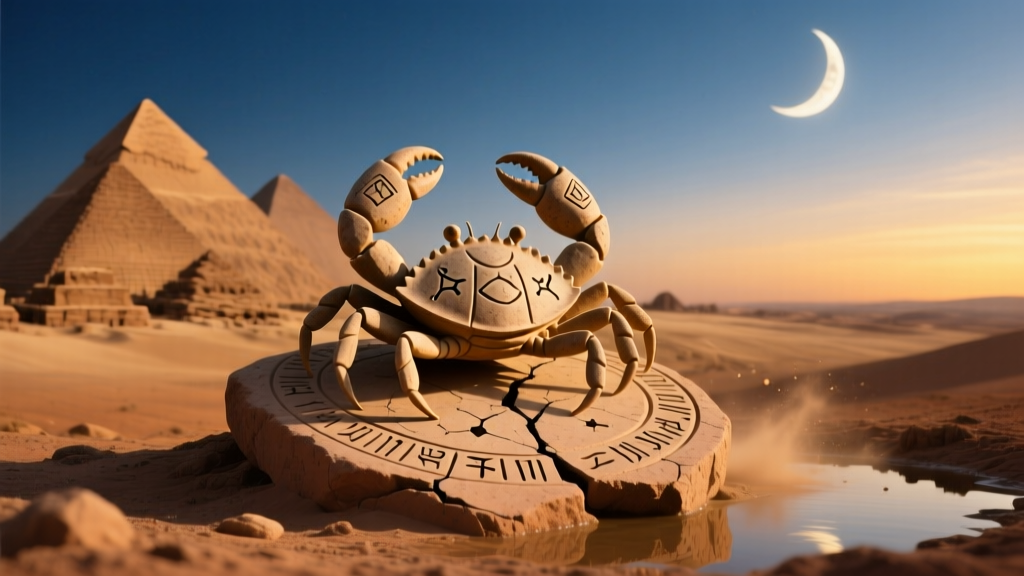
Individuals born on this mid-summer date fall under the star sign for July 17, which is universally recognized as Cancer. However, the modern understanding of this cardinal water sign barely scratches the surface of its rich historical and mythological lineage. Long before Western horoscopes simplified zodiac profiles, ancient Mesopotamian astronomers and Hellenistic astrologers mapped the ecliptic with profound precision. The archetype of the Crab carries millennia of esoteric data, agricultural timing, and celestial mythology. By examining the cuneiform tablets of Babylon and the astrological treatises of Ptolemy, we can decode the exact historical framework that defines this specific placement.
The Astronomical Roots of the Star Sign for July 17
Babylonian Origins: The MUL.APIN and the Crab
The earliest recorded observations of the zodiacal belt originate in ancient Mesopotamia. According to the Metropolitan Museum of Art's archives on Babylonian astronomy, the constellation we now call Cancer was identified in the MUL.APIN, a comprehensive cuneiform compendium compiled around 1000 BCE. The Babylonians referred to this region of the sky as al-lul, which translates to 'the crab' or 'crayfish.'
Unlike modern pop astrology, which focuses heavily on personality traits, Babylonian astrologers utilized al-lul for mundane astrology and agricultural timing. This constellation marked the summer solstice, the point of the Sun's highest northern declination. The heliacal rising and setting of specific stars within this sector signaled the flooding of the Euphrates River, an event critical for the survival and agricultural planning of the Sumerian and Akkadian empires. The crab’s hard exterior and soft interior perfectly mirrored the geography of the region: fortified cities surrounded by soft, fertile river mud.
Greek Mythology and the Karkinos Legend
Hera, Heracles, and the Celestial Reward
As astrological knowledge migrated from Babylon to Greece, the practical agricultural markers morphed into rich mythological narratives. The most prominent origin story for Cancer is tied to the legend of Karkinos, the giant crab.
During the second of his twelve labors, Heracles was tasked with slaying the Lernaean Hydra. According to the Catasterismi, a 2nd-century CE astronomical treatise attributed to Eratosthenes, the goddess Hera sent Karkinos to distract Heracles by pinching his foot. Heracles crushed the crab, but Hera, honoring the creature's loyalty and sacrifice, elevated Karkinos to the heavens.
This mythological framework is not merely a fairy tale; it encodes the astrological nature of the sign. Karkinos acted as a protector and a disruptor, reflecting the Cancerian archetype of defensive aggression when protecting one's emotional or physical territory. The crab’s indirect, sideways movement also mirrors the apparent retrograde-like behavior of the Sun at the summer solstice, where it appears to 'stop' and move sideways along the ecliptic before beginning its southern descent.
Evolution in Hellenistic and Medieval Astrology
The Gate of Men and Macrocosmic Descent
The philosophical depth of Cancer expanded significantly during the Hellenistic period. In his foundational text, the Tetrabiblos, Claudius Ptolemy codified the tropical zodiac, aligning the beginning of Cancer with the exact moment of the summer solstice.
More esoterically, Hellenistic and later Neoplatonic astrologers designated Cancer as the 'Gate of Men.' According to the macrocosmic philosophy detailed by scholars like Macrobius in his Commentary on the Dream of Scipio, souls descended from the divine realm into physical incarnation through the celestial gate of Cancer. Conversely, Capricorn served as the 'Gate of the Gods,' where souls exited the material plane upon death.
This esoteric history completely reframes the modern interpretation of Cancer. Rather than simply being 'nurturing' or 'emotional,' the star sign for July 17 represents the very threshold of physical incarnation, the descent of spirit into matter, and the initial spark of the biological imperative to survive and reproduce. The soul, upon entering through this celestial gate, takes on the heavy, protective armor of the physical body—much like the crab taking on its shell. This Neoplatonic framework provides a profound metaphysical context for the intense somatic empathy and physical protectiveness often exhibited by those born on this date.
Medieval Electional Astrology and Talismanic Magic
During the Islamic Golden Age, astrologers such as Abu Ma'shar translated and expanded upon these Hellenistic texts. In medieval electional astrology, the Crab was heavily utilized for talismanic magic. Astrologers would carve images of the crab into silver (the metal of the Moon) during favorable lunar transits to craft amulets designed for protection during travel or to secure emotional bonds. This practical, magical application underscores the sign's historical association with shielding and preservation.
| Era | Civilization | Designation | Primary Astrological Function |
|---|---|---|---|
| c. 1000 BCE | Babylonian | al-lul (The Crab) | Agricultural timing, solstice marking, mundane astrology |
| c. 2nd Century BCE | Hellenistic Greek | Karkinos / Gate of Men | Soul incarnation, solstitial turning point, defensive archetypes |
| 2nd Century CE | Roman (Ptolemaic) | Cancer (Tropical) | Cardinal water, lunar domicile, northern apex of the ecliptic |
| 8th Century CE | Islamic / Medieval | Al-Saratan | Electional astrology, talismanic magic, lunar exaltations |
Decans and Degrees: The Specifics of July 17
The Third Decan of Cancer and the 25th Degree
To understand the precise astrological signature of July 17, we must look beyond the broad 30-degree span of the sign and examine the specific degree and decan. The Sun typically occupies 24° to 25° of Cancer on this date.
This placement falls squarely within the Third Decan of Cancer (20°–30°). According to traditional Chaldean and Hellenistic decan systems, extensively documented by Deborah Houlding on Skyscript, the Third Decan of Cancer is traditionally ruled by the Moon. This creates a compounding effect: the Sun is in the domicile of the Moon (Cancer), and the specific decan is also ruled by the Moon.
This double-lunar influence amplifies the receptive, tidal, and deeply subconscious currents of the natal chart. In modern psychological astrology, this decan is often associated with a Pisces sub-influence, bringing a highly permeable emotional boundary and an innate capacity for collective empathy. Furthermore, the 25th degree of Cancer is historically noted in certain astrological traditions as a degree of deep intuition and latent psychic capability. When the Sun occupies this specific coordinate, it illuminates the subconscious mind, granting the native an innate understanding of generational trauma and familial lineage. Individuals born on July 17 possess an archetypal resonance with the 'seer' or 'oracle,' capable of reading the undercurrents of human emotion that remain invisible to others.
Actionable Frameworks: Applying Historical Archetypes
Understanding the ancient lineage of this placement provides concrete tools for psychological and spiritual development. Instead of relying on generic horoscopes, individuals born on July 17 can leverage these historical frameworks for targeted shadow work and decision-making.
- Embody the Gatekeeper: Recognize your historical role as the 'Gate of Men.' You are naturally equipped to manage transitions, whether onboarding new team members in a corporate setting or guiding family members through major life changes. Lean into roles that require facilitating safe passages and structural emotional support.
- Utilize Defensive Architecture: The Babylonian al-lul relied on a hard shell to protect a soft interior. Establish strict energetic and physical boundaries. Do not feel obligated to offer emotional labor to those who have not earned access to your inner sanctum. Protect your energy as a finite, valuable resource.
- Adopt Sideways Problem Solving: The crab moves laterally. When faced with a direct obstacle, historical archetypes suggest that frontal assaults are counterproductive for this placement. Adopt oblique strategies: approach conflicts from an unexpected angle, utilize emotional intelligence to bypass rigid logic, and allow the 'tide' of a situation to shift before making a decisive move.
- Leverage Lunar Timing: Because your core degree is double-ruled by the Moon, your cognitive and emotional peaks are highly tethered to lunar cycles. Schedule high-stakes negotiations or creative launches during the waxing moon, and reserve the waning moon for deep research, archival work, and psychological decompression.