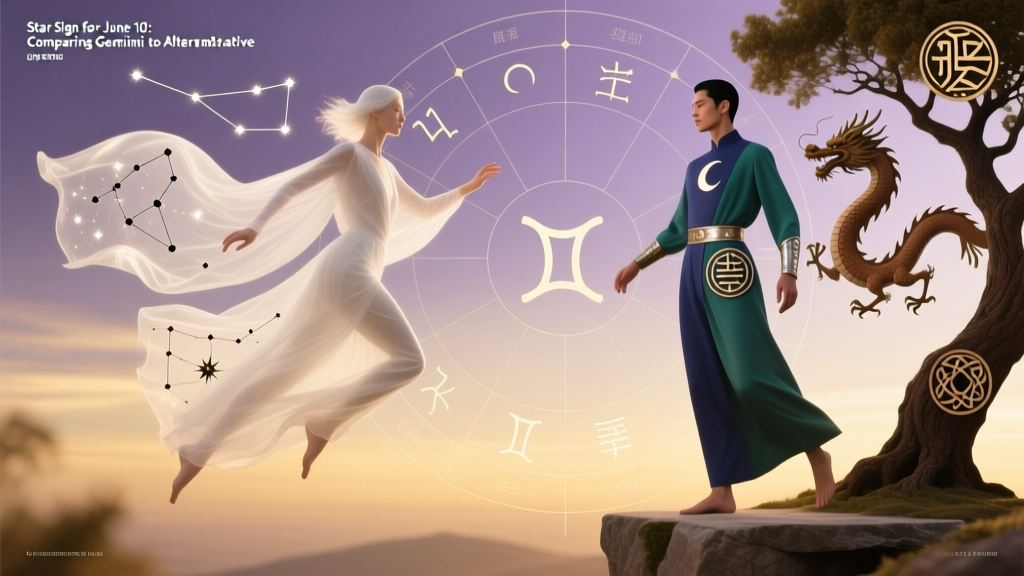
The Western Star Sign for June 10: Gemini Profile
The star sign for June 10 in the Western tropical zodiac is Gemini. Ruled by Mercury, this mutable air sign governs communication, intellect, and adaptability. However, relying solely on Western sun sign astrology provides an incomplete psychological profile. To understand the full spectrum of a June 10 birthdate, astrologers utilize alternative frameworks. This analysis compares the traditional Western Gemini profile against Vedic (sidereal), Chinese, and Celtic astrological systems. By evaluating these alternatives, individuals born on this date can identify overlapping archetypes and resolve contradictory traits that a single sun sign cannot adequately explain. The following breakdown examines the precise metrics of these distinct systems.
Core Gemini Metrics for the June 10 Decan
In the tropical zodiac, the sun transits through the 19th to 21st degrees of Gemini on June 10. This specific placement falls within the Second Decan of Gemini, which is sub-ruled by Venus (Libra). While the primary ruler, Mercury, grants sharp cognitive processing and linguistic agility, the Venusian sub-ruler introduces a strong aesthetic sensibility, diplomatic tact, and a desire for harmonious partnerships. According to Astro.com's decanate analysis, second decan Geminis are less erratic than their first decan counterparts. They possess a refined intellect and often channel their mental energy into artistic, legal, or relational pursuits. The core drive here is the synthesis of ideas and people, rather than mere data collection.
Alternative System 1: Vedic Astrology (Sidereal Zodiac)
Western astrology uses the tropical zodiac, which is aligned with the seasons. Vedic astrology (Jyotish) uses the sidereal zodiac, aligned with the actual constellations. Due to the precession of the equinoxes, there is currently a roughly 24-degree difference (the Lahiri Ayanamsa) between the two systems. Consequently, a person whose Western star sign for June 10 is Gemini will typically find their Vedic Sun sign is Taurus (Vrishabha). Specifically, the Sun is usually positioned in the Rohini or Mrigashira Nakshatra (lunar mansion) during this time.
Comparing Western Gemini vs. Vedic Taurus
This alternative framework resolves a common paradox for June 10 individuals: the internal conflict between restless mental exploration and a deep craving for physical stability. Western Gemini demands constant stimulation, novelty, and intellectual pivoting. Vedic Taurus, an earth sign ruled by Venus, demands routine, material security, and sensory comfort. When a June 10 native feels 'un-Geminian'—exhibiting stubbornness, a love for luxury, or a slow-to-change temperament—they are actively expressing their sidereal Taurus archetype. As detailed in Britannica's overview of Vedic Astrology, the sidereal system grounds the native's psychological profile in karmic and material realities rather than just seasonal psychological traits. The Rohini Nakshatra influence further amplifies a desire for creation, agriculture, and building lasting material wealth.
Alternative System 2: Celtic Tree Astrology
Celtic Tree Astrology, rooted in the ancient Ogham alphabet and popularized by mid-20th-century scholars, assigns tree archetypes based on lunar and solar cycles. For June 10, the governing tree is the Oak (Duir), which rules the period from June 10 to July 7. The Oak is the seventh letter of the Ogham alphabet and represents immense strength, deep-rooted wisdom, and community leadership.
The Oak Archetype vs. The Gemini Archetype
Unlike the airy, scattered energy of Western Gemini, the Oak archetype is profoundly grounded. It signifies a protector of the community, someone who values heritage, endurance, and structural integrity. If a June 10 individual struggles with the stereotypical Gemini flightiness, the Celtic Oak provides a vital alternative lens. It suggests that their mental agility (Gemini) is meant to be used in service of building lasting, robust structures (Oak). For deeper exploration of these arboreal archetypes, the Order of Bards, Ovates and Druids (OBOD) offers extensive documentation on how the Oak's energy manifests in personal character, emphasizing resilience and the role of the 'wise counselor' in social groups.
Alternative System 3: Chinese Zodiac & Elemental Cycles
Unlike Western or Celtic systems that rely on the solar day, the Chinese Zodiac is determined by the lunar year. Because June 10 always falls well after the Chinese Lunar New Year (which occurs between late January and mid-February), the lunar animal sign is stable and predictable for any given birth year. Analyzing recent cycles demonstrates how Chinese elemental theory modifies the June 10 profile:
- 1989 (Earth Snake) & 2001 (Metal Snake): The Snake is strategic, intuitive, and deeply private. This sharply contrasts with the extroverted, communicative Western Gemini. A June 10 Snake possesses a 'hidden mind'—they gather information like a Gemini but hoard and strategize with it like a Snake, rather than broadcasting it.
- 1990 (Metal Horse) & 2002 (Water Horse): The Horse values absolute freedom, independence, and physical movement. Combined with the mutable air of Gemini, a June 10 Horse exhibits extreme restlessness and a profound need for geographical and intellectual autonomy, often struggling with long-term confinement in rigid corporate structures.
Cross-System Comparison Matrix
| Astrological System | Sign / Archetype | Element | Modality / Ruling Force | Core Psychological Drive |
|---|---|---|---|---|
| Western Tropical | Gemini (2nd Decan) | Air | Mutable / Mercury & Venus | Synthesis of ideas, diplomacy, communication |
| Vedic Sidereal | Taurus (Rohini/Mrigashira) | Earth | Fixed / Venus & Moon/Mars | Material security, sensory comfort, wealth creation |
| Celtic Tree | Oak (Duir) | Wood / Earth | Cardinal / Endurance | Community protection, structural integrity, wisdom |
| Chinese (Example) | Snake or Horse | Varies (e.g., Earth, Metal) | Yin (Snake) / Yang (Horse) | Strategic privacy (Snake) or Autonomy (Horse) |
Actionable Synthesis: Integrating Your Astrological Alternatives
Understanding the star sign for June 10 requires moving beyond generic horoscopes and applying these cross-system insights to real-world decision-making. Here is how to integrate these alternative frameworks into your daily life, career, and relationships.
Career Alignment and Burnout Prevention
If your Western Gemini drives you toward communications, journalism, or sales, but you experience severe burnout from constant context-switching, you must pivot to honor your Vedic Taurus and Celtic Oak placements. Transition into roles requiring deep, sustained focus and structural building. Excellent alternatives include financial analysis, archival research, luxury goods curation, or organizational leadership. The Oak archetype thrives when managing long-term projects that require endurance rather than rapid, short-term pivots.
Relationship Dynamics and Communication
In relationships, the Western Gemini stereotype suggests a partner who is verbally expressive but emotionally detached. However, the Venusian sub-ruler of the second decan, combined with the Vedic Taurus Sun, indicates a deep need for physical touch, aesthetic harmony, and loyalty. If you are dating a June 10 individual, do not mistake their intellectual curiosity for a lack of commitment. Their sidereal Taurus nature requires a stable, comfortable home environment to recharge. Conversely, if you are a June 10 native, explicitly communicate your need for sensory grounding to partners who may only see your airy, intellectual exterior.
Shadow Work and Internal Friction
The primary shadow aspect of the June 10 birthdate is the friction between the desire to explore (Gemini/Horse) and the desire to hoard resources or remain entirely private (Taurus/Snake). To resolve this, implement 'compartmentalized exploration.' Dedicate 20% of your time and resources to high-stimulation, novel experiences (travel, learning new languages, networking) while fiercely protecting the remaining 80% for routine, wealth-building, and deep-rooted community ties. This structural approach satisfies the mutable air need for variety without triggering the fixed earth anxiety of instability.