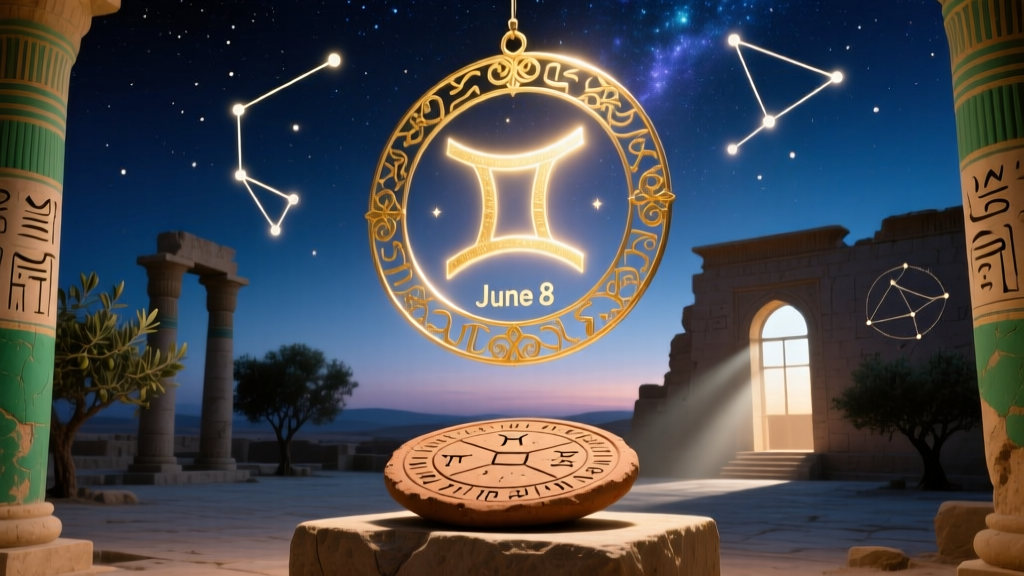
The astrological profile for the star sign June 8 is rooted in a complex tapestry of ancient astronomy, agricultural timing, and mythological syncretism. Falling at approximately 18 degrees of the tropical sign Gemini, this specific calendar date represents a fascinating intersection of Mesopotamian star lore and Hellenistic geometric division. To understand the esoteric and historical weight of a June 8 birth, one must look past modern horoscope columns and examine the cuneiform tablets of Babylon, the decanic systems of Hellenistic Egypt, and the lunar mansions of medieval Arabic astrologers. This deep historical analysis reveals how the archetype of the Twins evolved from underworld deities to symbols of intellectual and social harmony.
The Astronomical Roots of the Star Sign June 8
Before the zodiac was divided into the neat 30-degree signs used in Western astrology today, ancient astronomers tracked the ecliptic through irregular constellations tied to seasonal phenomena. The Metropolitan Museum of Art's archives on Babylonian astronomy highlight that the stars we now associate with early-to-mid June were originally cataloged in the MUL.APIN, a comprehensive Babylonian star catalog compiled around 1000 BCE. In this ancient text, the constellation was not a pair of chatty youths, but rather Mash.tab.ba.gal.gal—The Great Twins.
These twins were identified with Lugal-irra and Meslamta-ea, formidable deities of the underworld and guardians of the gates of Hades. In the harsh climate of ancient Mesopotamia, the heliacal rising and positioning of these stars in early June coincided with the onset of extreme summer heat, disease, and the waning of the agricultural cycle. Therefore, the original historical archetype of the June 8 star sign was deeply connected to protection, the warding off of plague, and the navigation of liminal spaces between the living and the dead.
Hellenistic Evolution and the Dioscuri Myth
The transformation of the Great Twins from underworld guardians to the heroic Dioscuri (Castor and Pollux) occurred during the Hellenistic period, as Greek culture synthesized with Babylonian astronomical data. By the time Claudius Ptolemy codified the tropical zodiac in his foundational 2nd-century text, the Tetrabiblos, the sign of Gemini had been firmly established as an airy, masculine, and bicorporeal (dual-bodied) sign ruled by Mercury.
Ptolemy’s geometric framework shifted the focus from the literal, irregular stars to the mathematical 30-degree sector of the ecliptic. For a birth occurring on June 8, the Sun sits roughly 18 degrees into this sector. The Greek myth of Castor (mortal) and Pollux (immortal) sharing each other's time between Mount Olympus and the Underworld provided a perfect allegory for the dual nature of the sign: the ability to bridge high intellectual concepts (Olympus) with practical, grounded communication (the earthly realm). This era cemented the June 8 archetype as one of cognitive agility, diplomacy, and the synthesis of opposing viewpoints.
Comparative Antiquity: How Early Cultures Viewed the Twins
The interpretation of the stars governing early June varied drastically across ancient civilizations. The following table illustrates the historical evolution of this celestial sector:
| Culture / Era | Constellation Name | Associated Figures / Deities | Primary Domain & Symbolism |
|---|---|---|---|
| Babylonian (c. 1000 BCE) | Mash.tab.ba.gal.gal | Lugal-irra & Meslamta-ea | Underworld guardians, disease, and protection |
| Hellenistic Greek (c. 200 BCE) | Didymoi (The Twins) | Castor & Pollux (Dioscuri) | Horsemanship, athletic contests, protection of sailors |
| Vedic / Jyotish (Ancient India) | Mithuna | Ashvini Kumaras (associated) | Duality, cosmic breath (Prana), healing, and transition |
| Medieval Arabic (c. 900 CE) | Al-Jawza (The Twins) | Linked to Al-Dhira (Forearm) | Commerce, architecture, medicine, and diplomacy |
The Second Decan: Venusian Influence on June 8
To achieve true astrological precision regarding the June 8 star sign, one must examine the decanic system. The Hellenistic astrologers divided each 30-degree sign into three 10-degree 'decans' or 'faces', utilizing the Chaldean order of planetary rulerships. The first decan of Gemini (0-10 degrees) is ruled by Mercury. However, June 8 falls squarely into the second decan of Gemini (11-20 degrees), which is sub-ruled by Venus and the sign of Libra.
This Venusian sub-rulership profoundly alters the historical and esoteric interpretation of the date. According to the Warburg Institute's research on astrological decans, medieval grimoires like the Picatrix describe the image of the second decan of Gemini as a man playing a lute or a musician surrounded by instruments. This imagery represents the harmonization of dualities through art, intellect, and social grace. While the first decan of Gemini is concerned with raw data, logic, and rapid communication, the Venus-ruled second decan (encompassing June 8) is historically associated with diplomacy, aesthetic refinement, and the ability to mediate conflicts through charm and eloquence.
Esoteric History and the Chaldean Order
The Chaldean order of decans was designed to map the planetary spheres onto the zodiac, creating a microscopic reflection of the macrocosm. The Venusian influence on this specific degree suggests that individuals born on this date possess a historical archetype geared toward 'civilizing' raw intellect. In Renaissance astrology, this degree was considered highly auspicious for musicians, diplomats, and architects—professions requiring the synthesis of mathematical precision (Gemini/Mercury) with aesthetic harmony (Venus/Libra).
Arabic Lunar Mansions and the 18th Degree
Further historical granularity is found in the Arabic Manazil al-Qamar (Lunar Mansions), a system of 28 sectors used extensively in medieval electional astrology. The Sun's position on June 8 (approximately 18 degrees tropical Gemini) aligns with the 7th Lunar Mansion, known as Al-Dhira (The Forearm).
- Symbolism: Al-Dhira represents the outstretched forearm of the Twins, symbolizing reach, measurement, and the physical manifestation of intellectual intent.
- Historical Application: Medieval astrologers such as Abu Ma'shar considered this mansion highly favorable for initiating commercial ventures, laying the foundations of buildings, and administering medicine.
- Esoteric Meaning: The 'forearm' denotes leverage and the ability to manipulate one's environment. It reflects the Gemini archetype's capacity to handle multiple tasks simultaneously and to bridge gaps between disparate groups of people.
The association with medicine in the 7th Lunar Mansion is particularly notable. In ancient medical astrology, Gemini rules the respiratory system, the arms, and the nervous system. The historical positioning of the Sun in Al-Dhira on June 8 was viewed as a time when the 'breath of life' (pneuma) could be most effectively channeled for healing and restorative practices.
Synthesizing the Historical Layers of June 8
The modern interpretation of the June 8 star sign often relies on superficial traits like talkativeness or restlessness. However, the historical record demands a more nuanced understanding. By tracing the lineage from the protective underworld guardians of the MUL.APIN, through the diplomatic Dioscuri of Ptolemy’s Alexandria, to the harmonious lute-player of the Venusian decan and the architectural leverage of Al-Dhira, a distinct profile emerges.
The true historical archetype of this date is the Harmonizer of Dualities. It represents the evolutionary point where raw, survival-based communication (the underworld twins) is elevated into diplomacy, art, and societal structure (the Venusian decan). Understanding this deep chronological lineage provides a highly specific, actionable framework for those born on this date: your innate historical directive is not merely to communicate, but to translate, mediate, and build structural harmony out of chaotic, opposing forces.